




Professional decline can become a second kind of strength
From Strength to Strength argues that midlife decline is a predictable shift high achievers can meet by moving from peak performance toward teaching, relationships, and meaning.
IJR · Oct 27, 2026 · 14 min read
In 60 seconds
- Professional decline starts earlier than most driven people expect—often by the late thirties or forties in skill-based work—and denial only makes the reckoning harder.
- The most talented strivers suffer worst because identity fuses with being exceptional and each win raises the dopamine baseline for the next.
- Ability does not just fade; it shifts from fluid intelligence that peaks early to crystallized intelligence—judgment, patterns, teaching—that keeps rising.
- Jumping the first curve on purpose while still capable beats being pushed off later by failure or forced retirement.
- Satisfaction is haves divided by wants; chasing more rarely fixes the ratio, and deal friends vanish when status fades.
- Openly admitting changed ability, investing in real friendship, and anchoring in something larger than the self turn the second half into a different ascent.
The big idea
Brooks holds that professional decline is not a personal failure but a biological and psychological transition from fluid to crystallized intelligence. People who cling to peak-era metrics suffer more than those who deliberately reorient toward teaching, mentorship, real relationships, and meaning beyond individual achievement.
The book in brief
Brooks opens with a sting at an airport: nearing fifty and running a major think tank, a stranger implied his best professional years were already behind him. The remark hurt because research on cognitive aging and career peaks suggested it might be true. Mathematicians, scientists, surgeons, air traffic controllers, and elite performers often hit measurable limits far earlier than ambition assumes. He treats the taboo itself as the first problem—professional culture treats talk of waning ability as weakness, so most people wait for a bad review or a younger rival’s rise before facing it.
He then names the curse of the striver. The people most fused with external excellence—star surgeons, celebrated professors, founders—suffer most when those markers erode, because triumph works like addiction: each win raises the baseline, and plateau feels like withdrawal. Ordinary aging fear is different; this is an occupational hazard of lives organized around being exceptional at one narrow skill.
The intellectual core is Cattell’s two intelligences. Fluid intelligence—novel problem-solving, speed, innovation—rises young and declines by the late thirties or forties. Crystallized intelligence—accumulated knowledge, pattern recognition, judgment—keeps climbing. Prestigious careers reward the first curve and give little structural room to the second, so high achievers keep competing on a slope already turning against them.
Darwin versus Bach makes the fork concrete. After Origin of Species in his fifties, Darwin chased the old flash and felt his mind duller. Bach shifted from youthful dazzle to synthesis, teaching, and late works built on craft; his later period is read as rich, not diminished. Brooks’s practical claim follows: leave the first curve voluntarily while still capable—surgeons into teaching at peak hands, executives into advisory roles while still respected—rather than waiting to be forced out.
He then attacks the satisfaction equation. Satisfaction is haves over wants; successful people’s wants rise with achievements, so the ratio never improves. The exit is working the denominator—wanting less—not endlessly raising the numerator. Parallel failures compound the pain: deal friends built on usefulness disappear when influence fades, exactly when support is needed, while real friendship and a sense of something larger than the self require years of prior investment. He closes by reversing the instinct to hide decline. Candor about changed ability, in his interviews, earned more respect than performed peak strength and reframed the second half as sage work rather than demotion.
Context
Arthur C. Brooks wrote the book in 2022 after the airport jolt while leading a major think tank and later drawing on interviews as a Harvard researcher and former think-tank president. It mattered because it took a subject professional culture treats as taboo—waning peak ability—and reframed aging from pure decline into a second, different ascent backed by cognitive-aging research, happiness economics, and high-achiever interviews.
The key ideas

1
Decline starts earlier
Professional decline follows something closer to a biological schedule than personal failure, and most driven people notice it only after they have already passed the horizon they thought kept receding.
Brooks opens with the airport stranger who implied his best years running a think tank were behind him. The comment landed because he already suspected the research pattern: many skill-based fields peak far earlier than ambition admits. Mathematicians and scientists often do their most original work from the late twenties to early forties; air traffic controllers and surgeons face mandatory testing or retirement well before old age; elite performers show measurable drops in speed and precision by their fifties.
He reads this not as individual collapse but as a schedule most people refuse to discuss. Professional culture treats honest talk of waning ability as an admission of irrelevance, so the subject stays buried until a missed promotion or a younger colleague’s rise forces it.
Early acknowledgment is itself a form of strength. The rest of his strategies only work for people willing to make the admission before crisis compels it. Waiting does not preserve the first curve; it only removes the chance to prepare the second.
In practice: Nearing fifty at career height, Brooks met a stranger whose offhand remark about his best years already being over forced the research that became the book.

2
The curse of talent
The traits that produce great achievement—obsessive focus, competitiveness, identity fused with work—are the same traits that make later decline feel like identity death.
Ordinary aging fear
Worry about health, time, or relevance shared by many
Curse of talent
Identity fused with excellence; plateau feels like withdrawal from being the best
Brooks names a trap specific to high achievers. When self-worth depends on external markers of excellence, any erosion of those markers threatens not just income but the sense of who you are. A star surgeon whose hands slow, a professor whose ideas stop landing, a founder whose company outgrows their instincts all face the same threat.
The mechanism is addiction-like. Professional triumph delivers a dopamine hit that raises the baseline for what counts as success. Each later win must be larger to register; plateau or decline feels like withdrawal. Interviews with musicians, athletes, and academics describe usefulness as if it carried an expiration date stamped on the day of first major success.
This differs from ordinary aging fear. It is the occupational hazard of lives organized around being exceptional at one narrow, demanding skill. Former leaders and record-holders often call the years after peak some of the darkest of their lives—not because circumstances were objectively bad, but because nothing replaced the specific high of being the best.
In practice: Former leaders and record-holders in Brooks’s interviews described post-peak years as among their darkest because nothing could replace the high of being the best.
3
Two intelligence curves
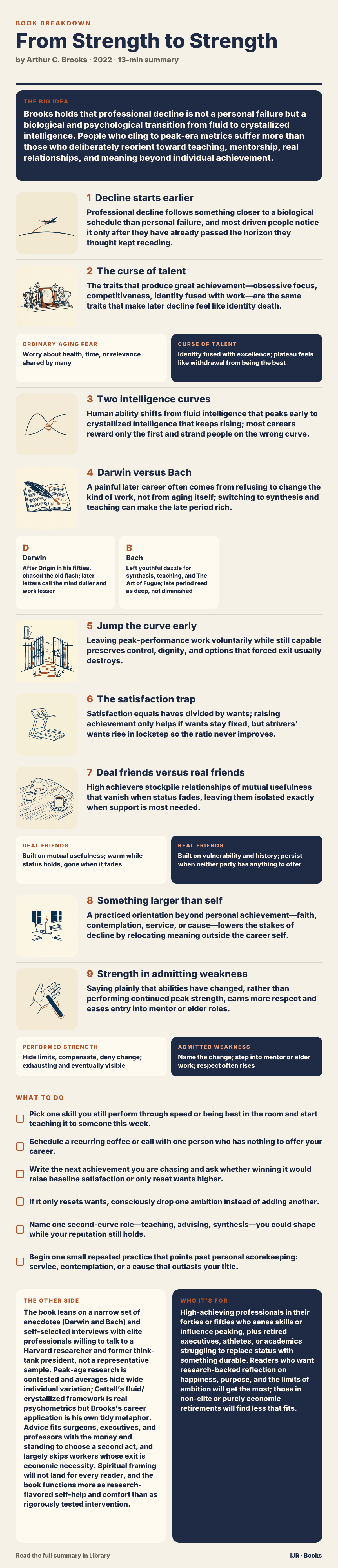
Human ability shifts from fluid intelligence that peaks early to crystallized intelligence that keeps rising; most careers reward only the first and strand people on the wrong curve.
Brooks builds the book’s scaffold on Raymond Cattell’s distinction. Fluid intelligence is raw capacity for novel problems, quick thought, and innovation; it rises sharply in youth and tends to decline by the late thirties or forties. Crystallized intelligence is accumulated knowledge, patterns, and judgment from decades of experience; it rises more slowly and keeps climbing well into old age.
Prestigious, lucrative careers are built almost entirely around fluid intelligence—quick analysis, technical innovation, physical speed. Surgery, entrepreneurship, and most sciences reward it and offer little structural role for later wisdom-based strengths. That is why so many high achievers hit a midlife wall: they keep competing on a downward curve against younger people still rising on it.
The way out is not fighting fluid decline but reorienting toward roles that reward crystallized strength—teaching, mentoring, synthesis, judgment, and pattern recognition earned by many mistakes over many years. Institutions often fail here too, leaving senior people no real place to deploy accumulated wisdom and forcing individuals to invent a second career themselves.
In practice: Fields like surgery and entrepreneurship keep rewarding speed and novelty long after the fluid curve has turned, leaving little formal room for judgment-based roles.

4
Darwin versus Bach
A painful later career often comes from refusing to change the kind of work, not from aging itself; switching to synthesis and teaching can make the late period rich.
- DDarwinAfter Origin in his fifties, chased the old flash; later letters call the mind duller and work lesser
- BBachLeft youthful dazzle for synthesis, teaching, and The Art of Fugue; late period read as deep, not diminished
Brooks pairs two lives to show the fork. After publishing On the Origin of Species in his fifties, Darwin spent remaining decades trying to replicate that youthful flash of insight. His own letters describe later work as never matching it and his mind as duller and less quick.
Bach took another path. Young, he was known for technical innovation and dazzling improvisation. Later he shifted energy toward synthesis, teaching, and works like The Art of Fugue that drew on a lifetime of craft rather than fresh invention. Contemporaries and later scholars generally treat his late period as artistically rich, not diminished, because he stopped competing with his younger self on fluid terms and leaned into structure, teaching, and depth.
Decline is not the real threat; failing to switch strategies is. Modern professionals, professors, and executives who moved from doing the work to teaching others how to do it often report far more satisfaction in the second role than they expected. A career locked to one skill set has a shelf life; a career allowed to evolve toward mentorship and judgment does not.
In practice: Bach’s late shift into teaching and cumulative craft is generally read as artistically rich, while Darwin’s attempt to recreate his peak insight left him feeling his mind had dulled.

5
Jump the curve early
Leaving peak-performance work voluntarily while still capable preserves control, dignity, and options that forced exit usually destroys.
Brooks centers the practical decision: wait to be displaced, or jump to the second curve while faculties and reputation still hold. Most people delay, treating any voluntary step back as defeat. He treats well-timed jumping as itself a skill.
Examples include surgeons who moved into teaching at the height of technical ability rather than after hands failed, and executives who took board or advisory roles while still respected rather than after being pushed out. Early jumpers shape the new role, choose successors, and keep dignity. Forced exits usually feel like pure loss.
Resistance is obvious. Stepping back from status, income, or visibility while still able to hold them runs against every instinct that produced success. Brooks counters that fear of jumping too early is usually overstated next to the real cost of jumping too late—waiting rarely improves the outcome and often closes options that existed earlier. Treat the transition as a planned event prepared years ahead, not a crisis managed after the fact.
In practice: Surgeons who entered teaching at peak technical ability, and executives who moved to advisory roles while still respected, kept control that forced retirements rarely allow.
6
The satisfaction trap
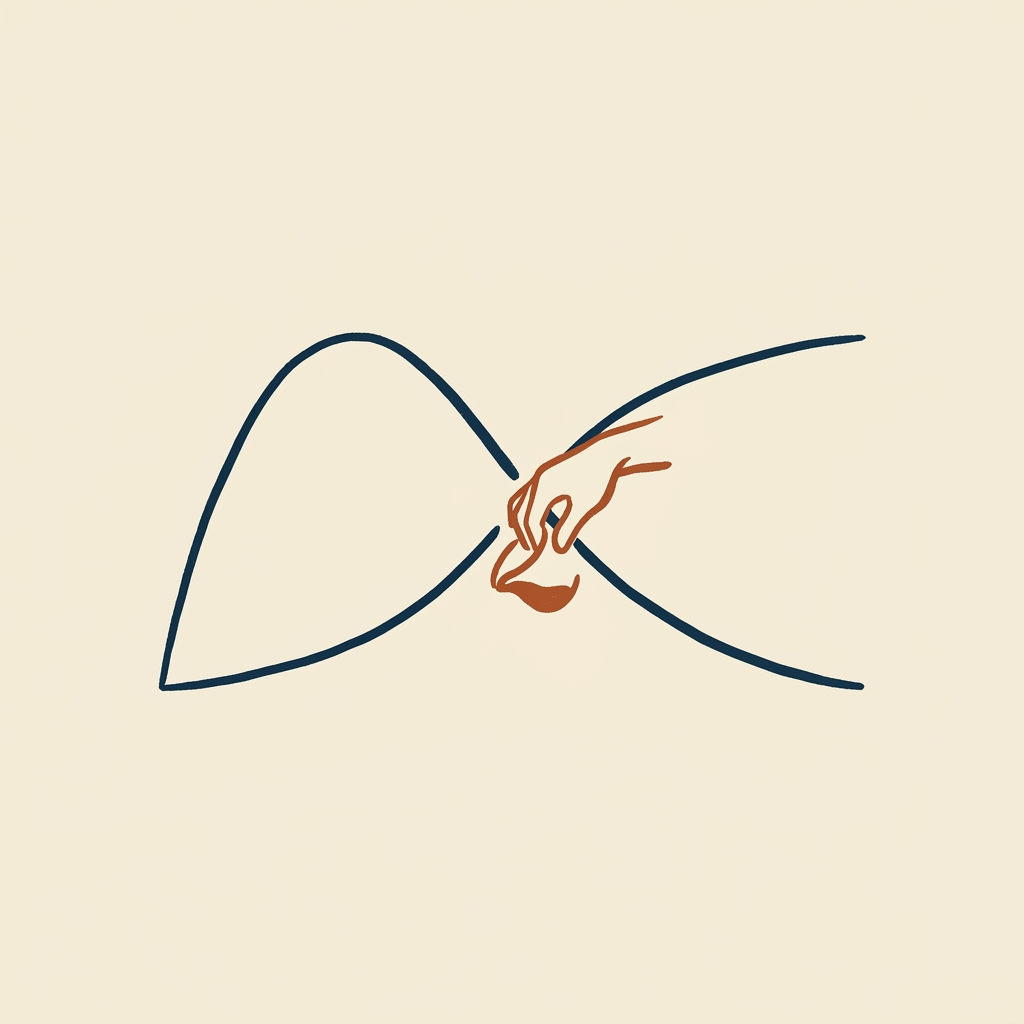
Satisfaction equals haves divided by wants; raising achievement only helps if wants stay fixed, but strivers’ wants rise in lockstep so the ratio never improves.
Brooks turns on the premise that more achievement equals more happiness. He frames satisfaction as a ratio: haves over wants. Successful people’s wants tend to climb with each win, so adding to the numerator rarely improves the fraction for long.
This is the hedonic treadmill applied to career ambition. Professionals reach a goal, feel a brief surge, then recalibrate what would count as success—next title, next record, next milestone. Each achievement raises the baseline for the next to feel meaningful. The trap perpetuates itself.
The durable exit is working the denominator: deliberately wanting less rather than endlessly pursuing more. That does not mean abandoning all ambition; it means stopping the full outsourcing of satisfaction to external validation and comparative status. People in his interviews who scaled back professional ambition in midlife often reported markedly higher wellbeing than peers still striving on the original terms. Rankings, promotions, and public recognition can actively work against the people who chase them hardest unless the cycle is interrupted.
In practice: Interviewees who deliberately scaled back midlife ambition reported higher wellbeing than peers who kept chasing the next title on the old terms.

7
Deal friends versus real friends
High achievers stockpile relationships of mutual usefulness that vanish when status fades, leaving them isolated exactly when support is most needed.
Deal friends
Built on mutual usefulness; warm while status holds, gone when it fades
Real friends
Built on vulnerability and history; persist when neither party has anything to offer
Brooks splits the social world of success into deal friends and real friends. Deal friends are cordial, even warm, while utility and status remain intact. They quietly disappear once influence, position, or usefulness fades.
That disappearance becomes a crisis at first-curve decline. Calendars and inboxes that once stayed full go quiet just as emotional support becomes necessary. Real friendship rests on vulnerability and shared history rather than transaction. It is underinvested during peak years precisely because it offers no immediate professional payoff.
Longitudinal adult-development research he cites treats strength of close personal relationships as one of the most consistent predictors of late-life satisfaction—more consistent than income, career achievement, or public recognition. The deal-friend strategy that accelerates the first curve is poor preparation for the second. Real friendship cannot be manufactured quickly once decline has begun; it has to be built years before the need turns urgent.
In practice: When influence fades, the hundreds of cordial career contacts stop returning calls just as the need for support peaks.

8
Something larger than self
A practiced orientation beyond personal achievement—faith, contemplation, service, or cause—lowers the stakes of decline by relocating meaning outside the career self.
Brooks treats transcendence as a functional buffer, not a doctrinal demand. Fear of decline is largely fear of loss of self. Any framework that locates ultimate meaning outside personal accomplishment reduces those stakes.
He draws on interviews with religious leaders, contemplative practitioners, and secular people who shifted later toward meditation, prayer, or service. The common thread is regular interruption of self-focused thinking and connection to something that outlasts one lifespan and career. That can be explicit religious practice, volunteer work, mentorship framed as service rather than status, or disciplines drawn from Buddhist and Stoic traditions.
He refuses to prescribe one tradition. He does insist the practice cannot be started overnight in crisis. Like real friendship, it needs years of cultivation before it stabilizes identity. Among his recommendations it is the deepest and least quantifiable, yet he argues it may matter most because it addresses root fear rather than only career symptoms.
In practice: Interviewees who built meditation, prayer, service, or cause-driven commitments over years described less terror when career metrics slipped.
9
Strength in admitting weakness
Saying plainly that abilities have changed, rather than performing continued peak strength, earns more respect and eases entry into mentor or elder roles.
Performed strength
Hide limits, compensate, deny change; exhausting and eventually visible
Admitted weakness
Name the change; step into mentor or elder work; respect often rises
Brooks closes by reversing the instinct that drives most strivers: hide decline, compensate, deny it publicly. In his interviews the healthiest transitions came from people willing to state that their abilities had changed and that they were stepping into a different contribution.
Counterintuitively, that candor increased respect. It replaced an exhausting performance of continued peak ability with an honest, often more useful role as mentor or elder. He reframes the airport stranger’s painful remark as a retrospective gift—it forced early confrontation with a truth many meet only through failure.
Research on aging and self-acceptance he invokes finds higher wellbeing among people who integrate decline into a coherent life narrative rather than fighting it as an enemy. The second half of life becomes a distinct stage with its own strengths—wisdom, teaching capacity, freedom from the anxious comparison that drove the first half. The practical move is narrative reframing: treat the shift from striver to sage as an intentional promotion, not an involuntary demotion.
In practice: People who said outright their skills had changed and moved into mentoring roles received more respect than those still performing peak ability they no longer had.
Key terms
- Fluid intelligence Raw ability to solve new problems fast and innovate; rises young and often declines by the late thirties or forties.
- Crystallized intelligence Judgment, patterns, and knowledge built over decades; keeps rising well into old age and suits teaching and synthesis.
- Curse of talent When identity fuses with being exceptional, any drop in peak markers feels like loss of self, not just loss of status.
- Jumping the curve Voluntarily leaving first-curve peak work for second-curve roles while still capable, instead of waiting to be forced out.
- Satisfaction ratio Haves divided by wants; raising achievement fails if wants rise in lockstep, so durable gains often come from wanting less.
- Deal friends Relationships built on mutual usefulness that fade when influence or position disappears.
- Real friends Bonds of vulnerability and shared history that remain even when neither person can offer career value.
- Second curve The later career arc built on crystallized strengths—mentorship, judgment, teaching—rather than youthful speed and novelty.
What to do
- Pick one skill you still perform through speed or being best in the room and start teaching it to someone this week.
- Schedule a recurring coffee or call with one person who has nothing to offer your career.
- Write the next achievement you are chasing and ask whether winning it would raise baseline satisfaction or only reset wants higher.
- If it only resets wants, consciously drop one ambition instead of adding another.
- Name one second-curve role—teaching, advising, synthesis—you could shape while your reputation still holds.
- Begin one small repeated practice that points past personal scorekeeping: service, contemplation, or a cause that outlasts your title.
Questions to think with
- Which of your current status markers would hurt most to lose, and what does that reveal about where identity is fused?
- If you had to jump the curve in three years by choice, what crystallized work would you already be practicing now?
- How many of your regular relationships would survive if you could offer no deals, introductions, or prestige?
- Where are you still competing on fluid-intelligence terms against people for whom that curve is still rising?
- What would it sound like to tell colleagues, plainly, that your best contribution has changed form?
The other side
The book leans on a narrow set of anecdotes (Darwin and Bach) and self-selected interviews with elite professionals willing to talk to a Harvard researcher and former think-tank president, not a representative sample. Peak-age research is contested and averages hide wide individual variation; Cattell’s fluid/crystallized framework is real psychometrics but Brooks’s career application is his own tidy metaphor. Advice fits surgeons, executives, and professors with the money and standing to choose a second act, and largely skips workers whose exit is economic necessity. Spiritual framing will not land for every reader, and the book functions more as research-flavored self-help and comfort than as rigorously tested intervention.
Who it's for
High-achieving professionals in their forties or fifties who sense skills or influence peaking, plus retired executives, athletes, or academics struggling to replace status with something durable. Readers who want research-backed reflection on happiness, purpose, and the limits of ambition will get the most; those in non-elite or purely economic retirements will find less that fits.