




People, not code, are the hole every system leaves open
Ghost in the Wires is the case study security teams and curious readers need when helpful employees, not weak firewalls, keep handing over the keys.
IJR · Nov 6, 2026 · 14 min read
In 60 seconds
- Mitnick's lonely Valley childhood steered him into phone phreaking, where talking past gatekeepers beat raw electronics skill.
- Pretexting—researched jargon, fake roles, manufactured urgency—weaponized ordinary helpfulness at Pacific Bell and beyond.
- He treated stolen VMS and other source code as trophies of curiosity, not loot to sell, then escalated from local switches to DEC, Novell, Motorola, Nokia, and Sun.
- The same phreaker underground that mentored him later informed on him, a blind spot his stranger-manipulation skills could not cover.
- Roughly three fugitive years under false IDs ended after the 1994 Shimomura intrusion, a media-fed manhunt, February 1995 capture, months of solitary, and a sentence just under four years.
- His later consulting career closed the loop: the tactics that broke trust became the training companies now pay for.
The big idea
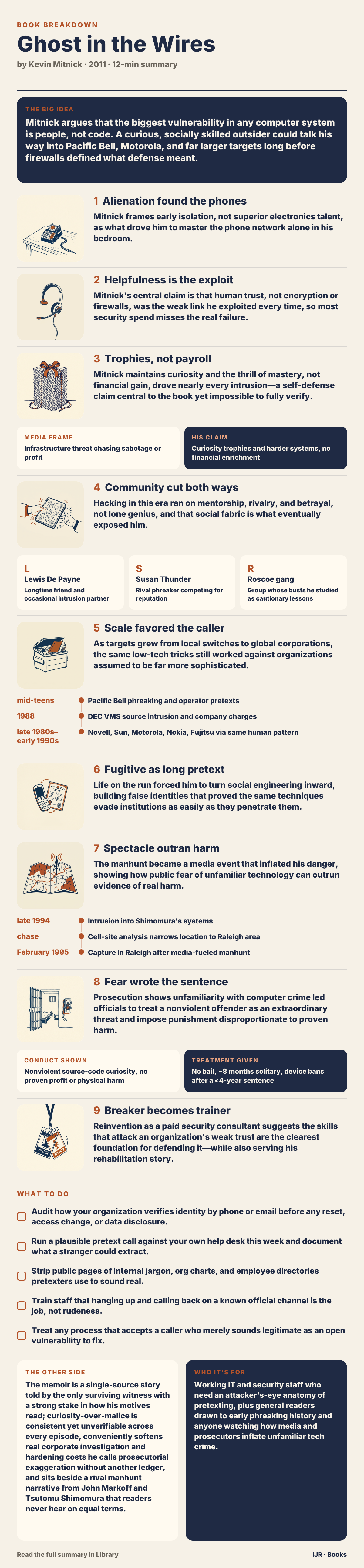
Mitnick argues that the biggest vulnerability in any computer system is people, not code. A curious, socially skilled outsider could talk his way into Pacific Bell, Motorola, and far larger targets long before firewalls defined what defense meant.
The book in brief
Mitnick starts as a lonely, overweight kid in the San Fernando Valley who finds belonging first in magic tricks, then in phone phreaking. A school friend and a local mentor pull him into tones, trunk lines, and the Los Angeles scene; free calls and operator impersonations teach him that a well-told story opens closed systems faster than any gadget. Juvenile trouble for unauthorized access barely slows him, because getting past a system that said no feels better than any consequence feels frightening.
The memoir's core method crystallizes next. He builds elaborate pretexts, researches org charts and internal jargon, then calls as a locked-out coworker or vendor and lets trained helpfulness do the rest. Dumpster diving and tailgating sit beside the phone work. He insists no technical hardening stops this, because the failure lives in the employee's wish to cooperate.
Motivation, he maintains, was curiosity and status, not cash. DEC's VMS source became a trophy to read and master; similar grabs at Novell, Motorola, Nokia, Sun, and Fujitsu followed the same pattern. Company size helped him: more employees to fool, harder pattern recognition across departments. Yet the phreaker community that taught him also doomed him—associates informed, probation broke, and by 1992 an arrest warrant forced him underground.
Roughly three fugitive years meant false identities built with the same pretext skills, cloned phones, radio monitoring, low-profile tech jobs, and continued hacking as early-warning. The 1994 break-in at Tsutomu Shimomura's systems turned the chase personal; cell-site work and Markoff's menacing coverage funneled the FBI to Raleigh. Capture in February 1995 brought no-bail detention, a whistle-and-launch-codes bail spectacle, roughly eight months solitary, a plea to wire fraud and unauthorized access, a sentence just under four years plus restitution fights, and post-2000 bans on ordinary devices.
The arc ends with reinvention: paid social-engineering tests, awareness training, earlier case-study books, a consulting firm, and congressional testimony. The same human-trust exploit becomes the product companies buy, completing his claim that the person who broke the weakest link is the clearest guide to defending it—while the memoir itself doubles as brand narrative.
Context
Kevin Mitnick's 2011 memoir mattered because it turned a demonized cybercriminal into a living case study. Corporate America and law enforcement had cast him as an infrastructure threat; the book reframed the real attack surface as trust, not technology, and reshaped how security professionals think about defense.
The key ideas

1
Alienation found the phones
Mitnick frames early isolation, not superior electronics talent, as what drove him to master the phone network alone in his bedroom.
He grew up in the San Fernando Valley with divorced parents and few close friends, a lonely overweight kid who first belonged through magic tricks. A school friend then taught him phone phreaking basics. The network's tones, trunk lines, and operator procedures became a solitary puzzle solved with a Radio Shack tone dialer.
Early wins stayed small: free long-distance, listening on other lines, impersonating operators to reroute calls. What separated him from other teenage phreakers was the instinct to talk past gatekeepers. He called phone-company offices, adopted employee voice and vocabulary, and asked for information a real worker would need—and it usually worked.
A local mentor opened the wider Los Angeles scene, where techniques and gossip about weak systems traded like baseball cards and delivered status school never gave. Brief pickup by juvenile authorities for unauthorized access warned of the pattern ahead yet failed to deter him. The thrill of defeating a system that excluded him outranked fear of consequences.
In practice: He would phone Pacific Bell offices posing as staff and simply request the internal details a colleague would already know.

2
Helpfulness is the exploit
Mitnick's central claim is that human trust, not encryption or firewalls, was the weak link he exploited every time, so most security spend misses the real failure.
The durable contribution is a detailed anatomy of pretexting: call an employee, adopt a plausible role—fellow worker, vendor, IT tech—and use confidence, jargon, and urgency to extract access or data. He built cover stories before any call, researching terminology, department names, and org charts so requests sounded routine.
A recurring move was ringing Pacific Bell support as a locked-out colleague and asking a helpful rep to reset a password or read an account number. He argues helpfulness, not stupidity, created the opening; people are trained to solve problems for callers who sound legitimate, and that training is what a skilled pretexter weaponizes.
Alongside calls he dumpster-dived for manuals and phone lists and tailgated into buildings by looking like he belonged. No amount of technical hardening stops the approach, because the vulnerability lives in the desire to cooperate and avoid conflict. Companies later hired him to run exactly these tests, confirming the chapter's uncomfortable point: spend on tech while ignoring phone identity checks and you are solving the wrong problem.
In practice: Posing as a fellow employee locked out, he persuaded Pacific Bell reps to reset passwords and read back account numbers.

3
Trophies, not payroll
Mitnick maintains curiosity and the thrill of mastery, not financial gain, drove nearly every intrusion—a self-defense claim central to the book yet impossible to fully verify.
Media frame
Infrastructure threat chasing sabotage or profit
His claim
Curiosity trophies and harder systems, no financial enrichment
He repeatedly separates himself from hackers chasing theft or sabotage. When he broke into Digital Equipment Corporation for VMS source code, he did not sell it or disrupt operations; he wanted to read it, understand it, and prove he could obtain it. Stolen code from other firms functioned as trophies confirming skill, not contraband for profit.
He stresses he never ran unauthorized charges on victims' accounts for enrichment, and that none of the companies lost money the way ordinary theft or fraud would cost them—though several spent heavily investigating and responding. That distinction shaped later legal treatment: prosecutors and media cast him as a threat to national infrastructure, a frame he argues mismatched behavior aimed at intellectual satisfaction.
The same motivation carried an addictive structure. Each success against a bigger target reset the baseline, so DEC led to Novell, then Motorola, Nokia, and Sun Microsystems. He likens it to a chess player seeking stronger opponents, while later chapters concede the restless need for a harder challenge is what finally made him impossible to hide.
In practice: He copied DEC's VMS source to study it as proof of skill rather than to sell or weaponize it.

4
Community cut both ways
Hacking in this era ran on mentorship, rivalry, and betrayal, not lone genius, and that social fabric is what eventually exposed him.
- LLewis De PayneLongtime friend and occasional intrusion partner
- SSusan ThunderRival phreaker competing for reputation
- RRoscoe gangGroup whose busts he studied as cautionary lessons
The book lingers on the circle around Mitnick. Lewis De Payne appears as longtime friend and occasional partner; Susan Thunder as rival phreaker with her own reputation. Shared techniques, gossip about vulnerable systems, and status competition defined the early world.
He learned as much from others' arrests as from his own trials, studying mistakes of a group he calls the Roscoe gang to see which behaviors drew law enforcement. Yet the same network became his greatest liability. People he trusted, including close associates, cooperated with investigators or informed—sometimes to cut their own exposure, sometimes from personal fallout.
First serious adult brushes with the law, including probation violations tied to unauthorized access, trace straight back to associates talking. His fluency at exploiting institutional trust had a blind spot: real relationships built on familiarity, where authority-and-stranger pretexting tools no longer applied. That failure sets up the fugitive years, because by the early 1990s the community that once sheltered him could also undo him.
In practice: Associates' cooperation and tips fed probation violations and the investigations that finally forced him underground.

5
Scale favored the caller
As targets grew from local switches to global corporations, the same low-tech tricks still worked against organizations assumed to be far more sophisticated.
- mid-teensPacific Bell phreaking and operator pretexts
- 1988DEC VMS source intrusion and company charges
- late 1980s–early 1990sNovell, Sun, Motorola, Nokia, Fujitsu via same human pattern
By the late 1980s and early 1990s he had moved past Pacific Bell into major technology firms. Detailed intrusion accounts form the book's most technically specific stretch. Dial-up numbers and directories for DEC came through pretext calls plus dumpster diving; stolen credentials then opened systems so he could copy VMS source—an intrusion serious enough that DEC pursued charges in 1988.
Later targets included Novell, Sun Microsystems, Motorola, Nokia, and Fujitsu. The pattern stayed constant: find an employee with legitimate access, impersonate someone with authority over that person, extract credentials or direct entry under a plausible story. Physical reconnaissance and employee turnover helped, since large firms rarely had every face memorized by security staff.
He argues size worked against the victims. More employees meant more people to fool; cross-department pattern recognition grew harder. He presents the work as proof of concept, still aimed at acquiring and studying code rather than altering or destroying systems. But hitting several of the world's most valuable tech companies elevated the case from local nuisance to federal priority and set up the manhunt.
In practice: DEC charges in 1988 followed pretext-and-dumpster work that yielded dial-ups, credentials, and a full VMS source copy.
6
Fugitive as long pretext
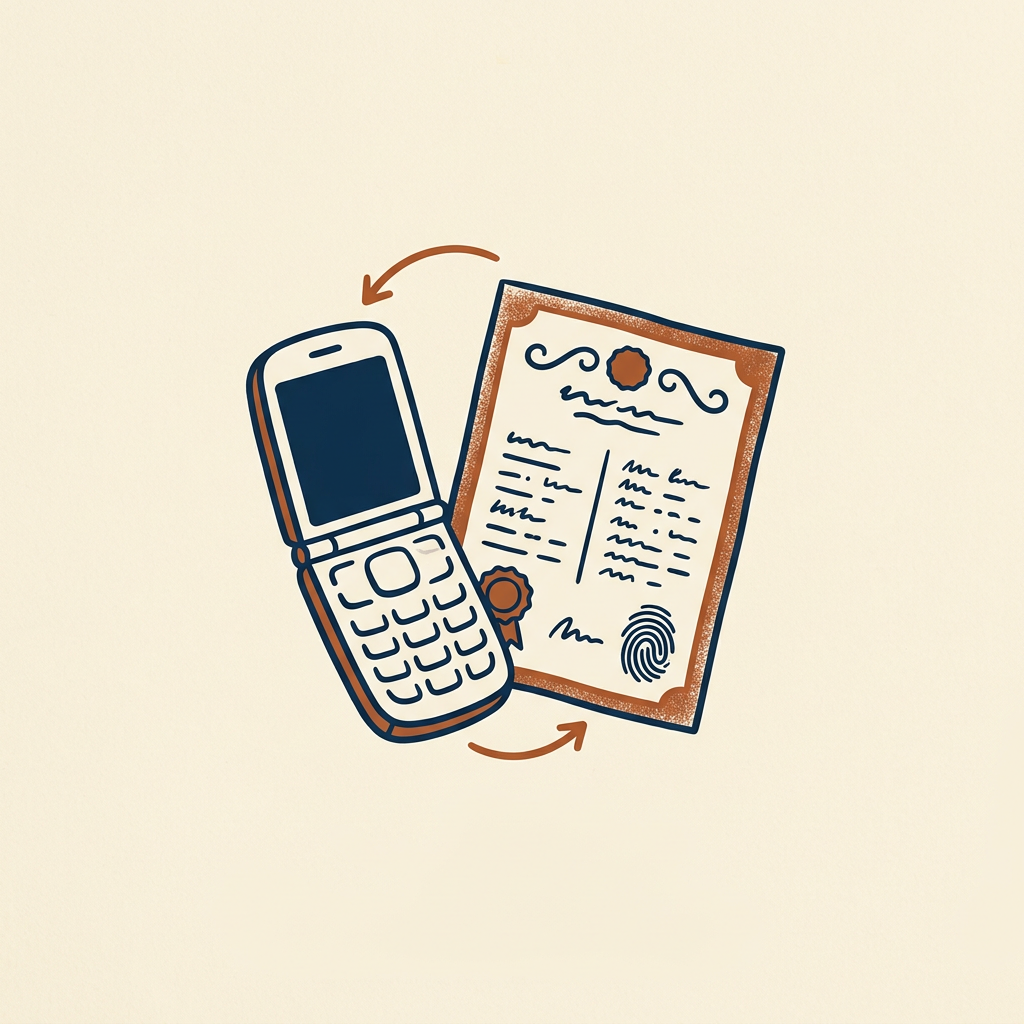
Life on the run forced him to turn social engineering inward, building false identities that proved the same techniques evade institutions as easily as they penetrate them.
After a 1992 probation violation became an active warrant, he spent roughly three years moving between Los Angeles, Denver, Seattle, and Raleigh under assumed names. False identities used tools already mastered against others: pretext calls to government offices for birth certificates and licenses, monitoring police and FBI radio to learn what investigators knew, cloned cellular phones for untraceable calls.
Low-profile jobs, including technical support under false names, required holding a consistent cover for months rather than one call. The psychological cost is among the memoir's candid stretches: constant vigilance, isolation from family, knowledge that one familiar voice or routine records check could end everything instantly.
He kept hacking partly because watching targets' systems gave early warning if investigators closed in, so fugitive status and intrusion reinforced each other. Adaptability, comfort with deception, and attention to institutional procedure made him skilled at both roles—and exacted a life with no stable relationships, no permanent home, and fear that outlasted any hack's thrill.
In practice: He obtained birth certificates and driver's licenses through pretext calls to government offices, then worked tech-support jobs under those names.

7
Spectacle outran harm
The manhunt became a media event that inflated his danger, showing how public fear of unfamiliar technology can outrun evidence of real harm.
- late 1994Intrusion into Shimomura's systems
- chaseCell-site analysis narrows location to Raleigh area
- February 1995Capture in Raleigh after media-fueled manhunt
Pursuit intensified after he broke into security researcher Tsutomu Shimomura's systems in late 1994. Shimomura treated the intrusion as a personal challenge and answered with his own technical resources, working with the FBI and phone companies.
Cell-site analysis of Mitnick's cellular data connections narrowed the location first to the Raleigh, North Carolina area. New York Times reporter John Markoff, who had covered him for years and later co-wrote a competing chase account with Shimomura, published stories casting Mitnick as an unprecedented cyber-menace.
That coverage cemented a public image far larger than the pattern of curiosity-driven source-code grabs the memoir describes. The chapter treats the gap between frightening headlines and proven nonviolent conduct as the hinge that turned a fugitive case into national spectacle and shaped the punishment that followed.
In practice: Shimomura's cell-site tracing, paired with Markoff's menace framing, fixed the FBI's attention on the Raleigh area.
8
Fear wrote the sentence
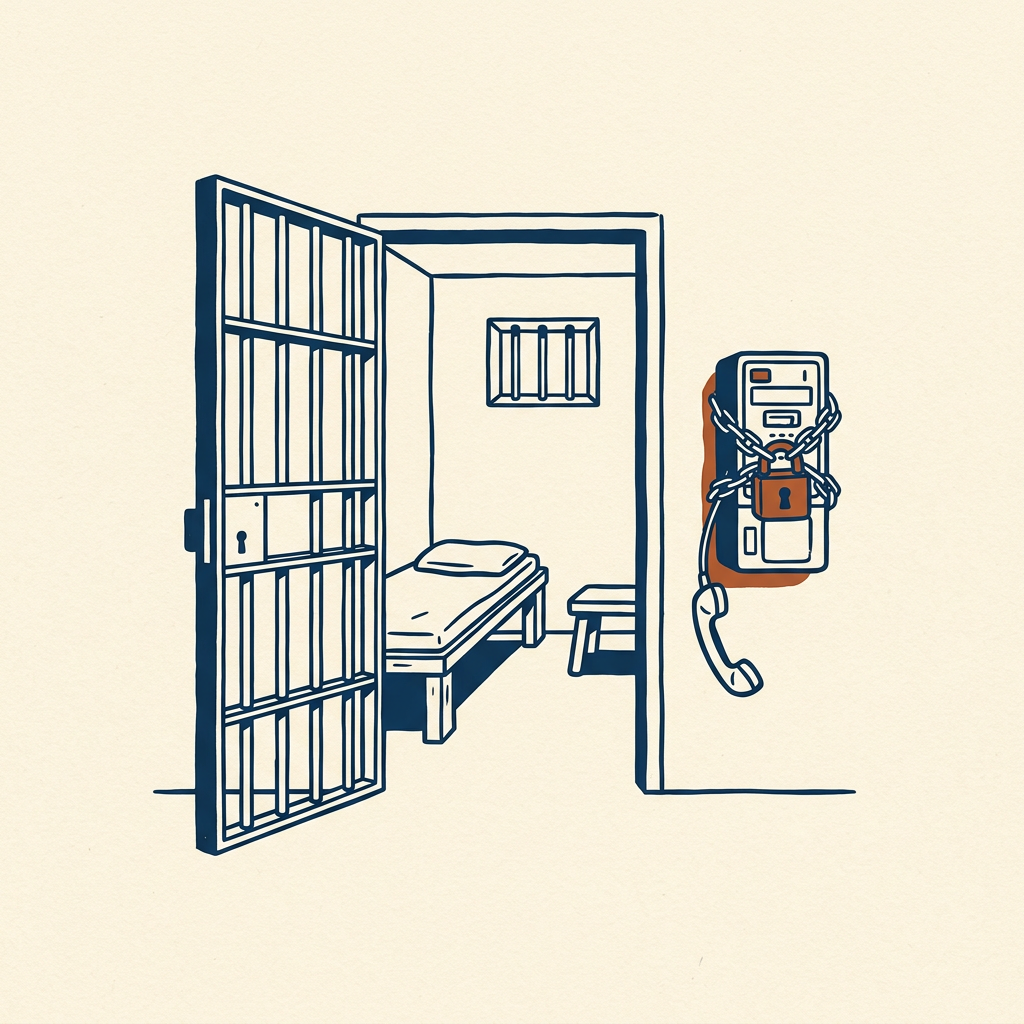
Prosecution shows unfamiliarity with computer crime led officials to treat a nonviolent offender as an extraordinary threat and impose punishment disproportionate to proven harm.
Conduct shown
Nonviolent source-code curiosity, no proven profit or physical harm
Treatment given
No bail, ~8 months solitary, device bans after a <4-year sentence
After the February 1995 Raleigh capture he was held without bail for months. At a bail hearing a prosecutor reportedly suggested he could cause serious harm by whistling launch codes into a telephone—an image the book treats as emblematic of officials' technological illiteracy.
He spent roughly eight months in solitary confinement, a condition normally reserved for the most violent offenders, justified by fear that unsupervised phone access might let him do further damage. He eventually pleaded guilty to wire fraud and unauthorized computer access, receiving just under four years on top of time served, plus restitution orders he and supporters called inflated for legal and insurance aims.
After 2000 release, restrictions stayed unusually strict for nonviolent crime: periods barred from computers, cell phones, or any internet-capable device without special permission, limits he had to fight even for legitimate work. The chapter argues the scale reflected public anxiety about hacking in general more than the specific facts, since he was never shown to have profited financially or caused physical harm—while leaving the real investigative costs companies bore somewhat underexamined.
In practice: A bail argument that he might whistle launch codes into a phone stood in for the era's official panic and helped justify solitary.
9
Breaker becomes trainer
Reinvention as a paid security consultant suggests the skills that attack an organization's weak trust are the clearest foundation for defending it—while also serving his rehabilitation story.
After the sentence he built a second career on exactly the abilities that made him a federal target: testing firms' vulnerability to social engineering, consulting on awareness training, and speaking on the tactics the memoir details. He had already co-written earlier books, including one of pure social-engineering case studies; by this book's appearance he ran a consulting firm and had testified before Congress on cybersecurity.
The transition is framed as evidence that motives were always about mastering systems rather than causing harm, since companies once in his crosshairs now paid him to probe their defenses. It also completes the central argument: if human trust is the weakest link, the most valuable expert on defending it is someone who spent years exploiting it.
The reinvention is genuine and commercially successful, yet it means the book partly promotes Mitnick's post-prison brand. Readers are left to weigh his account of motive against that incentive. Still, the arc from teenage phreaker to hunted fugitive to sought-after consultant supplies the throughline that turns a crime catalog into a training case study still cited for why organizations must train people, not only machines.
In practice: Firms that once might have been targets hired him to run social-engineering penetration tests and awareness programs built on his old pretexts.
Key terms
- pretexting Calling while playing a believable role—coworker, vendor, tech—to talk someone into handing over access or data
- social engineering Using psychology and trust, not code bugs, to get past people who guard systems
- phone phreaking Exploring and manipulating the telephone network with tones, operator tricks, and insider lingo
- dumpster diving Pulling manuals, directories, and phone lists from company trash to sound legitimate later
- tailgating Walking into a building right behind authorized people by simply looking like you belong
- cloned cellular phone A handset copying another phone's identity so calls leave no clean trace to the real user
- VMS source code Digital Equipment Corporation's operating-system code Mitnick copied as a mastery trophy
- wire fraud One of the charges in the plea that also covered unauthorized computer access
What to do
- Audit how your organization verifies identity by phone or email before any reset, access change, or data disclosure.
- Run a plausible pretext call against your own help desk this week and document what a stranger could extract.
- Strip public pages of internal jargon, org charts, and employee directories pretexters use to sound real.
- Train staff that hanging up and calling back on a known official channel is the job, not rudeness.
- Treat any process that accepts a caller who merely sounds legitimate as an open vulnerability to fix.
Questions to think with
- Where does your team still grant access because someone sounded like an insider under time pressure?
- If curiosity, not cash, drove the intrusions, how should that change what counts as proportionate punishment?
- What personal relationships in a security team could become the blind spot that stranger-focused training never covers?
- How much of today's security spend still hardens code while leaving phone and email identity checks thin?
- When a former attacker sells defense, how do you separate hard-won method from brand rehabilitation?
The other side
The memoir is a single-source story told by the only surviving witness with a strong stake in how his motives read; curiosity-over-malice is consistent yet unverifiable across every episode, conveniently softens real corporate investigation and hardening costs he calls prosecutorial exaggeration without another ledger, and sits beside a rival manhunt narrative from John Markoff and Tsutomu Shimomura that readers never hear on equal terms.
Who it's for
Working IT and security staff who need an attacker's-eye anatomy of pretexting, plus general readers drawn to early phreaking history and anyone watching how media and prosecutors inflate unfamiliar tech crime.