




How a utilitarian trader turned trust into an expected-value bet
Michael Lewis's Going Infinite is for anyone who saw the FTX headlines and still wants the mind and culture that produced the collapse.
IJR · Nov 4, 2026 · 13 min read
In 60 seconds
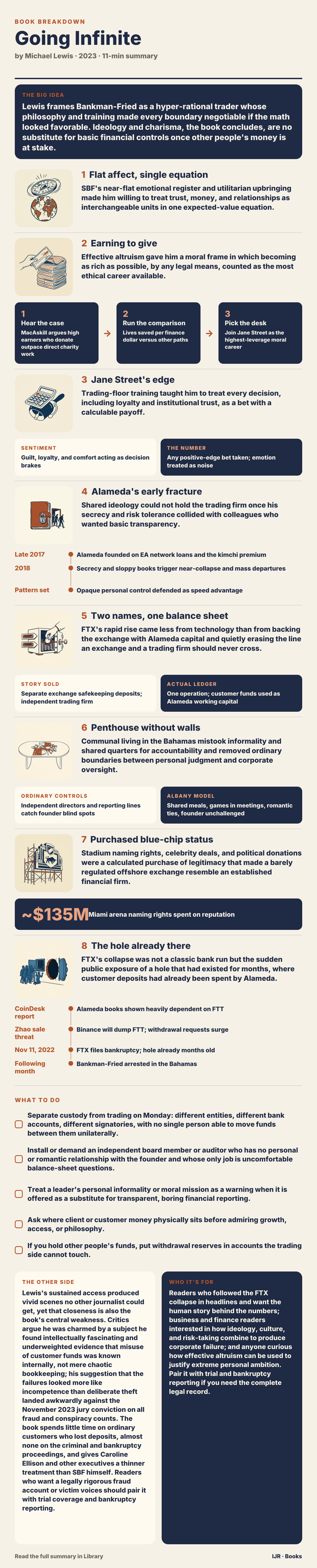
- Bankman-Fried's flat affect and utilitarian home trained him to treat money, trust, and relationships as units in one expected-value equation.
- Effective altruism's earning-to-give doctrine cast getting as rich as possible as his highest moral duty, not a private indulgence.
- Jane Street drilled him to take any positive-edge bet and treat emotion as noise, a habit that later corroded management of people and deposits.
- Alameda then FTX ran on opaque personal control; customer funds quietly became Alameda's working capital behind two company names.
- Bahamas dormitory living and huge legitimacy spending replaced independent controls with charisma, philosophy, and shared quarters.
- The November 2022 withdrawals only revealed a hole that already existed; deposits had already been spent on illiquid underwater positions.
The big idea
Lewis frames Bankman-Fried as a hyper-rational trader whose philosophy and training made every boundary negotiable if the math looked favorable. Ideology and charisma, the book concludes, are no substitute for basic financial controls once other people's money is at stake.
The book in brief
Lewis opens with a childhood shaped by moral philosophy and flat affect. Bankman-Fried grew up weighing choices by utility rather than feeling and carried one question into every later arena: does this maximize expected value.
Effective altruism, absorbed from a MacAskill talk at MIT, turned getting rich into a moral duty through earning to give. Jane Street then drilled the same logic into market form—take the positive-edge bet, treat emotion as noise. He left in 2017 when the firm's risk limits felt like wasted edge.
Alameda Research began with EA friends and the kimchi premium, then nearly failed in 2018 under secretive position-taking that drove founding staff out. From those ashes he and Gary Wang built FTX in 2019 as the exchange traders wanted. Growth came from product speed and from quietly letting Alameda tap customer deposits, collapsing two balance sheets into one.
The 2021 move to a Bahamas penthouse erased office and home. Shared living, games in meetings, and romantic entanglement with the person closest to the numbers replaced ordinary controls. Stadium rights, celebrity deals, political millions, and congressional testimony bought the look of a blue-chip firm at a valuation near 32 billion dollars.
In November 2022 a CoinDesk report on Alameda's FTT-heavy books, followed by Binance's sale threat, triggered withdrawals FTX could not meet. By some estimates around 8 billion dollars in customer funds had already been spent. Bankruptcy came on November 11; arrest followed the next month. The same negotiable boundaries visible from childhood math to the penthouse had produced an insolvency waiting to be noticed.
Context
Michael Lewis spent roughly a year with Bankman-Fried before FTX collapsed in November 2022. The result is the most intimate portrait available of a fraud unfolding in real time, told by a writer standing inside the room. It mattered because headlines had already carried the numbers; Lewis supplied the psychology and daily culture that produced them.
The key ideas

1
Flat affect, single equation
SBF's near-flat emotional register and utilitarian upbringing made him willing to treat trust, money, and relationships as interchangeable units in one expected-value equation.
Lewis traces the childhood to a household of Stanford law professors whose dinner talk ran on utilitarian logic, not sentiment. Bankman-Fried described his own feelings as close to flat, at times in the language of anhedonia. Most people check choices against guilt, loyalty, or comfort. He checked them against calculated outcomes alone.
As a teenager he preferred puzzles and games with clean payoffs over social approval. At MIT he studied physics and found the constant social performance of college exhausting and largely pointless. He kept a small circle of peers who spoke in odds and utility rather than right and wrong.
That wiring shaped the rest of the arc. Every later decision, from founding a firm to spending deposits, traces back to a mind trained to ask only whether a move maximized expected value. Instincts that stop most people simply did not fire.
In practice: He treated as straightforwardly correct a coin-flip thought experiment that could destroy the world if it also had a slightly better-than-even chance of doubling it.

2
Earning to give
Effective altruism gave him a moral frame in which becoming as rich as possible, by any legal means, counted as the most ethical career available.
- 1Hear the caseMacAskill argues high earners who donate outpace direct charity work
- 2Run the comparisonLives saved per finance dollar versus other paths
- 3Pick the deskJoin Jane Street as the highest-leverage moral career
The pivot, as Lewis tells it, was a talk by Oxford philosopher William MacAskill that Bankman-Fried heard as an MIT undergraduate. MacAskill held that a person could do more good in a high-paying job and donating the proceeds than by working directly in a nonprofit, because dollars convert efficiently into saved lives or reduced existential risk.
Earning to give reframed the pursuit of wealth as duty rather than indulgence. Bankman-Fried calculated how many lives a dollar at a Wall Street desk could save compared with a dollar earned anywhere else. He concluded finance was the highest-leverage path and chose Jane Street over academia or direct charity.
Lewis notes the ideology was sincere; friends from the effective altruism community back that up. Yet the same frame that justified extreme ambition also supplied a ready moral alibi for almost any means, since the ends were defined as saving the world. Once profit and virtue fused, internal guardrails against cutting corners with other people's money were already gone.
In practice: His post-graduation choice of Jane Street Capital, made by comparing lives saved per dollar across possible careers.

3
Jane Street's edge
Trading-floor training taught him to treat every decision, including loyalty and institutional trust, as a bet with a calculable payoff.
Sentiment
Guilt, loyalty, and comfort acting as decision brakes
The number
Any positive-edge bet taken; emotion treated as noise
Between 2013 and 2017 he worked at Jane Street Capital, a quantitative firm known for hiring physicists and mathematicians to price risk instantly. The culture ran on games of expected value. Traders learned to accept any bet with a positive mathematical edge and to distrust intuitions that contradicted the math.
He learned to make ETF markets off tiny price gaps across exchanges. The core lesson stuck: emotion is noise, the number is the truth. Lewis shows this produced a genuinely skilled trader. It also produced someone who came to see structure, hierarchy, and disclosure as negotiable variables rather than fixed obligations.
Frustration grew with rules he considered suboptimal rather than necessary. He felt the firm's caution left expected value on the table. That push is what sent him out in 2017 to build something with no one else's risk limits left to defer to. The same indifference to sentiment that works on a trading desk becomes dangerous once the trader controls other people's deposits.
In practice: His rising irritation at Jane Street risk limits he read as leaving edge unclaimed rather than protecting the firm.

4
Alameda's early fracture
Shared ideology could not hold the trading firm once his secrecy and risk tolerance collided with colleagues who wanted basic transparency.
- Late 2017Alameda founded on EA network loans and the kimchi premium
- 2018Secrecy and sloppy books trigger near-collapse and mass departures
- Pattern setOpaque personal control defended as speed advantage
In late 2017 he founded Alameda Research with a group drawn largely from the effective altruism community, including early leader Tara Mac Aulay. The founding trade was the kimchi premium—the gap between bitcoin prices in Korea and elsewhere—exploited by moving capital across borders faster than rivals. Early funding came partly from loans inside the EA network, people who trusted the philosophy enough to trust him with money.
Lewis describes 2018 as the year that trust broke. Colleagues grew alarmed at sloppy accounting, unclear position sizing, and his habit of withholding information even from his own risk managers. A near-collapse followed, with large losses through positions no one outside SBF fully understood.
Several founding employees left en masse. The rupture fractured relationships inside the effective altruism movement itself, because many had joined on shared moral commitments rather than a contract. Lewis treats the episode as preview, not aberration: concentrated opaque control, defended as necessary for speed and edge, would return at far larger scale.
In practice: The 2018 mass exit after positions only SBF fully understood nearly sank the firm and split EA friendships.

5
Two names, one balance sheet
FTX's rapid rise came less from technology than from backing the exchange with Alameda capital and quietly erasing the line an exchange and a trading firm should never cross.
Story sold
Separate exchange safekeeping deposits; independent trading firm
Actual ledger
One operation; customer funds used as Alameda working capital
After stabilizing Alameda, he identified a concrete inefficiency: existing crypto exchanges offered clumsy margin and derivatives products, and market makers were losing money to bad execution rather than bad predictions. In 2019 he and Gary Wang founded FTX, first based in Hong Kong, to build the exchange he wanted as a trader.
Early growth came from better product design, tighter spreads, and faster liquidations that attracted retail traders and professional firms. Lewis frames a structural decision as the real hinge. Alameda, still owned and effectively run behind the scenes by SBF, received privileged access to FTX systems and eventually to customer funds sitting on the exchange.
What looked from outside like two separate companies was in practice one operation with two names. Ordinary deposits became working capital for Alameda's trades. Lewis argues this did not begin as fraud in SBF's own mind; he believed overall positions were sound enough to make customers whole eventually. The practical effect was that FTX never simply held customer money the way it told customers and regulators it did.
In practice: Alameda's privileged system access turning customer deposits into trading capital while the public still saw two firms.

6
Penthouse without walls
Communal living in the Bahamas mistook informality and shared quarters for accountability and removed ordinary boundaries between personal judgment and corporate oversight.
Ordinary controls
Independent directors and reporting lines catch founder blind spots
Albany model
Shared meals, games in meetings, romantic ties, founder unchallenged
In 2021 FTX relocated to the Bahamas partly for regulatory convenience. Bankman-Fried moved into a penthouse at the Albany resort with roughly ten senior colleagues, including Alameda CEO Caroline Ellison, with whom he had an on-and-off romantic relationship. The boundary between office and household essentially disappeared.
Major financial decisions were discussed over shared meals. Staff played League of Legends or Storybook Brawl during meetings. SBF kept a famously disheveled appearance, drove a Toyota Corolla, and wore the same shorts and t-shirt regardless of audience. Outsiders read this as authenticity and focus. It became part of the mythology that helped FTX raise money at a valuation near 32 billion dollars in early 2022 from venture firms and pension funds that performed only limited due diligence.
Lewis treats the culture as structurally dangerous, not merely quirky. Conventional firms use independent boards, financial controls, and formal reporting lines precisely to catch problems founders cannot see or will not admit. FTX's dormitory-style management left almost no one inside positioned to challenge his decisions. The people closest to the actual numbers were also the most personally entangled with him.
In practice: The Albany penthouse where senior staff lived, ate, gamed, and decided major financial moves under one roof.

7
Purchased blue-chip status
Stadium naming rights, celebrity deals, and political donations were a calculated purchase of legitimacy that made a barely regulated offshore exchange resemble an established financial firm.
~$135M
Miami arena naming rights spent on reputation
Lewis catalogs a spending pattern that looked like ordinary marketing but functioned closer to reputation laundering. FTX paid roughly 135 million dollars for naming rights to the Miami arena that had housed the Heat. It signed endorsement deals with Tom Brady and Gisele Bundchen. It ran a Super Bowl advertisement in February 2022 featuring Larry David mocking historical figures who missed good ideas, implicitly casting crypto skepticism as the same error.
Politically, Bankman-Fried became one of the largest donors of the 2020 election cycle, giving tens of millions of dollars largely to Democratic causes while also funding Republican-aligned dark money groups. Lewis reads the dual track as an attempt to buy access across the spectrum rather than commitment to one side. He testified before Congress on crypto regulation, positioning FTX as the industry's responsible actor, which inclined regulators and journalists to treat him as a good-faith partner rather than a subject of scrutiny.
None of this spending built revenue. Its entire value was reputational. It converted a young, opaque, offshore company into something that felt, to investors, politicians, and customers, like an established institution. That borrowed legitimacy is part of why so many sophisticated parties failed to ask where customer money actually sat.
In practice: The roughly 135 million dollar Miami arena naming deal and the Larry David Super Bowl spot that made an offshore exchange feel institutional.
8
The hole already there
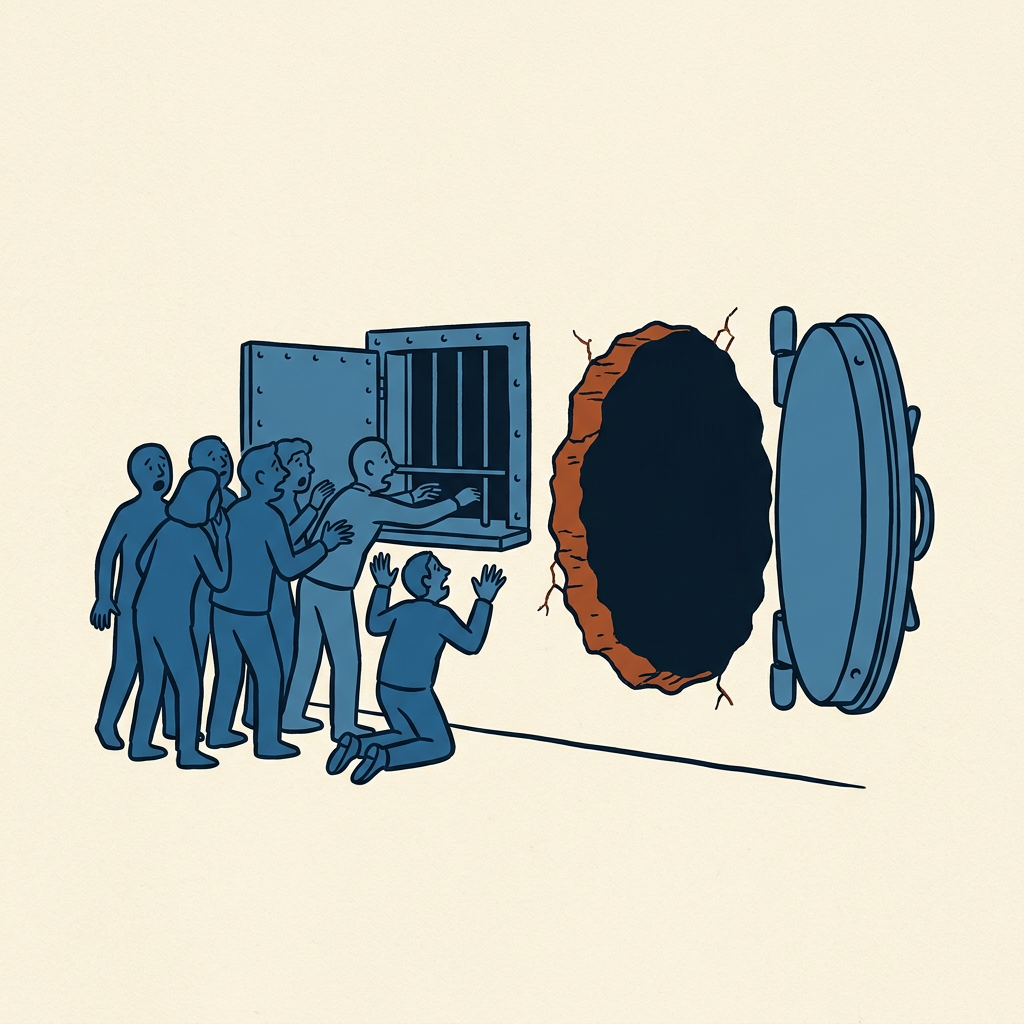
FTX's collapse was not a classic bank run but the sudden public exposure of a hole that had existed for months, where customer deposits had already been spent by Alameda.
- CoinDesk reportAlameda books shown heavily dependent on FTT
- Zhao sale threatBinance will dump FTT; withdrawal requests surge
- Nov 11, 2022FTX files bankruptcy; hole already months old
- Following monthBankman-Fried arrested in the Bahamas
The proximate trigger in November 2022 was a CoinDesk report revealing that a large share of Alameda Research's balance sheet consisted of FTT, the token issued by FTX itself, rather than independent assets. That raised an obvious solvency question in public. Binance CEO Changpeng Zhao then announced he would sell Binance's FTT holdings, a move Lewis frames as retaliatory given prior tension between the exchanges.
The announcement triggered a wave of customer withdrawal requests. Within days it became clear FTX could not honor them. A large portion of customer deposits, by some estimates around 8 billion dollars, had already been transferred to Alameda and used for trading, investments, and loans rather than held in reserve. FTX filed for bankruptcy on November 11, 2022. Bankman-Fried was arrested in the Bahamas the following month.
Lewis emphasizes that the run did not create the insolvency. It only revealed one that had existed for an extended period. Failure was close to inevitable once anyone looked closely at the assets actually backing customer accounts. Blurred boundaries visible since Alameda's founding had reached their logical endpoint.
In practice: CoinDesk's FTT revelation plus Zhao's sale announcement exposing that deposits were already gone into Alameda's positions.
Key terms
- expected value The probability-weighted average outcome of a bet; SBF's single test for almost every personal and business choice
- earning to give Effective-altruism idea that a high-earning career plus donations does more measurable good than working directly in a nonprofit
- effective altruism Moral framework that ranks actions by lives saved or existential risks reduced, not by sentiment or tradition
- kimchi premium The bitcoin price gap between Korea and the rest of the world that Alameda exploited as its early trade
- FTT The token issued by FTX; a large share of Alameda's reported assets turned out to be this sister-company token
- anhedonia Reduced ability to feel ordinary pleasure; language Bankman-Fried used for his own flat emotional register
What to do
- Separate custody from trading on Monday: different entities, different bank accounts, different signatories, with no single person able to move funds between them unilaterally.
- Install or demand an independent board member or auditor who has no personal or romantic relationship with the founder and whose only job is uncomfortable balance-sheet questions.
- Treat a leader's personal informality or moral mission as a warning when it is offered as a substitute for transparent, boring financial reporting.
- Ask where client or customer money physically sits before admiring growth, access, or philosophy.
- If you hold other people's funds, put withdrawal reserves in accounts the trading side cannot touch.
Questions to think with
- Where in your own work do you treat a boundary as negotiable because the expected upside looks large enough?
- Would an outsider with no social or romantic tie to your team be able to catch a problem your culture now misses?
- How would you tell if a moral mission were substituting for controls rather than reinforcing them?
- What evidence of solvency would you require beyond reputation, endorsements, and political access?
- If customer money and proprietary trading share any pipe, who can shut that pipe without the founder's permission?
The other side
Lewis's sustained access produced vivid scenes no other journalist could get, yet that closeness is also the book's central weakness. Critics argue he was charmed by a subject he found intellectually fascinating and underweighted evidence that misuse of customer funds was known internally, not mere chaotic bookkeeping; his suggestion that the failures looked more like incompetence than deliberate theft landed awkwardly against the November 2023 jury conviction on all fraud and conspiracy counts. The book spends little time on ordinary customers who lost deposits, almost none on the criminal and bankruptcy proceedings, and gives Caroline Ellison and other executives a thinner treatment than SBF himself. Readers who want a legally rigorous fraud account or victim voices should pair it with trial coverage and bankruptcy reporting.
Who it's for
Readers who followed the FTX collapse in headlines and want the human story behind the numbers; business and finance readers interested in how ideology, culture, and risk-taking combine to produce corporate failure; and anyone curious how effective altruism can be used to justify extreme personal ambition. Pair it with trial and bankruptcy reporting if you need the complete legal record.