




Geographic luck not race decided who conquered whom
Diamond’s case that wild species and continental shape—not smarter minds—built the conquest gap is for anyone who wants deep causes of inequality without racial myths.
IJR · Oct 14, 2026 · 13 min read
In 60 seconds
- Diamond treats Yali’s question about white people’s cargo as a scientific puzzle and rejects innate intelligence gaps as the answer.
- Food production arose only where wild plants worth domesticating existed, notably the Fertile Crescent around 8500 BC, then unlocked density, specialists, and armies.
- Only about fourteen large terrestrial mammals were ever domesticated before the twentieth century, and most were Eurasian; Africa and the Americas got almost none.
- Eurasia’s east-west axis let crops and tech spread across similar climates; north-south continents faced slow, often failed adaptation.
- Old World livestock diseases killed an estimated 90 percent or more of the pre-Columbian Americas, far outstripping battlefield deaths.
- Writing, states, and steel followed surplus, so Pizarro’s 168 men could topple the Inca after smallpox and civil war had already cracked the empire.
The big idea
Diamond argues that unequal power among continents came from geographic accidents—which lands offered domesticable plants and animals and which axes let those packages spread—not from differences in minds or effort. Those head starts compounded over millennia into food surplus, crowd immunity, writing, and steel, giving Eurasian societies the tools to conquer much of the rest of the world.
The book in brief
Diamond opens with Yali, a New Guinean politician who asked why white people developed so much cargo while New Guineans did not. He treats the question seriously and rules out racial or genetic explanations of intelligence. He finds no evidence for cognitive gaps between populations and notes New Guineans may show sharper practical intelligence in a demanding environment. Ultimate causes, he says, lie in each continent’s starting kit: available wild species, land shape, and ease of diffusion. Those piled up into the proximate causes—guns, germs, and steel—that decided conquest.
He then shows why farming began in only a few places. Early agriculture often meant harder work and worse nutrition than foraging, visible in shorter skeletons at early farm sites. What forced the shift was population pressure plus local wild cereals and pulses worth growing. In the Fertile Crescent around 8500 BC that package existed; across most of Australia it did not, so foraging stayed rational. Once farming stuck, it enabled sedentism, storage, higher density, labor specialists, elites, cities, and armies. Timing differences of thousands of years set later technology gaps.
Domestication of animals followed a harsh filter. A wild species had to meet many conditions at once—diet, growth rate, captive breeding, temperament, calm under stress, and a hierarchy humans could hijack—or fail. Only about fourteen large herbivores ever cleared the bar before the twentieth century, nearly all from Eurasia. Zebras and African buffalo failed on temperament; the Americas had already lost most megafauna, leaving mainly llamas and alpacas. Draft power, manure, milk, and cavalry then multiplied Eurasian yields and armies.
Continental geometry locked the advantage in. Eurasia’s east-west axis meant similar day length and climate across long distances, so wheat, barley, and livestock moved fast. The Americas and Africa run north-south, forcing crops through radically different zones; corn crawled slowly, and Andean llamas and potatoes never reached Mesoamerica before European contact. The Sahara added another wall. Eurasian societies could pool inventions from a vast belt while others stayed boxed in smaller ecological pockets.
Crowd diseases sealed the imbalance. Pathogens that jumped from cattle, pigs, and fowl had already swept Eurasian populations for millennia, leaving partial immunity. Native Americans lacked herd animals and that exposure. Epidemics, sometimes racing ahead of explorers, killed an estimated 90 percent or more of the pre-Columbian population. Smallpox in the 1520s killed the Inca emperor Huayna Capac and sparked the succession war Pizarro exploited in 1532 with 168 men. Writing, bureaucracy, and steel were further downstream of the same surplus and density. Diamond then tests the same variables inside continents—China’s early unity versus Europe’s fragmentation, Polynesian islands as a natural experiment, the Bantu expansion across Africa—and lands on geography as the deep driver, while leaving shorter-term institutional puzzles largely untouched.
Context
Jared Diamond published the book in 1997. It reshaped popular and academic debate about inequality among nations by offering a materialist alternative to racial theories of history.
The key ideas

1
Yali’s cargo question
Technological gaps between societies track environmental luck far more than differences in intelligence or effort.
Diamond begins with a blunt question from Yali, a New Guinean politician: why did white people end up with so much cargo—steel tools and manufactured goods—while New Guineans did not. He refuses to treat it as rhetoric. He also refuses the popular claim that Europeans are simply smarter or more inventive.
No good evidence, he says, shows genetic differences in cognitive capacity across populations. If anything, New Guineans navigating a hard tropical world with constant vigilance may display sharper practical intelligence in controlled comparisons. The real levers sit further back.
Ultimate causes are the environmental starting conditions of each continent: which wild plants and animals could be domesticated, how the landmass was shaped and oriented, and how easily ideas could travel. Over thousands of years those conditions produced the proximate causes—guns, germs, and steel—that decided who conquered whom.
The method is to work backward from the observed pattern of conquest with archaeology, linguistics, and biology. The moral claim is that a geographic answer removes the racist sting from a question long answered badly. The rest of the book shows why Eurasia, especially the Fertile Crescent and China, held the winning hand.
In practice: Yali’s question about cargo becomes the framing scientific problem Diamond spends the book answering without racial shortcuts.

2
Farming was no free upgrade
The turn to farming was a local response to ecological pressure and available wild species, not a universal step every clever society would take.
- 1Wild package presentNutritious local cereals and pulses make cultivation worth trying
- 2Population pressureForaging alone no longer feeds the growing group
- 3Sedentism and storageFixed fields and surplus free some people from food work
- 4Specialists and armiesElites, crafts, cities, and organized force become possible
Food production arose independently in only a handful of places—the Fertile Crescent, China, Mesoamerica, the Andes, and a few others. Diamond rejects the notion that farming was an obvious improvement any group would copy once shown it.
Early farming often meant heavier labor and poorer nutrition than foraging. Skeletal remains from early agricultural sites run shorter than earlier forager remains. What actually pushed the shift was rising population pressure combined with wild species worth the trouble.
Where nutritious wild cereals and pulses were abundant, as in the Fertile Crescent around 8500 BC, people moved gradually from intensive gathering to deliberate cultivation. Where no such candidates existed, as across most of Australia, hunting and gathering stayed the only workable path. Lack of ingenuity was not the issue; lack of raw biological material was.
Once farming took hold it set off a chain: sedentism, stored surplus, densities foraging could never support, specialized labor, non-farming elites, cities, and armies. The timing and location of that transition were set by biogeography, and the multi-thousand-year head start explains a large share of later continental technology gaps.
In practice: Fertile Crescent peoples could lean on wild cereals around 8500 BC; most Australian groups had no equivalent package and stayed foragers.

3
The animal domestication filter
Only species that cleared every domestication hurdle at once ever became livestock, so most continents never gained draft animals.
Diamond borrows the Anna Karenina idea that success requires clearing many conditions at once while failure needs only one miss. A candidate animal needs the right diet, fast growth, captive breeding, manageable temper, low panic, and a social hierarchy humans can take over.
Fail any single test and domestication collapses, no matter how useful the beast looks. Of the world’s large terrestrial herbivorous mammals, only about fourteen were domesticated before the twentieth century. The great majority—sheep, goats, cattle, pigs, horses—came from Eurasia.
Africa’s famous megafauna failed the temperament tests; zebras stay too vicious to break, and sustained modern efforts have not turned African herbivores into reliable stock. The Americas lost most candidate megafauna near the end of the Pleistocene, likely hastened by human hunting after first arrival, leaving llamas and alpacas as the main domesticates for the whole hemisphere.
The skew mattered. Domestic animals supplied meat, milk, wool, manure, transport, and above all plow power that multiplied yields. Societies with draft animals could feed denser populations, field larger armies, and later field cavalry. Continents without them faced a hard biological ceiling ingenuity alone could not lift.
In practice: Eurasia ended up with horses and oxen; Africa never domesticated the zebra despite its similarity to the horse.
4
Axes that speed or stall
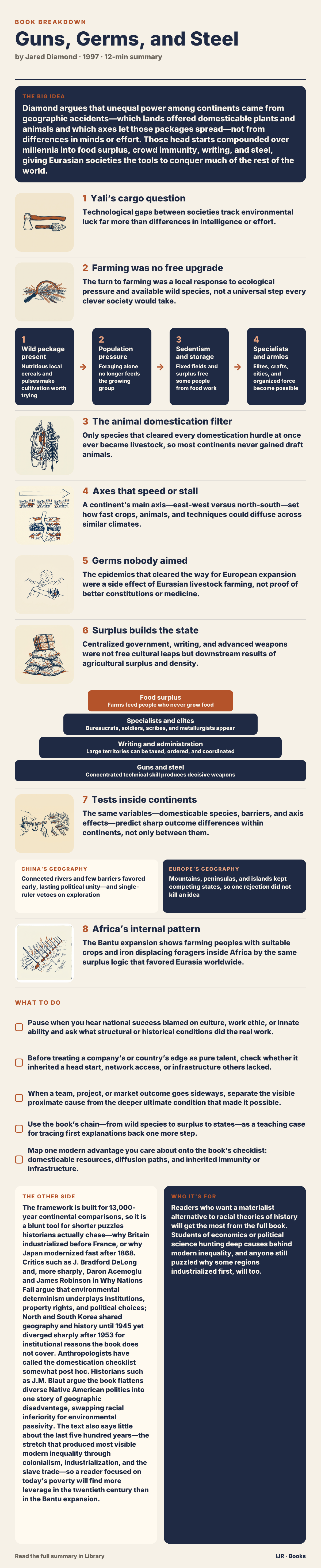
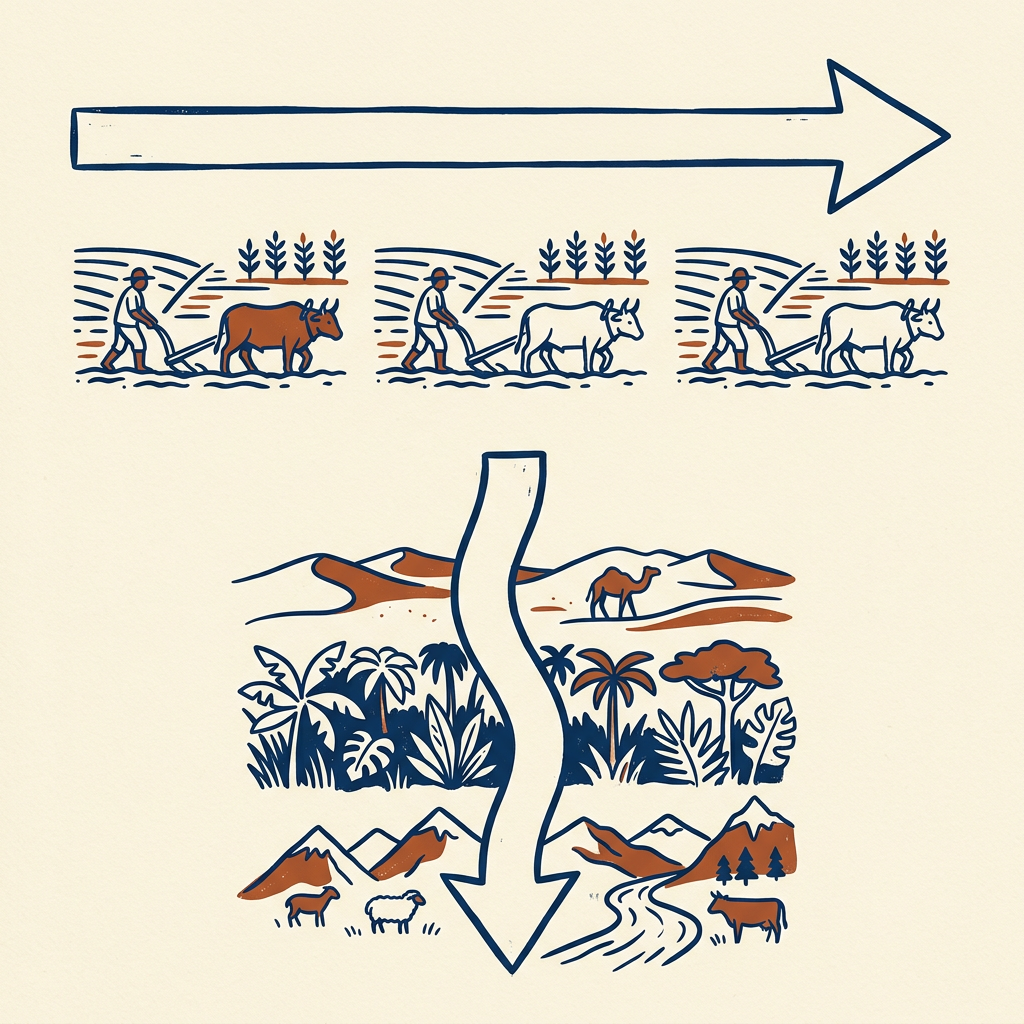
A continent’s main axis—east-west versus north-south—set how fast crops, animals, and techniques could diffuse across similar climates.
Diamond’s most geometric claim is that orientation controlled the pace of civilization. Eurasia stretches east-west, so places at like latitudes share day length, seasons, and broad climate bands. A crop or animal broken in the Fertile Crescent could move to Europe, Central Asia, or northern India without radical re-adaptation.
Wheat and barley did move rapidly across that belt within a few thousand years. The Americas and Africa run mainly north-south. A Mesoamerican crop headed for South America or the northern United States had to cross tropical and temperate zones and sharply different day lengths, demanding long and often failed adaptation.
Corn’s slow crawl north and south, and the failure of Andean llamas and potatoes to reach Mesoamerica before European contact despite thousands of years, illustrate the friction. Africa’s Sahara added an extra ecological wall that blocked Fertile Crescent packages from sub-Saharan regions for centuries.
Eurasian societies therefore pooled inventions from a huge interconnected zone. Societies on north-south continents stayed semi-isolated in smaller ecological bands even when neighbors held useful domesticates. The diffusion edge kept reinforcing Eurasia’s earlier farming head start instead of letting gaps close.
In practice: Andean potatoes and llamas never reached Mesoamerica before Europeans arrived, despite long opportunity on the same landmass.
5
Germs nobody aimed
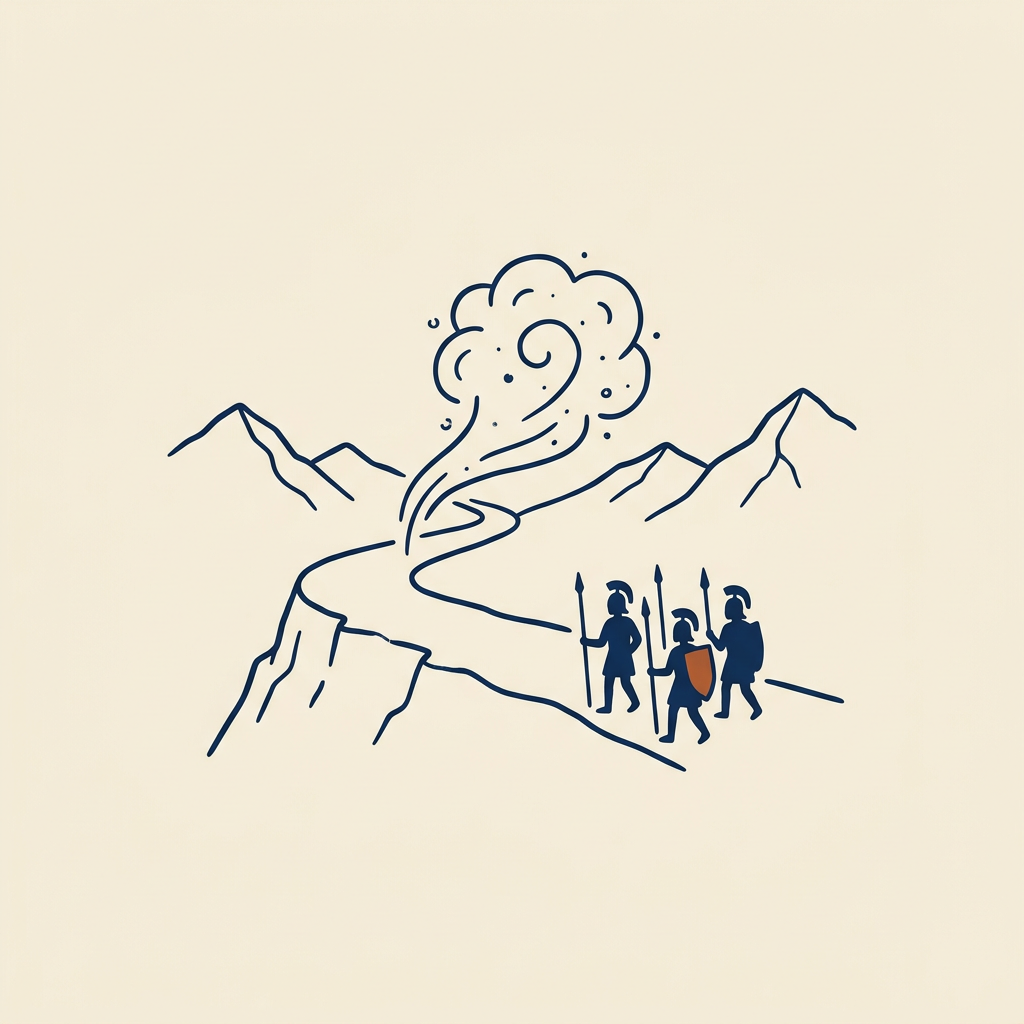
The epidemics that cleared the way for European expansion were a side effect of Eurasian livestock farming, not proof of better constitutions or medicine.
Most of history’s deadliest human infections—smallpox, measles, influenza, tuberculosis, and others—began as animal pathogens that jumped into people living close to herds. Eurasians had shared daily life with cattle, pigs, and fowl for thousands of years, so their populations had already endured repeated waves and carried partial hereditary and acquired immunity.
Native Americans had almost no domesticated herd animals and no comparable exposure. When Europeans arrived, the diseases they carried—sometimes racing ahead through indigenous trade networks—killed an estimated 90 percent or more of the pre-Columbian population of the Americas within a century or two, dwarfing deaths from direct fighting.
Diamond points to the smallpox wave that hit the Inca Empire in the 1520s, killed emperor Huayna Capac, and ignited the succession war Francisco Pizarro later exploited. Conquest looks less like superior European intent and more like an unintended byproduct of the animal-dense farming world built in earlier chapters.
Local diseases such as malaria or yellow fever sometimes hurt invaders in return, yet they did not empty the invaded regions the way Old World crowd diseases emptied the Americas and Pacific islands. The asymmetry still favored the livestock-rich side.
In practice: Smallpox in the 1520s killed Huayna Capac and fractured the Inca state before Pizarro’s tiny force arrived in 1532.
6
Surplus builds the state
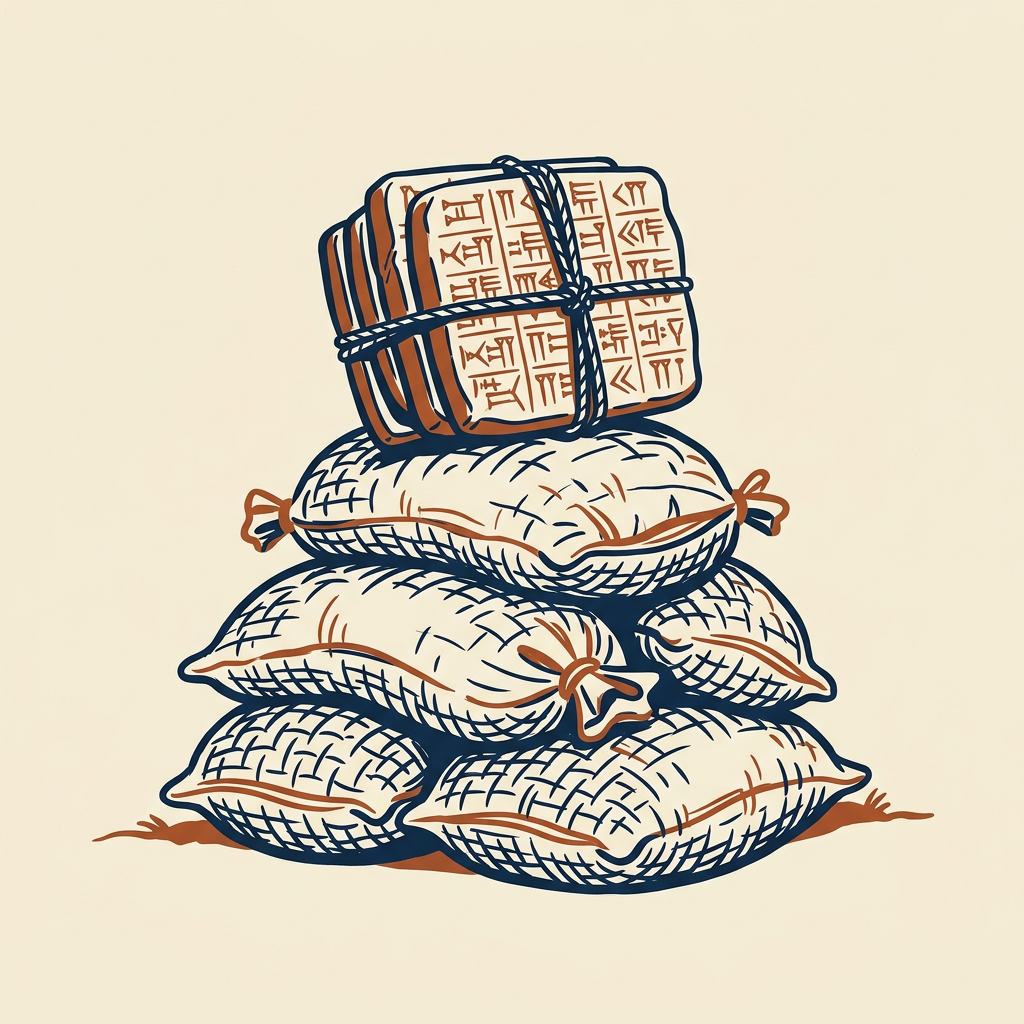
Centralized government, writing, and advanced weapons were not free cultural leaps but downstream results of agricultural surplus and density.
- Food surplusFarms feed people who never grow food
- Specialists and elitesBureaucrats, soldiers, scribes, and metallurgists appear
- Writing and administrationLarge territories can be taxed, ordered, and coordinated
- Guns and steelConcentrated technical skill produces decisive weapons
Once farms produced more food than farmers needed, societies could feed bureaucrats, priests, soldiers, and scribes. Diamond ties centralized states and steep hierarchies to the population densities only agriculture could sustain. Hunter-gatherer bands and small tribes simply lack the surplus for full-time specialists or standing armies.
Writing arose as a similarly contingent tool. It appeared independently in Sumer and Mesoamerica; most other literate societies borrowed or adapted a script rather than inventing one. The Phoenician alphabet’s descendants spreading around the Mediterranean show that pattern. Writing then enabled long-distance administration, technical and military knowledge transfer, and coordinated conquest.
The same chain produced steel and complex weaponry. Only large populations with occupational specialists and accumulated know-how could support metallurgists who made swords, guns, and armor. Dense, surplus-rich, interconnected Eurasian societies developed and spread these political and information tools just as they had spread crops.
More fragmented, lower-density societies elsewhere had fewer chances to invent or receive them. The machinery of conquest was therefore another compound interest payment on the original geographic head start.
In practice: Pizarro’s 168 men beat thousands of Inca warriors at Cajamarca in 1532 by combining guns, steel, horses, epidemic chaos, and civil war.
7
Tests inside continents
The same variables—domesticable species, barriers, and axis effects—predict sharp outcome differences within continents, not only between them.
China’s geography
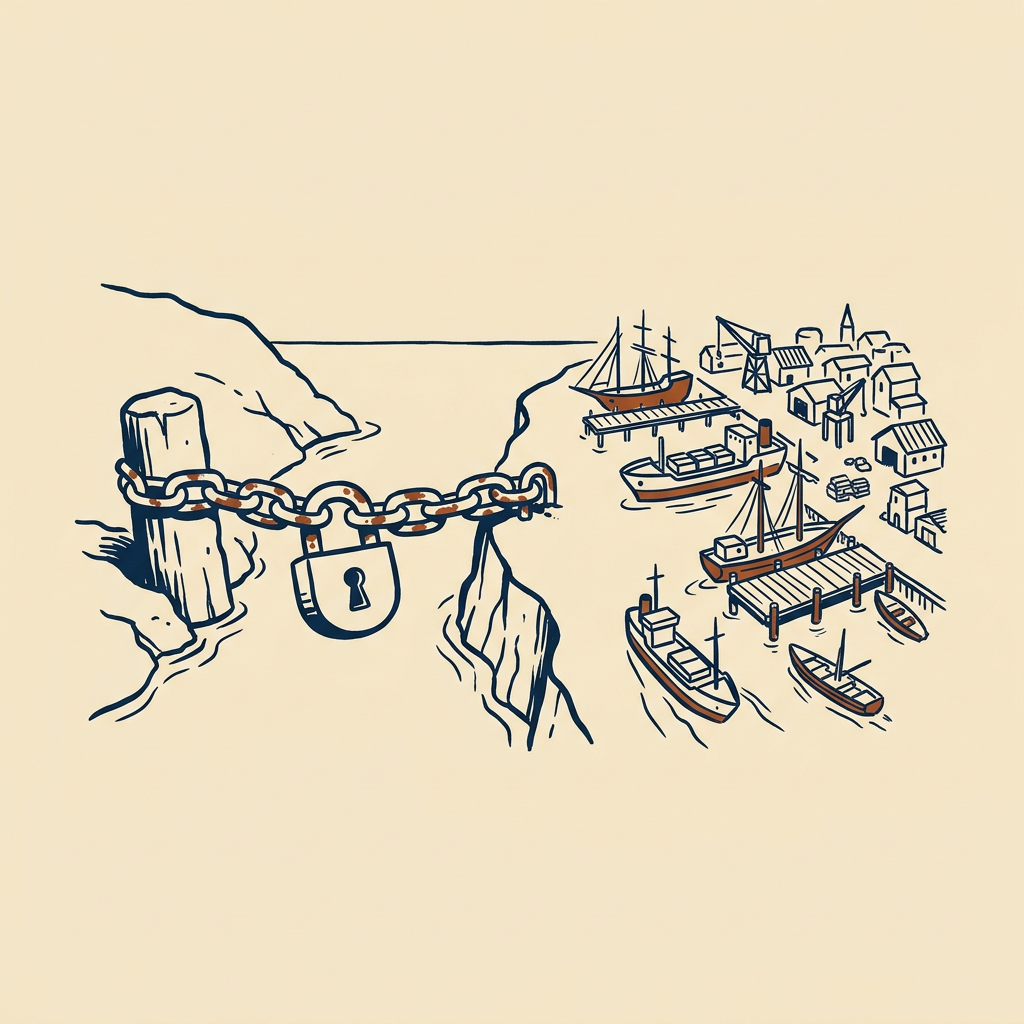
Connected rivers and few barriers favored early, lasting political unity—and single-ruler vetoes on exploration
Europe’s geography
Mountains, peninsulas, and islands kept competing states, so one rejection did not kill an idea
Diamond checks the framework on regional puzzles. China unified early and stayed largely unified because connected river systems and few natural barriers favored consolidation. Europe’s mountains, peninsulas, and islands kept many rival states alive.
That contrast cut both ways. China’s unity let one Ming ruler in the fifteenth century ban oceangoing fleets and stall exploration for a whole civilization. Fragmented Europe meant that if one court rejected Columbus, another—Spain after Portugal and others declined—could still fund the voyage.
Pacific islands supply a miniature natural experiment. Polynesian settlers from one ancestral culture spread to wildly different environments, from rich New Zealand soils to poor coral atolls, and within roughly a thousand years produced everything from complex chiefdoms to simple foraging bands. Environment, not inherited culture, tracked the complexity.
In the Americas, the Andes and Mesoamerica outpaced eastern North America partly through earlier and more productive domesticates such as maize and llamas, though the hemisphere as a whole still lagged Eurasia because of later initial settlement and the north-south axis problem.
In practice: A single Ming decision against fleets could freeze Chinese exploration, while European rivalry still found a backer for Columbus.
8
Africa’s internal pattern
The Bantu expansion shows farming peoples with suitable crops and iron displacing foragers inside Africa by the same surplus logic that favored Eurasia worldwide.
Sub-Saharan Africa’s north-south axis and the Saharan barrier long isolated it from Fertile Crescent packages, yet internal disparities still demand explanation. Diamond turns to the Bantu expansion: agricultural peoples from West Africa, carrying tropical-ready crops and later iron tools, spread over roughly two thousand years across most of sub-Saharan Africa.
They displaced or absorbed Pygmy and Khoisan hunter-gatherer populations already living there. The dynamic mirrors Eurasian dominance at smaller scale—farming surpluses, denser settlement, and metal tools out-competing foragers through numbers and technology, not inherent racial superiority.
The same variables operate at every scale. Differences in local domesticates, soil, and diffusion routes inside Africa produced unequal outcomes just as they did between continents. That undercuts the objection that geography cannot explain why some African societies dominated others.
At the Cape, a rare Mediterranean-type climate suited Eurasian crops and livestock, helping European settlement take hold in a way it did not in tropical Africa, where malaria and similar diseases worked against colonizers rather than for them.
In practice: Bantu farmers with iron and tropical crops spread across sub-Saharan Africa over roughly two thousand years, absorbing or displacing earlier foraging groups.
Key terms
- Yali’s question Why some peoples ended up with so much manufactured cargo while others did not
- Ultimate causes Deep environmental starting conditions such as available species and continental shape
- Proximate causes The immediate tools of conquest—guns, germs, and steel—that flow from those deeper conditions
- Anna Karenina principle A wild animal must pass every domestication test at once or domestication fails
- Continental axis East-west versus north-south orientation that speeds or slows the spread of crops and tech
- Food production Farming and herding that create surplus, density, and room for specialists
- Crowd diseases Lethal infections that jumped from livestock into dense human populations
- Bantu expansion The long spread of West African farming peoples across sub-Saharan Africa
What to do
- Pause when you hear national success blamed on culture, work ethic, or innate ability and ask what structural or historical conditions did the real work.
- Before treating a company’s or country’s edge as pure talent, check whether it inherited a head start, network access, or infrastructure others lacked.
- When a team, project, or market outcome goes sideways, separate the visible proximate cause from the deeper ultimate condition that made it possible.
- Use the book’s chain—from wild species to surplus to states—as a teaching case for tracing first explanations back one more step.
- Map one modern advantage you care about onto the book’s checklist: domesticable resources, diffusion paths, and inherited immunity or infrastructure.
Questions to think with
- If geography stacked advantages so heavily, how much room is left for cultural choice or individual agency in the long run?
- How should the estimated 90 percent disease death toll change the way conquest of the Americas is taught?
- Does China’s fifteenth-century fleet ban strengthen or weaken the claim that geography drives political outcomes?
- What evidence would show the domestication criteria are independent tests rather than stories fitted after the fact?
- Why does a 13,000-year continental framework struggle to explain Britain industrializing before Spain?
The other side
The framework is built for 13,000-year continental comparisons, so it is a blunt tool for shorter puzzles historians actually chase—why Britain industrialized before France, or why Japan modernized fast after 1868. Critics such as J. Bradford DeLong and, more sharply, Daron Acemoglu and James Robinson in Why Nations Fail argue that environmental determinism underplays institutions, property rights, and political choices; North and South Korea shared geography and history until 1945 yet diverged sharply after 1953 for institutional reasons the book does not cover. Anthropologists have called the domestication checklist somewhat post hoc. Historians such as J.M. Blaut argue the book flattens diverse Native American polities into one story of geographic disadvantage, swapping racial inferiority for environmental passivity. The text also says little about the last five hundred years—the stretch that produced most visible modern inequality through colonialism, industrialization, and the slave trade—so a reader focused on today’s poverty will find more leverage in the twentieth century than in the Bantu expansion.
Who it's for
Readers who want a materialist alternative to racial theories of history will get the most from the full book. Students of economics or political science hunting deep causes behind modern inequality, and anyone still puzzled why some regions industrialized first, will too.