




Emotions are constructions the brain builds in the moment
Barrett argues feelings are not fixed biological fingerprints but moment-to-moment assemblies from affect, learned concepts, and prediction.
IJR · Oct 30, 2026 · 13 min read

In 60 seconds
- Barrett argues the classical model of basic emotions with universal faces and dedicated brain circuits does not survive freer methods and meta-analyses.
- Core affect—always-on pleasantness and arousal from interoception—is ambiguous raw material the mind categorizes as specific emotions.
- The brain predicts rather than reacts, constructing emotional experience from past concepts before sensory data fully arrive.
- Emotion concepts carried by language let cultures and individuals build different feelings from the same bodily states.
- Feelings often report body-budget strain; hunger, fatigue, and depletion get misread as reactions to whoever is nearby.
- Higher emotional granularity is trainable through vocabulary and linked to better regulation, while face-reading and emotion tech rest on overconfident inference.
The big idea
Barrett argues anger, fear, and joy are not hardwired reactions with fixed faces and brain circuits but constructions: the brain predicts meaning for ambiguous internal sensations using concepts shaped by language and culture. That reframes emotion as an active, learnable process with consequences for parenting, mental health, law, and machines that claim to read faces.
The book in brief
Barrett opens by pressure-testing the classical view that a handful of basic emotions each own a universal facial signature and a dedicated neural circuit. She revisits the evidence that made that model orthodoxy and argues freer methods and large pooled studies strip away the claimed fingerprints.
She then splits raw affect from named emotion. Affect is the continuous sense of valence and arousal from the body’s internal monitoring—always on, often vague, and open to many readings. The same surge in heart rate can become fear, excitement, or nothing emotional once a category is applied.
Next she rebuilds the account on a predictive brain. Experience is not stimulus then feeling; the brain constantly simulates what is coming and treats incoming sense data mainly as error correction. Emotion is one such construction, formed when a learned concept meets mixed bodily and situational cues.
Concepts, and the words that transmit them, become the architects. Because they are acquired and vary by culture, emotional life is not a universal set of natural kinds waiting for labels. Vocabulary, on her account, shapes what children and whole societies can construct.
She anchors the system in the body budget: the brain’s core work of anticipating metabolic needs. Feelings are often the conscious edge of that accounting, so depleted resources bias which emotions appear. Later chapters carry the argument into face perception, courtrooms, security programs, diagnostic categories, and emotion-recognition software still built on classical assumptions, while treating constructionism as a live challenge rather than finished consensus.
Context
Lisa Feldman Barrett draws on decades of her neuroscience research, including brain-imaging meta-analyses she co-authored, to challenge the basic-emotion model formalized in the 1970s. The 2017 book arrived as a direct strike at textbooks, therapy models, and security practices still leaning on universal facial signatures, arguing their scientific floor was weaker than their institutional reach.
The key ideas

1
No universal fingerprints
Barrett shows the classical claim—one face, one circuit, one basic emotion—fails once forced-choice methods and fingerprint assumptions are stripped from the data.
Classical claim
Each basic emotion has a distinct universal face and dedicated brain circuit
Barrett’s data reading
No reliable facial or neural fingerprint survives freer methods and meta-analyses
Barrett targets the twentieth-century assumption, traceable to Darwin and formalized by Paul Ekman in the 1970s, that a small set of basic emotions each carries a distinct universal expression, a dedicated brain mechanism, and an automatic trigger. Ekman’s fieldwork with the Fore people of Papua New Guinea, matching scowling or smiling Western faces to emotion words, became founding evidence and shaped textbooks, therapy models, and airport security.
She argues the supporting data look far weaker without the fingerprint premise baked in. Later replications that dropped forced-choice lists saw agreement collapse when people could freely describe faces. Meta-analyses of facial electromyography found people scowl during anger less than a third of the time and scowl during other or no emotional states just as often.
Brain-imaging meta-analyses she co-authored, pooling hundreds of studies, found no region or reliable circuit—including the amygdala long billed as a fear center—that fires consistently and only for one emotion. The amygdala, she notes, responds to novelty, uncertainty, and salience generally. People may still scowl when angry; the one-face, one-circuit model is what she says the evidence does not secure.
In practice: When researchers let subjects freely describe faces instead of picking from a short emotion list, agreement collapsed; scowls tracked anger less than a third of the time and appeared equally in other states.

2
Affect before emotion
Beneath every emotion sits continuous core affect—pleasant to unpleasant, calm to agitated—from interoception, and that raw feeling can be misassigned as whatever emotion the mind expects.
Body supplies
Intensity and tone via interoception
Mind supplies
The emotion category from context and concepts
Barrett separates core affect from the discrete emotions people name. Affect is a continuous reading along valence and arousal that never switches off, even while reading a sentence. It arises from interoception—the brain’s monitoring of heart rate, breathing, hormones, and gut—mostly below awareness except as vague comfort or unease.
Because affect is ambiguous, the same bodily surge can be categorized many ways. A racing heart might become fear on a dark street, nerves in an interview, or the aftermath of climbing stairs. The body supplies intensity and tone; something else must supply the category.
She treats this split as load-bearing: without grasping that affect is not already an emotion, the construction account that follows does not hold. Raw feeling is always available to be read as evidence for whatever the mind is prepared to construct.
In practice: In the 1974 Dutton and Aron bridge study she leans on, men who met an attractive researcher on a high swaying bridge rated her more attractive and called more often than men on a low stable bridge—arousal from the bridge attributed to romantic interest.

3
Prediction builds feeling
The brain does not wait for sensations then react; it predicts what body and world mean and constructs emotion before the data fully arrive.
- 1SimulateBrain runs predictions from past experience and present context
- 2ConstructIt assigns meaning to expected body changes as a specific emotion
- 3CorrectIncoming sensory input mainly updates prediction errors
Barrett builds on a broader neuroscience shift from stimulus-response machine to prediction engine. The brain constantly runs simulations from past experience, generates guesses about incoming sensations from body and world, and uses actual sensory input mainly to correct errors.
She extends that logic from vision research to interoception and emotion. When heart rate spikes, the brain does not passively register the fact then figure out meaning; drawing on history and context, it predicts what the spike signifies and builds the feeling before anything unusual is noticed. A dark unfamiliar street yields fear; a job interview yields nervous anticipation from the same physiology.
Predictions can outrun and override incoming data. Her work on affective realism shows mood or expectation can change what people perceive in an ambiguous face or scene, not only how they interpret it afterward. The traditional arrow—world causes sensation causes emotion—flips: predictions shape sensation and emotion together, with the outside world as check rather than pure trigger.
In practice: Barrett describes the same racing heart constructed as fear on a dark street and as nervous anticipation in a job interview, depending on the brain’s prior prediction.

4
Concepts assemble instances
An emotion is assembled when the brain applies a learned concept such as anger to mixed sensations and context, so instances of the same emotion can look nothing alike.
Prediction needs categories to predict with. Barrett treats emotion concepts as learned templates, not innate modules, built from a lifetime of instances labeled anger or sadness. She draws on Lawrence Barsalou’s ad hoc categories—things to grab in a house fire can be a bicycle, a photo album, and a passport united by goal rather than resemblance.
Emotion categories, she argues, work the same way. What unifies varied anger instances is shared function under a learned concept, not a common physical signature. Courtroom anger, toddler anger, and anger at a news article can therefore produce different faces, postures, and physiology—patterns fingerprint models struggle to absorb.
Developmental evidence fits her claim: infants do not display adult-recognizable emotion categories from birth; they acquire them as caregivers narrate feelings and language sharpens which sensations group together. Without the concept, she holds, there is affect but not the specific emotion; lacking guilt, a person would still feel bad yet construct shame or sadness from whatever concepts remain.
In practice: Barrett notes instances of anger can include a clenched jaw and raised voice, complete silence and a fixed stare, or crying—grouped by function under a learned concept, not a shared bodily fingerprint.

5
Culture builds different feelings
Because emotion concepts travel through language, different societies construct different emotional experiences rather than merely relabeling the same underlying states.
Classical assumption
Emotions are natural kinds everywhere, like water is H2O under any word
Barrett’s claim
Categories work more like weed—grouped by purpose and available concepts
Barrett treats variation in emotion vocabulary as evidence, not decoration. If concepts architect experience, languages that supply different concepts enable different emotional lives for the predicting brain.
She recounts Robert Levy’s Tahiti fieldwork: no native word closely matching sadness, so grief-like states were reported as fatigue or illness without scaffolding to build sadness as its own category. Dutch gezellig blends coziness with togetherness without a single English equivalent; Ifaluk fago bundles compassion, sadness, and love in a way no single English word captures.
These are not mere translation gaps on her account. She challenges the classical idea that emotions are natural kinds inside us waiting for labels the way water is H2O regardless of the word, and likens emotion categories instead to weed—grouped by human purpose rather than shared biology. Expanding a child’s emotion vocabulary, then, is not only better labeling of feelings already distinct; it supplies materials to construct more precise feelings in the first place.
In practice: Barrett cites Tahitians reporting what Westerners would call grief as fatigue or illness, alongside Dutch gezellig and Ifaluk fago as concept bundles English cannot match in one word.

6
Feelings track body budget
Most feelings are the conscious residue of allostasis—the brain’s anticipatory management of metabolic resources—so budget strain gets misread as emotion about the nearest situation.
~65%→0
favorable parole rulings from after food to before the next break
Barrett situates emotion inside the brain’s oldest demanding job: managing metabolic resources such as glucose, water, and salt by anticipating needs before deficits hit. That anticipatory regulation is allostasis, distinct from homeostasis as passive correction after the fact.
Every action, thought, and social exchange draws on or deposits into this body budget; interoception is the ledger. Unpleasantness or agitation often signals strain even when the person blames whoever is nearby. Hangry is the everyday case: a deficit misread as anger or frustration at the present company.
Her larger claim is that emotions are not a separate system stacked on rational cognition. They are summary reports on the regulatory project, which means chronic stress, poor sleep, or illness that strain the budget will bias which emotions get constructed regardless of the outer scene.
In practice: Barrett cites the 2011 Israeli parole-board study by Danziger, Levav, and Avnaim-Pesso: favorable decisions dropped from roughly 65 percent to nearly zero as time passed since judges’ last meal, then jumped after they ate.

7
Granularity is trainable
People who construct many specific shades of feeling rather than broad bad or stressed regulate better and show better health markers, and vocabulary can build that capacity.
If concepts are learned, the number and precision of available concepts should change how finely feelings can be built. Barrett calls that capacity emotional granularity. Someone with low granularity may construct only feeling bad across an argument, a deadline, or an illness; someone with high granularity can construct disappointed, humiliated, anxious, or resentful as separate situation-specific experiences.
She points to research linking greater emotional diversity and specificity—emodiversity—to lower depression rates, less medication use, and fewer doctor visits, independent of overall positive or negative affect. The mechanism she proposes is better prediction and regulation: a vague I feel bad offers few targeted moves, while I feel resentful because I was excluded points toward a concrete step such as raising the issue.
Because granularity depends on the stock of concepts, it can be built deliberately through expanding emotional vocabulary and attending to context when labeling feelings, sometimes called affect labeling. For parenting and education, narrating a child’s states with varied specific words rather than only happy, sad, or mad supplies the toolkit the predicting brain will use later.
In practice: Barrett points to Quoidbach and colleagues’ 2014 study of over 35,000 participants linking greater emodiversity to lower depression, less medication use, and fewer doctor visits.

8
Face reading is inference
Confident emotion perception from a face is usually the observer’s predictive construction from context and expectation, not detection of a universal signal.
Face alone
Ambiguous configuration compatible with many internal states
Face plus context
Observer concepts and expectations do most of the labeling
Barrett extends constructionism from the person feeling to the person perceiving. If facial configurations lack fixed universal meanings, reading emotion off a face is itself construction by the observer, not detection of a signal the sender broadcasts.
Context, expectation, and the observer’s own emotion concepts do most of the interpretive work; the face supplies ambiguous raw material. The same configuration can arise from many internal states, and the same internal state can produce many configurations, so any single observation fits multiple explanations.
That undercuts applied confidence that trained observers can reliably catch concealed emotion or deception from microexpressions. Skilled readers, on her view, are better at rapidly folding in situation, past knowledge of the person, and cultural norms—a different skill from pattern-matching a face to a fixed code.
In practice: Barrett’s experiments using professional tennis players’ faces right after winning or losing a crucial point show faces often indistinguishable without context, yet observers confidently label them triumphant or anguished once told the outcome—mirroring the Kuleshov effect in film.
9
High stakes on thin science
Courts, airport security, diagnostic categories, and emotion-detection software still lean on classical fingerprints Barrett argues the data do not support.
- 1970sEkman-style basic-emotion model shapes textbooks and later security training
- SPOT yearsTSA spends hundreds of millions on microexpression-based screening
- GAO reviewProgram performs no better than chance at spotting threats from faces
- 2017Barrett extends the critique to courts, diagnostics, and commercial emotion AI
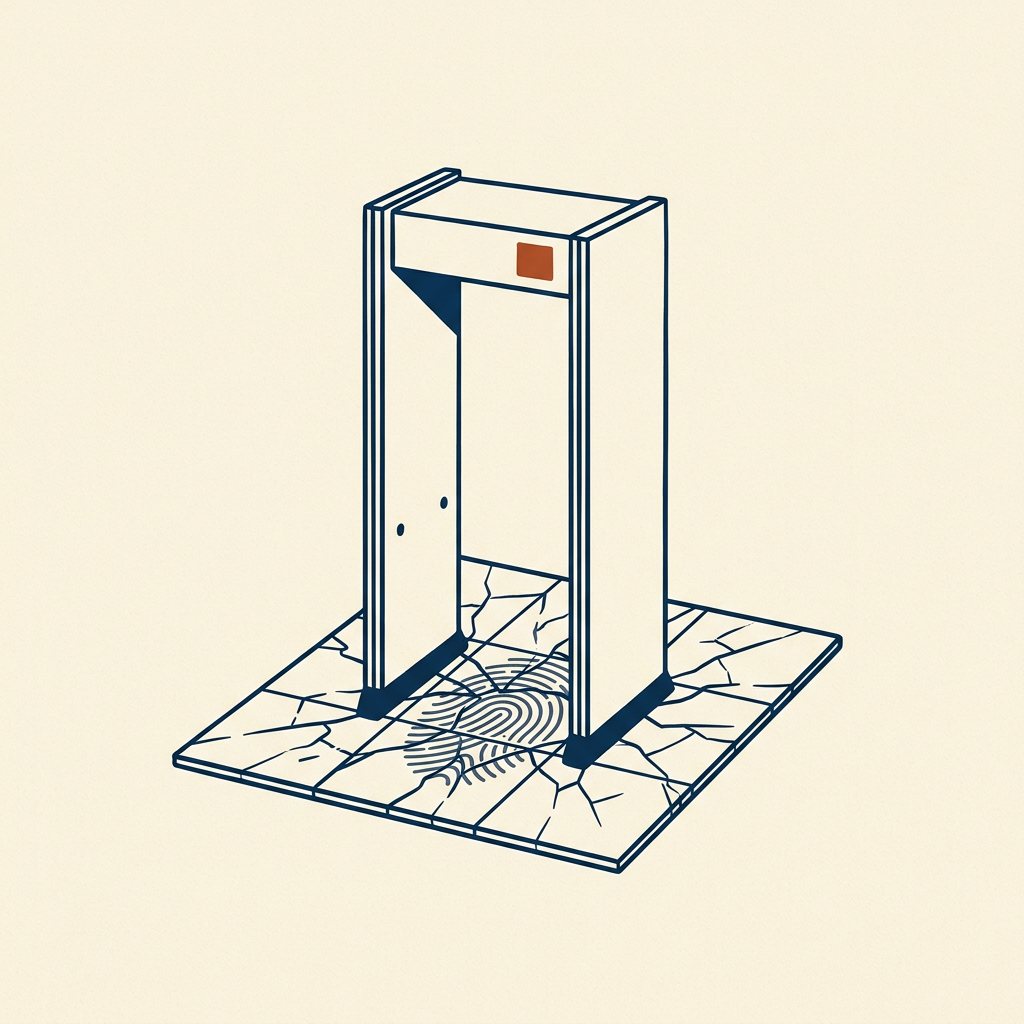
Barrett traces the classical model into institutions that treat it as solid ground. Courts in several countries have allowed testimony or instructions assuming a genuine victim or defendant should show a specific universal expression, such as visible distress, and have treated its absence as evidence of dishonesty despite wide real variability.
In mental health she argues categories like depression and anxiety, built as discrete disorders with expected biological markers, have struggled to find consistent biomarkers partly because they may reflect body-budget dysregulation and faulty prediction rather than a broken discrete circuit—helping explain varied symptom profiles and mixed single-target drug results.
She also flags commercial emotion-recognition systems trained to infer emotion from facial video for marketing or hiring. Those tools inherit the contested assumption that facial configurations map reliably onto emotion categories, risking cultural bias and unreliable inference at scale. Her theory alone does not refute every application, but it shows the classical view is already wired into policy and technology with consequences for real people.
In practice: The TSA’s SPOT program, trained on Ekman-style microexpression theory and costing hundreds of millions over more than a decade, was found by the Government Accountability Office to perform no better than chance at identifying threats from facial behavior.
Key terms
- Core affect The always-on sense of pleasant or unpleasant and calm or agitated arising from the body’s internal state
- Interoception The brain’s ongoing monitoring of heart rate, breathing, hormones, gut, and other internal signals
- Allostasis Anticipatory regulation of the body’s energy resources before deficits hit, not only correction afterward
- Body budget Barrett’s name for the brain’s running account of metabolic deposits and withdrawals that feelings often report
- Emotion concepts Learned categories, shaped by language and culture, used to construct specific emotions from affect and context
- Emotional granularity How finely someone can construct distinct feelings instead of broad labels like bad or stressed
- Affective realism When mood or expectation changes what people perceive in an ambiguous face or scene, not only later interpretation
- Construction of emotion Assembling a feeling in the moment by predicting meaning for sensations with learned concepts
What to do
- Label feelings with precise words such as disappointed, overwhelmed, resentful, or restless instead of stressed, fine, or bad
- Check whether you have eaten, slept, or moved before treating irritability or low mood as a reaction to whoever is nearby
- Ask people directly what they feel in tense moments rather than trusting a snap read of their face
- Question tools and policies that assume a face reliably reveals inner state if you manage people or design detection systems
- Narrate children’s internal states with varied specific words to supply concepts their brains can use later
Questions to think with
- When you last felt only bad or stressed, what more specific concept might have fit and suggested a different next step?
- How much of a recent mood do you now suspect was body-budget strain rather than the story you attached to it?
- Which emotion words are missing in your household or workplace, and what experiences might that make harder to construct?
- Where do you still treat a face as proof of what someone feels?
- If classical fingerprints are shaky, what should replace them in courts, classrooms, or hiring tools?
The other side
Researchers who accept more variability than classical theory claimed still reject full constructionism. Keltner and Cowen’s 2017 machine-learning study of over 6,000 spontaneous video clips found observers sorted expressions into roughly 27 blended categories with more cross-cultural structure than Barrett’s account easily allows. Izard, Ekman, and others argue many replication failures reflect flawed methods rather than a fatal flaw in basic emotions, and point to consistent recognition of smiles and laughter in enjoyment. Constructionism can be hard to falsify because inconsistent findings get absorbed as context effects; Barrett’s reliance on human language sits uneasily with fear-like and pain-like responses in animals raised by critics such as LeDoux; and the law, health, and technology chapters draw broad institutional lessons from lab findings not yet tested at that scale.
Who it's for
Psychology students taught the six basic emotions who want to know why that model is contested; therapists, teachers, and parents seeking a research basis for emotional vocabulary and self-regulation; and general readers curious whether faces really reveal what people feel.