




Psychedelics loosen the rigid self and may ease deep suffering
Pollan argues LSD and psilocybin dismantle the brain’s self-narrating system and, under careful guidance, show real promise against depression, addiction, and death anxiety.
IJR · Oct 21, 2026 · 12 min read
In 60 seconds
- Researchers revived LSD and psilocybin studies only after stripping the drugs of the 1960s politics that got them banned in 1970.
- A 2006 Johns Hopkins trial with 36 volunteers gave the field its first modern foothold when most rated guided psilocybin among life’s most meaningful experiences.
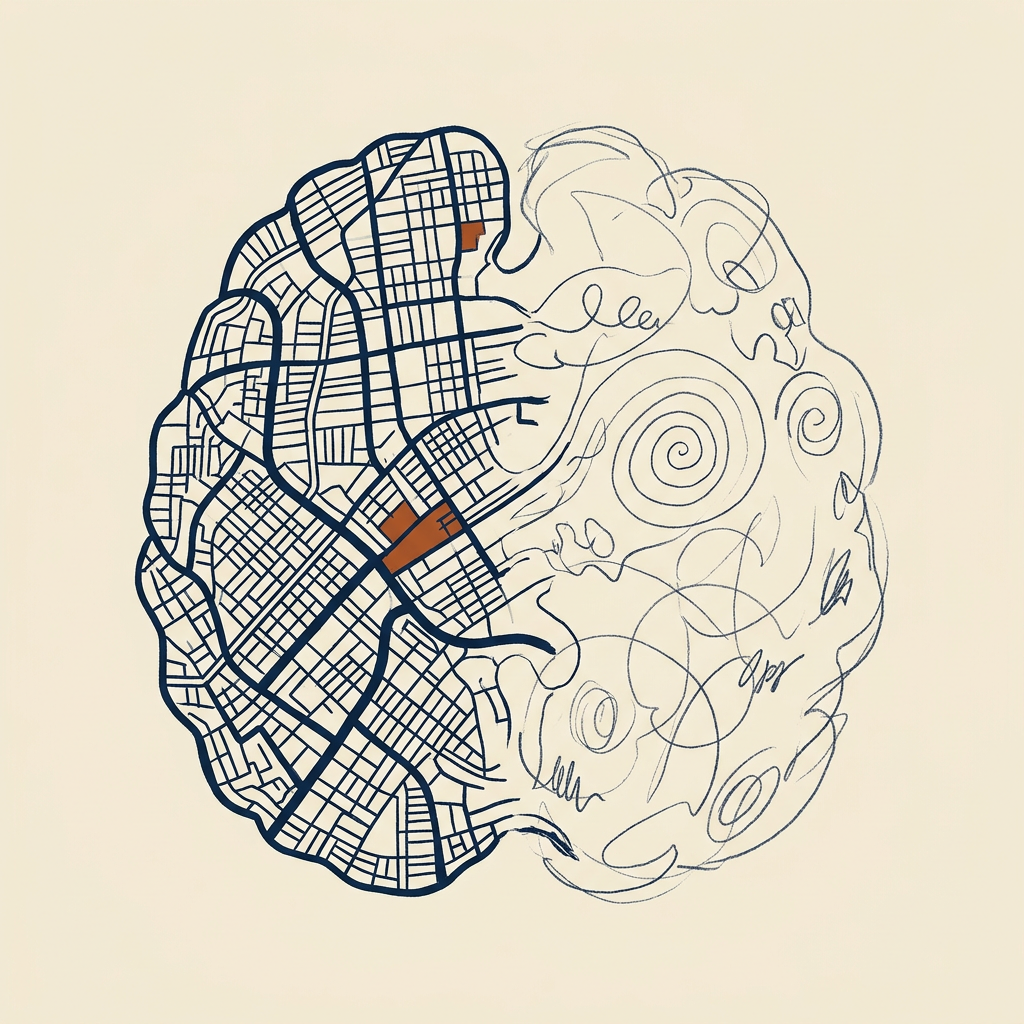
- Psychedelics suppress the default mode network, raising neural entropy and temporarily dissolving the defended, narrating self.
- In 2016 cancer trials, roughly 80 percent of patients showed lasting drops in depression and anxiety after one guided high-dose session.
- Small pilots found about 80 percent of long-term smokers still abstinent six months after psilocybin plus therapy, well above typical cessation rates.
- Pollan closes by framing the drugs as a brief return to childlike mental plasticity, pointing toward occasional guided sessions instead of daily medication.
The big idea
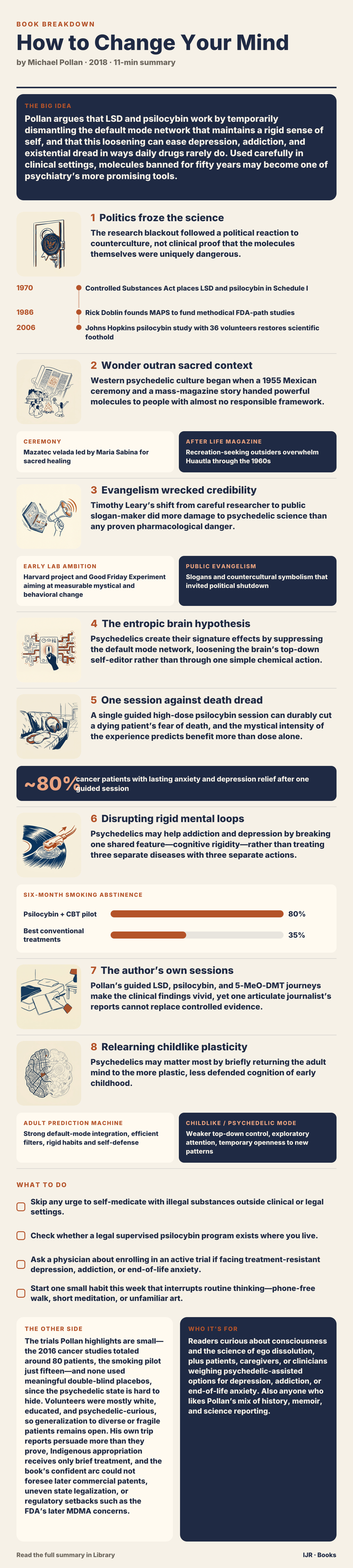
Pollan argues that LSD and psilocybin work by temporarily dismantling the default mode network that maintains a rigid sense of self, and that this loosening can ease depression, addiction, and existential dread in ways daily drugs rarely do. Used carefully in clinical settings, molecules banned for fifty years may become one of psychiatry’s more promising tools.
The book in brief
Pollan starts as a cautious middle-aged outsider who still links psychedelics with 1960s excess. He wants to know why serious labs at Johns Hopkins, NYU, and Imperial College quietly resumed work on LSD and psilocybin decades after the 1970 Controlled Substances Act froze the field.
He then rewinds the origin story: a banker’s 1955 Mexican mushroom ceremony, a mass-magazine reveal, Hofmann’s chemistry, and Timothy Leary’s slide from Harvard researcher to countercultural symbol. That political backlash, not clear clinical harm, is what shut the science down.
The middle of the book turns to the rebuilt lab work. Brain-imaging and the “entropic brain” idea supply a mechanism; parallel cancer trials and small addiction pilots supply early clinical results. Pollan treats the mystical quality of the experience itself as the therapeutic variable more than raw dose.
He inserts his own underground sessions with LSD, psilocybin, and 5-MeO-DMT to make the abstract findings felt, while admitting the limits of one journalist’s testimony. He ends by tying the neuroscience to a broader claim about adult rigidity versus childhood plasticity, and by urging a careful second look rather than a new round of overclaiming.
Context
Michael Pollan’s 2018 blend of history, memoir, and science journalism mattered because it moved psychedelics out of countercultural memory and into mainstream medical and scientific conversation. The book arrived as early trials were just giving the field a new public foothold.
The key ideas

1
Politics froze the science
The research blackout followed a political reaction to counterculture, not clinical proof that the molecules themselves were uniquely dangerous.
- 1970Controlled Substances Act places LSD and psilocybin in Schedule I
- 1986Rick Doblin founds MAPS to fund methodical FDA-path studies
- 2006Johns Hopkins psilocybin study with 36 volunteers restores scientific foothold
Pollan opens by noting his own cautious unfamiliarity with drugs he still associated with 1960s excess. He frames the puzzle as why serious scientists at Johns Hopkins, NYU, and Imperial College London had quietly restarted work on LSD and psilocybin after the 1970 Controlled Substances Act placed them in Schedule I.
That classification treated them as having no accepted medical use and high abuse potential, effectively freezing legitimate research for a generation. Rick Doblin’s MAPS, founded in 1986, began the slow rebuild one FDA step at a time.
Pollan treats the 2006 Johns Hopkins study led by Roland Griffiths as the real turning point. Thirty-six psychedelic-naive volunteers received psilocybin under controlled conditions; a majority ranked the experience among the most meaningful of their lives, on par with a child’s birth, and follow-ups showed the ratings held for months.
The same molecules that once triggered moral panic were re-entering psychiatry. Pollan argues the difference lay less in chemistry than in who administered them, under what conditions, and with what institutional backing.
In practice: The 2006 Griffiths study, run inside a rigorous academic setting rather than a commune, gave the field the foothold it had lacked since the 1960s.

2
Wonder outran sacred context
Western psychedelic culture began when a 1955 Mexican ceremony and a mass-magazine story handed powerful molecules to people with almost no responsible framework.
Ceremony
Mazatec velada led by Maria Sabina for sacred healing
After Life magazine
Recreation-seeking outsiders overwhelm Huautla through the 1960s
R. Gordon Wasson, a Wall Street executive and amateur ethnomycologist, joined a night-long velada in Huautla de Jiménez, Oaxaca, in 1955 under Mazatec curandera Maria Sabina. His 1957 Life magazine account introduced psilocybin mushrooms to a mass American audience.
Albert Hofmann, already known for the 1943 LSD self-experiment later called Bicycle Day, isolated and synthesized psilocybin from mushroom samples in 1958. Pollan presents the convergence as two unrelated discoveries—one accidental, one extractive—delivering potent tools without a culture of use.
Maria Sabina later said publicly that outsiders seeking recreation rather than ceremony degraded something sacred, and seekers overwhelmed Huautla through the 1960s. Pollan refuses to treat this as a minor footnote.
He reads it as the first turn of a pattern that recurs: awe at the substance’s effects repeatedly outruns any serious reckoning with the culture that first gave it meaning.
In practice: Maria Sabina’s later public regret and the tourist rush into Huautla show the extractive pattern Pollan tracks through the rest of the story.

3
Evangelism wrecked credibility
Timothy Leary’s shift from careful researcher to public slogan-maker did more damage to psychedelic science than any proven pharmacological danger.
Early lab ambition
Harvard project and Good Friday Experiment aiming at measurable mystical and behavioral change
Public evangelism
Slogans and countercultural symbolism that invited political shutdown
The Harvard Psilocybin Project run by Leary and Richard Alpert from 1960 to 1962 began with real scientific ambition. Walter Pahnke’s 1962 Good Friday Experiment at Marsh Chapel gave divinity students psilocybin; a 1991 follow-up by Rick Doblin found most still called the experiences meaningful decades later.
The Concord Prison Experiment claimed reduced recidivism but was later shown to be methodologically weak. Even so, it fed a sense that the drugs might reshape behavior at scale.
Leary’s ambitions left the lab. Dismissed from Harvard in 1963, he embraced slogans such as “turn on, tune in, drop out” and became the symbol the establishment could cite as proof the drugs threatened social order.
Pollan argues the backlash was political, not primarily a response to clinical evidence of harm. Nixon’s 1970 scheduling decision cut funding for nearly forty years, forcing later researchers like Griffiths and Doblin to rebuild credibility by deliberately avoiding Leary’s rhetoric.
In practice: The Good Friday Experiment’s lasting personal meaning survived; Leary’s public evangelism did not, and the field paid for decades.
4
The entropic brain hypothesis
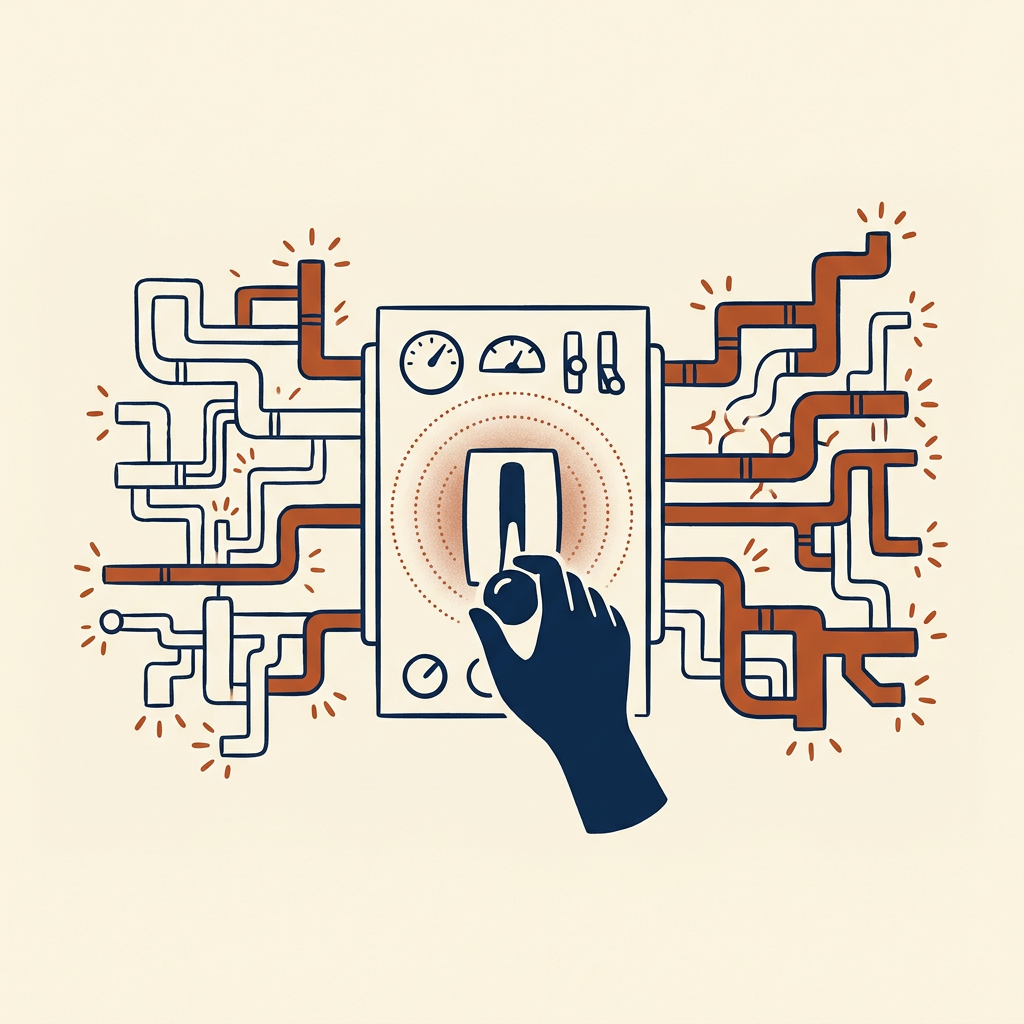
Psychedelics create their signature effects by suppressing the default mode network, loosening the brain’s top-down self-editor rather than through one simple chemical action.
Robin Carhart-Harris and colleagues at Imperial College London used fMRI in 2012 to show psilocybin decreases blood flow and activity in the default mode network. That network, including the medial prefrontal cortex and posterior cingulate cortex, runs hot during self-referential thought, rumination, and the sense of a continuous narrating self.
Pollan builds the “entropic brain” account around this finding. The ordinary brain acts as an efficient hierarchical prediction machine; the default mode network sits atop it as executive editor. Psychedelics disrupt that top-down control and raise neural entropy, letting normally separate networks talk in unusual combinations.
Subjectively this appears as synesthesia, a dissolving boundary between self and world, and the hyper-real quality common in trip reports. Researchers note parallels with EEG patterns in experienced meditators and with the exploratory cognition of young children, whose default mode networks are less developed.
Pollan uses the chapter to claim that the everyday psychological ego is not a fixed brain feature but an achievement of neural organization—one these drugs can temporarily undo.
In practice: The 2012 Imperial College fMRI work showed psilocybin quieting the very network that sustains the narrating self.
5
One session against death dread
A single guided high-dose psilocybin session can durably cut a dying patient’s fear of death, and the mystical intensity of the experience predicts benefit more than dose alone.
~80%
cancer patients with lasting anxiety and depression relief after one guided session
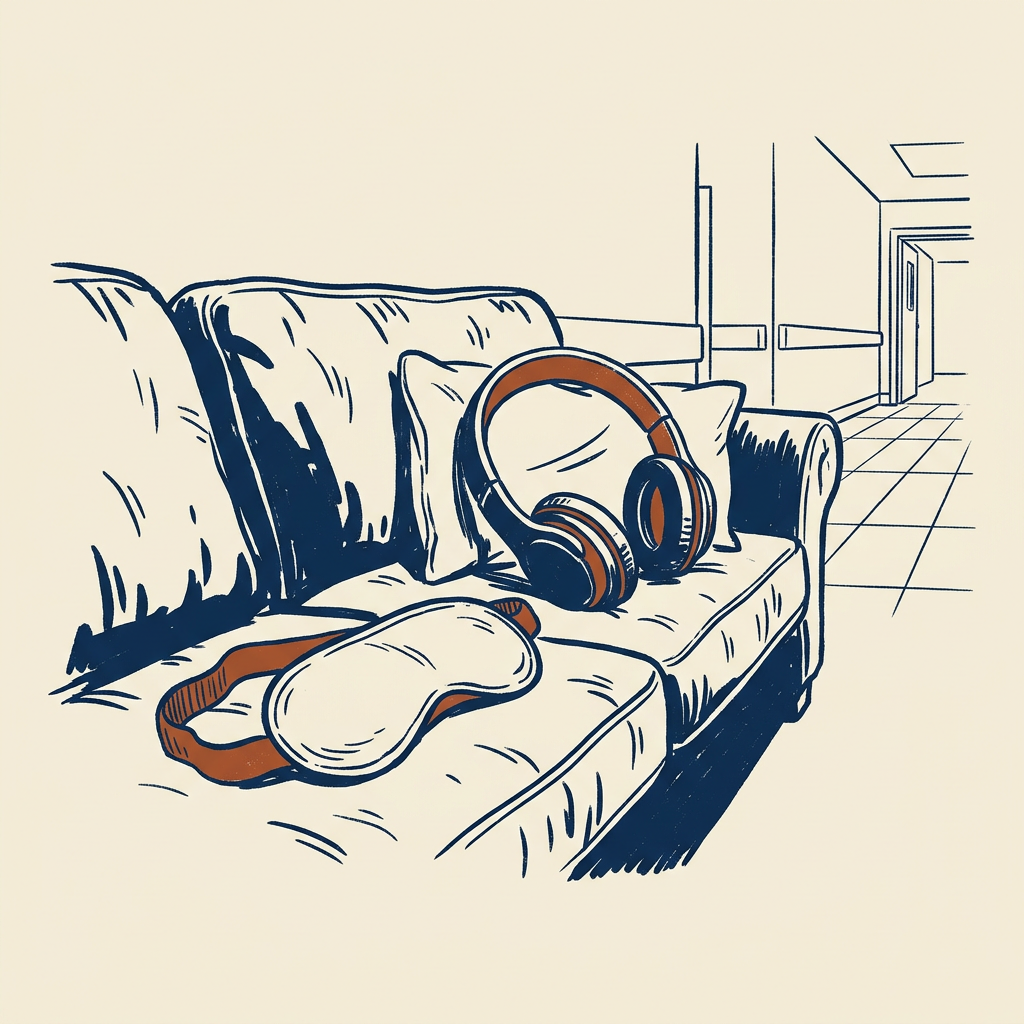
Parallel trials at NYU and Johns Hopkins, published together in 2016, gave one high dose of psilocybin to cancer patients with clinical depression and anxiety tied to their diagnoses. Patients wore eyeshades, heard curated music, and sat with two trained guides in a room furnished to feel nothing like a hospital.
Roughly 80 percent showed clinically significant reductions in depression and anxiety that held at six-month follow-up—an effect size unusual for any single-session psychiatric intervention. Patients often described the experience as more real than ordinary life and as an encounter outside personal identity that reframed mortality rather than distracting from it.
The strongest outcome predictor was not dose but intensity of the mystical-type experience, scored on a scale descended from Pahnke’s earlier work and asking about unity, sacredness, and transcendence of time and space.
Pollan reads the link back to the 1962 Good Friday markers as evidence that felt quality, not mere molecular exposure, is the therapeutic variable—and that preparation and setting may matter as much as the drug.
In practice: In the 2016 cancer trials, mystical-experience intensity, not milligrams alone, best predicted who still felt less anxiety six months later.
6
Disrupting rigid mental loops
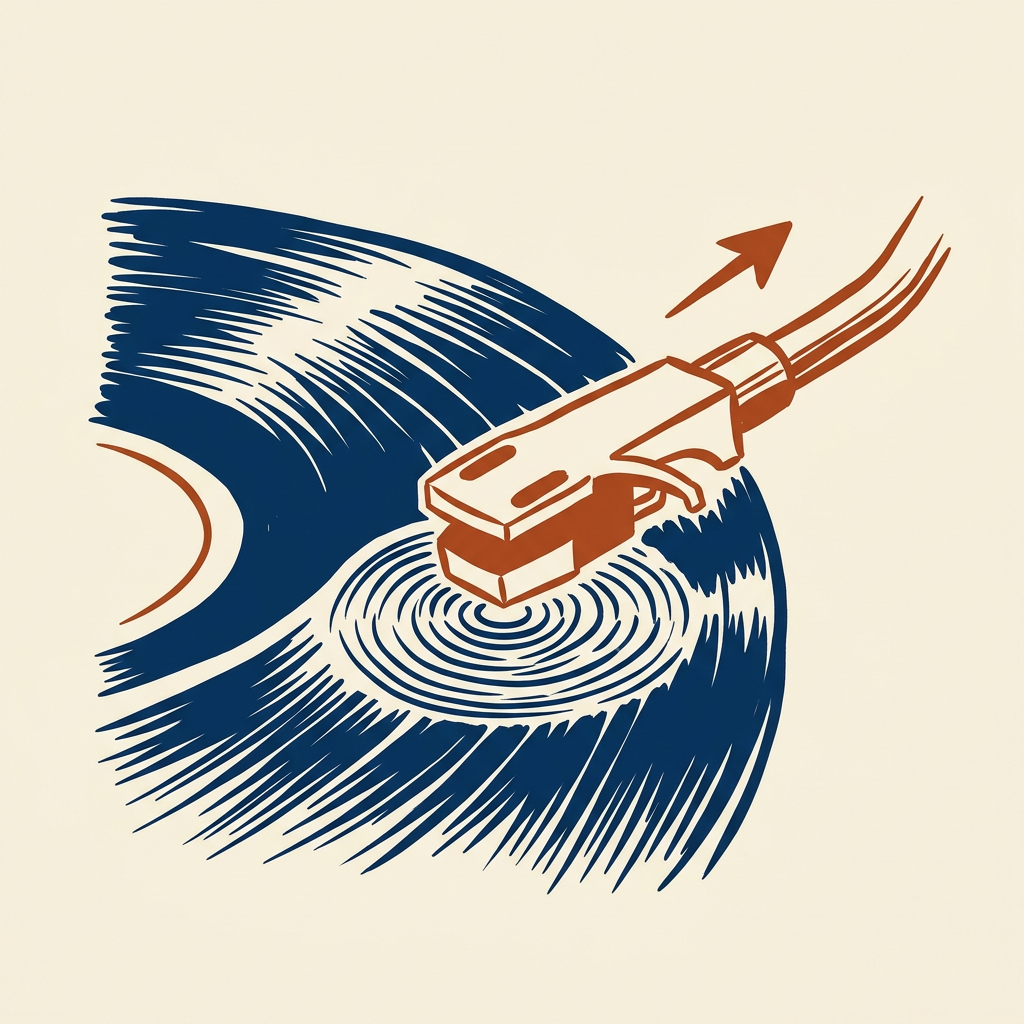
Psychedelics may help addiction and depression by breaking one shared feature—cognitive rigidity—rather than treating three separate diseases with three separate actions.
Six-month smoking abstinence
Matthew Johnson’s 2014 Johns Hopkins pilot gave fifteen long-term smokers three psilocybin sessions plus cognitive behavioral therapy. At six months, about 80 percent remained abstinent, far above the roughly 35 percent success rate of the best conventional treatments, including varenicline.
A related NYU-led trial by Michael Bogenschutz found similar drops in heavy drinking after psilocybin-assisted sessions. Pollan ties both results to the entropic-brain story: addiction and depression can look like minds stuck in overly rigid predictive loops—craving circuits or rumination circuits.
Temporary disorder may let the brain settle into less entrenched patterns once the drug wears off. That model departs from chronic daily SSRIs, which manage transmitter levels without necessarily rewriting cognitive architecture.
Pollan notes the trials were small, poorly placebo-controlled, and narrow in population, yet he finds the mechanism coherent enough to explain why one class of experience might touch nicotine addiction, alcoholism, and treatment-resistant depression at once.
In practice: Johnson’s fifteen smokers reached about 80 percent six-month abstinence versus roughly 35 percent for top ordinary cessation aids.

7
The author’s own sessions
Pollan’s guided LSD, psilocybin, and 5-MeO-DMT journeys make the clinical findings vivid, yet one articulate journalist’s reports cannot replace controlled evidence.
Pollan arranges underground sessions through guides given only pseudonyms, because most of the work remains illegal outside trials. He tries a low-dose LSD session partly to test microdosing claims, a psilocybin journey in which personality felt like a temporary construction, and 5-MeO-DMT from Sonoran Desert toad venom that produced near-total obliteration of self-boundary.
He is candid about fear beforehand, disorientation during, and a weeks-long afterglow that softened defensiveness and heightened connection to the natural world. He also flags real risks of unsupervised use: without a stable setting and experienced sitter, intense experiences can leave lasting distress.
The chapter puts a voice on the earlier neuroscience and statistics. It remains inherently anecdotal—one health-privileged, self-selected subject reporting retrospectively under no regulatory oversight.
Pollan acknowledges the limit without fully resolving it: testimony bridges science and felt life, but it does not carry the weight of the clinical trials.
In practice: His psilocybin session left personality feeling almost arbitrary; the toad-venom session erased self-boundary almost completely.
8
Relearning childlike plasticity
Psychedelics may matter most by briefly returning the adult mind to the more plastic, less defended cognition of early childhood.
Adult prediction machine
Strong default-mode integration, efficient filters, rigid habits and self-defense
Childlike / psychedelic mode
Weaker top-down control, exploratory attention, temporary openness to new patterns
Pollan closes by linking default-mode neuroscience to mental development. Infant and young-child brains show weaker default-mode integration, matching the loosely associative, less filtered quality of early attention before the network matures into the efficient but rigid adult system.
He proposes that psychedelics offer a controlled, temporary reversal of that maturation. Adults briefly experience a mode of attention closer to a child’s, less burdened by entrenched expectations about self and world.
That frame gathers the earlier results—dying patients losing death fear, smokers dropping a decades-long habit, depressed patients escaping rumination—as variations on one shift: loosen the mind’s most rigid organizer and new patterns can take hold when ordinary consciousness returns.
Pollan is explicit that this implies a different psychiatric model built on occasional, carefully supported experiences rather than daily maintenance drugs. A coherent mechanism is not proof of safe scale, he cautions, yet the consistency across conditions justifies a serious second look.
In practice: Fear of death, nicotine craving, and depressive rumination all appear in his closing argument as rigid loops that ease when the adult predictive hierarchy briefly loosens.
Key terms
- Default mode network Brain regions that stay busy during self-focused thought and the sense of a continuous narrating self; psychedelics quiet them.
- Entropic brain The idea that psychedelics raise neural disorder, letting separate networks communicate in unusual combinations.
- Schedule I The 1970 U.S. drug category for substances judged to have no accepted medical use and high abuse potential, which froze research.
- Mystical-type experience Feelings of unity, sacredness, and transcendence of time and space; intensity of this state best predicted clinical benefit.
- Ego dissolution The temporary undoing of the defended, bounded self that filters ordinary experience.
- Velada The all-night Mazatec mushroom ceremony Wasson attended with Maria Sabina in 1955.
- Bicycle Day The 1943 self-experiment in which Hofmann first felt LSD’s effects.
- Set and setting The psychological preparation and physical surroundings that Pollan and the trials treat as decisive for safety and outcome.
What to do
- Skip any urge to self-medicate with illegal substances outside clinical or legal settings.
- Check whether a legal supervised psilocybin program exists where you live.
- Ask a physician about enrolling in an active trial if facing treatment-resistant depression, addiction, or end-of-life anxiety.
- Start one small habit this week that interrupts routine thinking—phone-free walk, short meditation, or unfamiliar art.
Questions to think with
- If the self is partly a neural achievement, what parts of your own identity feel most like fixed fact and which feel more like habit?
- How much should mystical feeling count as a medical outcome versus a side effect to be managed?
- What safeguards would you demand before offering these sessions to more clinically fragile patients?
- Does a psychiatry built on occasional guided experiences sound freer or riskier than daily medication?
- Where is the line between learning from Indigenous ceremony and repeating the extractive pattern Pollan describes?
The other side
The trials Pollan highlights are small—the 2016 cancer studies totaled around 80 patients, the smoking pilot just fifteen—and none used meaningful double-blind placebos, since the psychedelic state is hard to hide. Volunteers were mostly white, educated, and psychedelic-curious, so generalization to diverse or fragile patients remains open. His own trip reports persuade more than they prove, Indigenous appropriation receives only brief treatment, and the book’s confident arc could not foresee later commercial patents, uneven state legalization, or regulatory setbacks such as the FDA’s later MDMA concerns.
Who it's for
Readers curious about consciousness and the science of ego dissolution, plus patients, caregivers, or clinicians weighing psychedelic-assisted options for depression, addiction, or end-of-life anxiety. Also anyone who likes Pollan’s mix of history, memoir, and science reporting.