




Your conscious mind is just a late passenger
Eagleman argues most perception, choice, and behavior run on autopilot below awareness, so free will, blame, and identity need a biological rewrite.
IJR · Oct 29, 2026 · 11 min read
In 60 seconds
- Conscious awareness is a tiny, slow fraction of brain activity—more headline than CEO.
- What feels like direct seeing is a delayed, edited reconstruction the brain builds after the fact.
- Behavior emerges from rival neural factions negotiating, not from one unified self deciding.
- Tumors, drugs, and genes can seize control of conduct without the person’s knowledge or consent.
- Justice should track how modifiable future behavior is, not metaphysical desert.
- The same plastic wiring that runs automatic routines can be retrained, and your own self-story is often confabulation.
The big idea
Eagleman argues conscious awareness is a small, late-arriving passenger on a brain that runs almost entirely on autopilot, with competing subsystems voting on outcomes before the conscious mind ever gets the memo. Law and ordinary self-understanding both need updating to match what brains actually do.
The book in brief
Eagleman starts by dismantling the everyday picture of a conscious “you” steering the ship. Reaction-time limits and the eyes’ raw bandwidth show that filtering and motor responses finish before awareness arrives; consciousness mostly summarizes work already done and is useful mainly for novelty and long-range planning. Trying to micromanage automatic skills often makes them worse.
He next shows that even basic perception is manufactured. Color and brightness illusions, blind-spot filling, and the need to synchronize senses that travel at different speeds mean the brain delays and edits a coherent scene after the fact. Later stimuli can rewrite how earlier ones are remembered, so two sincere witnesses can construct different stories from the same event.
The book’s spine is the “team of rivals” model: the brain is a confederation of subsystems that lobby and vote, not a single ruler. Split-brain cases and the tug-of-war between impulsive limbic circuits and patient prefrontal ones make the conflict literal. What feels like one choice is simply the winning coalition; the losers remain and can prevail under fatigue or stress.
Medical outliers then push the model into ethics. A tumor pressing on aggression circuitry, sudden pedophilic urges that vanish when a tumor is removed, and gambling addictions triggered by Parkinson’s medication all show behavior riding on biological substrate that can change without consent. Eagleman does not abolish accountability; he argues the pure, will-based notion of blame is a folk psychology the brain sciences keep eroding.
The practical proposal is forward-looking justice: ask how modifiable someone’s future behavior is. Fixed dangerous profiles may need incapacitation for safety; highly plastic cases—addicts, juveniles whose prefrontal cortex is still maturing—belong in treatment tracks already visible in drug courts. Causation alone cannot excuse, because nearly all behavior is caused.
Finally Eagleman turns to plasticity and self-knowledge. Sensory-substitution devices prove cortex will treat novel data streams as usable input; effortful practice hands tasks off to automatic circuits. Yet the conscious self is largely a press secretary that confabulates coherent reasons after the fact. The honest stance is humility toward other people’s unseen conflicts, toward retributive assumptions, and toward your own confident account of why you acted.
Context
David Eagleman’s 2011 book translated cutting-edge neuroscience for a general audience and pushed questions of free will, blame, and identity into mainstream conversation. It argued that both law and ordinary self-understanding need updating to match what brains actually do.
The key ideas
1
The unconscious majority
Conscious awareness is a tiny, slow-reporting fraction of total brain activity, not the executive in charge.
Folk picture
Conscious CEO steers every choice in real time
Eagleman’s picture
Consciousness is a late headline summarizing an unseen staff’s work
Eagleman opens by rejecting the intuitive captain-of-the-ship picture. The eyes alone deliver far more data than attention can handle, so the brain filters and decides what matters long before awareness sees the result. Motor acts finish faster than deliberation could ever manage.
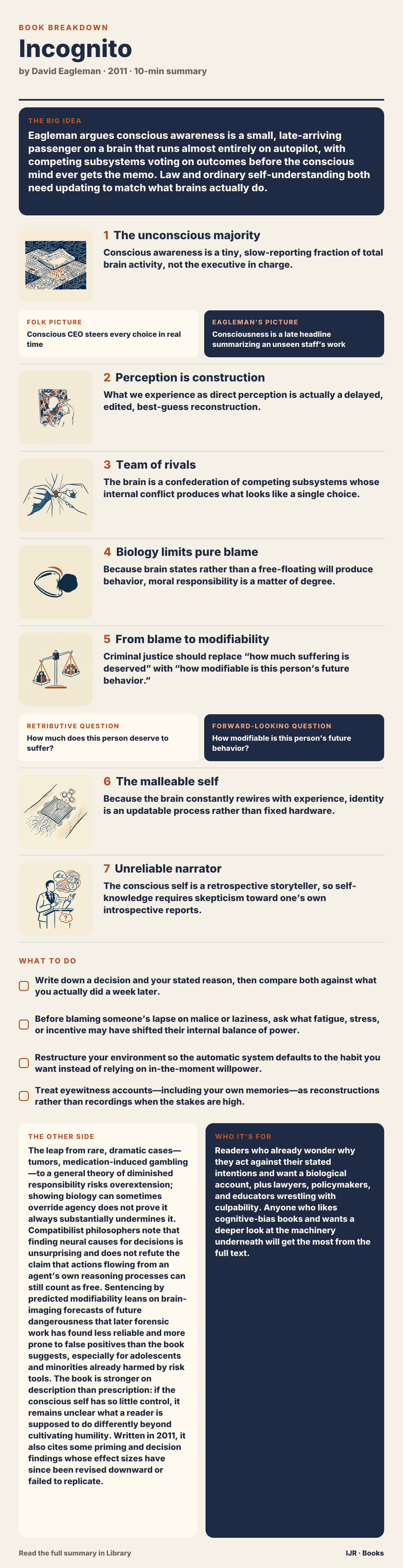
He reframes consciousness as roughly a newspaper headline: it summarizes decisions already reached by an enormous unseen staff. It is not useless; it handles novel problems and long-range plans that benefit from slow processing. For walking, talking, face recognition and the rest of moment-to-moment life, subroutines run without ever surfacing.
The practical sting is that trying to seize conscious control of an automatic skill often degrades it. Expert athletes choke when they overthink a movement that should stay unconscious. Once most of cognition is invisible to the self that experiences it, the folk notion of a unified “I” choosing in real time becomes largely fiction, and questions of responsibility later in the book inherit that reframing.
In practice: Catching a ball or swerving a car happens faster than conscious deliberation could manage.

2
Perception is construction
What we experience as direct perception is actually a delayed, edited, best-guess reconstruction.
Building on the claim that consciousness only sees finished products, Eagleman shows basic sensory experience itself is manufactured. Identical pixels look different colors or brightnesses depending on context; the blind spot is filled with fabricated detail that has no external source at all.
Timing exposes the editing. Different senses travel at different speeds, so the brain delays conscious perception by a fraction of a second to glue sound and sight into one coherent moment. A stimulus arriving after an event can alter how the earlier event is remembered—postdiction that rewrites the past to keep the story plausible.
The courtroom consequence is immediate. If perception is a model built from expectation plus incomplete delayed data, two witnesses can sincerely disagree without either lying; their brains simply constructed different plausible versions. The unconscious is not only deciding most of the time; it is also seeing most of the time and never confesses how much editing occurred.
In practice: The brain fabricates visual information across the blind spot with no external input whatsoever.
3
Team of rivals
The brain is a confederation of competing subsystems whose internal conflict produces what looks like a single choice.
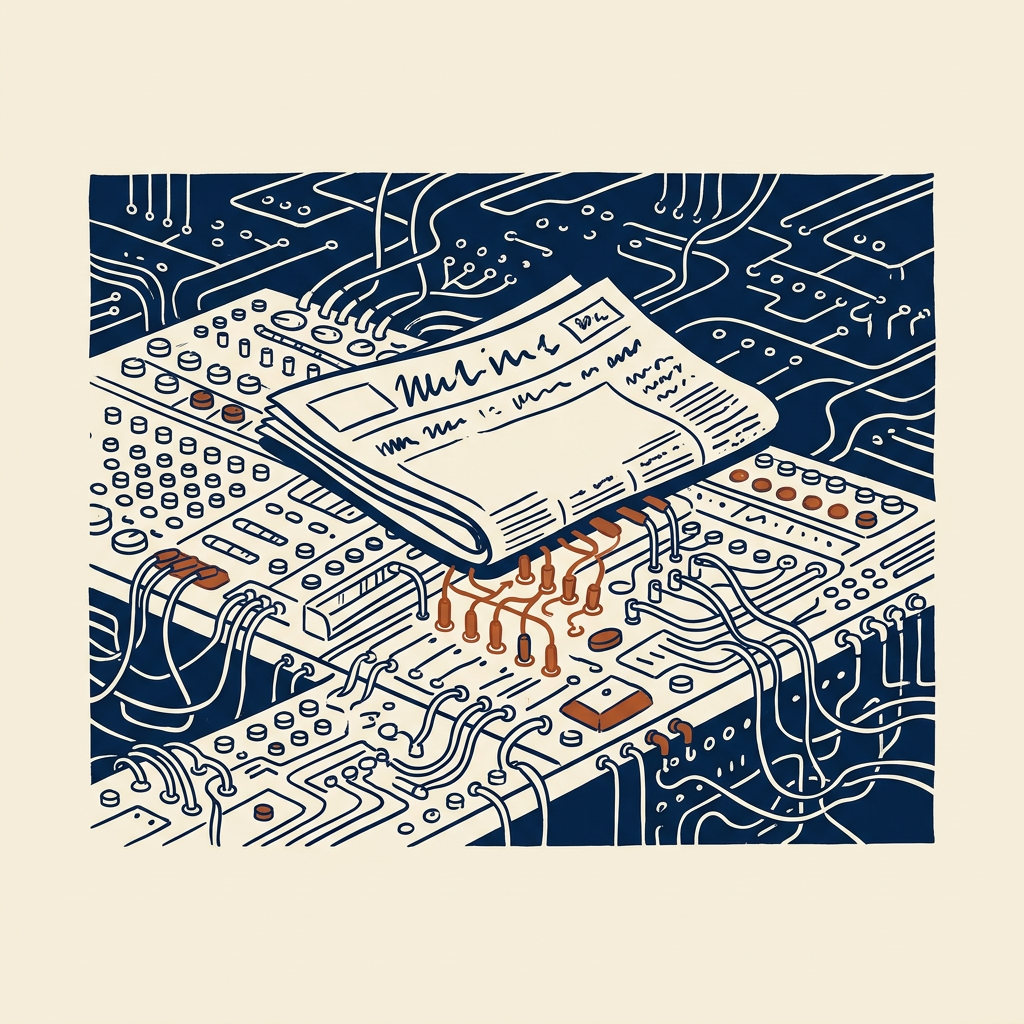
Eagleman supplies the model that organizes the rest of the book: the brain works like a political system with factions lobbying for control, not a monarchy. Severing the corpus callosum can leave two hemispheres with independent, even contradictory intentions—one hand buttoning a shirt while the other unbuttons it.
The same architecture appears in ordinary self-control. Impulsive, present-focused circuits battle patient, future-focused ones; behavioral-economics choices between smaller-sooner and larger-later rewards light up different coalitions, limbic regions winning when people grab the immediate payoff. Fatigue or stress simply shifts the balance of power.
Willpower feels effortful because it is an internal contest. People act “out of character” when a different coalition temporarily holds the floor. The losing faction does not vanish; it waits for conditions that let it win the next vote. What we experience as unified behavior is only the settled outcome of that negotiation.
In practice: In split-brain patients one hand may button a shirt while the other unbuttons it.
4
Biology limits pure blame
Because brain states rather than a free-floating will produce behavior, moral responsibility is a matter of degree.
Eagleman moves the team-of-rivals model into ethics with medical cases that strip away the illusion of a will floating free of tissue. A tumor can press on circuitry tied to fear and aggression and rewrite a person’s conduct; the person may even sense something is wrong yet remain unable to stop it.
Sudden pedophilic urges have appeared with brain tumors, vanished after removal, and returned when the tumor regrew. Parkinson’s patients have developed crushing gambling addictions on dopamine-agonist medication that disappeared the moment the drug stopped. These are not curiosities to quarantine from “normal” behavior; they demonstrate that all conduct, criminal or virtuous, rides on biological substrate that tumors, genes, hormones, sleep loss or chemicals can alter without awareness or consent.
The legal question “did he do it” remains answerable. The further question “was he blameworthy in some pure, will-based sense” rests on folk psychology that neuroscience steadily erodes. Eagleman does not plead for universal excuse; he asks what combination of biology and circumstance produced the act and what response actually reduces future risk.
In practice: Charles Whitman’s autopsy found a tumor pressing on his amygdala; Parkinson’s patients’ gambling compulsions vanished when their dopamine agonists were stopped.
5
From blame to modifiability
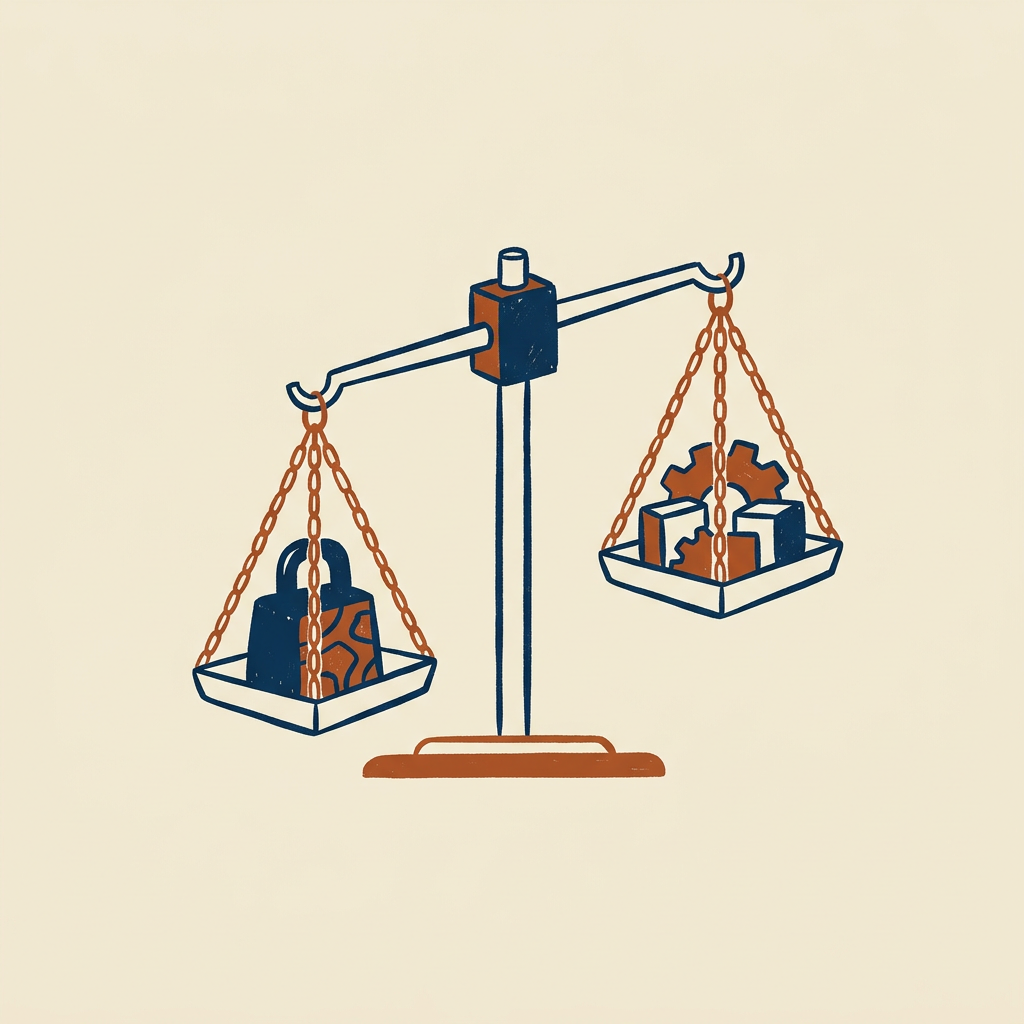
Criminal justice should replace “how much suffering is deserved” with “how modifiable is this person’s future behavior.”
Retributive question
How much does this person deserve to suffer?
Forward-looking question
How modifiable is this person’s future behavior?
Once classical blame is undercut, Eagleman offers a forward-looking substitute. Some offenders show relatively fixed neural patterns—certain psychopathic profiles with measurable differences in amygdala and prefrontal responses to fear and empathy. Others, such as addicts or juveniles whose prefrontal cortex is still maturing, remain highly responsive to intervention.
Sentencing and treatment, he argues, should track that distinction. Retrainable or maturing machinery warrants a different societal response than a profile that predicts unmodifiable reoffending, where incapacitation for public safety takes priority over moral reeducation. “My brain made me do it” cannot become a blanket excuse, because nearly all behavior—including law-abiding behavior—is caused by brain states; causation alone therefore cannot decide exemption.
Graduated frameworks already appear in drug courts and juvenile reforms that couple or replace incarceration with treatment tracks. The proposal is the book’s most policy-heavy and contested move: it asks systems built on retributive assumptions to calibrate consequences to neuroscience-informed forecasts of future conduct, while leaving hard questions of predictive accuracy and civil liberties acknowledged but unresolved.
In practice: Juvenile impulsivity tracked to still-developing prefrontal cortex is treated as more modifiable than certain psychopathic fear-and-empathy response patterns.
6
The malleable self
Because the brain constantly rewires with experience, identity is an updatable process rather than fixed hardware.
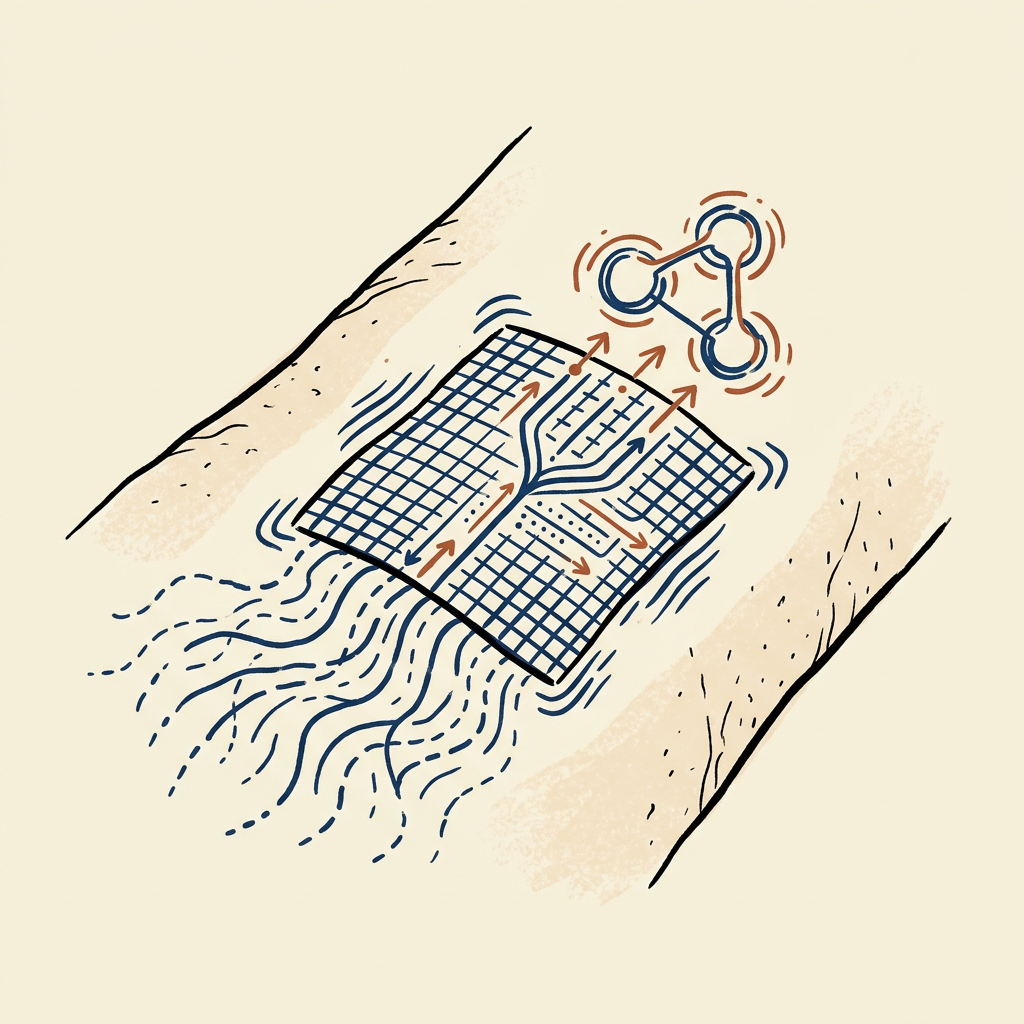
Eagleman balances the deterministic picture with the brain’s flexibility. The same organ that generates automatic unconscious behavior can reorganize substantially. A grid of vibrating tactile stimulators on the skin can feed auditory or balance information; cortex simply uses whatever structured data arrives, regardless of the original sense organ—an adaptability he calls plug-and-play.
Skill learning runs the same logic in reverse. Effortful conscious practice—learning a manual transmission—gradually hands the task to automatic circuitry until the once-deliberate sequence runs without awareness. Consciousness is not only the late recipient of finished output; it can also train and then release routines into the unconscious.
If behavior is the outcome of internal negotiation among trainable coalitions, then deliberate practice and environmental redesign shift the balance of power. Previously effortful self-control can become the new default. Determinism becomes a starting condition that training can alter, not a life sentence.
In practice: Vibrating skin grids convey sound or balance data so effectively that users gain a usable new sensory channel.
7
Unreliable narrator
The conscious self is a retrospective storyteller, so self-knowledge requires skepticism toward one’s own introspective reports.
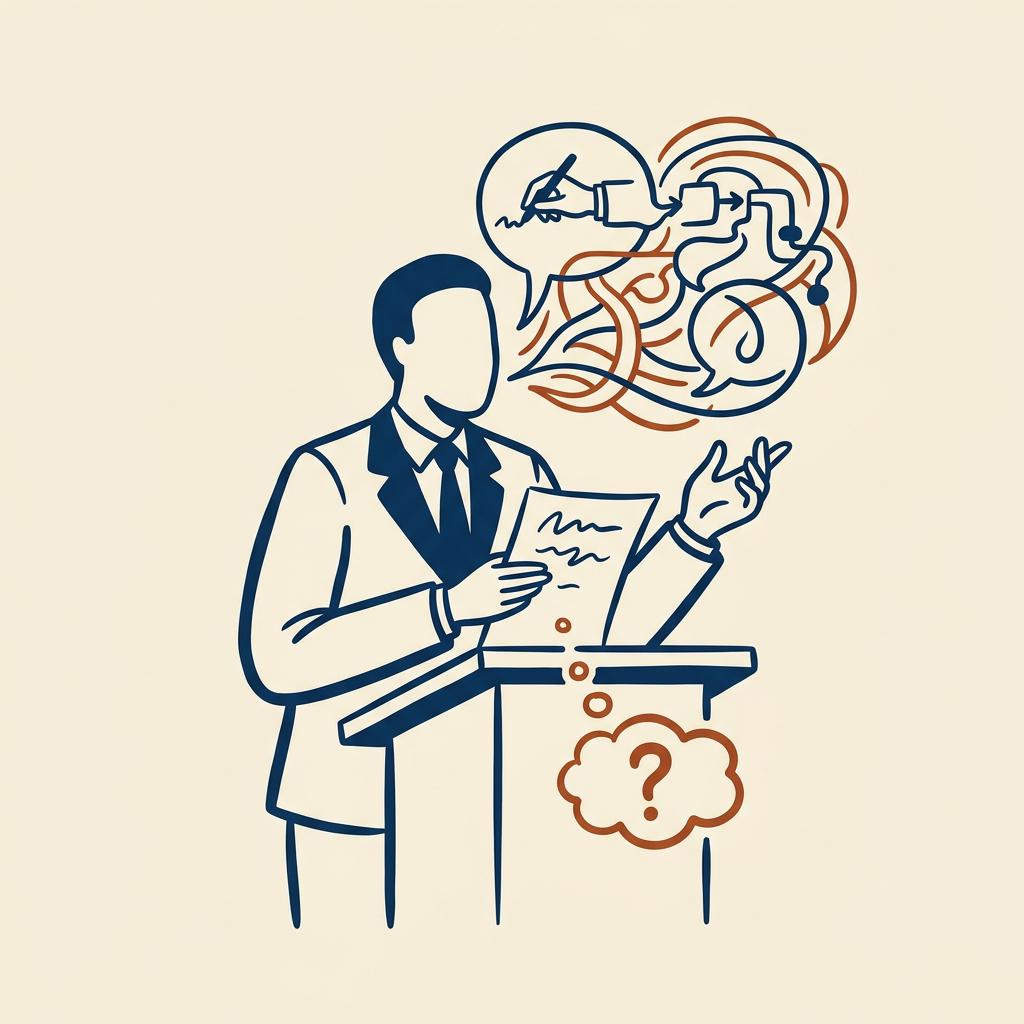
Eagleman closes by turning the lens on introspection itself. When actions are triggered by unconscious processes or direct brain stimulation, people confidently invent plausible but false reasons and experience them as voluntary choices. The narrating mind functions partly as a press secretary generating coherent copy after the fact.
Everyday life shows the same pattern. People misjudge their own motives, underestimate unconscious bias in hiring or dating, and over-credit conscious deliberation for choices that unconscious weighting had largely settled. The conscious account feels like privileged access; it is often just one more constructed narrative.
The practical stance is epistemic humility. High-stakes claims—“I saw it,” “I chose this because I truly believe X”—should be held loosely and checked against behavior and external evidence, including brain-based evidence that may contradict the confident self-report. Understanding yourself well means treating your own story as a hypothesis, not ground truth.
In practice: Subjects whose hands move because of brain stimulation later explain the movement as a fully voluntary decision they simply chose to make.
Key terms
- Unconscious majority The vast share of brain activity that filters, decides, and acts before awareness ever arrives
- Team of rivals Competing neural subsystems that negotiate and vote, producing what feels like one unified choice
- Postdiction Later information rewriting how an earlier event is consciously remembered so the story stays coherent
- Confabulation The conscious mind inventing a plausible but false explanation for an action driven by unseen processes
- Modifiability How responsive a person’s future behavior is to training, treatment, maturation, or environment
- Plug-and-play The cortex’s readiness to extract patterns from whatever structured data stream it receives
- Sensory substitution Routing information through an unusual channel (such as skin vibration) so the brain learns to treat it as a usable sense
What to do
- Write down a decision and your stated reason, then compare both against what you actually did a week later.
- Before blaming someone’s lapse on malice or laziness, ask what fatigue, stress, or incentive may have shifted their internal balance of power.
- Restructure your environment so the automatic system defaults to the habit you want instead of relying on in-the-moment willpower.
- Treat eyewitness accounts—including your own memories—as reconstructions rather than recordings when the stakes are high.
Questions to think with
- If most of your decisions are settled before you feel yourself choosing, what exactly is the “you” that claims credit or blame?
- When would a forward-looking, modifiability-based sentence feel fairer than a retributive one—and when would it feel dangerous?
- How would courtroom rules change if every witness statement were treated as a constructed model rather than a recording?
- Which of your own confident self-explanations would look different if you checked them only against later behavior?
- Where should society draw the line between treating a brain-based compulsion and simply incapacitating the person who has it?
The other side
The leap from rare, dramatic cases—tumors, medication-induced gambling—to a general theory of diminished responsibility risks overextension; showing biology can sometimes override agency does not prove it always substantially undermines it. Compatibilist philosophers note that finding neural causes for decisions is unsurprising and does not refute the claim that actions flowing from an agent’s own reasoning processes can still count as free. Sentencing by predicted modifiability leans on brain-imaging forecasts of future dangerousness that later forensic work has found less reliable and more prone to false positives than the book suggests, especially for adolescents and minorities already harmed by risk tools. The book is stronger on description than prescription: if the conscious self has so little control, it remains unclear what a reader is supposed to do differently beyond cultivating humility. Written in 2011, it also cites some priming and decision findings whose effect sizes have since been revised downward or failed to replicate.
Who it's for
Readers who already wonder why they act against their stated intentions and want a biological account, plus lawyers, policymakers, and educators wrestling with culpability. Anyone who likes cognitive-bias books and wants a deeper look at the machinery underneath will get the most from the full text.