




Why smart people still get fooled by everyday numbers
Readers who want to stop misreading risk headlines, lotteries, and disease scares get a plain habit for catching bad stats without a math degree.
IJR · Nov 5, 2026 · 14 min read
In 60 seconds
- Educated adults joke about being bad at math in ways they never would about reading, and that permission lets nonsense slide in news, courts, and budgets.
- Raw totals of a million versus a billion both just feel like 'a lot,' so politicians and journalists can dress tiny per-person costs as crises.
- Independent chance events have no memory: streaks do not make the opposite 'due,' and most lottery systems are a slow transfer of wealth to the house.
- With enough people and trials, wild coincidences become nearly certain somewhere, so most amazing stories need no special cause.
- Even a highly accurate test for a rare condition mostly flags healthy people, because base rates swamp the stated accuracy.
- Vivid rare threats crowd out larger common risks in the news, so fear calibrated by story leads people to choose the more dangerous option.
The big idea
Paulos argues that discomfort with quantity, scale, and chance is a culturally excused gap with real costs in money, health, politics, and vulnerability to con artists. The remedy is not advanced formulas but a reflex for converting big numbers into human terms, checking base rates, and treating everyday statistics with the same skepticism we give words.
The book in brief
The book opens on a double standard: people who would never admit they cannot read freely confess they cannot handle numbers, and that casual permission lets basic quantitative errors pass unchallenged in newsrooms, courtrooms, and legislatures. Isolated slips are treated as symptoms of a deeper discomfort with scale and chance that makes citizens easier targets for advertisers, politicians, and pseudoscience.
From there the argument moves into concrete failures of scale. Large public figures are reported without translation into per-person or per-day terms a mind can actually hold, so unremarkable amounts sound scandalous and genuine problems stay buried. The same numbness then appears in chance: people treat independent events as if they owe a correction after a streak, and they buy systems that cannot beat true randomness.
Next come the surprising regularities of large populations. Rare-sounding coincidences and psychic hits look inevitable once you multiply across enough trials and notice that only the hits get remembered. That logic is turned on horoscopes, biorhythms, and unfalsifiable prophecy, which thrive on vague statements and selective memory rather than systematic records.
The middle chapters apply the same base-rate thinking to medicine and law. A positive test or a rare matching trait feels like near-proof until you picture the full population of healthy or innocent people who can also trigger the signal. The identical habit of ignoring background frequency then explains why dramatic accidents dominate fear while common killers stay background noise, warping both personal choices and public spending.
The close turns from diagnosis to cause. Schools reward procedural fluency over the habit of asking whether an answer is plausible, and social life never shames the gap the way it would shame illiteracy. Paulos’s proposed fix is behavioral and lifelong: estimate, compare, demand base rates in ordinary talk, so number sense becomes a reflex rather than a forgotten course.
Context
Published in 1988, the book coined a name for a problem that had gone largely unnamed and tried to make quantitative reasoning feel as socially necessary as literacy. Paulos relied on short, everyday cases rather than formal drills so that readers would leave with a sniff test for bad numbers instead of formulas they would forget.
The key ideas

1
Math shame is socially optional
Society treats confessing math weakness as a charming quirk while treating illiteracy as a scandal, and that double standard lets bad numbers pass in public life.
Illiteracy
Admitting you cannot read is treated as a serious social failure
Innumeracy
Admitting you cannot handle numbers is treated as an acceptable joke
Dinner-party confessions of lifelong math failure meet laughs rather than concern. The same room would never treat an admission of not reading as light entertainment. That asymmetry is not merely personal style; it is a cultural green light for quantitative nonsense to go unchallenged.
Newsrooms, courtrooms, and legislatures inherit the same comfort with sloppiness. A weathercaster can add the chance of rain on Saturday to the chance on Sunday and announce a weekend total that exceeds one hundred percent; a paper can blur a percentage increase with a percentage-point change; an official can treat a million in waste as interchangeable with a billion. None of these slips needs advanced theory to catch—only the habit of asking whether the figure fits its setting.
Isolated errors are not the disease. The disease is a general unease with quantity, scale, and chance that makes people accept impressive-sounding garbage. An innumerate citizen is not only personally handicapped; they become cheaper to manipulate by anyone who trades in empty statistics.
The offered cure is a reflex, not a syllabus: build intuition on absurd real cases so readers learn to smell a bad number the way a literate person smells a broken sentence.
In practice: A television weathercaster states separate chances of rain for Saturday and Sunday, then adds them incorrectly to announce the chance of rain over the whole weekend.
2
Large numbers need human scale
Without deliberate conversion into per-person or per-day terms, a million and a billion both just register as huge and become tools for awe or alarm.
Most minds lose traction past a few thousand. Totals that differ by orders of magnitude therefore feel interchangeable, which is exactly the opening institutions need. A program overrun that sounds catastrophic in a speech can be statistically invisible beside a national budget once you do the division.
Journalists and politicians often skip that division on purpose. Eye-catching raw totals appear without the relevant population or time window, so a trivial per-person cost arrives dressed as crisis and a genuine threat arrives buried. The same numbness appears with grains of sand, space distances, and deficits: the figure stays abstract until someone forces a translation a person can hold.
The point is not that big numbers are unknowable. They are foreign currency. Convert them and they mean something; skip the conversion and you are easy to awe with unremarkable sums or to lull past the sums that actually deserve alarm.
This is the first precise place the general discomfort with quantity does public damage: the gap between raw totals and human-scaled comparisons.
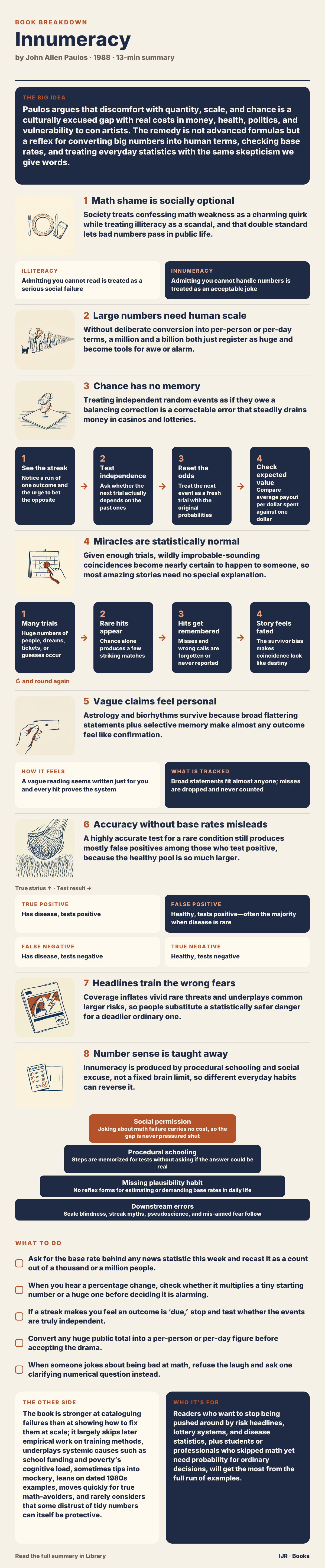
In practice: A million-dollar overrun is set beside a trillion-dollar budget and shown to be roughly the weight of a housecat next to a herd of elephants.

3
Chance has no memory
Treating independent random events as if they owe a balancing correction is a correctable error that steadily drains money in casinos and lotteries.
- 1See the streakNotice a run of one outcome and the urge to bet the opposite
- 2Test independenceAsk whether the next trial actually depends on the past ones
- 3Reset the oddsTreat the next event as a fresh trial with the original probabilities
- 4Check expected valueCompare average payout per dollar spent against one dollar
After a long run of one outcome, people feel the opposite is due. A roulette wheel that has hit red many times in a row still has the same odds on the next spin; the wheel keeps no ledger. Each trial is fresh, which the simple multiplication rule for independent events makes plain.
The same illusion shapes lottery play. Sequences that look patterned feel less random than scattered picks, even though every specific combination has identical odds. Systems that track past rolls or counts in games without real memory cannot beat chance; they only sell the feeling of control.
Expected value makes the long-run picture unavoidable. A typical lottery ticket returns far less than a dollar on average for every dollar spent, so repeated play is a slow, certain transfer of wealth from player to house or state, costumed as a shot at fortune.
Here innumeracy stops being an abstract embarrassment and becomes a direct personal tax.
In practice: Players avoid the ticket 1-2-3-4-5-6 because it feels non-random, though its odds match any other six-number set.
4
Miracles are statistically normal
Given enough trials, wildly improbable-sounding coincidences become nearly certain to happen to someone, so most amazing stories need no special explanation.
- 1Many trialsHuge numbers of people, dreams, tickets, or guesses occur
- 2Rare hits appearChance alone produces a few striking matches
- 3Hits get rememberedMisses and wrong calls are forgotten or never reported
- 4Story feels fatedThe survivor bias makes coincidence look like destiny
↻ and round again
Intuition compares one person’s birthday against everyone else’s and therefore undercounts. The real calculation multiplies across all pairs, and the chance of a shared birthday rises far faster than gut feeling allows. The same logic scales to any rare event spread across a huge population.
Millions of vivid dreams occur every night. A few will resemble the next day’s news by chance alone; the dreamer remembers the hit and forgets the misses. Psychic hotlines and self-styled prophets live on exactly that selective spotlight. Lottery players who win twice sound fated until you notice how many tickets and repeat players exist nationwide; someone is nearly guaranteed to look miraculous.
Independence is what lets the multiplication work. Once each trial is separate, you can compute the odds across a crowd instead of treating every coincidence as a unique signal. A planet of billions of people and countless daily events is a machine for manufacturing apparent miracles; a numerate reader expects them rather than gasps.
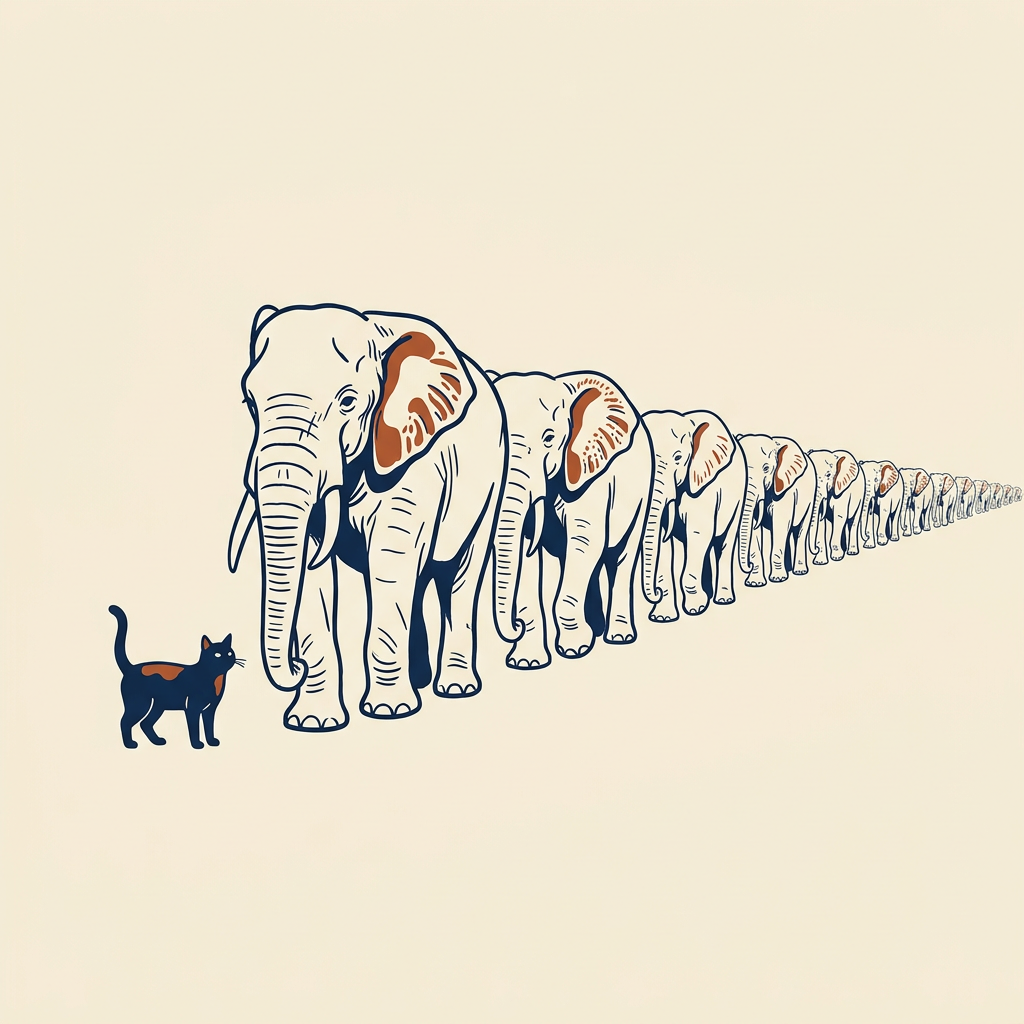
In practice: In a room of twenty-three people the chance that two share a birthday is better than half, a result almost everyone guesses far too low.
5
Vague claims feel personal
Astrology and biorhythms survive because broad flattering statements plus selective memory make almost any outcome feel like confirmation.
How it feels
A vague reading seems written just for you and every hit proves the system
What is tracked
Broad statements fit almost anyone; misses are dropped and never counted
Hand someone a generic personality sketch and tell them it was written for them alone; many rate it as uncannily exact. Horoscopes and biorhythm charts run the same trick: language wide enough to fit nearly anyone feels intimate because the reader supplies the confirming detail from private life.
Believers in public prophets remember the occasional right-sounding call and forget the larger pile of misses. Without a full systematic record, the hits dominate memory. Claims are often built to be unfalsifiable: a failure is reinterpreted rather than tallied, so contrary evidence never lands.
Genuine scientific claims must risk disproof. Early positive ESP results have repeatedly faded under tighter controls once selective reporting and multiple testing are corrected—the same statistical trap that turns raw coincidences into seeming proof. Demanding a complete ledger of hits and misses is the single strongest everyday tool against the pattern.
In practice: Followers of a well-known psychic recall her striking hits while discarding the much larger set of wrong or missed predictions.
6
Accuracy without base rates misleads
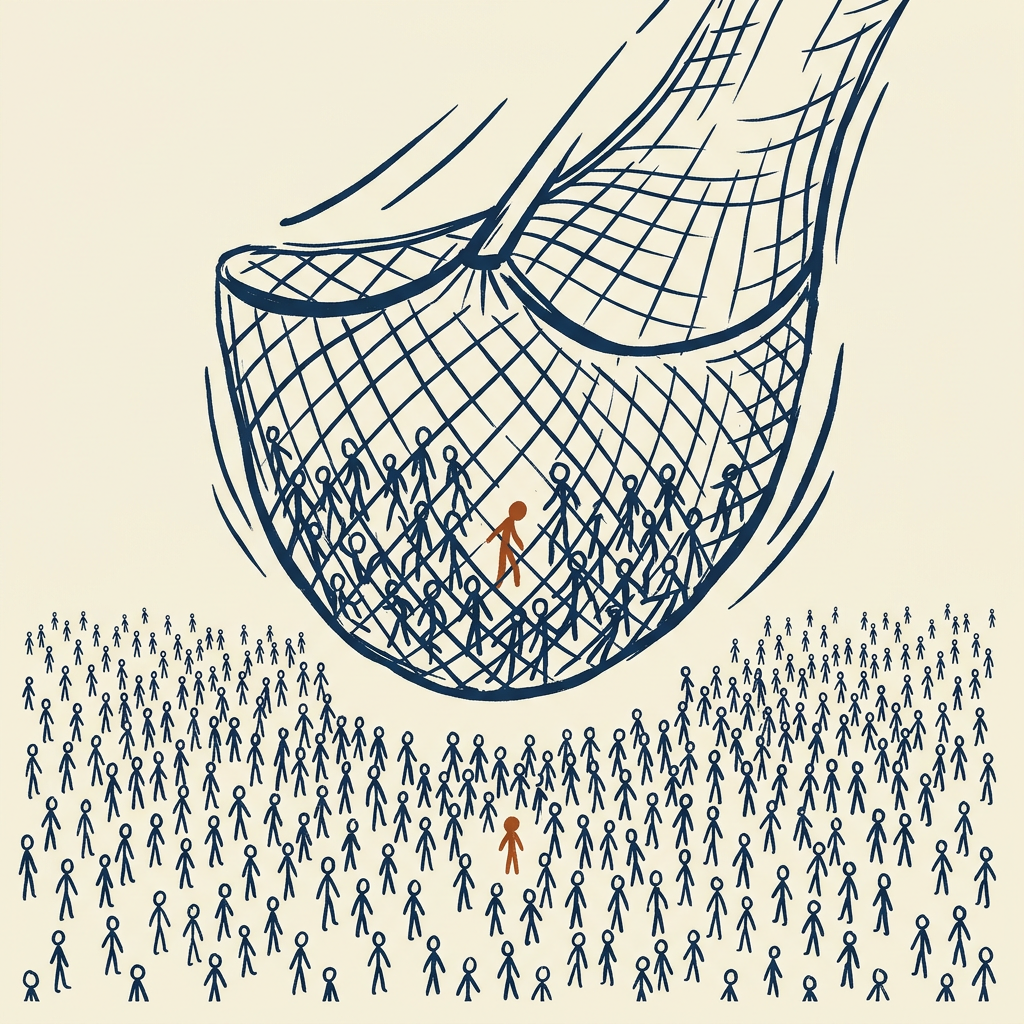
A highly accurate test for a rare condition still produces mostly false positives among those who test positive, because the healthy pool is so much larger.
True status ↑ · Test result →
True positive
Has disease, tests positive
False positive
Healthy, tests positive—often the majority when disease is rare
False negative
Has disease, tests negative
True negative
Healthy, tests negative
People lock onto the test’s stated accuracy and ignore how common the condition is. When the disease is scarce, even a small false-positive rate among the vast healthy majority overwhelms the true positives from the tiny sick group. The result is counterintuitive and routinely missed by doctors, patients, and juries.
Courtrooms replay the identical error. A lawyer may stress that a blood-type match occurs in only one person in many thousands and treat it as near-certain guilt, while ignoring how many other people in the relevant population could also match—the prosecutor’s fallacy. Both mistakes are failures to picture the full population of trials instead of one dramatic case.
The practical fix is procedural. Always ask for the base rate before reading a positive result, then imagine the test run on a concrete crowd of a thousand people so the counts become visible. Turning abstract percentages into natural frequencies out of a real population makes the arithmetic followable even for self-described math avoiders.
The same population-level habit already explained coincidence and psychic hits; here it decides medical and legal stakes.
In practice: A blood-type match said to occur in only one in ten thousand people is offered to a jury as near-proof of guilt while the rest of the matching population is left uncounted.

7
Headlines train the wrong fears
Coverage inflates vivid rare threats and underplays common larger risks, so people substitute a statistically safer danger for a deadlier ordinary one.
Airplane crashes arrive with saturation drama: concentrated, visual, story-ready. Car crashes kill far more people in the aggregate yet register as routine background because they arrive dispersed. The availability heuristic does the rest—probability is judged by how easily an example comes to mind, and media makes the rare event mentally louder than the common one.
Poisoned-candy panics, shark attacks, and rare violent crimes follow the same script. News tracks unusualness and narrative punch, not the threat an average person actually faces. Public fear then pulls regulation and money toward telegenic low-probability dangers while less photogenic but larger problems—routine workplace accidents, common diseases—starve for attention.
A reported “doubling” of risk still needs the base rate. Doubling a tiny background chance can remain a tiny chance; the earlier habit of demanding human-scale numbers is what lets a reader see it. Fear itself is not the enemy; fear calibrated by story rather than frequency produces worse personal and political choices.
In practice: Someone who dreads flying chooses a long drive instead, a swap that statistically raises the chance of dying.
8
Number sense is taught away
Innumeracy is produced by procedural schooling and social excuse, not a fixed brain limit, so different everyday habits can reverse it.
- Social permissionJoking about math failure carries no cost, so the gap is never pressured shut
- Procedural schoolingSteps are memorized for tests without asking if the answer could be real
- Missing plausibility habitNo reflex forms for estimating or demanding base rates in daily life
- Downstream errorsScale blindness, streak myths, pseudoscience, and mis-aimed fear follow
Classrooms often present math as a sequence of steps to memorize and reproduce on tests, cut off from estimation and sense-checking. A student can clear years of algebra and calculus without once being asked whether an answer is plausible, so the habit of testing a number against reality never forms. Reading instruction constantly asks whether a sentence makes sense; math rarely gets the equivalent demand for numerical plausibility.
Social permission compounds the damage. Because “I’m bad at math” carries little stigma, adults feel no pressure to close the gap, and children absorb the comfortable resignation of parents and teachers. Textbooks and media that drop statistics without context train people to compute an answer rather than to interrogate whether the question or framing itself is sensible.
Every earlier failure—misjudged scale, gambler’s streaks, pseudoscience, wrong fears—traces to the same root: a system that rewards fluent procedures over genuine number sense. The proposed repair is modest and behavioral. Build a lifelong practice of estimating, comparing, and asking for base rates in ordinary situations; that habit, more than formal coursework, is what actually inoculates against the pattern.
In practice: A student who can grind through calculus still never guesses whether a newspaper figure is in the right ballpark before accepting it.
Key terms
- innumeracy The everyday inability to handle numbers, probability, and scale, treated here as a cultural gap rather than a private quirk
- base rate How common a condition or trait actually is in the whole population before any test or match is interpreted
- gambler's fallacy The belief that a random streak makes the opposite outcome more likely on the next independent trial
- expected value The average payout per dollar spent over many plays; for most lotteries it sits far below a dollar
- Forer effect The tendency to rate a vague, flattering description as uniquely accurate when told it was written for you
- prosecutor's fallacy Treating a rare matching trait as near-proof of guilt while ignoring how many other people could also match
- availability heuristic Judging how likely something is by how easily a vivid example comes to mind
- law of large numbers With enough trials, rare events will occur somewhere as a matter of course
What to do
- Ask for the base rate behind any news statistic this week and recast it as a count out of a thousand or a million people.
- When you hear a percentage change, check whether it multiplies a tiny starting number or a huge one before deciding it is alarming.
- If a streak makes you feel an outcome is ‘due,’ stop and test whether the events are truly independent.
- Convert any huge public total into a per-person or per-day figure before accepting the drama.
- When someone jokes about being bad at math, refuse the laugh and ask one clarifying numerical question instead.
Questions to think with
- Which recent headline fear of yours would shrink or grow if you forced the base rate into view?
- Where do you still treat independent events as if they kept a memory of past results?
- What large number in this week’s news stays meaningless until it is divided by population or time?
- How often do you remember a striking coincidence while discarding the misses that surrounded it?
- If math failure carried the same social weight as illiteracy, what habit would you change first?
The other side
The book is stronger at cataloguing failures than at showing how to fix them at scale; it largely skips later empirical work on training methods, underplays systemic causes such as school funding and poverty’s cognitive load, sometimes tips into mockery, leans on dated 1980s examples, moves quickly for true math-avoiders, and rarely considers that some distrust of tidy numbers can itself be protective.
Who it's for
Readers who want to stop being pushed around by risk headlines, lottery systems, and disease statistics, plus students or professionals who skipped math yet need probability for ordinary decisions, will get the most from the full run of examples.