




How paid Everest dreams stacked the odds against survival
Commercial guiding, death-zone physiology, and eroded safety rules turned a survivable storm into eight deaths.
IJR · Oct 25, 2026 · 12 min read
In 60 seconds
- Krakauer climbed with Rob Hall's Adventure Consultants as a journalist-client reporting on Everest's commercialization and then survived the May 1996 storm that killed eight.
- Guiding firms charged $65,000 or more, offering ropes, oxygen, and porters so clients with moderate experience could chase a summit once reserved for elites.
- Above roughly 26,000 feet the body cannot acclimatize and judgment fails as if intoxicated, which is why pre-set descent hours matter so much.
- Crowding, late ropes, and summit fever pushed people including Doug Hansen past the usual 1 or 2 p.m. turnaround, leaving them high when weather collapsed.
- Chance ruled outcomes: Weathers walked into camp after being left for dead twice; Hall died after a last radio call to his pregnant wife; Boukreev saved clients with solo unoxygenated forays.
- Permit demand barely fell afterward—the known body count still lost to the wish for one irreversible summit credit.
The big idea
Krakauer argues that turning Everest into a guided product mismatched client skill with the mountain's real demands and stacked money, ego, and empathy against any firm decision to turn back. The May 1996 deaths followed from ordinary human pressures operating in air so thin that bodies and minds were already failing, not from one freak storm or a single guide's blunder.
The book in brief
Beck Weathers was left for dead twice on the upper mountain. Buried under snow and written off by rescuers who feared more deaths if they stayed, he later woke, walked into camp on his own, and survived after amputations. That same May 1996 day killed eight climbers. Guide Rob Hall stayed too long near the summit with client Doug Hansen and managed one last radio call to his pregnant wife before dying of exposure.
Krakauer reconstructs the disaster from inside it. Outside magazine had sent him to climb with Hall's Adventure Consultants and write about commercialization. He was an experienced climber but not a Himalayan specialist—both paying client and reporter. Hall's outfit had put dozens of clients on top without a death. That confidence, Krakauer suggests, may have papered over how thin the margins really were.
By the mid-1990s outfits charged $65,000 or more and supplied fixed ropes, bottled oxygen, and high-altitude porters. Clients with fitness, cash, and moderate experience could reasonably expect the summit if weather held. Guides needed success rates for reputation and referrals. Clients who had spent years and savings found turnaround calls hard to accept. Multiple teams crowded one narrow weather window and bottlenecked at points like the Hillary Step.
Above roughly 26,000 feet the body cannot acclimatize. Cells die. Judgment deteriorates like significant intoxication. Oxygen only partially helps. Turnaround times around 1 or 2 p.m. exist because descending in daylight is essential. On May 10 those times were not enforced. Delayed ropes and crowding slowed everyone. Hansen summited late; Hall stayed with him. When a storm arrived that afternoon—dangerous but not extraordinary by Himalayan standards—climbers were already strung out, low on oxygen, and impaired.
Krakauer tracks fates without simple moral math. Scott Fischer died after hitting his limit on the descent. Anatoli Boukreev made repeated solo trips into the storm without supplemental oxygen and saved several clients. Krakauer later questioned some of Boukreev's earlier choices; Boukreev disputed the critique. Krakauer also admits his own hypoxic errors, including mistaking one climber for another and failing to flag that guide Andy Harris was in trouble. Afterward Everest permits did not drop much. Some companies tightened protocols, but the business of matching wealthy amateurs with elite guides in fatally thin air remained. Safety systems can shrink risk. They cannot erase the desire that keeps people buying the chance.
Context
Krakauer wrote as a participant-observer sent by Outside magazine. The magazine piece and later book forced public reckoning with guided high-altitude tourism and the ethics of selling extreme risk as a product.
The key ideas

1
Reporter on the rope
Krakauer's dual role as reporter and paying client on Hall's team framed the book as an inside test of what money and professionalism can actually control at extreme altitude.
Hall's Adventure Consultants carried a strong safety record. He had put dozens of clients on the summit without a death. That history bred institutional confidence.
The team mixed motives and experience. Doug Hansen, a postal worker, had failed the year before and came back determined to finish. Beck Weathers, a Texas pathologist, joined the same effort. Krakauer brought solid climbing miles but no deep Himalayan résumé.
The expedition looked expensive, organized, and sober. That polish blocks the easy exit of calling the whole thing reckless amateurism. It leaves a harder question: how much can professionalism hold when the mountain kills on its own schedule.
In practice: Hall's pre-1996 record of getting clients to the summit without a single fatality.
2
Summit for sale
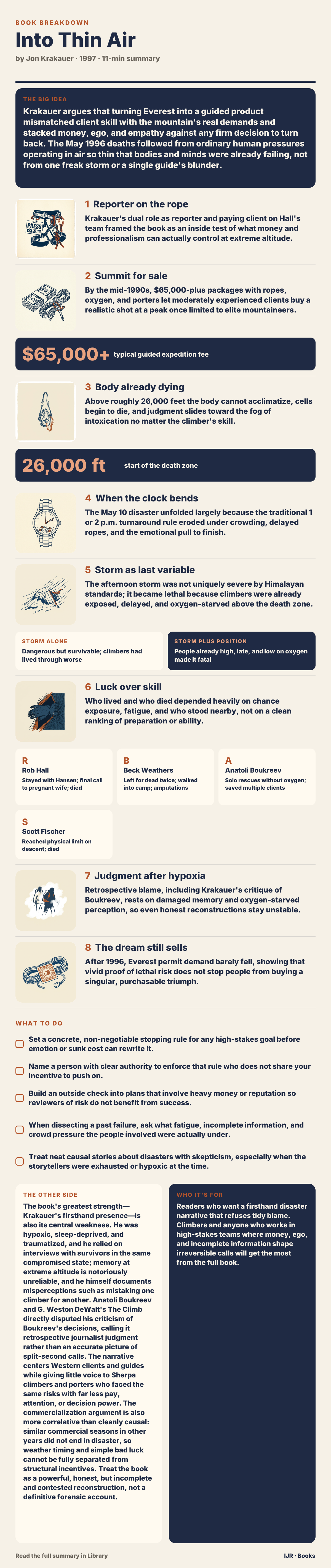
By the mid-1990s, $65,000-plus packages with ropes, oxygen, and porters let moderately experienced clients buy a realistic shot at a peak once limited to elite mountaineers.
$65,000+
typical guided expedition fee
Krakauer traces the shift without moralizing. Adventure Consultants and Scott Fischer's Mountain Madness charged $65,000 or more. They supplied fixed ropes, bottled oxygen, high-altitude porters, and seasoned guides.
Earlier decades kept Everest mostly for elite mountaineers who spent years building skill. Now strong lungs, cash, and moderate experience could buy a realistic chance if weather and systems held.
New pressures followed. Guides needed summit rates for referrals and reputation. Clients who had trained for years and emptied savings resisted any call to turn around. Multiple teams aiming at one weather window stacked up at the Hillary Step and other fixed points.
The structural case lands before any storm cloud appears. Incentives pointed forward, not back.
In practice: Clients on both Adventure Consultants and Mountain Madness shared the same narrow summit window and bottlenecked on the route.
3
Body already dying
Above roughly 26,000 feet the body cannot acclimatize, cells begin to die, and judgment slides toward the fog of intoxication no matter the climber's skill.
26,000 ft
start of the death zone
Krakauer walks through the physiology without mercy. Atmospheric pressure falls so low the body never adapts. Cells start dying. The mental state resembles significant intoxication, yet climbers still make turn-around and rope-in calls.
Supplemental oxygen keeps people moving. It also creates dependency. Running out high can kill. Guides must track every client's burn rate at once. A storm that wrecks the schedule turns that tracking into an almost impossible load.
Krakauer felt the fog himself on the summit push—details slipping, reactions lagging. That baseline reframes every later choice. The disaster was not only bad decisions. It was decisions made by bodies already failing. Firm turnaround times are the practical safeguard a deteriorating mind cannot supply for itself.
In practice: Krakauer missing details and reacting slowly during his own summit push under altitude fog.
4
When the clock bends
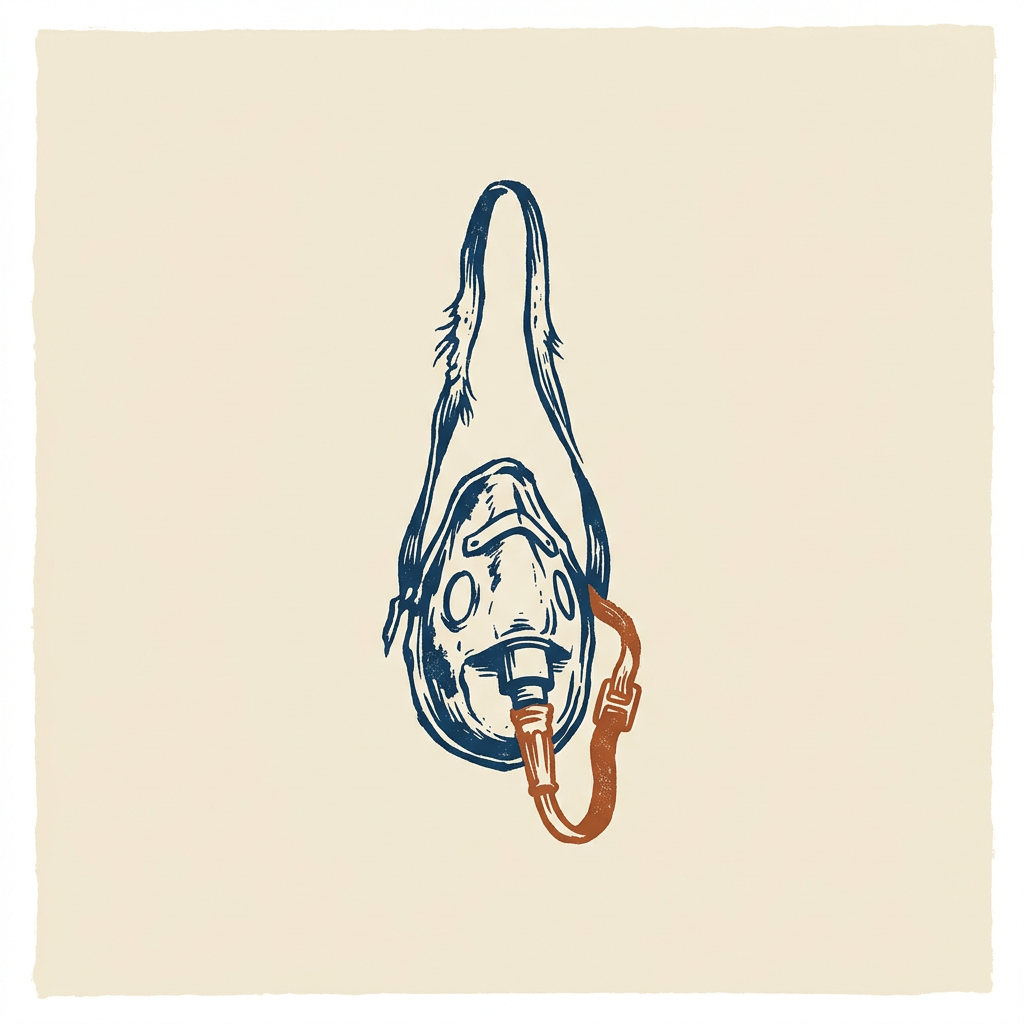
The May 10 disaster unfolded largely because the traditional 1 or 2 p.m. turnaround rule eroded under crowding, delayed ropes, and the emotional pull to finish.
Guides traditionally named a hard hour to start down. Daylight and stable weather on the descent are survival tools, not preferences.
On May 10 the rule bent. Fixed ropes had not been fully set in advance. Too many climbers from several teams shared one route. The ascent crawled. Hansen stood on the summit well after 2 p.m. Hall stayed with him past the safe window.
Krakauer refuses to pin this on one man's lapse. The earlier incentive structure plus clients' emotional stakes made rigid enforcement feel nearly impossible. Hansen's prior failure and Hall's reported sense of responsibility pulled the clock apart.
Safety rules at that altitude work more like social norms than laws of physics. Empathy, the glue of a team that has lived together for weeks, is exactly what makes enforcement fail.
In practice: Doug Hansen summiting after 2 p.m. while Hall remained with him instead of forcing an immediate descent.
5
Storm as last variable
The afternoon storm was not uniquely severe by Himalayan standards; it became lethal because climbers were already exposed, delayed, and oxygen-starved above the death zone.
Storm alone
Dangerous but survivable; climbers had lived through worse
Storm plus position
People already high, late, and low on oxygen made it fatal
Visibility dropped to near zero. Temperatures plunged under high winds. Krakauer is explicit: the weather was dangerous yet not extraordinarily severe by Everest standards. Climbers had survived worse.
What made it lethal was location and timing. People were still strung along the upper mountain inside the death zone. Many were short on oxygen. Some were exhausted and slow from earlier delays. Radio links between guides and base camp frayed. Separated climbers lost coordinated information.
Krakauer himself staggered toward Camp Four and barely found the tents in whiteout. The irony hardens here. The same route had been climbed successfully many times. Crowding, late ropes, missed turnarounds, and thinning gas had already stacked the deck. The storm was the final variable, not the sole cause.
In practice: Krakauer nearly missing the Camp Four tents while descending in zero-visibility whiteout.
6
Luck over skill
Who lived and who died depended heavily on chance exposure, fatigue, and who stood nearby, not on a clean ranking of preparation or ability.
- RRob HallStayed with Hansen; final call to pregnant wife; died
- BBeck WeathersLeft for dead twice; walked into camp; amputations
- AAnatoli BoukreevSolo rescues without oxygen; saved multiple clients
- SScott FischerReached physical limit on descent; died
Krakauer records fates with flat precision. Hall stayed with Hansen near the top as strength and oxygen ran out. Both died. Hall reached his pregnant wife by radio one last time before exposure took him. Fischer hit his physical wall on the way down and also died.
Weathers was left for dead twice. Rescuers judged him unsalvageable under snow. He later woke, stood, and walked into camp severely frostbitten, then lived after amputations. Boukreev went back into the storm alone and without supplemental oxygen, repeated the trips, and pulled several clients to safety. Krakauer praises those rescues even while questioning some of Boukreev's earlier positioning.
Survival refused a clean formula. Highly experienced climbers died. Some less experienced clients lived through luck, timing, or another person's intervention. The thin line undercuts any story that skill alone sorts the living from the dead.
In practice: Beck Weathers walking into camp under his own power after rescuers had twice left him for dead in the snow.
7
Judgment after hypoxia
Retrospective blame, including Krakauer's critique of Boukreev, rests on damaged memory and oxygen-starved perception, so even honest reconstructions stay unstable.
Later chapters turn to responsibility. Krakauer admits he handles it imperfectly. He faults Boukreev for descending ahead of clients without oxygen, arguing the choice may have left people under-supervised when the storm hit. Boukreev and co-author G. Weston DeWalt answered in The Climb, calling Krakauer's view journalist hindsight rather than a fair read of split-second, oxygen-starved calls.
Krakauer was himself hypoxic, traumatized, and rebuilding events from memory plus interviews with survivors whose minds had been equally altered. He owns personal guilt: mistaking one climber for a teammate in the whiteout, and failing to raise the alarm that guide Andy Harris was in trouble near the summit—an error that may have helped cost Harris his life.
Disaster stories told afterward, even candid ones, stay unstable. The people closest to the truth were the least able to perceive it cleanly in the moment. Krakauer's choice to implicate himself is part of the book's credibility. It also invites the disputes that followed.
In practice: Krakauer mistaking another climber for a teammate in whiteout and not signaling that Andy Harris needed help.

8
The dream still sells
After 1996, Everest permit demand barely fell, showing that vivid proof of lethal risk does not stop people from buying a singular, purchasable triumph.
International news and Krakauer's reporting put commercial high-altitude guiding under a harsh light. Yet applications for Everest permits did not drop significantly in later seasons. If anything the mountain's mystique grew.
Krakauer examines the stubborn why. A summit offers a rare marker of achievement. The same drivers that kept Hansen moving past turnaround—money spent, training logged, public expectation—also pull new clients to sign up after they have read the body count.
He asks whether guides should take limited-experience paying clients into a death zone at all and refuses a tidy answer. Some companies tightened turnaround enforcement and communications. The core structure stayed. Wealthy amateurs still met elite guides in air that cannot sustain life for long.
Safety systems can cut risk. They cannot fully cancel that underlying wish.
In practice: Everest permit applications holding steady in the seasons after 1996 despite global coverage of the deaths.
Key terms
- Death zone Altitude above roughly 26,000 feet where the body cannot acclimatize and begins to die even at rest.
- Turnaround time A pre-set hour, often 1 or 2 p.m., when climbers must start down no matter how close the summit looks.
- Commercial guiding Paid expeditions that supply ropes, oxygen, porters, and guides so less-experienced clients can attempt extreme peaks.
- Summit fever The urge, fed by sunk cost and expectation, to keep climbing past safe limits.
- Fixed ropes Ropes pre-placed on the route so clients can clip in through technical sections.
- Supplemental oxygen Bottled gas that partially offsets thin air but creates dependency and runs out on a fixed schedule.
- Hillary Step A narrow technical bottleneck near the summit where multiple teams can stack up and lose hours.
What to do
- Set a concrete, non-negotiable stopping rule for any high-stakes goal before emotion or sunk cost can rewrite it.
- Name a person with clear authority to enforce that rule who does not share your incentive to push on.
- Build an outside check into plans that involve heavy money or reputation so reviewers of risk do not benefit from success.
- When dissecting a past failure, ask what fatigue, incomplete information, and crowd pressure the people involved were actually under.
- Treat neat causal stories about disasters with skepticism, especially when the storytellers were exhausted or hypoxic at the time.
Questions to think with
- Would you accept a guide's hard turnaround call after years of training and tens of thousands spent?
- How should rescue decisions weigh the chance of saving one person against the risk of losing the rescuers?
- Can any safety protocol fully counteract the desire for a singular public achievement?
- When two firsthand accounts disagree about oxygen-starved decisions, how should outsiders weigh them?
- What duty do commercial guides owe clients who arrive fit and funded but not fully skilled for the death zone?
The other side
The book's greatest strength—Krakauer's firsthand presence—is also its central weakness. He was hypoxic, sleep-deprived, and traumatized, and he relied on interviews with survivors in the same compromised state; memory at extreme altitude is notoriously unreliable, and he himself documents misperceptions such as mistaking one climber for another. Anatoli Boukreev and G. Weston DeWalt's The Climb directly disputed his criticism of Boukreev's decisions, calling it retrospective journalist judgment rather than an accurate picture of split-second calls. The narrative centers Western clients and guides while giving little voice to Sherpa climbers and porters who faced the same risks with far less pay, attention, or decision power. The commercialization argument is also more correlative than cleanly causal: similar commercial seasons in other years did not end in disaster, so weather timing and simple bad luck cannot be fully separated from structural incentives. Treat the book as a powerful, honest, but incomplete and contested reconstruction, not a definitive forensic account.
Who it's for
Readers who want a firsthand disaster narrative that refuses tidy blame. Climbers and anyone who works in high-stakes teams where money, ego, and incomplete information shape irreversible calls will get the most from the full book.