




Bluff beat analysis on the 1980s bond floor
Salomon Brothers, Lewis argues, selected for poker-table nerve and client extraction more than financial skill, and a novice could rise by performing confidence.
IJR · Oct 25, 2026 · 10 min read
In 60 seconds
- Salomon hired for aggression and tribal fit; training was hazing that rewarded whoever pushed back hardest, not quantitative polish.
- The dollar-bill bluffing game Liar's Poker was the real curriculum for reading bluffs and projecting false confidence on the floor.
- Ranieri's mortgage desk invented tradeable mortgage bonds and for years generated profits that exceeded the rest of the firm combined.
- Salesmen were taught to overcharge clients who could not price complex bonds, turning information asymmetry into the core profit engine.
- When first-mover gains shrank, unmanaged bonus fights and internal rivalries turned the firm's aggression inward and drove key talent out.
- Lewis drifted from uneasy outsider to fluent extractor, then quit because the money, once won, did not deliver the meaning its pursuit promised.
The big idea
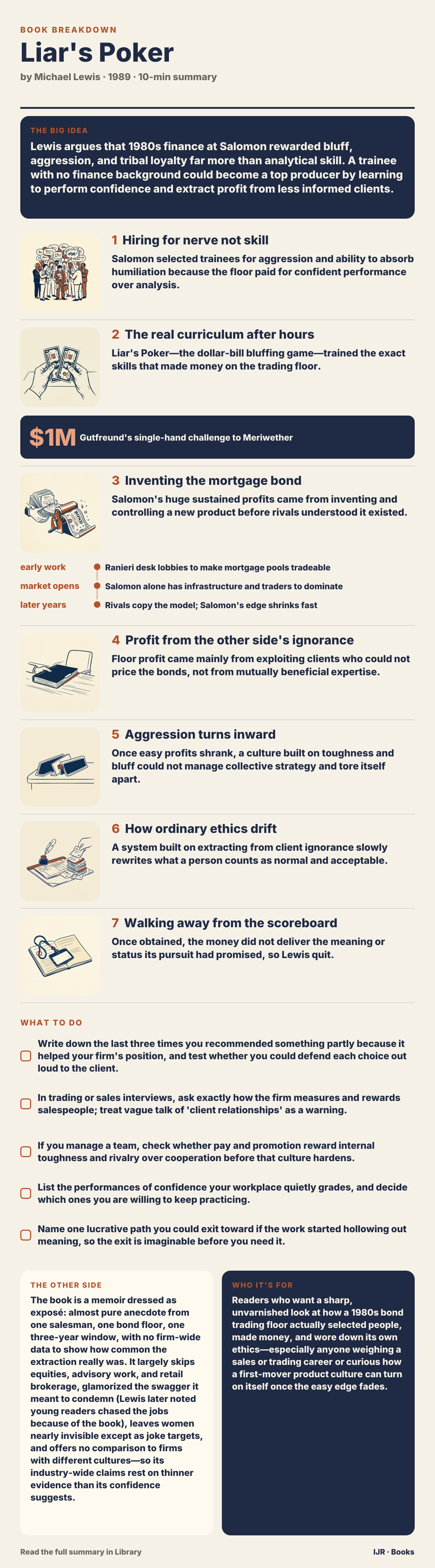
Lewis argues that 1980s finance at Salomon rewarded bluff, aggression, and tribal loyalty far more than analytical skill. A trainee with no finance background could become a top producer by learning to perform confidence and extract profit from less informed clients.
The book in brief
Lewis arrives at Salomon in 1985 with an art-history degree and finds a training program that works as hazing: seniors scream, mock slow answers, and keep the thick-skinned. The firm, he shows, is selecting poker temperament, not scholars, because the floor runs on instant high-stakes decisions.
The same traits are drilled after hours in Liar's Poker, the dollar-bill bluffing game that gives the book its name. A famous million-dollar challenge between CEO John Gutfreund and star trader John Meriwether turns the game into a status ritual: nerve and calm refusal signal who belongs among the elite risk-takers.
Meanwhile Lewis Ranieri's mortgage desk quietly lobbies regulators, turns illiquid home loans into nationwide bonds, and for a stretch earns more than the rest of Salomon combined. The edge is structural first-mover control, not permanent superior judgment; once rivals copy the infrastructure, the advantage erodes.
On the floor itself, profit comes from spotting which clients cannot price the new products and charging them hidden spreads. The salesman's job is to move inventory at Salomon's best price while speaking the language of service. Lewis's own rise rests on mastering that extraction.
As easy mortgage profits shrink, Gutfreund's toughness-first management lets bonus politics and department rivalries hollow the firm. Senior mortgage talent, including Ranieri, leaves. Lewis traces his own moral drift—small rationalizations that normalize steering clients toward Salomon's inventory—and finally walks away in 1987, treating the money as a performance that failed to deliver meaning once obtained.
Context
Lewis wrote from his 1985–1988 stint as a bond salesman at Salomon Brothers, the firm that invented the mortgage-backed securities market and briefly dominated Wall Street. The book mattered because it exposed, from the inside, how bond trading floors actually worked just before that culture spread industry-wide.
The key ideas

1
Hiring for nerve not skill
Salomon selected trainees for aggression and ability to absorb humiliation because the floor paid for confident performance over analysis.
Lewis enters with a Princeton art-history degree and an LSE master's—credentials nearly useless on the desk. The training program functions less as education than as hazing: seniors humiliate trainees in mock trading games, scream in meetings, and reward whoever pushes back hardest.
Executives openly prefer recruits who can withstand and dish out verbal abuse over those with quantitative polish. Hesitation costs money on a floor of instant decisions, so the firm wants poker players, not scholars.
Classmates who studied finance seriously get discarded while blunt, thick-skinned traders thrive. Success, Lewis learns, is a performance to be mimicked, not a talent to be certified. That mimicry becomes his ticket onto the floor and the foundation for every later claim about how power and money move through the firm.
In practice: Trainees face rapid-fire bond-price questions before the whole class; wrong or slow answers draw mockery, and the test is whether the trainee flinches, not whether the answer is right.

2
The real curriculum after hours
Liar's Poker—the dollar-bill bluffing game—trained the exact skills that made money on the trading floor.
$1M
Gutfreund's single-hand challenge to Meriwether
Senior traders play with serial numbers on dollar bills, bluffing about digit counts the way poker players bluff about cards. Juniors learn to read bluffs, project false confidence, and absorb humiliation without breaking—skills transferred straight to government bonds and mortgage securities.
The game is a status ritual. Winning, or refusing to play on bad terms, signals who belongs among Salomon's elite risk-takers. Underneath talk of yields and spreads sits a fraternity that rewards whoever can out-bluff the room.
Financial skill and gambling bravado become, inside the firm, the same currency. The traits rewarded in daytime training are the ones performed nightly in the game and deployed on clients the next morning.
In practice: CEO John Gutfreund challenges star trader John Meriwether to a single hand for a million dollars; Meriwether's calm, on-his-own-terms refusal displays the nerve the firm prizes most.

3
Inventing the mortgage bond
Salomon's huge sustained profits came from inventing and controlling a new product before rivals understood it existed.
- early workRanieri desk lobbies to make mortgage pools tradeable
- market opensSalomon alone has infrastructure and traders to dominate
- later yearsRivals copy the model; Salomon's edge shrinks fast
Lewis Ranieri's mortgage desk turns home mortgages—previously illiquid and held locally by savings and loans—into tradeable bonds sold to investors nationwide. The work takes years of quiet lobbying to change tax and legal treatment of mortgage pools while competitors ignore the market as unglamorous.
Once the market exists, Salomon alone has the infrastructure, relationships, and trained traders to make markets in the new instrument. In some years the mortgage desk's profits exceed the earnings of the entire rest of the firm combined.
The early edge is being first and structurally embedded, not smarter people continuously outthinking the market. When First Boston and Goldman build comparable capabilities, the advantage erodes fast. Flush mortgage traders become the internal aristocracy the training system was designed to feed—and the self-image of permanent genius collides with the mundane truth of temporary structural luck.
In practice: Ranieri's team lobbies Congress and regulators for years while rivals still treat mortgages as a backwater; once rules change, Salomon dominates the new bonds until copycats catch up.

4
Profit from the other side's ignorance
Floor profit came mainly from exploiting clients who could not price the bonds, not from mutually beneficial expertise.
Salesmen learn to sort clients by how well they understand bond pricing and to charge the ignorant far higher hidden spreads. Internally, a reliably overcharged client is simply a source of easy profit; traders discuss which institutions fit the category.
Complex mortgage derivatives go to savings-and-loan managers who lack the tools to price them, at spreads a sophisticated buyer would never tolerate. The prized skills from training and Liar's Poker—reading an opponent, projecting confidence, concealing position—translate directly into extraction rather than efficient-market value creation.
The salesman's real job is moving Salomon inventory at the best price for the firm, dressed as service. Lewis admits his own success rests on mastering that extraction, which he finds morally uncomfortable even as it builds his internal reputation. Information asymmetry is cultivated, not incidental.
In practice: Salesmen steer complex mortgage derivatives to savings-and-loan managers who cannot properly price them, locking in spreads far above what an informed buyer would pay.

5
Aggression turns inward
Once easy profits shrank, a culture built on toughness and bluff could not manage collective strategy and tore itself apart.
CEO John Gutfreund commands fear through trading-floor toughness yet lets compensation and promotion become a battleground. Bonus talks turn adversarial; top producers threaten to leave; departments fight each other for capital and credit instead of collaborating.
The mortgage desk, still flush from earlier wins, draws resentment from other divisions over outsized bonuses. Management does little to resolve it. Without a shared external enemy or an expanding pie, aggression once aimed at clients and competitors turns inward.
Senior mortgage traders depart, eventually including Ranieri. Lewis treats the unraveling not as bad luck but as the predictable result of a management style optimized for individual dominance. Later scandals and losses, beyond Lewis's own years, root in the same unmanaged culture.
In practice: Bonus negotiations become threats to defect, and the mortgage department's outsized payouts spark open rivalry with other desks that leadership never settles.

6
How ordinary ethics drift
A system built on extracting from client ignorance slowly rewrites what a person counts as normal and acceptable.
Lewis traces his shift from outsider uneasy with the practices to salesman fluent in the rationalizations. He justifies more aggressive tactics by pointing to colleagues and by telling himself clients own their lack of sophistication.
The mechanism is not one corrupting event but thousands of small accommodations, each defensible alone. Steering clients toward securities that help Salomon's inventory starts to feel like ordinary business rather than a conflict of interest.
Leadership that will not curb internal rivalry has no appetite for curbing hard treatment of clients; both flow from the same prized toughness and self-interest. The moral problem sits in the incentive structure that predictably produces this drift in ordinary people—including an author who arrived explicitly skeptical.
In practice: Lewis grows comfortable recommending securities that clear Salomon's books over ones that better match the client's interest, using the shared salesman line that this is simply how the business works.

7
Walking away from the scoreboard
Once obtained, the money did not deliver the meaning or status its pursuit had promised, so Lewis quit.
By 1987 Lewis is a successful salesman earning far more than he expected at twenty-seven, yet he feels disillusioned rather than satisfied. He leaves to write instead of climbing further, against the backdrop of the 1987 crash and the mortgage desk's continued unraveling.
Colleagues who stay longer describe the same hollow feeling but remain, held by rising bonuses and the inability to picture an equally lucrative life outside finance. Leaving requires resisting the incremental accommodations that keep most people in place.
Journalism offers Lewis alternative status and income most colleagues lack. The book itself becomes evidence for its central claim: the culture was legible from the inside because it was a set of learnable performances and rationalizations, not a body of specialized, defensible expertise.
In practice: Lewis walks out at the peak of his earnings while peers who feel the same emptiness stay, locked by bonuses and no clear alternative path.
Key terms
- Liar's Poker Bluffing game played with the serial numbers on dollar bills; the firm's after-hours school for reading and projecting false confidence.
- Mortgage-backed securities Home loans pooled and turned into bonds that could be sold to investors nationwide—the product Salomon invented and briefly owned.
- Training program hazing Mock trading, public mockery, and verbal abuse used to select thick-skinned performers rather than to teach finance.
- Hidden spread Extra price charged to a client who cannot properly value the bond; the main extraction tool on the sales desk.
- Easy-profit client Internal label for an institutional buyer reliably overcharged because of weak pricing skill.
- First-mover edge Temporary advantage from building the market infrastructure and relationships before rivals noticed the product.
- Moral drift Gradual shift from unease to fluent rationalization as small inventory-first choices start to feel normal.
What to do
- Write down the last three times you recommended something partly because it helped your firm's position, and test whether you could defend each choice out loud to the client.
- In trading or sales interviews, ask exactly how the firm measures and rewards salespeople; treat vague talk of 'client relationships' as a warning.
- If you manage a team, check whether pay and promotion reward internal toughness and rivalry over cooperation before that culture hardens.
- List the performances of confidence your workplace quietly grades, and decide which ones you are willing to keep practicing.
- Name one lucrative path you could exit toward if the work started hollowing out meaning, so the exit is imaginable before you need it.
Questions to think with
- Where in your own work do confident performance and actual expertise come apart, and who pays the difference?
- If a firm's biggest profits once came from a product rivals had not yet copied, what happens to culture when that gap closes?
- Which small rationalizations have already started to feel like ordinary business rather than conflicts of interest?
- Would you still want the role if the money arrived without the status theater that usually comes with it?
- How would the trading-floor story change if it included the people the culture systematically kept off the floor?
The other side
The book is a memoir dressed as exposé: almost pure anecdote from one salesman, one bond floor, one three-year window, with no firm-wide data to show how common the extraction really was. It largely skips equities, advisory work, and retail brokerage, glamorized the swagger it meant to condemn (Lewis later noted young readers chased the jobs because of the book), leaves women nearly invisible except as joke targets, and offers no comparison to firms with different cultures—so its industry-wide claims rest on thinner evidence than its confidence suggests.
Who it's for
Readers who want a sharp, unvarnished look at how a 1980s bond trading floor actually selected people, made money, and wore down its own ethics—especially anyone weighing a sales or trading career or curious how a first-mover product culture can turn on itself once the easy edge fades.