




Fraud is the hidden tax trust-based economies always pay
Bankers, auditors, regulators, and finance-curious readers get Davies’s structural map of why swindles keep outrunning the systems meant to catch them.
IJR · Nov 4, 2026 · 14 min read
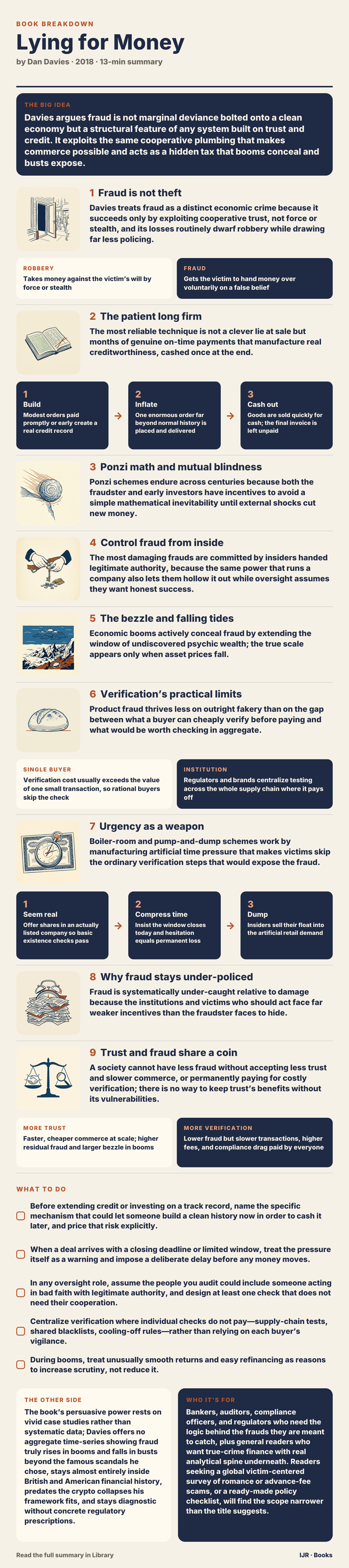
In 60 seconds
- Fraud works by getting victims to hand money over willingly and parasitizes the trust modern commerce needs to function beyond barter.
- A long firm earns a real credit record with prompt payments, then cashes it once with a single huge unpaid order.
- Ponzi schemes last because both the operator and early investors benefit from not facing the math until new money slows.
- Control fraud by people handed legitimate power hollows out institutions from the boardroom and defeats tools built for outside cheats.
- Booms inflate a ‘bezzle’ of undiscovered psychic wealth; busts are when society finally counts the losses.
- Economies cannot wipe out fraud without killing trust-based speed, so they permanently trade residual fraud for commercial efficiency.
The big idea
Davies argues fraud is not marginal deviance bolted onto a clean economy but a structural feature of any system built on trust and credit. It exploits the same cooperative plumbing that makes commerce possible and acts as a hidden tax that booms conceal and busts expose.
The book in brief
Davies starts by splitting fraud from robbery. A robber takes against the victim’s will. A fraudster gets the victim to hand money over voluntarily while believing something false. That gap matters because every commercial system depends on people extending trust before they can fully verify: suppliers ship before payment clears, depositors leave funds without daily audits, investors buy on prospectuses they cannot fully check. Fraud is parasitic on exactly that necessary trust, and its losses routinely dwarf street crime even while it draws a fraction of the policing attention.
He then walks through classic patterns. The long firm patiently builds a genuine credit reputation with real on-time payments before one enormous unpaid order. Ponzi schemes race exponential payouts against exponential recruitment until external shocks cut new money. Control fraud turns the people legally entrusted to run an institution into the ones hollowing it out. Across these cases the same shape appears: authentic-seeming trust is earned or inherited, then cashed once at maximum exposure.
The middle chapters widen the lens. Rising markets create a bezzle—the psychic wealth that exists between the moment of fraud and the moment of discovery—so busts, not better auditors alone, are what finally reveal scale. Product adulteration and boiler-room stock pushes show fraud clustering wherever verification is costly relative to a single transaction and wherever artificial urgency steals the time needed to check. In each setting the fraudster does not need universal deception, only a systematic gap most rational counterparties will not close on their own.
Davies closes on enforcement failure and the hard tradeoff. Proving intent is expensive, costs are diffused across victims, and regulators face asymmetric incentives, so fraud stays under-policed relative to damage. Societies therefore cannot drive fraud to zero without making commerce as slow and costly as back-alley suspicion. Regulation and disclosure only shift the curve. The realistic goal is a sustainable balance point, not a final cure, and every major case in the book is a moment when that balance sat too far toward trust.
Context
Davies published the book in 2018 as applied economic storytelling drawn from centuries of British and American financial swindles. Its control-fraud and bezzle framing later proved a useful lens for crypto and DeFi collapses he never covered, which both compliments the taxonomy and marks the book as a snapshot rather than an updated field guide.
The key ideas

1
Fraud is not theft
Davies treats fraud as a distinct economic crime because it succeeds only by exploiting cooperative trust, not force or stealth, and its losses routinely dwarf robbery while drawing far less policing.
Robbery
Takes money against the victim’s will by force or stealth
Fraud
Gets the victim to hand money over voluntarily on a false belief
A robber takes money against the victim’s will. A fraudster gets the victim to hand it over voluntarily while believing something false. That difference is not moral hair-splitting. It is mechanical.
Modern commerce runs on people extending trust before outcomes can be verified. A supplier ships goods before payment clears. A depositor leaves money in a bank without auditing the loan book daily. An investor buys shares on a prospectus he cannot fully check. Fraud is parasitic on exactly those necessary acts of trust.
You cannot eliminate fraud without also eliminating the trust that lets an economy function beyond barter. Davies notes that fraud losses routinely dwarf all robbery and burglary combined, yet fraud receives a fraction of the resources and cultural attention. Part of the reason is theatrical: there is no broken window and no masked assailant. The victim often signs the check himself.
The law generally requires proof of intent to deceive, not merely a bad outcome, which makes prosecution harder. Davies uses the distinction to reframe fraud as market failure built into the plumbing of trust-based exchange rather than pure individual moral failure. Every later case illustrates a specific way that plumbing can be exploited.
In practice: A depositor leaves money in a bank without daily audits of its loan book; the fraudster needs that ordinary, rational trust, not a forced entry.

2
The patient long firm
The most reliable technique is not a clever lie at sale but months of genuine on-time payments that manufacture real creditworthiness, cashed once at the end.
- 1BuildModest orders paid promptly or early create a real credit record
- 2InflateOne enormous order far beyond normal history is placed and delivered
- 3Cash outGoods are sold quickly for cash; the final invoice is left unpaid
Davies traces the classic long-firm pattern back to nineteenth-century British trade credit. A fraudster sets up an ordinary-looking business, orders modest quantities, and pays every invoice promptly, sometimes early.
From the supplier’s point of view nothing is false during the buildup. The payments really arrive. Credit reputation becomes genuinely excellent. Only then does the operator place one enormous order far larger than the history would normally justify, take delivery, sell for cash, and vanish, leaving the final invoice unpaid.
“Long” refers to time invested before payoff, not the scale of any single lie. Ordinary due diligence fails because a credit check during the buildup shows a clean, even impressive record. No rule has been broken and no lie told until the final act.
Davies treats this as the archetype for nearly every other fraud in the book: authentic good behavior manufactures trust, then a single betrayal hits at maximum exposure. Any system that only checks track records is structurally blind to it.
In practice: Suppliers see months of early payments and a clean record, then lose everything on one oversized final delivery that is sold off for cash before disappearance.

3
Ponzi math and mutual blindness
Ponzi schemes endure across centuries because both the fraudster and early investors have incentives to avoid a simple mathematical inevitability until external shocks cut new money.
Charles Ponzi’s 1920 Boston scheme used a real but tiny arbitrage in postal reply coupons while paying early investors from later investors’ cash. The underlying arithmetic is unforgiving. To keep paying promised returns, the scheme needs an ever-growing stream of new money that grows faster than the promised rate.
Davies shows the same structure in Bernie Madoff’s operation, which reported roughly $65 billion in fictitious account value before collapsing in 2008, with actual cash losses closer to $18 billion. Longevity depended less on pure cunning than on investors’ reluctance to ask why steady, market-beating returns never varied even in downturns.
Whistleblower Harry Markopolos raised that red flag to the SEC repeatedly starting in 1999 without effect. Both sides benefit from not looking closely. The fraudster wants no scrutiny. Early investors receiving real returns have no incentive to kill the goose currently paying them.
The scheme is therefore a race between exponential payout growth and exponential recruitment that mathematics guarantees the operator eventually loses. Collapse typically arrives when external events slow new money—such as a market crash prompting withdrawals—not from internal vigilance.
In practice: Madoff’s reported $65 billion fictitious value and roughly $18 billion cash losses only became undeniable once the 2008 crash forced mass withdrawals.
4
Control fraud from inside
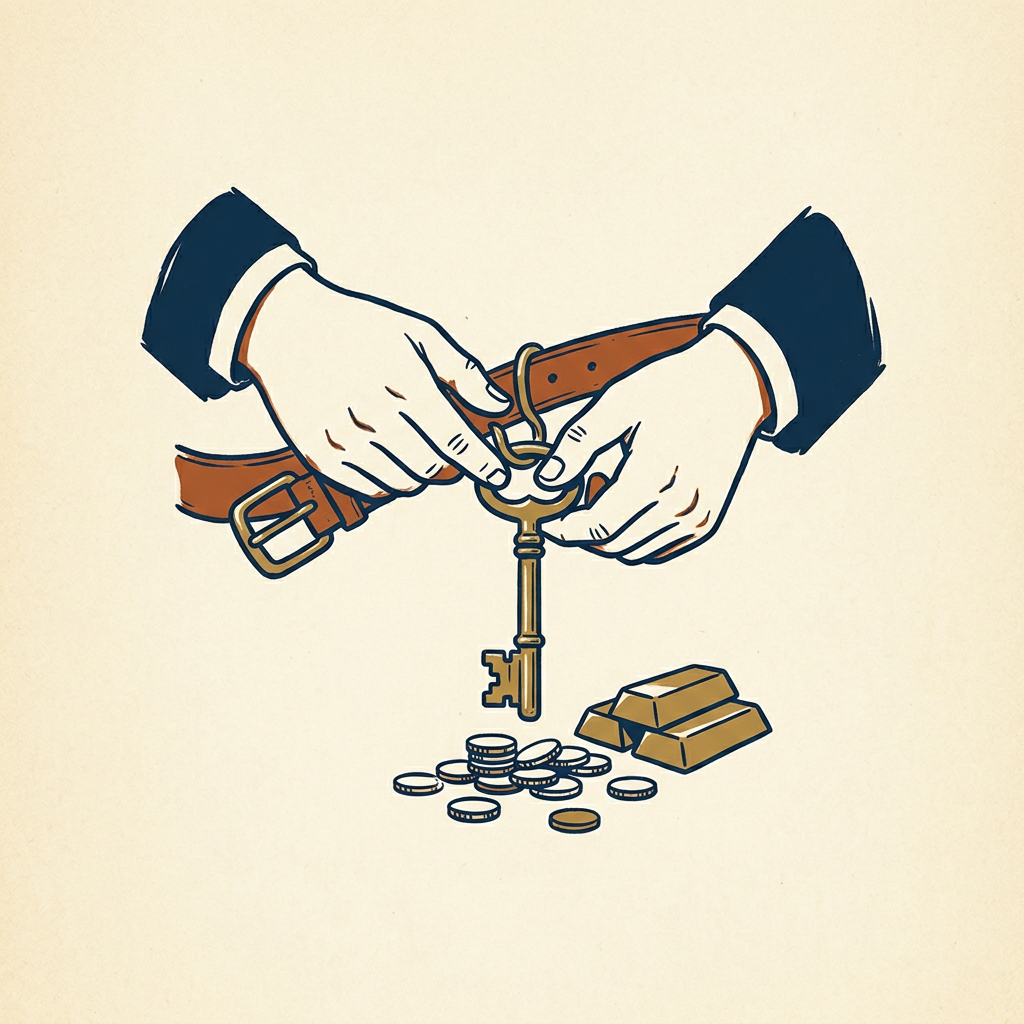
The most damaging frauds are committed by insiders handed legitimate authority, because the same power that runs a company also lets them hollow it out while oversight assumes they want honest success.
Building on outsider trust games, Davies turns to fraud from the boardroom—what economist William K. Black named control fraud. Here the fraudster is not deceiving an institution from outside but is the person legally entrusted to run it.
Robert Maxwell used control over the Mirror Group’s pension funds in the early 1990s to plug cash shortfalls elsewhere in his empire, moving hundreds of millions of pounds from employee retirement savings before his 1991 death exposed the theft. Allen Stanford ran an Antigua-based bank issuing certificates of deposit with implausibly steady high returns, funding roughly $7 billion in payouts to earlier customers with new depositors’ money until his 2009 arrest.
Internal auditors, compliance staff, and even outside regulators generally assume people at the top want the institution to succeed honestly, since that is normally in their interest as owners or long-term managers. Control fraud inverts the assumption. The executive’s interest lies in extracting value even as the institution fails, walking away with proceeds before collapse.
Standard oversight tools built to catch external cheats or careless staff are poorly suited to a chief executive who directs the deception and can override or intimidate anyone positioned to report it.
In practice: Maxwell diverted hundreds of millions from Mirror Group pension funds to other parts of his empire until his 1991 death made the gap visible.

5
The bezzle and falling tides
Economic booms actively conceal fraud by extending the window of undiscovered psychic wealth; the true scale appears only when asset prices fall.
Davies borrows “bezzle” from John Kenneth Galbraith for the psychic wealth that exists between the moment a fraud is committed and the moment it is discovered. During that window both fraudster and victim believe they are richer than they are.
Rising markets extend the window indefinitely. A fraud that a falling price would expose can instead be refinanced, refunded, or simply outgrown while values climb. Ivar Kreuger, the Swedish Match King, built a global monopoly partly on fictional match-industry returns, sustained by continually raising new capital while confidence and credit stayed buoyant. When credit tightened in 1932 the structure collapsed within weeks and Kreuger killed himself, revealing years of fraud that had operated in plain sight.
Davies draws the parallel to 2008. Liar loans and NINJA mortgages with fabricated income and assets looked profitable and low-risk while house prices rose, because a defaulting borrower could refinance or sell. Once prices fell, the embedded fraud became visible almost overnight.
Fraud detection is therefore not primarily a function of better auditing but of the business cycle itself. Busts are when society’s accumulated bezzle gets destroyed and finally counted.
In practice: Kreuger’s match-bond structure survived for years on buoyant credit and collapsed within weeks when markets tightened in 1932.

6
Verification’s practical limits
Product fraud thrives less on outright fakery than on the gap between what a buyer can cheaply verify before paying and what would be worth checking in aggregate.
Single buyer
Verification cost usually exceeds the value of one small transaction, so rational buyers skip the check
Institution
Regulators and brands centralize testing across the whole supply chain where it pays off
Davies shifts from pure financial fraud to physical goods, using food adulteration as the template. Victorian bakers stretched bread with alum and dairies watered milk because ordinary buyers had no cheap way to test composition before consuming.
The fraud was not a lie about the product’s name—it really was bread or milk—but a lie about composition detectable only through analysis the average shopper could not perform. The same logic extends to modern counterfeit pharmaceuticals and luxury goods.
Fraud clusters wherever verification cost exceeds the value at stake for an individual transaction, even when aggregate verification would clearly repay society. A single buyer testing one aspirin bottle is rarely worth the expense; a regulator checking an entire supply chain is.
That is why product fraud is addressed less through individual vigilance and more through institutional solutions—food and drug inspectorates, brand policing, customs enforcement—that centralize costs no single consumer could bear. The recurring rule: the fraudster needs only that most rational buyers choose not to check.
In practice: Victorian shoppers bought alum-stretched bread and watered milk because chemical tests were impractical for a single household purchase.
7
Urgency as a weapon
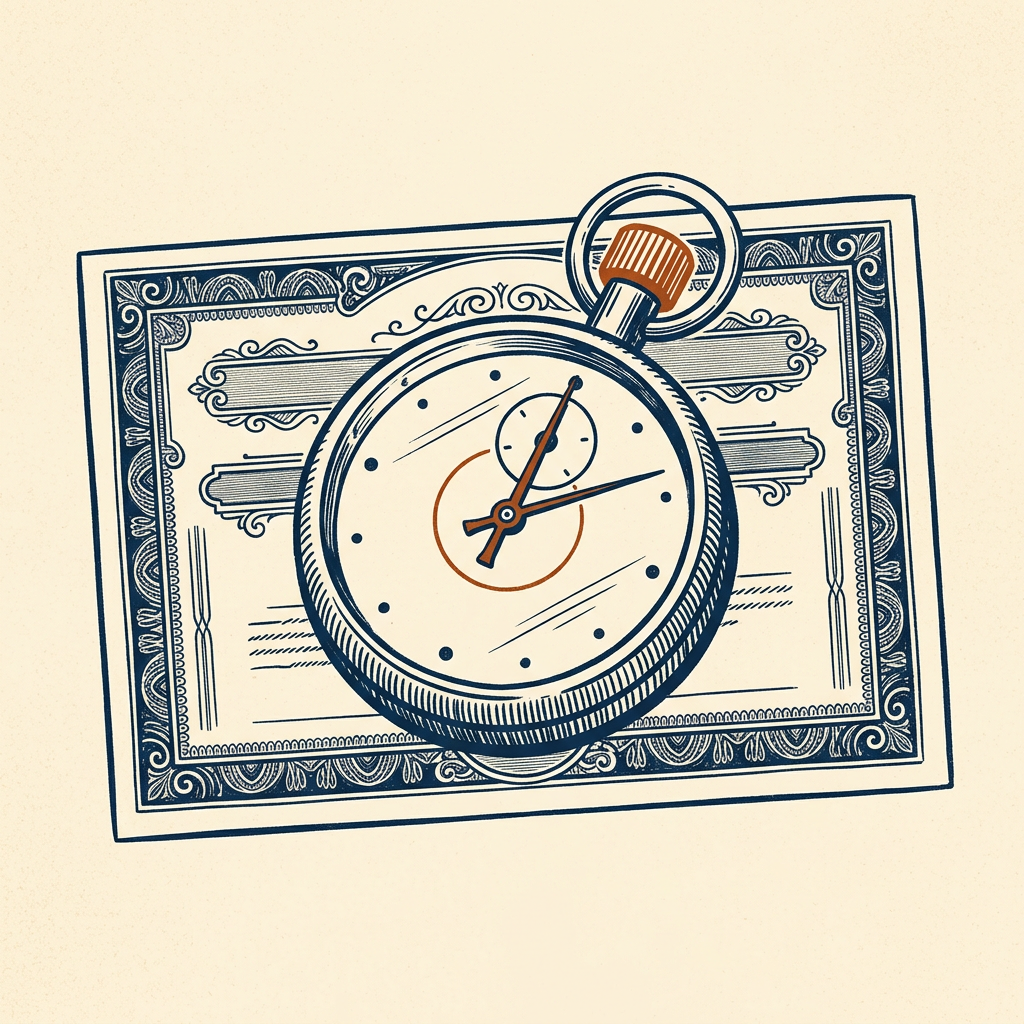
Boiler-room and pump-and-dump schemes work by manufacturing artificial time pressure that makes victims skip the ordinary verification steps that would expose the fraud.
- 1Seem realOffer shares in an actually listed company so basic existence checks pass
- 2Compress timeInsist the window closes today and hesitation equals permanent loss
- 3DumpInsiders sell their float into the artificial retail demand
Davies examines high-pressure securities operations that cold-call retail investors into worthless or vastly overvalued shares. The stock is usually a real, legally listed company, so a cautious check of its existence finds nothing obviously wrong—similar to a genuine-seeming product with a false core.
The sales tactic adds manufactured urgency. Callers stress that the opportunity closes today, that a takeover or contract is imminent, and that hesitation means missing out. The compression deliberately steals the window an investor would normally use for second opinions or basic research.
Meanwhile insiders who control the float quietly sell into the artificial demand the call center generates—the dump after the pump. Operations often target people who have already fallen for one scam, because prior victim lists are valuable commodities showing who is susceptible and unlikely to report from embarrassment.
The fraud is not mainly about faking a document. It is about denying the normal period in which trust is supposed to be tested. Cooling-off periods and cold-calling bans are direct attempts to put that missing time back.
In practice: Cold callers push a real listed stock while insisting a major announcement is imminent today, then insiders sell into the demand the pressure created.

8
Why fraud stays under-policed
Fraud is systematically under-caught relative to damage because the institutions and victims who should act face far weaker incentives than the fraudster faces to hide.
Prosecuting fraud requires proving intent to deceive—a higher bar than proving a loss occurred. Defendants with resources can mount lengthy defenses that prosecutors on fixed public budgets often cannot match.
Regulators face a related asymmetry. A fraud that eventually costs billions may first appear as one anomalous tip among thousands of routine complaints, easy to dismiss. That is what happened when the SEC repeatedly failed to act on Markopolos’s detailed Madoff warnings between 1999 and 2008.
Victims themselves often will not pursue claims. Sums per person may be too small to justify legal costs when losses are spread wide, or the sums are large but the victim is embarrassed—especially sophisticated investors and institutions worried about reputational damage.
Davies frames this as a collective-action problem. The fraudster concentrates enormous personal benefit; the cost is diffused across many parties, none of whom captures enough of the benefit from fixing it. The gap between true prevalence and resources devoted to catching fraud is therefore structural, not a simple failure of will.
In practice: Markopolos’s repeated, detailed warnings to the SEC about Madoff from 1999 onward were not enough to trigger action before the 2008 collapse.

9
Trust and fraud share a coin
A society cannot have less fraud without accepting less trust and slower commerce, or permanently paying for costly verification; there is no way to keep trust’s benefits without its vulnerabilities.
More trust
Faster, cheaper commerce at scale; higher residual fraud and larger bezzle in booms
More verification
Lower fraud but slower transactions, higher fees, and compliance drag paid by everyone
Every mechanism that lets an economy move faster than face-to-face cash—credit, limited liability, listed securities, wholesale trade on invoice—also creates an opening some fraction of participants will exploit.
Reducing fraud to near zero would require verifying every transaction as thoroughly as a suspicious buyer checks a stranger in a back alley. Most modern commerce would become too slow and expensive to function. Societies therefore choose an intermediate level of enforcement and accept a residual fraud rate as the price of trust-based efficiency, much as a baseline of loan defaults is accepted as the cost of extending credit at scale.
Regulation, auditing, and disclosure are best understood not as attempts to eliminate fraud but as investments that shift the tradeoff curve—buying somewhat less fraud at a somewhat higher fixed cost paid by everyone through fees, compliance overhead, and slower transactions.
Davies is skeptical of rhetoric that promises to end fraud entirely, viewing it as naive or as cover for someone selling expensive compliance products. The realistic goal is choosing a sustainable balance point. Every historical case in the book, from Kreuger to Madoff to Maxwell, marks a moment when that balance sat too far toward trust and was corrected only after the damage was done.
In practice: Credit, limited-liability companies, and invoice trade all speed commerce and simultaneously open the exact gaps long firms, control frauds, and Ponzis later exploit.
Key terms
- long firm A fraud that builds a real credit reputation with prompt small payments, then vanishes after one huge unpaid order.
- control fraud Fraud committed by the person legally handed power to run an institution, using that authority to hollow it out.
- bezzle The psychic wealth that exists between the moment fraud happens and the moment it is discovered; booms stretch it.
- Ponzi arithmetic The requirement that new money grow faster than promised returns, a race the operator is guaranteed to lose.
- boiler room A high-pressure cold-calling operation that sells overvalued shares by manufacturing artificial urgency.
- verification gap The space where checking costs more than a single transaction is worth, so rational buyers skip the test.
- trust-based exchange Commerce that extends credit or goods before full verification; the same system fraud parasitizes.
What to do
- Before extending credit or investing on a track record, name the specific mechanism that could let someone build a clean history now in order to cash it later, and price that risk explicitly.
- When a deal arrives with a closing deadline or limited window, treat the pressure itself as a warning and impose a deliberate delay before any money moves.
- In any oversight role, assume the people you audit could include someone acting in bad faith with legitimate authority, and design at least one check that does not need their cooperation.
- Centralize verification where individual checks do not pay—supply-chain tests, shared blacklists, cooling-off rules—rather than relying on each buyer’s vigilance.
- During booms, treat unusually smooth returns and easy refinancing as reasons to increase scrutiny, not reduce it.
Questions to think with
- Where in your own work do people extend trust before they can fully verify, and what would a long-firm style cash-out look like there?
- If a deal feels urgent, what ordinary second opinion or document check is the urgency designed to skip?
- Which of your oversight tools still assume the person at the top wants the institution to succeed honestly?
- When markets are rising, what hidden bezzle might simply be refinanced rather than discovered?
- What residual fraud rate is your organization actually willing to accept as the price of speed, and is that choice conscious?
The other side
The book’s persuasive power rests on vivid case studies rather than systematic data; Davies offers no aggregate time-series showing fraud truly rises in booms and falls in busts beyond the famous scandals he chose, stays almost entirely inside British and American financial history, predates the crypto collapses his framework fits, and stays diagnostic without concrete regulatory prescriptions.
Who it's for
Bankers, auditors, compliance officers, and regulators who need the logic behind the frauds they are meant to catch, plus general readers who want true-crime finance with real analytical spine underneath. Readers seeking a global victim-centered survey of romance or advance-fee scams, or a ready-made policy checklist, will find the scope narrower than the title suggests.