




Why top traders put hard risk rules before market forecasts
Sustained outperformance, Schwager argues, comes from capped losses and personal discipline more than from superior prediction.
IJR · Nov 3, 2026 · 13 min read
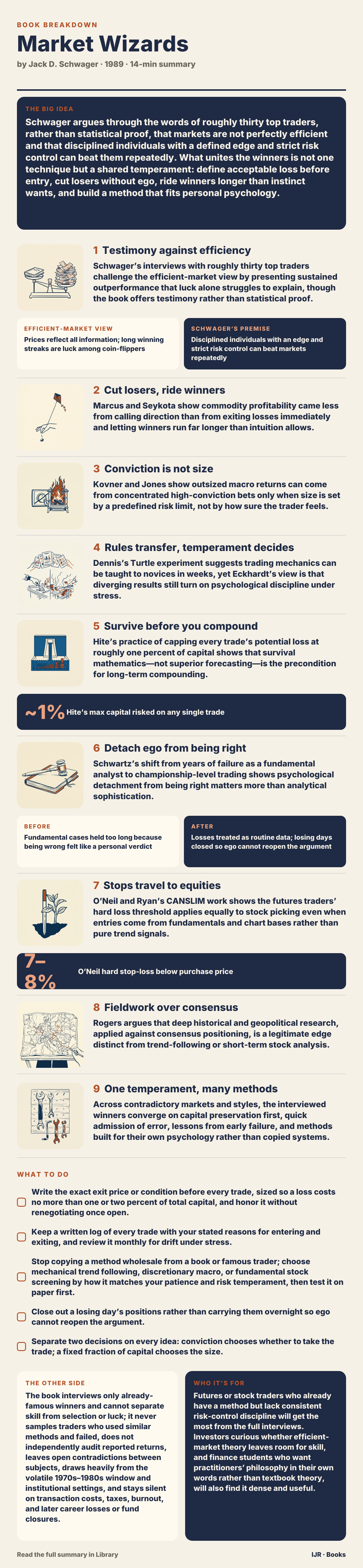
In 60 seconds
- Schwager interviews roughly thirty extraordinary traders to challenge efficient-market orthodoxy with testimony that disciplined people with an edge and strict risk control can beat markets repeatedly.
- Trend followers such as Marcus and Seykota made sustainable profits by cutting losses immediately and letting winners run far longer than intuition allows.
- Macro traders Kovner and Jones sized concentrated bets from predefined capital-at-risk limits, not from confidence in the forecast.
- Dennis’s Turtle program suggests trading rules can be taught in weeks, though Eckhardt stresses psychological fidelity under stress still splits results.
- Hite’s roughly one-percent risk-per-trade rule makes survival math—not forecasting quality—the precondition for compounding.
- Across contradictory methods the winners share capital preservation first, quick admission of error, lessons from early failure, and methods fitted to their own psychology.
The big idea
Schwager argues through the words of roughly thirty top traders, rather than statistical proof, that markets are not perfectly efficient and that disciplined individuals with a defined edge and strict risk control can beat them repeatedly. What unites the winners is not one technique but a shared temperament: define acceptable loss before entry, cut losers without ego, ride winners longer than instinct wants, and build a method that fits personal psychology.
The book in brief
By the late 1980s academic finance had largely settled on the efficient-market hypothesis: prices already reflect available information, so consistent outperformance looks like luck among a huge population of coin-flippers. Schwager, a futures researcher, had watched a small number of traders post returns that strained that story—long stretches of outsized gains at serious size. He sat down with roughly thirty of the most successful people in futures, stocks, and options and asked, in extended conversation, how they actually worked.
Early interviews center on commodity trend followers who treat trading more like systems engineering than forecasting. Their accounts stress mechanical exits from losers and the harder emotional work of staying with winners. The book then turns to discretionary macro traders who make concentrated bets on currencies, rates, and indices, still under strict rules about how much capital can be risked when a thesis is wrong.
A middle section tests whether the skill transfers. Richard Dennis recruited novices, taught a simple breakout system in about two weeks, and funded them; many traded profitably, yet results still varied with how faithfully people followed the rules under stress. That tension leads into the quantitative case that position sizing and risk of ruin matter more than prediction quality, and into the psychological case that knowing a loss rule is different from executing it when ego is on the line.
Later chapters widen the lens to growth-stock specialists who screen on earnings and relative strength yet still use hard percentage stops, and to a contrarian global investor who relies on historical and geopolitical fieldwork rather than charts. Closing reflections gather what recurs across these contradictory styles: capital preservation as the first constraint, early painful failure as a teacher, flexibility over stubborn conviction, and refusal to copy someone else’s system wholesale.
The book leaves contradictions standing and offers testimony rather than a controlled proof. Its lasting use is a close look at how seriously the winners treated risk, discipline, and self-knowledge.
Context
Jack D. Schwager was a futures researcher who interviewed roughly thirty top traders across stocks, futures, and options about how they produced extraordinary sustained returns in the 1970s and 1980s. Published in 1989, the book became a foundational text for a generation of professional and retail traders by putting practitioners’ own words on risk control, discipline, and personal method against the era’s efficient-market orthodoxy.
The key ideas

1
Testimony against efficiency
Schwager’s interviews with roughly thirty top traders challenge the efficient-market view by presenting sustained outperformance that luck alone struggles to explain, though the book offers testimony rather than statistical proof.
Efficient-market view
Prices reflect all information; long winning streaks are luck among coin-flippers
Schwager’s premise
Disciplined individuals with an edge and strict risk control can beat markets repeatedly
Academic finance by the late 1980s had largely settled on the efficient-market hypothesis: prices reflect all available information, so beating the market except by luck should be impossible. A long winning streak looked, in that frame, like the survivor of a huge coin-flipping population.
Schwager had watched a small number of traders post returns that strained that story—decades of triple-digit annual gains, or years without a single losing month, at sizes no lucky amateur could sustain. He did not build a statistical case. He went to the traders themselves across stocks, futures, and options and recorded extended conversations about path, mistakes, and rules.
The book groups interviews loosely by market and style and mostly keeps editorial voice out of the way. Contradictions stand unresolved: charts versus no charts, diversification versus concentration, mechanical systems versus feel. The diversity itself is presented as instructive—there is no single formula, but recurring habits of mind become visible once enough accounts sit side by side.
In practice: Subjects describe decades of triple-digit annual gains or multi-year stretches without a losing month at institutional position sizes.

2
Cut losers, ride winners
Marcus and Seykota show commodity profitability came less from calling direction than from exiting losses immediately and letting winners run far longer than intuition allows.
Michael Marcus and Ed Seykota represent trend following: markets move in extended directional runs, and the job is not to forecast the turn but to join a trend already underway and stay until it clearly ends.
Marcus was mentored early by Seykota in the single rule that mattered most—cut losses without hesitation before ego or hope turns a small loss large. At Commodities Corporation he turned a modest starting account into tens of millions over roughly a decade. The win rate was not high; a few large winners far outweighed many small, quickly abandoned losers.
Seykota framed trading as systems engineering more than forecasting: build a mechanical process that removes emotional interference, then trust it through the losing streaks any trend system produces in choppy markets. Both stressed that the hard part is psychological—staying in a winner long after intuition says take the money, and exiting a loser long before intuition says average down.
In practice: Marcus applied Seykota’s cut-loss rule at Commodities Corporation and compounded a modest account into tens of millions over about a decade through asymmetric winners, not a high win percentage.

3
Conviction is not size
Kovner and Jones show outsized macro returns can come from concentrated high-conviction bets only when size is set by a predefined risk limit, not by how sure the trader feels.
Bruce Kovner and Paul Tudor Jones built fortunes on discretionary judgment about currencies, interest rates, and stock indices informed by macro analysis, not mechanical trend rules.
Kovner’s formative mistake was borrowing against a credit card for an early trade, watching a large paper profit, then holding too long as it round-tripped nearly to breakeven. That episode taught him to define, before every entry, exactly how much he was willing to lose and to set the stop accordingly. At Caxton he sized every position as a fraction of capital at risk rather than as a vote of confidence.
Jones became known for positioning defensively ahead of the October 1987 crash after studying the 1929 pattern, and for the rule that protecting capital comes before seeking gains. A trader who avoids catastrophe stays alive long enough for a good year to compound. Both separate two decisions: conviction says whether to take the trade; an unemotional risk calculation says how large it may be. Conflating the two turns a good idea catastrophic when a rare high-conviction call fails.
In practice: Jones studied the 1929 crash pattern closely enough to position his fund defensively before October 1987 and profit from the decline.

4
Rules transfer, temperament decides
Dennis’s Turtle experiment suggests trading mechanics can be taught to novices in weeks, yet Eckhardt’s view is that diverging results still turn on psychological discipline under stress.
Richard Dennis turned a few hundred dollars borrowed from family into several hundred million trading commodities from the Chicago floors. He believed the success came from learnable rules, not a rare gift.
With William Eckhardt he recruited novices—many with no trading background—through a newspaper advertisement. Over roughly two weeks they taught a simple trend-following system: enter on breakouts from recent price ranges, size positions by market volatility, and cut losses at predetermined points. Each trainee then received real capital to apply the rules independently.
A significant number of the Turtles traded profitably for years, which Dennis read as proof that sound mechanics transfer to almost anyone who follows them exactly. Eckhardt, interviewed separately, was more cautious: identical rules still produced meaningfully different results because some trainees deviated under stress while others stayed faithful through losing streaks that felt, in the moment, like proof the system was broken. The scarce ingredient looks less like the rule set than the temperament to execute an uncomfortable rule set without deviation.
In practice: Dennis and Eckhardt taught novices a breakout system in about two weeks, funded them, and watched a significant number trade profitably for years—while results still split on rule fidelity.

5
Survive before you compound
Hite’s practice of capping every trade’s potential loss at roughly one percent of capital shows that survival mathematics—not superior forecasting—is the precondition for long-term compounding.
~1%
Hite’s max capital risked on any single trade
Larry Hite of Mint Investment Management built his philosophy around risk of ruin: the chance that a string of losses plus oversized positions will wipe an account even when the long-run strategy is sound.
His rule was never to risk more than a small fixed percentage of total capital—often cited around one percent—on any single trade, and to diversify across many uncorrelated markets so one bad stretch could not inflict serious damage. Even a system right sixty percent of the time will, over enough trades, produce five, six, or more consecutive losses purely by chance.
A trader risking ten percent per trade can be functionally destroyed by that streak; a trader risking one percent barely notices it. Hite’s frame reframes the earlier stories: Marcus’s fast cuts, Kovner’s predefined stops, and the Turtles’ volatility sizing are all implementations of the same constraint. A mediocre edge survives with proper sizing; an excellent edge fails when one oversized bet meets one bad outcome.
In practice: Hite never risked more than roughly one percent of capital on a single trade and spread exposure across uncorrelated markets so no one commodity stretch could wreck the account.

6
Detach ego from being right
Schwartz’s shift from years of failure as a fundamental analyst to championship-level trading shows psychological detachment from being right matters more than analytical sophistication.
Before
Fundamental cases held too long because being wrong felt like a personal verdict
After
Losses treated as routine data; losing days closed so ego cannot reopen the argument
Marty Schwartz spent roughly a decade as a fundamental securities analyst, underperforming and financially strained despite intelligence and effort. He needed to prove himself right through careful research, which made him slow to exit once he had built an intellectual case—too much identity was invested in being correct.
The turnaround came with a shift toward price-based technical trading and a new relationship to being wrong. A losing trade became routine information to act on immediately, not a referendum on judgment. That shift coincided with winning the US Investing Championship, a real-money short-term returns contest he treated as evidence of a structural change rather than simple luck.
He linked earlier struggles to personal history, including a drive for his father’s approval—trading performance tangled with psychology outside the market. The practical fix was procedural: habits like closing a losing day’s positions rather than carrying them home, so ego could not renegotiate the stop after the fact. Knowing the cut-loss rule is not the same as being able to execute it in the moment.
In practice: After abandoning ego-driven fundamental holds for technical rules and same-day loss exits, Schwartz won the US Investing Championship.

7
Stops travel to equities
O’Neil and Ryan’s CANSLIM work shows the futures traders’ hard loss threshold applies equally to stock picking even when entries come from fundamentals and chart bases rather than pure trend signals.
7–8%
O’Neil hard stop-loss below purchase price
William O’Neil, founder of Investor’s Business Daily, built CANSLIM around current and annual earnings growth, new products or leadership, supply and demand shown through volume, and relative price strength, among other factors. The method screens for growth companies before gains become obvious, starting from fundamentals and quantitative signals rather than pure price patterns.
David Ryan studied under O’Neil and won the US Investing Championship in stocks multiple times by applying the framework with rigorous consistency—buying breakouts from well-formed chart bases on strong volume and earnings, and treating any failed signal as a reason to exit.
The bridge back to the commodity traders is O’Neil’s hard stop-loss, commonly cited around seven to eight percent below purchase price, applied without exception no matter how compelling the original thesis. Define maximum acceptable loss before entry and honor it mechanically. The same principle used in currencies and grains survives the switch to equities, different entries, and different holding periods.
In practice: O’Neil insisted on a roughly seven-to-eight-percent stop below purchase price on growth stocks, transplanting the futures traders’ capital-preservation logic into equities.

8
Fieldwork over consensus
Rogers argues that deep historical and geopolitical research, applied against consensus positioning, is a legitimate edge distinct from trend-following or short-term stock analysis.
Jim Rogers, co-founder with George Soros of the Quantum Fund in the 1970s, works on a long horizon and is openly dismissive of chart-based technical analysis and of mainstream Wall Street research incentives.
His edge came from independent study of history, politics, and commodity cycles, often traveling to a country or region before committing capital. He looked for markets left for dead because recent history had been bad, then bought into pessimism once underlying fundamentals had turned—accepting an uncomfortable stretch of being early and looking wrong.
He was skeptical of brokerage research, arguing analysts and salespeople face structural conflicts that bias recommendations toward commissions rather than client returns. Placed after the technical chapters, his account blocks any reduction of the book to one technique: the shared trait is developing an independently verified view before risking capital, not a shared analytical tool.
In practice: Rogers often traveled to a country before investing, seeking ignored or left-for-dead markets where fundamentals had turned while consensus stayed pessimistic.

9
One temperament, many methods
Across contradictory markets and styles, the interviewed winners converge on capital preservation first, quick admission of error, lessons from early failure, and methods built for their own psychology rather than copied systems.
No single technique unites the people in the book. Some use charts, some ignore them; some hold for months, some for hours; some diversify broadly, some concentrate heavily.
What recurs is a small set of behavioral commitments. Every successful trader interviewed treats capital preservation as the first-order constraint, defining acceptable loss before entering rather than after. Nearly all describe an early period of significant loss or failure that forced a change in method or temperament—the later discipline was earned, not innate from the start.
Most value flexibility over conviction: exit or reverse the moment new information contradicts the thesis, without treating reversal as personal failure. Several reject copying another trader’s system wholesale; a workable method must match individual psychological tolerances. Michael Steinhardt’s short-term block-trading style would not suit Jim Rogers’s multi-year patience, and the reverse is also true.
The synthesis is professional seriousness: treat trading as a business with a defined, testable edge and strict loss limits, continuously adjusting method to changing markets and demonstrated personal strengths.
In practice: The book notes Steinhardt’s short-term block-trading style would not suit someone with Rogers’s multi-year patience, and vice versa—method must fit temperament.
Key terms
- Efficient-market hypothesis The academic view that prices already reflect available information, so consistent outperformance is mostly luck
- Trend following Joining a market move already underway and staying until it clearly ends, rather than forecasting turns
- Risk of ruin The chance that a loss streak plus oversized positions wipes out an account even if the long-run strategy is sound
- Position sizing How large a trade is, set from capital at risk rather than from confidence in the idea
- Turtles Novices Dennis and Eckhardt trained on a simple breakout system and funded to test whether trading rules can be taught
- CANSLIM O’Neil’s stock framework combining earnings growth, new products or leadership, volume-driven supply and demand, and relative strength
- Stop-loss A predefined price or loss level at which a trade is exited without renegotiation
- Discretionary macro Judgment-based trading of currencies, rates, and indices informed by economic analysis rather than pure mechanical signals
What to do
- Write the exact exit price or condition before every trade, sized so a loss costs no more than one or two percent of total capital, and honor it without renegotiating once open.
- Keep a written log of every trade with your stated reasons for entering and exiting, and review it monthly for drift under stress.
- Stop copying a method wholesale from a book or famous trader; choose mechanical trend following, discretionary macro, or fundamental stock screening by how it matches your patience and risk temperament, then test it on paper first.
- Close out a losing day’s positions rather than carrying them overnight so ego cannot reopen the argument.
- Separate two decisions on every idea: conviction chooses whether to take the trade; a fixed fraction of capital chooses the size.
Questions to think with
- Before your last few trades, did you write the maximum loss and exit condition while calm, or only after the position moved?
- When a trade goes against you, do you treat the loss as information or as a verdict on your judgment?
- Which style in these interviews—trend following, discretionary macro, growth-stock screening, or long-horizon contrarian research—actually matches how long you can sit with discomfort?
- If you taught your exact rules to someone else, would their results match yours, or would discipline under a losing streak be the real variable?
- Are you sizing positions from how sure you feel, or from a fixed fraction of capital you can afford to lose?
The other side
The book interviews only already-famous winners and cannot separate skill from selection or luck; it never samples traders who used similar methods and failed, does not independently audit reported returns, leaves open contradictions between subjects, draws heavily from the volatile 1970s–1980s window and institutional settings, and stays silent on transaction costs, taxes, burnout, and later career losses or fund closures.
Who it's for
Futures or stock traders who already have a method but lack consistent risk-control discipline will get the most from the full interviews. Investors curious whether efficient-market theory leaves room for skill, and finance students who want practitioners’ philosophy in their own words rather than textbook theory, will also find it dense and useful.