




Fewer measurable goals beat a long list of vague ones
Focus by subtraction—a handful of public goals checked weekly and cut free from pay—beats scattered annual ambition.
IJR · Oct 13, 2026 · 10 min read
In 60 seconds
- Doerr argues organizations fail less from bad goals than from too many vague ones that never force real tradeoffs.
- OKRs pair a qualitative Objective with a few measurable Key Results, ideally three to five objectives each with no more than five results.
- He insists goals stay public across the company, get scored continuously on a 0.0–1.0 scale, and stay fully separate from bonuses and ratings.
- Aspirational targets are calibrated so roughly 70 percent achievement counts as success; committed targets still aim for 100 percent.
- Annual reviews should yield to ongoing CFRs—conversations, feedback, and recognition—tied to the same weekly rhythm.
- OKRs amplify existing culture rather than create a healthy one; every major proof case is a well-resourced success story.
The big idea
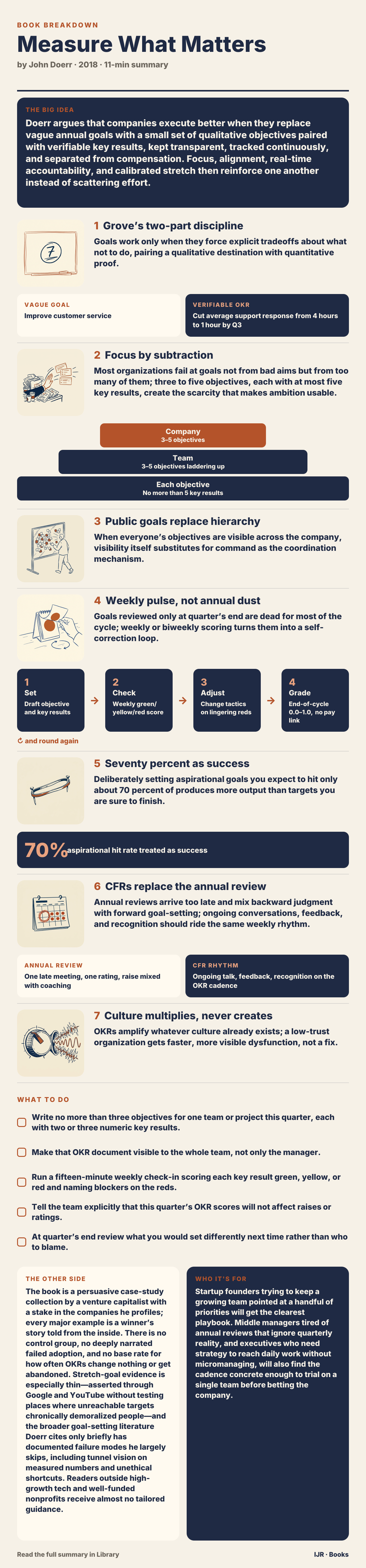
Doerr argues that companies execute better when they replace vague annual goals with a small set of qualitative objectives paired with verifiable key results, kept transparent, tracked continuously, and separated from compensation. Focus, alignment, real-time accountability, and calibrated stretch then reinforce one another instead of scattering effort.
The book in brief
The book opens on the failure mode of corporate goals that sound ambitious yet cannot be verified, so they never force anyone to drop competing work. It roots the fix in a two-part discipline: a qualitative destination plus quantitative signposts that prove arrival, graded honestly rather than used as slogans.
From there the argument builds four linked powers. First comes scarcity—few enough priorities that people can actually remember and act on them, drafted both top-down and bottom-up. Second is radical visibility, so teams catch misalignment in weeks rather than at quarter’s end. Third is a continuous check-in rhythm that turns goals into a living self-correction loop instead of a January document revisited in December. Fourth is stretch calibration, where partial hits on ambitious targets drive more experimentation than guaranteed full completion.
The same logic then dismantles the annual performance review. Doerr wants ongoing conversations, feedback, and recognition to ride the tracking cadence already in place, separating improvement talk from raise decisions.
Late chapters qualify the whole system: it multiplies whatever trust and psychological safety already exist. The book lands on a plain practitioner claim—write down a few things that matter, make the proof numbers visible, check them far more often than once a year—while conceding that nearly every illustrated win comes from talent-dense, well-funded organizations.
Context
John Doerr learned the system from Andy Grove’s Intel operations reviews in the 1970s and carried it to a forty-person Google in 1999 with a slide deck he still keeps. The book mattered because it handed a generation of tech companies a shared vocabulary for turning strategy into measurable execution.
The key ideas

1
Grove’s two-part discipline
Goals work only when they force explicit tradeoffs about what not to do, pairing a qualitative destination with quantitative proof.
Vague goal
Improve customer service
Verifiable OKR
Cut average support response from 4 hours to 1 hour by Q3
Doerr’s origin story is sitting in Grove’s reviews and watching every goal split in two: an Objective as the destination people can say out loud, and Key Results as the numbers that prove you arrived. Most corporate aims fail from vagueness, not low ambition; a slogan cannot be checked, so it never forces anyone to abandon competing work.
Grove graded results on a 0.0-to-1.0 scale and treated a string of perfect 1.0s as evidence the bar sat too low. The same discipline had to survive crisis: when competition threatened the core business, every division had to state in measurable terms what dropping old priorities actually meant.
Doerr treats the mechanism as content-neutral. The same explicit-objective-plus-verifiable-results pattern scaled, in his telling, from a chip maker to a search company because honesty of measurement mattered more than the industry.
In practice: Grove’s Intel used the system to pivot company-wide from memory chips toward microprocessors, requiring each division to quantify what abandoning the old line of work would look like.

2
Focus by subtraction
Most organizations fail at goals not from bad aims but from too many of them; three to five objectives, each with at most five key results, create the scarcity that makes ambition usable.
- Company3–5 objectives
- Team3–5 objectives laddering up
- Each objectiveNo more than 5 key results
Ambition without constraint produces paralysis. When everything is labeled priority, nothing receives enough attention to move. Doerr’s first superpower is therefore subtraction: leadership and teams alike keep the list short enough that people can hold it in their heads.
The cadence is quarterly or annual. Top-level OKRs come first, then teams draft their own that ladder upward, yet roughly half the drafting runs bottom-up so people closest to the work shape the how. Later powers—transparency, stretch, tracking—only function once this scarcity is already in place; a public list of twenty aims is just visibility into noise.
Doerr never fully proves with controlled data that the narrowing itself causes the gain rather than simply marking companies that would have focused anyway. He still treats the discipline of saying no as the foundation every other chapter assumes.
In practice: Remind’s founders sprawled across a dozen fronts until they narrowed to one top-line objective—growing daily active teacher usage—and let secondary aims wait; traction followed the cut.

3
Public goals replace hierarchy
When everyone’s objectives are visible across the company, visibility itself substitutes for command as the coordination mechanism.
Alignment, in Doerr’s account, comes from radical transparency rather than tighter top-down orders. Marketing can see engineering’s key results and the reverse, so duplicated effort and late surprises drop; misalignment surfaces in week two instead of the quarter’s post-mortem.
He distinguishes true connection from mere cascading. Goals should link logically, not be copy-pasted downward. In well-run systems he describes, roughly 20 percent of team OKRs do not tie neatly to any parent goal at all; he reads that remainder as healthy local initiative, not dysfunction.
This power depends on the prior scarcity rule. Transparency without focus only broadcasts chaos. Once the list is short, making it public lets people coordinate without waiting for a manager to notice the collision.
In practice: At Google, Larry Page’s top-level company OKRs were visible to every employee, so an engineer could trace quarterly work to product-wide bets such as Chrome’s early growth targets.

4
Weekly pulse, not annual dust
Goals reviewed only at quarter’s end are dead for most of the cycle; weekly or biweekly scoring turns them into a self-correction loop.
- 1SetDraft objective and key results
- 2CheckWeekly green/yellow/red score
- 3AdjustChange tactics on lingering reds
- 4GradeEnd-of-cycle 0.0–1.0, no pay link
↻ and round again
Traditional annual goal-setting writes targets in January and revisits them in December, rendering them irrelevant by March. Doerr’s third superpower is a light, frequent rhythm: individuals score each key result, flag it green, yellow, or red, and name blockers in minutes, not as theater for leadership but as their own early-warning system.
A result stuck on red for two consecutive check-ins should trigger a tactic change before the quarter is lost. At cycle’s end the same 0-to-1.0 score appears, yet Doerr repeats that the score must stay decoupled from performance reviews and compensation—the single most common implementation failure he sees. Tie key results to bonuses and people set safe targets, killing stretch.
He is candid that the cadence demands real management discipline and a fast habit or tool. Skipped check-ins or stale dashboards quietly restore the annual-review pattern the system was meant to replace.
In practice: Zume Pizza caught a stalled key result on truck-routing efficiency early enough to redesign the approach mid-quarter instead of writing a failure post-mortem.

5
Seventy percent as success
Deliberately setting aspirational goals you expect to hit only about 70 percent of produces more output than targets you are sure to finish.
70%
aspirational hit rate treated as success
Following Grove and Google’s later convention, Doerr splits goals in two. Committed OKRs—shipping a promised feature, hitting a sales number—still aim at 100 percent and carry clearer accountability. Aspirational OKRs are aimed higher on purpose; landing near 70 percent counts as success because a target guaranteed to finish was definitionally too easy to change behavior.
He admits the psychological cost. Teams can feel like failures when they land at 70 percent of a stretch number. Cultural retraining is required, especially the prior separation of scores from judgment of the person; without that firewall the stretch culture demoralizes rather than energizes.
This is where the book’s evidence is thinnest. Doerr offers survivor stories from companies that already had strong cultures and resources, not data on failure rates or morale damage at places that tried stretch goals and abandoned them.
In practice: YouTube under Susan Wojcicki set an OKR for one billion hours of daily watch time when the platform sat far below that mark; the near-impossibility reoriented recommendations and autoplay until the number was hit in 2016.

6
CFRs replace the annual review
Annual reviews arrive too late and mix backward judgment with forward goal-setting; ongoing conversations, feedback, and recognition should ride the same weekly rhythm.
Annual review
One late meeting, one rating, raise mixed with coaching
CFR rhythm
Ongoing talk, feedback, recognition on the OKR cadence
Doerr extends OKR logic outward: a single yearly meeting and numeric rating cannot capture a year of work, cannot correct course in time, and confuses two incompatible jobs—helping someone improve and deciding their raise—inside one document.
His replacement is CFRs: Conversations, Feedback, and Recognition. If OKR check-ins already happen weekly, performance talk becomes a natural extension rather than a dreaded ritual bolted on top. Lightweight peer feedback and recognition tools keep the signal frequent and distributed.
The case rests heavily on cash-rich technology firms that already possessed strong management cultures and could retrain managers. He does not show comparable results at resource-constrained companies or in settings where documented, defensible ratings remain a legal necessity.
In practice: Adobe’s 2012 drop of formal annual reviews in favor of frequent manager check-ins was reported to reduce voluntary turnover; Google paired the rhythm with peer-to-peer thanks tools.

7
Culture multiplies, never creates
OKRs amplify whatever culture already exists; a low-trust organization gets faster, more visible dysfunction, not a fix.
Late case studies qualify every earlier claim. Doerr now treats the system as a multiplier, not a cultural transplant. Dysfunction plus transparent goals simply surfaces the dysfunction sooner.
He revisits Intel with more ambivalence than in earlier tellings: OKRs coexisted with a fear-driven style under Grove, producing results at a human cost he no longer soft-pedals. He contrasts that climate with Google’s early psychological safety, where tolerance for ambitious failure let stretch goals function as intended rather than as threats.
The selection problem is real and only partly acknowledged. Nearly every profiled company was already succeeding by conventional measures, talent-dense and well-resourced, before OKRs arrived. Isolating the framework’s causal contribution from the underlying quality of people and market position remains difficult; calling OKRs “not a silver bullet” gestures at the limit without fully mapping what the system looks like in mediocre hands.
In practice: Doerr contrasts fear-tinged OKR use in one Intel period with Google under Page and Brin, where safety let stretch targets drive experimentation instead of anxiety.
Key terms
- OKR A qualitative Objective paired with a few measurable Key Results that prove progress
- Objective The memorable, qualitative destination for a cycle
- Key Result A quantitative signpost, ideally scored 0.0 to 1.0, that shows whether the objective was reached
- Committed OKR An operational target expected to hit 100 percent and tied more tightly to accountability
- Aspirational OKR A stretch target calibrated so roughly 70 percent achievement counts as success
- CFR Conversations, Feedback, and Recognition—ongoing performance talk meant to replace the annual review
- Superpowers Doerr’s four claimed gains: focus, alignment, tracking, and stretch
What to do
- Write no more than three objectives for one team or project this quarter, each with two or three numeric key results.
- Make that OKR document visible to the whole team, not only the manager.
- Run a fifteen-minute weekly check-in scoring each key result green, yellow, or red and naming blockers on the reds.
- Tell the team explicitly that this quarter’s OKR scores will not affect raises or ratings.
- At quarter’s end review what you would set differently next time rather than who to blame.
Questions to think with
- Which current goals could you cut this week so the remaining three actually receive attention?
- If every teammate could see everyone else’s key results tomorrow, what misalignment would surface first?
- Are your stretch targets truly calibrated for ~70 percent success, or are they quietly safe?
- Where does your organization still tie goal scores to bonuses, and what safer targets might that produce?
- What cultural precondition—trust, fear, resources—would OKRs amplify rather than fix if you adopted them now?
The other side
The book is a persuasive case-study collection by a venture capitalist with a stake in the companies he profiles; every major example is a winner’s story told from the inside. There is no control group, no deeply narrated failed adoption, and no base rate for how often OKRs change nothing or get abandoned. Stretch-goal evidence is especially thin—asserted through Google and YouTube without testing places where unreachable targets chronically demoralized people—and the broader goal-setting literature Doerr cites only briefly has documented failure modes he largely skips, including tunnel vision on measured numbers and unethical shortcuts. Readers outside high-growth tech and well-funded nonprofits receive almost no tailored guidance.
Who it's for
Startup founders trying to keep a growing team pointed at a handful of priorities will get the clearest playbook. Middle managers tired of annual reviews that ignore quarterly reality, and executives who need strategy to reach daily work without micromanaging, will also find the cadence concrete enough to trial on a single team before betting the company.