




Even your worst parts are trying to protect you
Therapists and anyone stuck in self-criticism, addiction, or trauma get a method that treats inner conflict as protection rather than pathology.
IJR · Oct 31, 2026 · 14 min read
In 60 seconds
- Schwartz holds that the mind is naturally multiple—a system of subpersonalities with their own ages, memories, and agendas—not one unified self that must be forced into a single voice.
- He contends that rage, addiction, bingeing, and self-harm come from parts trying to shield unbearable pain, so the problem is the burden a part carries, not the part itself.
- Beneath the parts sits Self, an unconditioned core marked by calm, curiosity, and compassion that trauma can bury but never destroy.
- Lasting change, he argues, requires unblending from an activated part so Self can meet it, then retrieving the exile it guards and releasing the burden.
- The same protective roles, he proposes, scale to couples and political tribalism, though he presents those extensions more as analogy than tested theory.
- Nothing inside you is broken; some part is simply still doing an old job it no longer needs to do.
The big idea
Schwartz contends the psyche is a family of parts—managers, firefighters, and exiles—each trying to protect rather than sabotage, and that an undamaged core he calls Self can lead them once they are met with curiosity instead of force. Healing means separating enough to honor why a part took its extreme job, then retrieving the wounded exile it guards and releasing the burden it carries.
The book in brief
Schwartz built the model from 1980s sessions with bulimia clients who described distinct inner voices—a part that binges when anxious, a part that despises the self afterward—rather than a single I. Conventional therapy treated that language as metaphor to be reduced. He took it literally, asked clients to speak directly with the parts, and found faster, deeper change than confrontation or behavioral technique produced. From those sessions he held that every mind is composed of many parts, each with its own history and agenda, and that health is a well-organized internal family under wise leadership, not forced unity into one personality.
He names what can lead the parts: Self. Self is not another part, not a trait, and not something built by years of effort. It appears as the 8 C's—calm, curiosity, compassion, confidence, courage, creativity, clarity, and connectedness—and remains accessible regardless of abuse or chaos because it is not created by circumstance. Trauma only buries it under protective parts, so a person feels chronically anxious, numb, or enraged. Clients who briefly access Self often feel sudden spacious compassion toward childhood memories they could not face for decades. The therapist’s job is therefore not to supply wisdom but to help the client’s own Self step forward.
Protective parts organize into three roles. Managers work proactively to keep life controlled and pain out of awareness. Exiles hold the actual wound, often frozen at the age it occurred, carrying shame, terror, or grief. Firefighters react the instant an exile’s pain leaks, using drinking, bingeing, rage, self-harm, or dissociation to extinguish the feeling at any long-term cost. Managers and firefighters frequently collide, producing the familiar cycle of restriction then binge, or restraint then explosive anger. Treating the firefighter’s behavior alone through willpower or punishment leaves the driving exile untouched.
The title claim follows directly: no part is bad, only burdened. A burden is an extreme belief or emotion absorbed in a painful event and carried thereafter as permanent truth. The part itself remains a capable, well-intentioned aspect of the person. Once its protective intent is honored, even a harsh inner critic can soften. Change then proceeds by unblending—separating enough from an activated part that Self can relate to it with curiosity—followed by retrieval of the exile from the frozen scene and unburdening of the belief it carries. Protectors are checked afterward and often release jobs they no longer need.
Schwartz extends the same logic outward. Some burdens are legacy burdens inherited from family or culture rather than earned in the client’s own life. Couples locked in pursue-withdraw cycles and political tribes guarding collective wounds, he suggests, follow the same protector-exile pattern. He closes by treating Self as possibly continuous with a larger field of awareness, while noting that the clinical method of unblending, retrieval, and unburdening does not require accepting the metaphysics.
Context
Richard C. Schwartz draws on decades of clinical work to present Internal Family Systems as a structured alternative to diagnosis-first treatment. The 2021 book mattered because it reframed psychopathology as misunderstood protection and offered general readers a practical way to befriend rather than fight their own minds.
The key ideas
1
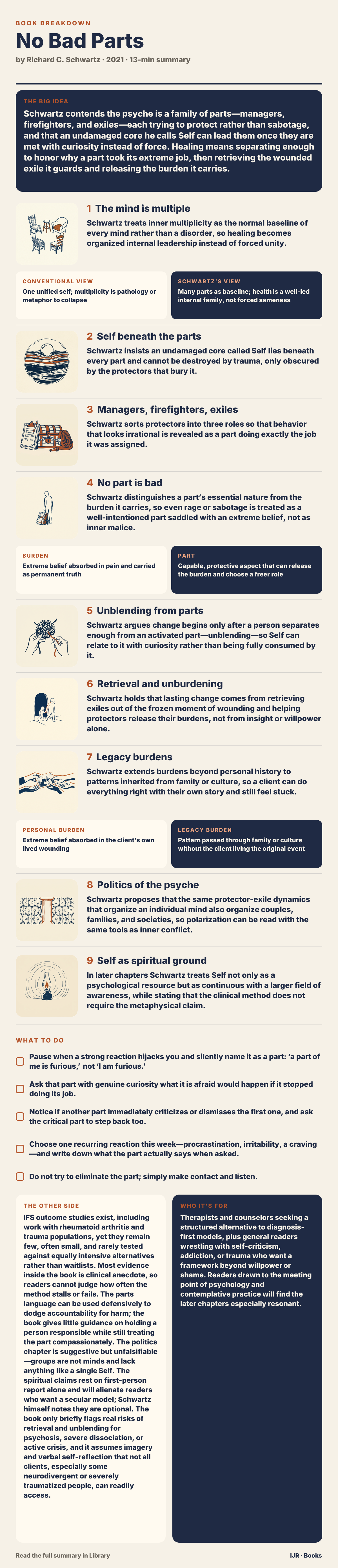
The mind is multiple
Schwartz treats inner multiplicity as the normal baseline of every mind rather than a disorder, so healing becomes organized internal leadership instead of forced unity.
Conventional view
One unified self; multiplicity is pathology or metaphor to collapse
Schwartz’s view
Many parts as baseline; health is a well-led internal family, not forced sameness
In the 1980s Schwartz noticed bulimia clients speaking of distinct voices inside rather than a single continuous I. Conventional approaches heard metaphor and tried to collapse the voices into one integrated personality. He did the reverse: he took the language literally and invited clients to address the parts directly.
The shift produced faster change than confrontation or standard behavioral work. From it he built the claim that everyone’s mind contains many parts, each with its own age, memories, beliefs, and agenda, much like members of a family. This is not dissociative identity disorder; IFS treats multiplicity as the ordinary condition of all minds.
A part might be an inner critic formed at eight, a playful part that never got to be a child, or a controlling part that seized control after a parent’s divorce. None is the whole person. None should be silenced. The work is to help them coexist under wise internal leadership rather than to erase them into one voice.
In practice: Clients described ‘a part of me that binges when I’m anxious’ and ‘a part that despises myself afterward’; speaking to those parts as real produced deeper relief than treating the language as mere metaphor.

2
Self beneath the parts
Schwartz insists an undamaged core called Self lies beneath every part and cannot be destroyed by trauma, only obscured by the protectors that bury it.
If the mind is many parts, something must be able to relate to all of them without itself being a part. Schwartz calls that capacity Self. He describes it through the 8 C’s: calm, curiosity, compassion, confidence, courage, creativity, clarity, and connectedness.
Self is not manufactured by therapy or built through years of effort. Every person retains access to it no matter how severe the history, because Self is not created by circumstance and therefore cannot be erased by it. What trauma does is pile protective parts on top of it, so the person feels only anxiety, numbness, or rage.
The practical claim is optimistic: healing is not installing new capacities but clearing the parts that block a capacity already present. The therapist’s role shrinks accordingly—not to be the source of safety or wisdom, but to help the client’s own Self step forward and lead.
In practice: After even brief guided work, clients unexpectedly access clear, spacious compassion toward a childhood memory they had spent decades unable to face.

3
Managers, firefighters, exiles
Schwartz sorts protectors into three roles so that behavior that looks irrational is revealed as a part doing exactly the job it was assigned.
Managers work ahead of time to keep life controlled and painful feelings out of awareness. A perfectionist part that demands flawless performance is a classic manager. Exiles hold the actual pain, usually frozen at the age of the wound, carrying shame, terror, or grief the rest of the system tries to lock away.
Firefighters activate the moment an exile’s feeling leaks. They use extreme, immediate measures—drinking, bingeing, self-harm, dissociation, rage—to smother the feeling regardless of later cost. Managers want control; firefighters want instant relief. The collision produces the familiar loop of restriction followed by binge, or tight restraint followed by explosive anger.
The clinical stake is direct. Treating only the firefighter’s behavior through willpower, punishment, or medication alone leaves the exile’s pain untouched. Real change eventually requires reaching the exile, yet that cannot happen safely until the protectors trust the person will not be left defenseless.
In practice: A man who binge-drinks at the first flicker of loneliness looks self-destructive; from inside the system his firefighter is successfully doing its one job—smothering an unbearable feeling before the exile can overwhelm him.
4
No part is bad
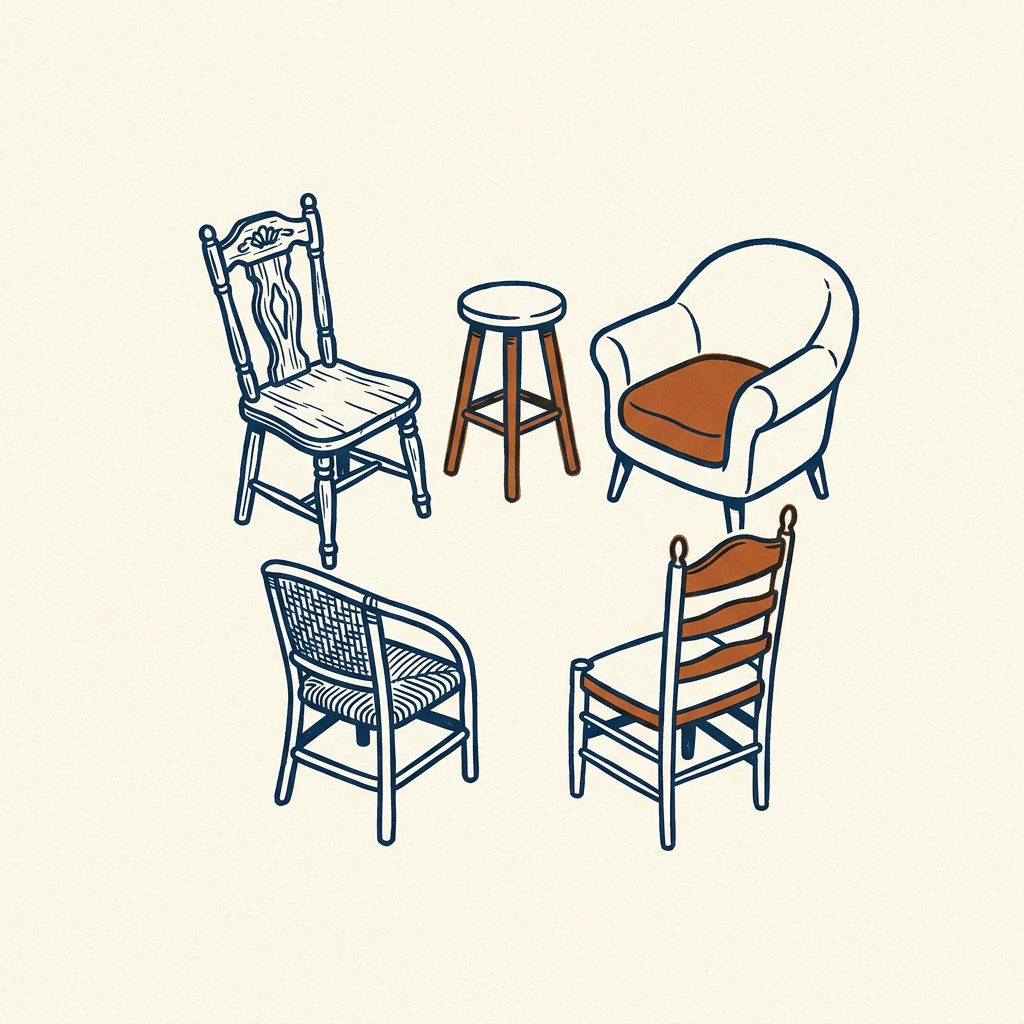
Schwartz distinguishes a part’s essential nature from the burden it carries, so even rage or sabotage is treated as a well-intentioned part saddled with an extreme belief, not as inner malice.
Burden
Extreme belief absorbed in pain and carried as permanent truth
Part
Capable, protective aspect that can release the burden and choose a freer role
A burden is an extreme belief or emotion—‘I am worthless,’ ‘everyone eventually abandons you’—absorbed during a painful event and then carried by a part as if it were permanent truth. The part is not the burden. The part is a capable aspect of the person that got saddled with the burden while trying to protect the system.
When an inner critic is met directly rather than fought, it often reveals it took on its harsh voice early because a parent’s rage felt less frightening if the child criticized herself first. Once that protective intent is recognized and honored, the critic frequently softens of its own accord.
Schwartz contrasts this stance with diagnostic labels that name a person by their most desperate protector. Calling someone borderline or narcissistic, he argues, can entrench the very extreme behavior clinicians hope to change. The claim that no part is evil does not excuse harm or erase consequences; it changes the internal and clinical stance from suppression and shame to curiosity and negotiation, which he holds is what actually produces lasting change.
In practice: An inner critic that berated a client without rest had formed at age seven to pre-empt a parent’s unpredictable anger; once its intent was honored, it willingly eased.
5
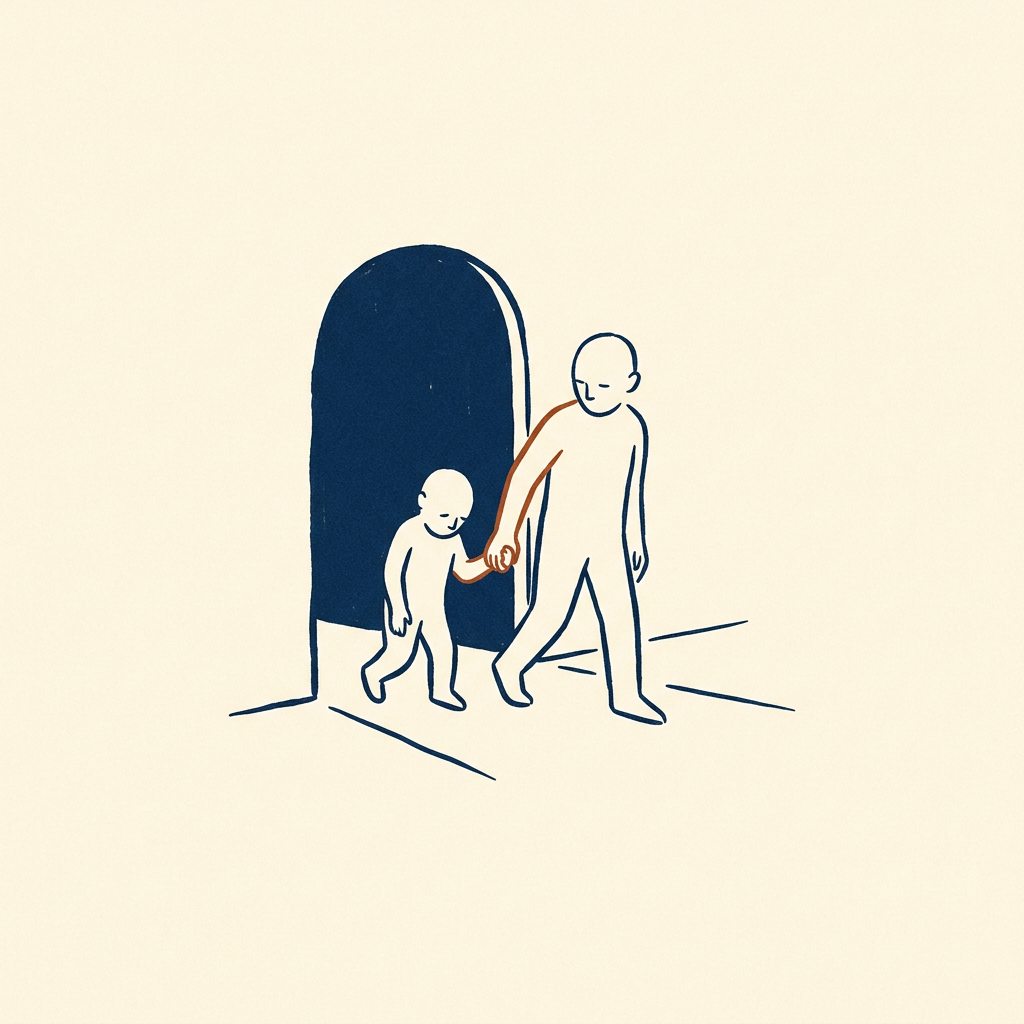
Unblending from parts
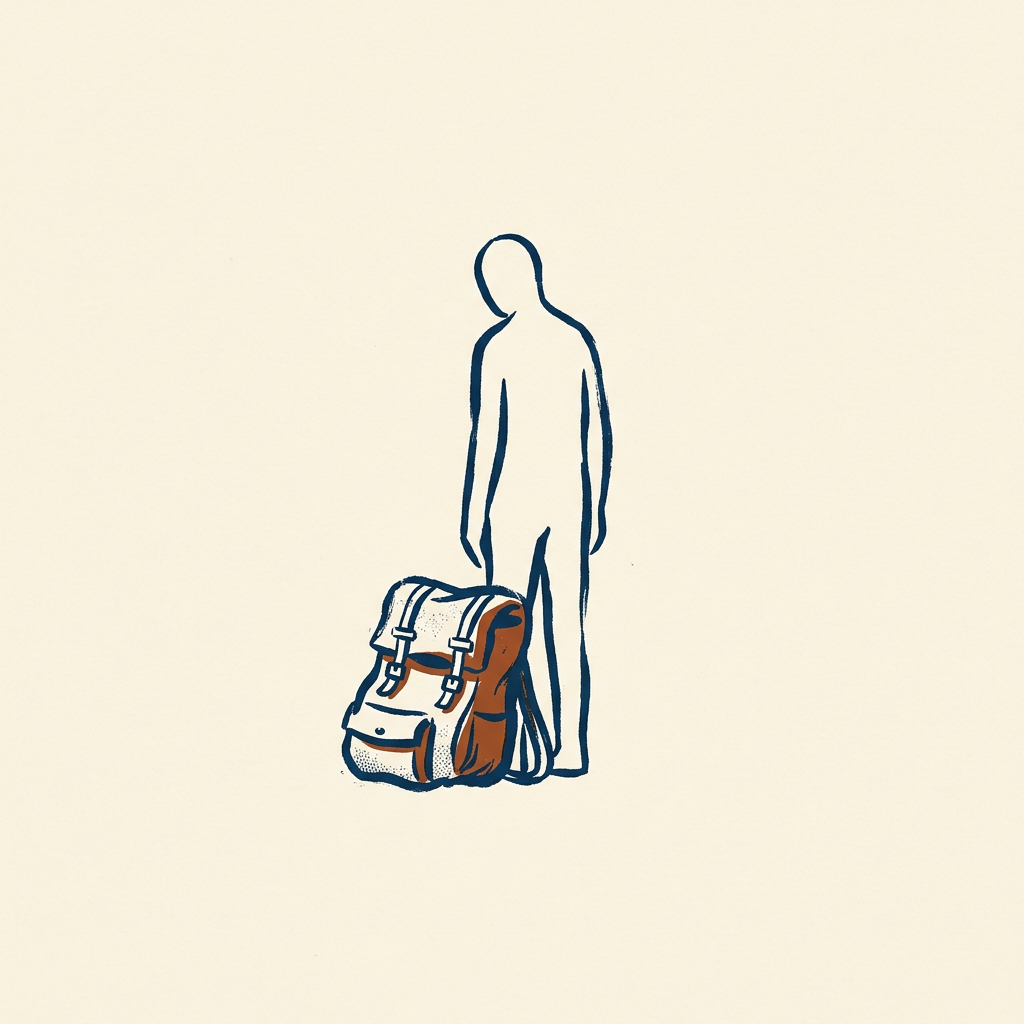
Schwartz argues change begins only after a person separates enough from an activated part—unblending—so Self can relate to it with curiosity rather than being fully consumed by it.
Parts frequently take over completely. Schwartz calls that state being blended: the person does not feel a part of them is angry; they feel they are anger. Insight or willpower attempted while still blended tends to produce understanding without lasting relief.
The in-session move is simple and repeated. Locate the part in or around the body. Ask how you feel toward it right now. Hatred, fear, or impatience signals that another part has blended in, because those reactions are not qualities of Self. Self meets even destructive parts with curiosity.
The reactive part is asked to step back temporarily. The check is repeated until the person can honestly say they feel curious or open. Only then does dialogue with the target part begin. Sequencing unblending before exploration is what Schwartz claims separates IFS from approaches that challenge thoughts while the person remains fused with the fear or shame generating them.
In practice: A therapist asks a client how they feel toward an angry part; if the answer is hatred, that second reactive part is asked to step back before any work with the anger itself continues.
6
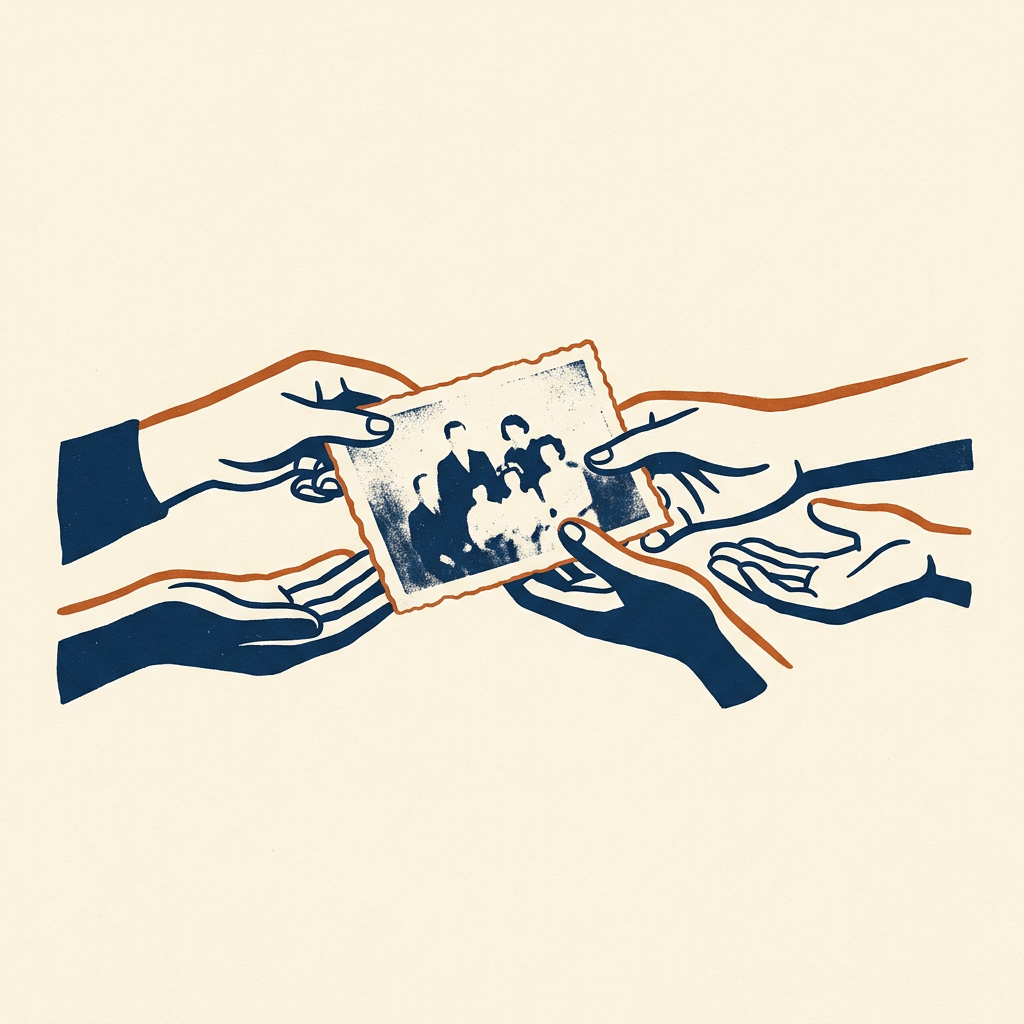
Retrieval and unburdening
Schwartz holds that lasting change comes from retrieving exiles out of the frozen moment of wounding and helping protectors release their burdens, not from insight or willpower alone.
Once a protector trusts Self enough to relax, work moves toward the exile it has guarded. From Self the client revisits the scene where the exile is stuck—sometimes imagining walking into the childhood room—and brings that younger part into present safety.
The part is then invited to release its burden, often through an image of water carrying it away, fire burning it, or wind dispersing it. Schwartz reports clients experience the moment as vivid and often accompanied by physical relief. He treats the image as a container the mind uses to mark the shift; what matters is that the belief genuinely lifts rather than being merely discussed.
Afterward the part is invited to take on qualities it actually wants—playfulness, trust, curiosity—instead of the role it was forced into. Guarding protectors are checked back in; a hypervigilant manager may no longer need that job and can settle into lighter attentiveness. The full sequence—contact, trust, retrieval, unburdening, reintegration—matters because skipping ahead, especially trying to unburden before protectors trust the process, risks flooding the person with unmanageable pain.
In practice: A client imagines entering the childhood room where an exile remains frozen, brings the part into present safety, and watches the belief ‘I am unlovable’ lift as if carried off by water.
7
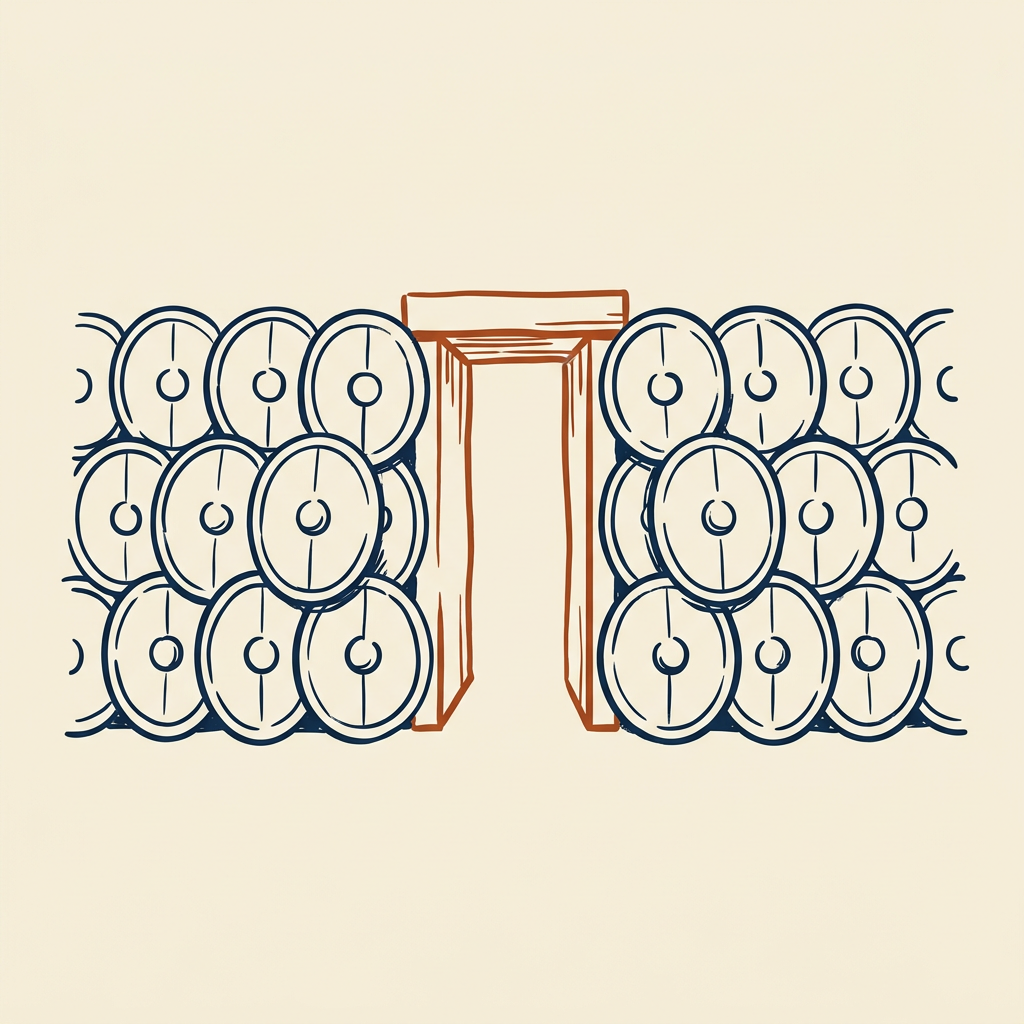
Legacy burdens
Schwartz extends burdens beyond personal history to patterns inherited from family or culture, so a client can do everything right with their own story and still feel stuck.
Personal burden
Extreme belief absorbed in the client’s own lived wounding
Legacy burden
Pattern passed through family or culture without the client living the original event
Some intense shame or fear does not map onto anything in the client’s own life. It traces instead to a parent’s or grandparent’s unspoken trauma—war, displacement, abuse, poverty—absorbed in childhood as if by osmosis. Schwartz also points to cultural and collective burdens such as internalized racism or chronic vigilance carried by descendants of historically oppressed groups.
These operate on the individual the same way personal burdens do: as absolute truths a part holds even though the person never lived the founding event. The clinical implication is that examining only one’s own timeline can leave the real load untouched.
IFS technique still applies. A part can be asked where the burden came from; sometimes the answer is ‘my mother’s mother,’ and the part can then release what it never should have had to carry. Schwartz himself notes this extension rests more on clinical anecdote than controlled evidence, yet it follows the core logic: if burdens are separable from the parts that carry them, origin need not be limited to the carrier’s direct experience.
In practice: A client carrying crushing shame that matched no event in their own history traced it to a grandmother’s unspoken trauma and released a burden the part had absorbed rather than earned.
8
Politics of the psyche
Schwartz proposes that the same protector-exile dynamics that organize an individual mind also organize couples, families, and societies, so polarization can be read with the same tools as inner conflict.
A couple locked in withdraw-and-pursue is, in his account, structurally identical to an internal fight between a manager controlling distance and a firefighter reacting to feared abandonment. Each partner’s protector triggers the other’s exile.
He scales the pattern further to political tribalism. Groups that feel historically wounded develop collective protectors—sometimes extreme rhetoric or aggression—guarding collective exiles of shame, grief, or fear the group has not been allowed to process. Extremism on any side, he suggests, functions the way a firefighter functions internally: a desperate, often counterproductive attempt to protect against feared harm or erasure.
He is careful to deny moral equivalence among political positions; the claim is about mechanism. Just as internal protectors stand down only after they trust vulnerability will not be exploited, social reconciliation requires that underlying pain be witnessed before the most defensive voices soften. He presents the chapter as analogy rather than tested collective theory, though he advances it with confidence.
In practice: One partner withdraws to manage distance while the other pursues against feared abandonment; each protector keeps re-triggering the other’s exile in a loop that mirrors internal manager-firefighter conflict.
9
Self as spiritual ground
In later chapters Schwartz treats Self not only as a psychological resource but as continuous with a larger field of awareness, while stating that the clinical method does not require the metaphysical claim.
Clients in deep unburdening sometimes report feeling merged with something beyond the individual. Schwartz takes these reports as pointing toward an undifferentiated field of awareness of which individual Selves are expressions rather than private possessions.
He draws loose parallels to Buddhist non-self, nondual spirituality, and speculative ideas of interconnected fields, without presenting them as rigorous science. The material is grounded almost entirely in first-person report and his own interpretation.
He is explicit that this chapter will not persuade everyone and that IFS as a clinical method does not require accepting the spiritual reading. A therapist or client can use unblending, retrieval, and unburdening effectively while remaining agnostic about whether Self connects to anything universal. The section functions more as a disclosure of the author’s worldview than as a load-bearing piece of the model.
In practice: During deep unburdening some clients describe a sense of merging with a wider awareness; Schwartz reads the reports as contact with a field rather than a purely private brain state, while noting the method works without that reading.
Key terms
- Parts Distinct subpersonalities inside the mind, each with its own history, fears, and agenda
- Self The undamaged core of calm, curiosity, compassion and related qualities that can lead the parts
- Managers Protective parts that work proactively to keep life controlled and pain out of awareness
- Firefighters Protective parts that react instantly to exile pain with extreme numbing or discharge
- Exiles Parts frozen in earlier wounding that carry the raw shame, terror, or grief
- Burden An extreme belief or emotion a part absorbed in pain and then carries as permanent truth
- Blending The state in which a part has taken over so completely the person feels they are the emotion
- Unblending Separating enough from an activated part that Self can relate to it with curiosity
- Unburdening The process of helping a part release the extreme belief or emotion it has carried
- Legacy burden A painful pattern inherited from family or culture rather than earned in one’s own life
What to do
- Pause when a strong reaction hijacks you and silently name it as a part: ‘a part of me is furious,’ not ‘I am furious.’
- Ask that part with genuine curiosity what it is afraid would happen if it stopped doing its job.
- Notice if another part immediately criticizes or dismisses the first one, and ask the critical part to step back too.
- Choose one recurring reaction this week—procrastination, irritability, a craving—and write down what the part actually says when asked.
- Do not try to eliminate the part; simply make contact and listen.
Questions to think with
- Which recurring reaction of yours might be a firefighter successfully doing an old job?
- What would your harshest inner critic need to trust before it could soften its voice?
- Is there a fear or shame you carry that seems larger than anything in your own timeline?
- When you last felt fully blended with anger or dread, what would unblending one degree have looked like?
- If no part is bad, how do you still hold yourself accountable for harm a part has caused?
The other side
IFS outcome studies exist, including work with rheumatoid arthritis and trauma populations, yet they remain few, often small, and rarely tested against equally intensive alternatives rather than waitlists. Most evidence inside the book is clinical anecdote, so readers cannot judge how often the method stalls or fails. The parts language can be used defensively to dodge accountability for harm; the book gives little guidance on holding a person responsible while still treating the part compassionately. The politics chapter is suggestive but unfalsifiable—groups are not minds and lack anything like a single Self. The spiritual claims rest on first-person report alone and will alienate readers who want a secular model; Schwartz himself notes they are optional. The book only briefly flags real risks of retrieval and unblending for psychosis, severe dissociation, or active crisis, and it assumes imagery and verbal self-reflection that not all clients, especially some neurodivergent or severely traumatized people, can readily access.
Who it's for
Therapists and counselors seeking a structured alternative to diagnosis-first models, plus general readers wrestling with self-criticism, addiction, or trauma who want a framework beyond willpower or shame. Readers drawn to the meeting point of psychology and contemplative practice will find the later chapters especially resonant.