




Crypto's boom ran on trust no audit ever checked
Zeke Faux's Number Go Up argues the industry's value was unverified trust that damaged workers, savers, and a nation long before FTX fell.
IJR · Nov 4, 2026 · 14 min read
In 60 seconds
- Tether kept more than $80 billion in USDT circulating as crypto's dollar substitute without a full major-firm audit, only single-day attestations.
- Sam Bankman-Fried's awkward effective-altruist image helped FTX reach a $32 billion valuation while Alameda held undisclosed privileged access to customer funds.
- Axie Infinity's Filipino scholars earned real cash until SLP crashed more than 99 percent and the Ronin Bridge was hacked for $625 million, leaving debt behind.
- El Salvador's Bitcoin legal-tender bet and $30 Chivo bonuses mainly served Bukele's brand; most citizens stuck with dollars as holdings lost paper value.
- Cambodian pig-butchering compounds used USDT's instant irreversible rails to industrialize romance scams that drained victims worldwide.
- After Terra destroyed roughly $40 billion and FTX exposed an estimated $8 billion hole, Tether survived and grew because markets needed a working dollar substitute more than proof.
The big idea
Faux argues crypto's 2020–2022 boom ran less on technology than on unverified trust, with Tether's unaudited dollar claim at the center. That trust, fed by the thrill of rising numbers, enabled fraud and human damage from Manila to the Bahamas until hidden leverage snapped in 2022.
The book in brief
Faux opens on a blunt question the industry would not answer: whether the stablecoin under nearly every crypto trade actually held the dollars it claimed. He treats that single unverified promise as load-bearing plumbing, so doubt about one issuer becomes doubt about every wallet and exchange that rests on it. Early regulatory warnings and the stubborn preference for thin attestations over full audits set the terms for the rest of the investigation.
He then follows the people who thrived on opacity. In Milan and the Bahamas he finds executives structured to avoid the scrutiny ordinary banks face, and in Sam Bankman-Fried he finds the same pattern turned into a personal brand of disheveled genius and effective altruism that made ordinary due diligence feel unnecessary. Access itself becomes part of the story; Faux notes the risk of serving as a prop for the image he is examining.
The middle stretch leaves finance centers for human damage. In the Philippines a play-to-earn game recruits subsistence workers into borrowed-NFT arrangements that look more like sharecropping than ownership, then collapses when new money stops arriving. In El Salvador a presidential Bitcoin experiment reads, on the ground, as international branding and leverage against lenders more than a tool ordinary people wanted for daily life.
Darker reporting reaches Cambodian compounds where trafficked labor runs long-con romance and investment scams at industrial scale. Faux argues crypto's celebrated irreversibility and borderless settlement did not merely fail to stop the fraud; they supplied the rails that made it efficient. A later cascade of protocol and lending failures then shows how little real diversification existed once hidden leverage linked everyone to everyone else.
When the exchange marketed as crypto's responsible adult finally fails, he treats it not as an exception but as trust-without-verification at full scale. He returns to his original target and finds it still standing, larger than before, still unverified, because markets rewarded a dollar substitute that worked under stress more than they punished missing proof. He closes by naming the shared psychological product: the dopamine of a rising chart, strong enough to override caution across tokens, games, countries, and founders.
Context
Zeke Faux is a Bloomberg Businessweek reporter who spent more than a year chasing the story across Manila, Sihanoukville, El Salvador, and the Bahamas. The book appeared in September 2023, before Sam Bankman-Fried's criminal trial ended that November with guilty verdicts on all seven fraud and conspiracy counts, so its FTX chapters stop short of that legal resolution while drawing on bankruptcy filings and interviews.
The key ideas
1
The load-bearing stablecoin
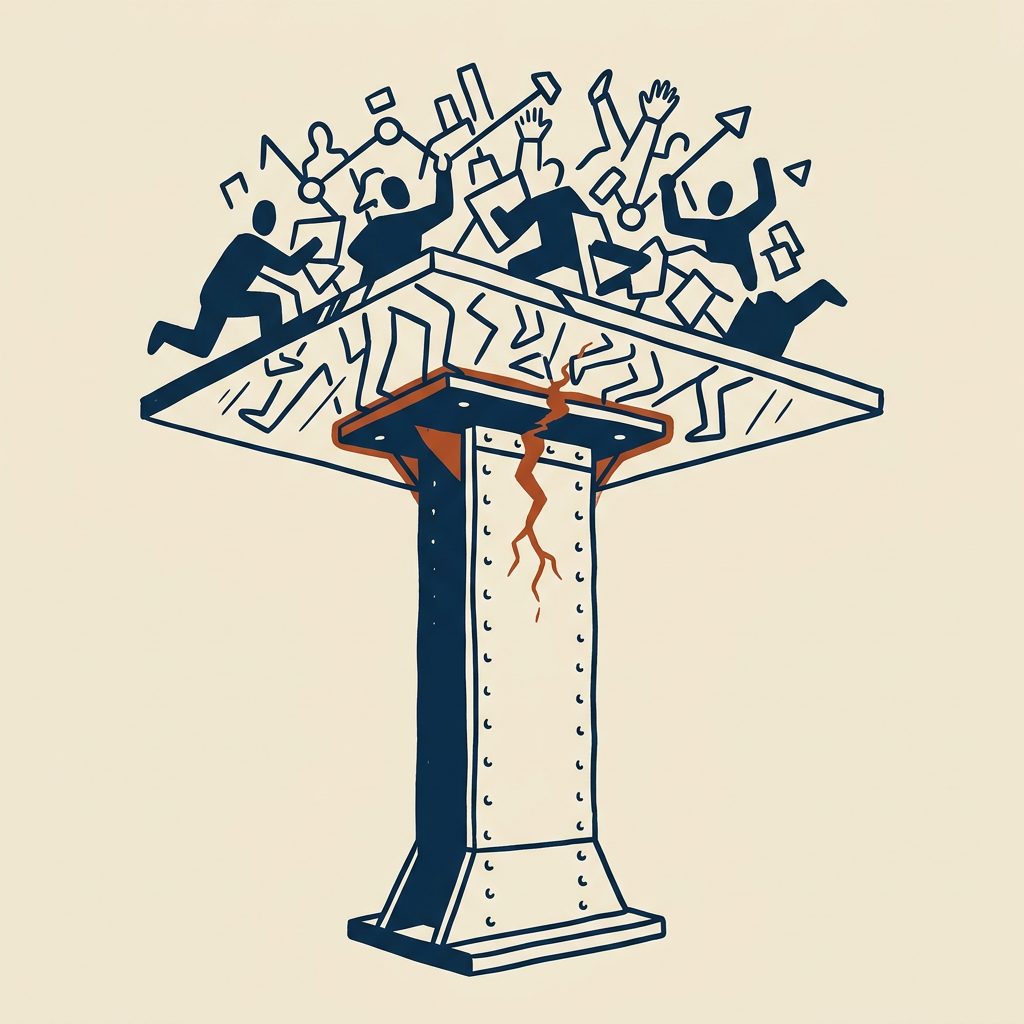
Faux treats Tether's one-dollar-per-token claim as the wall holding up the entire speculative structure; if it was false, everything built on it was false too.
$80B
USDT in circulation when Faux began asking
By the time he starts asking, more than $80 billion in USDT is already circulating as the dollar substitute on nearly every exchange, including venues that cannot legally touch real banks. Tether insists every token is backed one-to-one by cash and safe assets, yet it has never submitted to a full audit from a major accounting firm. It publishes attestations from smaller firms—snapshots that confirm numbers add up on a single day without verifying where the money actually sits.
That audit-versus-attestation distinction becomes the spine of the book. In 2019 the New York Attorney General accused Tether and sister exchange Bitfinex of using $850 million in client funds to cover a shortfall; they settled in 2021 for $18.5 million without admitting wrongdoing. Faux reads the episode as an open warning, not a closed case.
He refuses to treat the issue as a niche accounting dispute. Traders move in and out of Bitcoin, Ethereum, and thousands of tokens using USDT as the stable resting place; exchanges rely on it to settle instantly across borders and outside banking hours. If that resting place does not hold what it claims, the risk runs through every wallet and market that touches it.
Everything that follows—the games, the national experiments, the collapses—sits downstream of this one unanswered question about the industry's basic unit of account.
In practice: The New York case over an $850 million shortfall, settled for $18.5 million with no admission of wrongdoing, is the early red flag Faux refuses to treat as resolved.

2
Opacity as the business model
Tether's refusal of ordinary scrutiny is, in Faux's account, a deliberate choice by people who profit enormously from staying unaudited.
He tracks key figure Giancarlo Devasini, a former plastic surgeon turned crypto financier, to Milan and finds a small circle controlling a company registered in offshore jurisdictions such as the British Virgin Islands. By some estimates it makes hundreds of millions of dollars a year in interest on the reserves it holds while avoiding the regulatory apparatus that governs banks or money-market funds.
The sit-down interview never happens. Executives dodge, lawyers intervene, and public statements stay vague. Faux pieces the structure together from court filings, former employees, and intermediaries, learning that money has moved through small obscure banks including Deltec in the Bahamas—an institution most Americans have never heard of yet holding billions for a global settlement layer.
The real argument is incentive. A full audit could reveal gaps between liabilities and reserves or expose how much of the 'cash equivalents' are actually loans to other crypto firms, some of them insiders. Staying unaudited protects the profit engine.
He compares it to a bank whose customers have implicitly agreed never to ask for the books. The Bahamas cluster of offshore crypto firms, FTX included, appears as the geographic version of the same preference for light touch.
In practice: Reserves sitting at little-known Deltec Bank in the Bahamas show how systemically important balances lived outside familiar oversight.

3
Charisma instead of controls
Bankman-Fried's success depended less on trading skill than on a carefully built image of altruistic genius that discouraged the scrutiny FTX needed.
Public persona
Awkward altruist, risk talk, charity and campaign gifts
Internal setup Faux reports
Sister trading firm with undisclosed access to customer deposits
By 2021 he had built FTX into an exchange valued at $32 billion and Alameda Research into one of crypto's most active trading firms. He cultivated a specific persona: disheveled, awkward, Corolla-driving, beanbag-sleeping, promising to give away his fortune under the banner of effective altruism.
Faux interviews him more than once and comes away struck by how effectively the image substituted for due diligence. Celebrities, mainstream investors, and regulators treated FTX as the responsible, adult-supervised alternative partly because SBF talked fluently about risk management and consumer protection while giving large sums to campaigns and charities.
Reporting shows the gap: Alameda had privileged access to FTX customer funds, a relationship the public did not understand and that SBF did not volunteer. Faux frames the genius as reputational engineering—a recurring crypto pattern in which trust replaces verification and charisma replaces audits.
He notes his own uneasy position, flying on SBF's plane and interviewing in the Bahamas, aware that access carried the risk of becoming a validating prop. The Tether lesson reappears in human form in the person the industry cast as its most trustworthy adult.
In practice: Alameda's privileged draw on FTX customer funds stayed opaque to the public even while effective-altruism branding invited broad trust.

4
Play-to-earn sharecropping
Axie Infinity extracted real income and real debt from poor communities by dressing a pyramid scheme up as economic empowerment.
In the Philippines, Sky Mavis's game let players breed and battle NFT creatures called Axies to earn Smooth Love Potion that could be cashed out for real money. During the pandemic, thousands became 'scholars,' playing for hours on Axies they did not own, borrowed from managers who took a cut—an arrangement Faux likens more to sharecropping than any digital-ownership revolution.
For a stretch in 2021 some scholars genuinely earned more than local jobs; families bought motorbikes and paid down debt with SLP income. The economics only worked while new players kept buying Axies and supporting the token's price, the classic widening base of a pyramid.
When SLP crashed more than 99 percent in 2022 and the Ronin Bridge was hacked for $625 million that March, scholars were left with worthless tokens and, in some cases, debt taken on to buy starter Axies. Faux uses the case to show that crypto's damage was not confined to sophisticated traders who understood the risk.
It reached subsistence-level workers who had been told, credibly, that a video game could be their way out of poverty, and who bore the loss when a token never backed by anything but continued enthusiasm stopped going up.
In practice: Families who bought motorbikes with SLP earnings later faced debt on starter Axies after the token's more than 99 percent crash and the $625 million Ronin hack.

5
A country's branding bet
El Salvador's Bitcoin legal-tender law served President Bukele's brand and leverage against the IMF far more than it served ordinary Salvadorans.
Official story
Legal tender, Bitcoin City, volcano bonds, innovator image
Street reality
Low wallet use, dollar preference, terminal failures, paper losses
In 2021 Bukele made the country the first to adopt Bitcoin as legal tender and floated a geothermal Bitcoin City funded by volcano energy and Bitcoin-backed bonds. The government built the Chivo wallet and gave citizens $30 in Bitcoin to drive sign-ups.
On the ground Faux finds low adoption. Most people continued using cash and dollars—the actual currency since 2001—distrusting or simply not understanding the new system. Businesses were technically required to accept Bitcoin yet often lacked working terminals or staff who knew how. Volatility made it a poor tool for groceries.
Meanwhile the state's Bitcoin holdings lost significant paper value as prices fell through 2022, and the IMF repeatedly criticized the policy as risky, complicating loan negotiations. Faux reads the move as branding: it drew foreign crypto attention and cast an increasingly authoritarian figure who had suspended parts of the constitution as a bold innovator rather than a strongman consolidating power.
A national government, he argues, can be pulled into the same number-go-up logic that drives individual speculators, betting public resources on a price continuing to rise.
In practice: Citizens got $30 in Bitcoin for installing Chivo, yet most kept spending dollars while government holdings lost paper value and the IMF raised alarms.

6
Irreversible scam rails
Crypto's instant, borderless, irreversible transfers did not merely fail to prevent fraud; they built the infrastructure that made industrial-scale scam compounds possible.
- 1ContactScripted outreach on dating and chat apps
- 2FattenWeeks of fake romance or business trust
- 3SteerPush onto bogus platforms showing fake gains
- 4SlaughterPlatform vanishes; funds leave in USDT
↻ and round again
In Cambodia Faux investigates compounds often disguised as casinos or office parks in cities like Sihanoukville that run pig-butchering scams—fattening a victim's trust before slaughtering the savings. Workers, many trafficked from China, Vietnam, and other parts of Southeast Asia under false job offers, are held against their will and forced to run scripts on dating apps and messaging platforms worldwide.
They build fake romantic or business relationships over weeks, then steer victims toward bogus crypto trading platforms that show fabricated gains and urge larger deposits, sometimes emptying retirement savings, before vanishing. Workers who miss quotas describe beatings or being sold between compounds; U.S. victims recount losses of hundreds of thousands to people they never met in person.
None of this scales without crypto, specifically USDT, which lets operators receive funds instantly, move them across borders without banks asking questions, and cash out through unregulated exchanges. Researchers estimate billions of dollars a year moving through Southeast Asian scam compounds alone.
Irreversibility, marketed as protection from government interference, is functionally identical to the feature that makes theft permanent. Tether reappears here not as abstraction but as the settlement layer for trafficking and fraud.
In practice: Trafficked workers beaten for missed quotas and U.S. victims who lost hundreds of thousands both depended on USDT moving money without bank friction.

7
The hidden-leverage cascade
Terra's May 2022 collapse proved crypto's supposed diversification was an illusion because everything was quietly leveraged against everything else.
- May 2022TerraUSD loses peg; Luna hyperinflates; ~$40B destroyed
- Following weeksThree Arrows, Voyager, Celsius fail in cascade
- Same panicUSDT briefly slips then meets redemptions
TerraUSD was an algorithmic stablecoin created by Do Kwon that held its dollar peg not through reserves but through a linked token, Luna, and the Anchor lending protocol's unsustainable 20 percent yields meant to attract deposits. In May 2022 UST lost its peg; the mechanism designed to defend it instead hyperinflated Luna and destroyed roughly $40 billion in value within days.
Faux treats the failure as a stress test that exposed interconnection. Hedge funds and lending platforms that had chased yield across protocols, often borrowing against crypto collateral to amplify returns, found themselves holding worthless assets and unable to meet withdrawals. Three Arrows Capital, Voyager Digital, and Celsius Network collapsed in the following weeks, each having quietly lent to or borrowed from the others so one failure cascaded through the rest.
During the panic USDT itself briefly wobbled below its dollar peg, then met a wave of redemptions—evidence defenders call solvency and skeptics call one survived test. The industry, Faux argues, should have woken to hidden leverage; instead it treated still-standing FTX as proof of its own stability and set up the larger collapse to come.
Interconnection, not isolation, was the real architecture of the boom.
In practice: Anchor's 20 percent yields helped pull deposits into a design that wiped roughly $40 billion when the UST peg broke and Luna hyperinflated.

8
The trusted adult was hollow
FTX's failure showed the exchange treated as crypto's most trustworthy institution was running the same trust-without-verification scheme as everyone else, only at greater scale.
$8B
estimated hole between FTX customer deposits and assets
In November 2022 a CoinDesk report revealed that Alameda's balance sheet was heavily weighted in FTT, a token created by FTX itself—essentially an asset Alameda had conjured rather than earned. The revelation triggered a bank run; within days FTX admitted it could not cover withdrawals, exposing an estimated $8 billion hole between customer deposits and available assets.
Faux, who had interviewed SBF extensively and flown on his plane, reconstructs how customer funds deposited on FTX had been funneled to Alameda for trading bets, venture investments, political donations, and lavish Bahamas real estate while FTX publicly promised customer assets were segregated and safe. SBF was arrested in the Bahamas in December 2022.
He argues the collapse was not a departure from crypto norms but their fullest expression: an institution built almost entirely on the founder's reputation, operating with minimal internal controls, in a jurisdiction chosen partly for light regulation, holding customer money that outsiders assumed was verified but never was. Effective-altruism branding had inoculated SBF from scrutiny a traditional firm of similar size would have faced years earlier.
Writing before the criminal trial finished, Faux is careful about what bankruptcy filings already established—the movement of customer funds without consent to cover losses—versus what remained for the courts.
In practice: The Alameda balance-sheet revelation that it was stuffed with FTX's own FTT token triggered the run that uncovered the estimated $8 billion gap.

9
Function without proof
Tether's survival and growth after every 2022 crash suggests the market cared more about a workable dollar substitute than about ever verifying it.
After Terra, Three Arrows, Celsius, and FTX all collapsed, Faux checks back on the company he started with. Tether not only survived; its market capitalization grew, exceeding $80 billion and later climbing higher, as traders fled failed platforms and consolidated around USDT as the least-bad option for parking money.
It continued publishing attestations rather than full audits, continued declining detailed questions about reserve composition, and continued to profit from interest on assets it says it holds—likely well over a billion dollars a year at prevailing rates on tens of billions in reserves. The entity whose backing he could never verify became, in the market's eyes, the safe haven amid wreckage that had claimed far more transparency.
Faux calls this the book's most unsettling finding: proof was never really the point. What the market needed was a stable, liquid dollar substitute that worked when called upon, and Tether had demonstrated through the Terra panic and the FTX collapse that it could function as one, at least so far. Functional reliability, not verified solvency, kept it central.
He closes still not knowing, and by his own account possibly never knowing, whether the reserves are exactly what the company claims. The unresolved status of the industry's most important financial institution after everything else burned down is the uncomfortable fact he leaves on the table.
In practice: Tether met redemption pressure during both the Terra panic and the FTX collapse, then grew past $80 billion while still skipping a full major-firm audit.

10
The chart was the product
Crypto's actual product, Faux concludes, was never a technology but the psychological pleasure of watching a number rise—strong enough to make smart people ignore fraud evidence.
In the closing chapter he steps back from individual scandals to name the mechanism running through all of them. Bitcoin, Ethereum, Axie Infinity's SLP, Terra's Luna, FTX's FTT: each asset's primary appeal was not a use case but a chart, and the emotional reward of watching a number climb reliably overrode caution even among people who understood the underlying mechanics were shaky.
He revisits his own early skepticism and admits the pull was real even for him, watching friends and sources make and lose fortunes on paper gains that felt, while they lasted, like proof of something. This psychology explains why so much of the industry tolerated, even welcomed, opacity: verified boring assets do not produce the same dopamine as a token that might multiply by next month, and asking too many questions risked ending the ride.
Tolerance for unanswered financial questions ran from individual meme coins all the way up to the reserves backing the dollar substitute everyone used. Faux does not claim every blockchain application is worthless, but he argues the dominant wealth-generating activity of the 2020–2022 boom was speculation dressed as innovation.
The human costs documented throughout—trafficked scam workers, indebted Filipino gamers, a country's public finances, customers who lost savings—were the predictable result of an industry whose central promise was simply that the number would keep going up.
In practice: Friends and sources Faux watched ride paper gains show how the rising-chart feeling substituted for proof even among people who knew better.
Key terms
- USDT / Tether The stablecoin meant to equal one real dollar each and used as the resting place for nearly every crypto trade.
- Attestation A single-day snapshot from a smaller firm confirming numbers add up, not a full audit of where the money sits.
- Effective altruism The give-it-all-away banner SBF used that, in Faux's telling, helped deflect ordinary financial scrutiny.
- Scholars Filipino Axie players who borrowed NFT creatures from managers and shared earnings, closer to sharecropping than ownership.
- Pig butchering Long-con scams that fatten a victim's trust over weeks before draining them through fake crypto platforms.
- Algorithmic stablecoin A token such as TerraUSD that holds a dollar peg through code and a sister token rather than cash reserves.
- FTT The exchange token FTX itself created that bulked up Alameda's balance sheet until the revelation sparked the run.
- Number go up Faux's label for the shared psychology that treated a rising chart as proof and made opacity feel worth tolerating.
What to do
- Ask what would happen if everyone tried to redeem a product at once, and whether anyone independent has verified the answer rather than attested a snapshot.
- Treat any return detached from a clear, boring source of profit—interest, rent, or revenue—as a red flag no matter how sophisticated the story sounds.
- If a platform's main appeal is a rising chart rather than a described mechanism for generating return, assume the mechanism is other people's incoming money.
- Separate a charismatic founder's personal narrative from the financial statements and demand the statements before believing the story.
- Before parking meaningful size in any stablecoin, check whether it has ever produced a full major-firm audit instead of periodic attestations.
Questions to think with
- If a dollar substitute can survive panics without a full audit, what should 'backing' actually mean to users and regulators?
- How do you tell useful blockchain tools apart from speculation that works only while new money keeps arriving?
- What duty do journalists have when access to a founder also risks becoming free publicity for an unverified operation?
- When a poor community is sold a play-to-earn escape, who owns the downside once the token chart breaks?
- Why did markets treat still-standing FTX as proof of stability right after the Terra cascade exposed hidden leverage?
The other side
Faux himself never proves whether Tether's reserves match its claims; after a year of reporting the spine remains circumstantial—refusals, offshore structures, past settlements, pattern recognition—rather than a smoking-gun reserve document. The book also gives relatively little space to serious technical defenses of non-speculative crypto uses, sometimes lets vivid first-person scenes stand in for systematic data on how representative the harm is, and went to press before SBF's November 2023 guilty verdicts on all seven counts supplied details it could only estimate.
Who it's for
Readers who want concrete evidence of how crypto fraud worked in practice, along with investors and journalists trying to size digital-asset risk, will get the most. Anyone who followed the Axie Infinity, El Salvador, or FTX headlines and wants the human cost traced to unverified trust will too.