




Positioning is the frame customers need before any pitch works
April Dunford argues most companies inherit their competitive frame by accident, then misread the resulting confusion as a sales or messaging failure.
IJR · Nov 1, 2026 · 14 min read
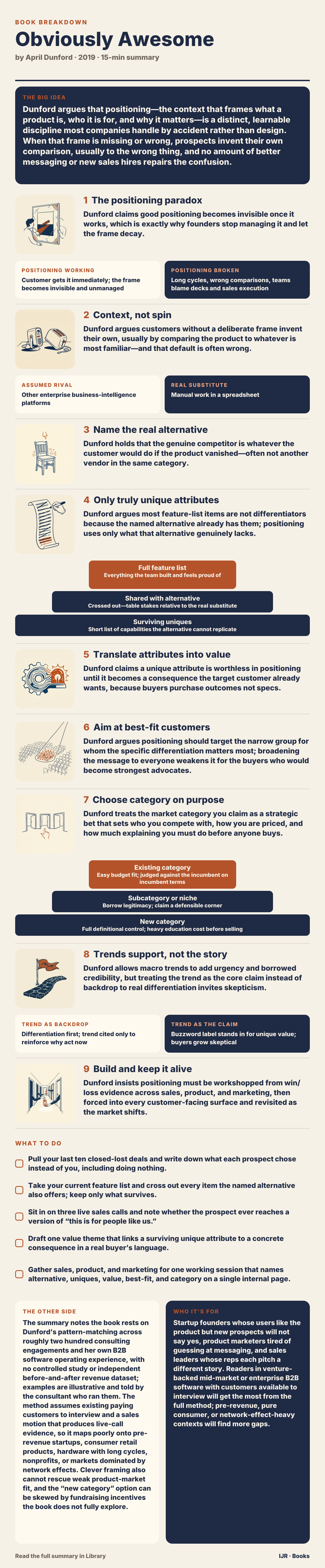
In 60 seconds
- Dunford argues positioning is the deliberate context that tells customers what a product is, who it is for, and why it beats their real alternative—not a tagline or deck slide.
- She claims teams usually skip that frame, so prospects invent their own comparison, sales cycles stretch, and rewrites of copy never fix the root problem.
- Her five-part method starts by naming what buyers would actually do if the product vanished, often manual work or nothing rather than a rival vendor.
- Only capabilities that named alternative truly lacks count as differentiators, and each must be translated into a consequence a specific buyer already wants.
- The message should aim at the narrow best-fit group who feel that pain most, with market category chosen as a conscious bet rather than a default label.
- Positioning sticks only when sales, product, and marketing build it from win/loss evidence together and keep every customer-facing surface telling the same story.
The big idea
Dunford argues that positioning—the context that frames what a product is, who it is for, and why it matters—is a distinct, learnable discipline most companies handle by accident rather than design. When that frame is missing or wrong, prospects invent their own comparison, usually to the wrong thing, and no amount of better messaging or new sales hires repairs the confusion.
The book in brief
Dunford opens with a pattern she saw as an operating executive: strong products with happy early users stall when new prospects shrug, ask unrelated questions, or go silent. Teams rewrite decks or replace reps, but she locates the fault upstream—nobody has decided, on purpose, what frame of reference buyers should use. She names the paradox that good positioning becomes invisible once it works, so founders stop managing it and let it decay, while bad positioning stays loud through long cycles and wrong comparisons.
She then defines positioning as context applied to a product that already exists, not spin or branding tone. Without a deliberate frame, cognition fills the gap by comparing the product to whatever is most familiar—often a spreadsheet—and that default sets price and expectation anchors. Her consulting anecdotes show teams pitching against the wrong class of rival until customer interviews revealed the real substitute.
The core of the book is a five-part method. First, name the genuine competitive alternative: what the customer would do today if the product disappeared. Second, list every capability and cross out anything that alternative already offers, leaving only true unique attributes. Third, translate those attributes into value themes tied to outcomes specific buyers already care about. Fourth, aim the whole argument at best-fit customers who face that alternative, feel the pain acutely, and can buy without endless consensus. Fifth, choose a market category deliberately—existing category, subcategory, or new category—because the label sets expectations, pricing logic, and how much education is required.
She treats trends as optional support for urgency, not the core claim, and warns that buzzword-first pitches invite skepticism. The method itself is a cross-functional workshop fed by win/loss records, buyer interviews, and live-call objections, producing a living internal document that website copy, scripts, and decks must all derive from. She closes by insisting alignment and live testing matter as much as the analysis: listen for the moment a prospect recognizes “this is for people like us,” revisit the frame as alternatives and attributes shift, and treat stalled growth that looks like the opening confusion as a signal to run the process again.
Context
April Dunford writes from her time as a startup executive—including as VP of Marketing at PostRank, a social media analytics company later acquired by Google in 2011—and from later consulting across hundreds of technology companies. The 2019 book packages the repeatable method she used when strong products still failed to make sense to new buyers.
The key ideas

1
The positioning paradox
Dunford claims good positioning becomes invisible once it works, which is exactly why founders stop managing it and let the frame decay.
Positioning working
Customer gets it immediately; the frame becomes invisible and unmanaged
Positioning broken
Long cycles, wrong comparisons, teams blame decks and sales execution
She opens with products that have real technical merit and happy early customers yet hit a wall where new prospects shrug or never reply. Teams typically rewrite the pitch or replace salespeople, treating the failure as execution. Dunford locates the break further upstream: nobody has decided, deliberately, what frame of reference customers should use to judge the product.
The paradox she names is structural. When positioning works, the customer simply “gets it,” so the scaffolding disappears from view and stops being maintained. When positioning fails, the noise is constant—stretched cycles, wrong comparisons, blame aimed at messaging or headcount.
She insists positioning is not a tagline or a single slide. It is the underlying set of decisions about competitive frame, differentiation, and audience that website copy, sales scripts, and pricing talks should all trace back to. Skipping that groundwork and jumping to words is, in her account, why so many rebrands fail to move results.
In practice: At PostRank, strong social analytics technology still left prospects unable to place the product until the team deliberately reframed the problem and audience; the company was acquired by Google not long after.

2
Context, not spin
Dunford argues customers without a deliberate frame invent their own, usually by comparing the product to whatever is most familiar—and that default is often wrong.
Assumed rival
Other enterprise business-intelligence platforms
Real substitute
Manual work in a spreadsheet
She defines positioning as the context that tells a buyer what the product is like, what it is not like, and who it is for, applied after the product already exists. Absent that context, human cognition fills the gap automatically.
A specialized tool with no clear frame gets judged against the nearest familiar object that seems to do something similar. That comparison then anchors both price and expectations, regardless of what the company intended.
Her approach therefore starts with accurate diagnosis of the comparison customers are already making, then a deliberate choice to confirm or redirect it. She separates this from branding exercises focused on tone and tagline: get the frame right and the words become easy; get the frame wrong and clever copy answers a question the buyer is not asking.
In practice: A data analytics company assumed its rivals were enterprise BI platforms until interviews showed prospects were replacing Excel manual work; repositioning against that alternative shortened cycles and supported a different price.

3
Name the real alternative
Dunford holds that the genuine competitor is whatever the customer would do if the product vanished—often not another vendor in the same category.
Her framework begins with competitive alternatives because teams constantly mistake category peers or search-result neighbors for the real baseline. The better question, asked directly of customers, is what they would do today if the product disappeared: keep doing it by hand, hire someone, cobble a workaround, or live with the pain.
That answer sets the measuring stick for every later claim. If the alternative is a person building a roster in a spreadsheet, the pitch must address labor cost and error rates, not feature parity with another app’s dashboard. If the alternative is tolerating the pain, the company must first make the problem feel worth solving.
She warns against listing every conceivable substitute. The useful cut is the two or three alternatives best-fit customers actually consider, found through structured interviews with recent buyers—especially those who almost did not buy. Skip this step and differentiation targets a rival customers were never choosing between.
In practice: A workforce-scheduling startup may learn its true alternative is a part-time employee manually building a roster each week, not a rival scheduling product.

4
Only truly unique attributes
Dunford argues most feature-list items are not differentiators because the named alternative already has them; positioning uses only what that alternative genuinely lacks.
- Full feature listEverything the team built and feels proud of
- Shared with alternativeCrossed out—table stakes relative to the real substitute
- Surviving uniquesShort list of capabilities the alternative cannot replicate
Once the real alternative is named, she runs a blunt audit: list every capability, then cross out anything the alternative also offers. What survives is usually far shorter than founders expect, and that honesty is the point.
She pushes for specific, technical language at this stage. A unique attribute is a capability, feature, resource, or process the alternative cannot replicate—not a soft claim like “easy to use,” which belongs later. Mobile apps, single sign-on, and dashboards rarely survive once modern workarounds are admitted.
The cross-reference must be done against the specific alternative from the prior step, not a generic industry landscape, because uniqueness is relative. Sales and customer-success voices matter here: live objections reveal which attributes prospects actually notice and which stay invisible no matter how much engineering pride they carry.
In practice: Capabilities that feel important internally often prove table stakes once honestly compared to the spreadsheet or manual process customers would otherwise use.

5
Translate attributes into value
Dunford claims a unique attribute is worthless in positioning until it becomes a consequence the target customer already wants, because buyers purchase outcomes not specs.
She treats the gap between attribute and value as the most common failure point in technical companies’ messaging. Sub-second latency, field-level encryption, or a proprietary matching algorithm are facts about the product; they become positioning only when tied to a buyer consequence.
Engineering-led teams often stop at the attribute and assume the value is obvious. Sales-led teams sometimes leap to generic claims like “saves time” that could describe almost anything and therefore persuade no one. Her discipline is explicit value themes: short statements linking a specific unique attribute to a specific consequence for a specific kind of buyer, tested against real customer language from earlier interviews.
She also insists one generic value proposition rarely travels across segments, because different buyers weight the same underlying attribute differently. Value themes are therefore built alongside best-fit customer definition, not before it. Skipping the translation produces messaging that impresses internally and lands flat outside.
In practice: She describes turning a processing-speed claim into the concrete consequence of catching fraud before a transaction settles—language a risk officer feels that a latency number alone never reaches.

6
Aim at best-fit customers
Dunford argues positioning should target the narrow group for whom the specific differentiation matters most; broadening the message to everyone weakens it for the buyers who would become strongest advocates.
Founders under growth pressure widen the audience, reasoning that broader appeal means a bigger market. She argues the opposite: because positioning is built from a specific alternative and specific value themes, it can only ring true for customers who actually face that alternative and want that value.
She defines best-fit less by firmographics alone than by situation—buyers already burned by the named alternative, who feel the pain acutely enough to act, and who hold authority and budget without a long consensus gauntlet. Narrowing does not mean permanently ignoring other segments; it means sequencing a beachhead of reference customers before expanding with a modified theme.
Sales teams often resist because narrowing feels like turning away revenue. Dunford’s counter is conversion speed and word-of-mouth strength: a precise message to a committed segment beats a diluted message to a large but lukewarm audience that produces long cycles and weak champions.
In practice: Inventory software may fit regional retail chains still on spreadsheets better than large national chains with dedicated IT, even when the national deals look bigger on paper.

7
Choose category on purpose
Dunford treats the market category you claim as a strategic bet that sets who you compete with, how you are priced, and how much explaining you must do before anyone buys.
- Existing categoryEasy budget fit; judged against the incumbent on incumbent terms
- Subcategory or nicheBorrow legitimacy; claim a defensible corner
- New categoryFull definitional control; heavy education cost before selling
She lays out three broad options. Slotting into an existing, well-understood category makes buying easy because budget lines and mental models already exist, but it forces judgment against the dominant incumbent on the incumbent’s terms.
Carving a subcategory borrows the parent category’s legitimacy while claiming a defensible corner—often the pragmatic middle path. Declaring an entirely new category grants definitional control and can dodge unfavorable comparisons, yet demands expensive market education before any specific product sale can happen.
Founders, she notes, often drift into a label applied by a competitor or analyst and then wonder why they are stuck competing with a giant they never chose. The decision is not free; new-category work needs sustained investment and can fail if enough buyers do not yet acknowledge the pain.
In practice: Companies that branded around “conversational marketing” rather than the narrower, more commoditized “chatbots” label were making a new-category bet to redefine the space instead of competing on price inside it.

8
Trends support, not the story
Dunford allows macro trends to add urgency and borrowed credibility, but treating the trend as the core claim instead of backdrop to real differentiation invites skepticism.
Trend as backdrop
Differentiation first; trend cited only to reinforce why act now
Trend as the claim
Buzzword label stands in for unique value; buyers grow skeptical
Trends—a technology wave, a regulatory shift, a change in buyer behavior—can explain why now is the moment to act and can validate that a class of problem is becoming urgent. That helps overcome inertia.
Her caution is substitution: companies that name themselves an “AI,” “cloud,” or “blockchain” company as if the label were the value proposition skip the hard work of unique attributes and value themes. Buyers desensitized by buzzword waves read a trend-first pitch as opportunistic.
Correct sequencing in her framework builds alternative, attributes, and value first, then checks whether an external trend can reinforce urgency. She also flags roadmap distortion: teams sometimes retrofit product decisions to match investor-fashionable labels, creating a mismatch customers discover in evaluation and that erodes trust faster than modest honest positioning would.
In practice: Citing a regulatory deadline that forces companies to solve a data-retention problem your product already handles well works as support; opening as a “compliance-AI company” and hoping the label persuades does not.

9
Build and keep it alive
Dunford insists positioning must be workshopped from win/loss evidence across sales, product, and marketing, then forced into every customer-facing surface and revisited as the market shifts.
She rejects two shortcuts: the founder who declares positioning from personal conviction without checking how deals are won or lost, and the agency that polishes language without ground-level call and ticket evidence. The process starts with data—recent win/loss records, interviews with best-fit buyers about why they bought and what they almost chose, and the objections reps hear live.
That evidence feeds a cross-functional workshop that works through alternatives, attributes, value themes, and category tradeoffs explicitly. Draft language is tested in real sales conversations before it is finalized, because phrases that sound sharp among colleagues often confuse prospects who lack internal context. The output is a living internal document—chosen alternative, unique attributes and values, best-fit profile, category decision—from which all external copy and scripts derive.
A finished document changes nothing alone. Homepages, first slides, demo scripts, and onboarding emails must repeat the same frame, or inconsistency recreates the original confusion. She recommends listening for a specific moment on calls after a repositioning: the prospect’s shift to “oh, so it’s for people like us with this problem.” Its absence is a cue to revise language, not blame delivery. Positioning also has a shelf life; as alternatives shift, once-unique attributes become table stakes, and the customer base matures, the whole process needs deliberate revisiting—especially after launches, new rivals, or growth stalls that resemble the book’s opening confusion.
In practice: A company that nailed positioning at ten customers may find at two hundred that the best-fit profile has shifted or that a formerly obscure rival has become the comparison buyers actually use.
Key terms
- Positioning The deliberate context that tells a customer what your product is, what it is not, who it is for, and why it beats their real alternative.
- Competitive alternative What the customer would actually do if your product did not exist—including manual work, a hire, a workaround, or living with the pain.
- Unique attributes The short list of capabilities, features, resources, or processes the named alternative genuinely cannot replicate.
- Value themes Short statements that connect a specific unique attribute to a specific consequence a specific kind of buyer already wants.
- Best-fit customers The narrow group who face the named alternative, feel the pain acutely, and can buy without a long consensus process.
- Market category The strategic label you claim—existing category, subcategory, or new category—that sets expectations, pricing logic, and education burden.
- Positioning paradox Dunford’s observation that positioning done well becomes invisible, so teams stop managing it until confusion returns.
- Living internal document The shared source of truth stating alternative, attributes, value, best-fit profile, and category that all customer-facing materials must derive from.
What to do
- Pull your last ten closed-lost deals and write down what each prospect chose instead of you, including doing nothing.
- Take your current feature list and cross out every item the named alternative also offers; keep only what survives.
- Sit in on three live sales calls and note whether the prospect ever reaches a version of “this is for people like us.”
- Draft one value theme that links a surviving unique attribute to a concrete consequence in a real buyer’s language.
- Gather sales, product, and marketing for one working session that names alternative, uniques, value, best-fit, and category on a single internal page.
Questions to think with
- If your product vanished tomorrow, what would your best recent customers actually do instead?
- Which capabilities on your roadmap would still look unique after that honest comparison?
- Who are the buyers for whom your remaining differentiation is immediate and undeniable, even if the contracts are smaller?
- Did you choose your market category on purpose, or inherit a label from an analyst or competitor?
- After a prospect hears your current pitch, do they recognize themselves—or keep asking unrelated questions?
The other side
The summary notes the book rests on Dunford’s pattern-matching across roughly two hundred consulting engagements and her own B2B software operating experience, with no controlled study or independent before-and-after revenue dataset; examples are illustrative and told by the consultant who ran them. The method assumes existing paying customers to interview and a sales motion that produces live-call evidence, so it maps poorly onto pre-revenue startups, consumer retail products, hardware with long cycles, nonprofits, or markets dominated by network effects. Clever framing also cannot rescue weak product-market fit, and the “new category” option can be skewed by fundraising incentives the book does not fully explore.
Who it's for
Startup founders whose users like the product but new prospects will not say yes, product marketers tired of guessing at messaging, and sales leaders whose reps each pitch a different story. Readers in venture-backed mid-market or enterprise B2B software with customers available to interview will get the most from the full method; pre-revenue, pure consumer, or network-effect-heavy contexts will find more gaps.