




Past success blinds you until the rules of competition change
Grove argues structural shifts look like noise until most of the useful response time is already gone.
IJR · Oct 20, 2026 · 13 min read
In 60 seconds
- Grove defines a strategic inflection point as a structural shift that makes a once-winning strategy stop producing results even while revenue still looks fine.
- He says these moments almost always arrive as a 10X intensification of one of six forces, not as ordinary competitive pressure.
- Intel survived, he recounts, only by exiting memory chips in 1985 and redirecting the company to microprocessors against its own identity.
- Warning signs surface first with salespeople, engineers, and mid-level managers; senior dashboards filter them into noise.
- He urges leaders to let open debate reign before a decision, then impose firm order once the direction is set.
- The same diagnostic, he claims, applies to individual careers and even to his own prostate-cancer treatment choices.
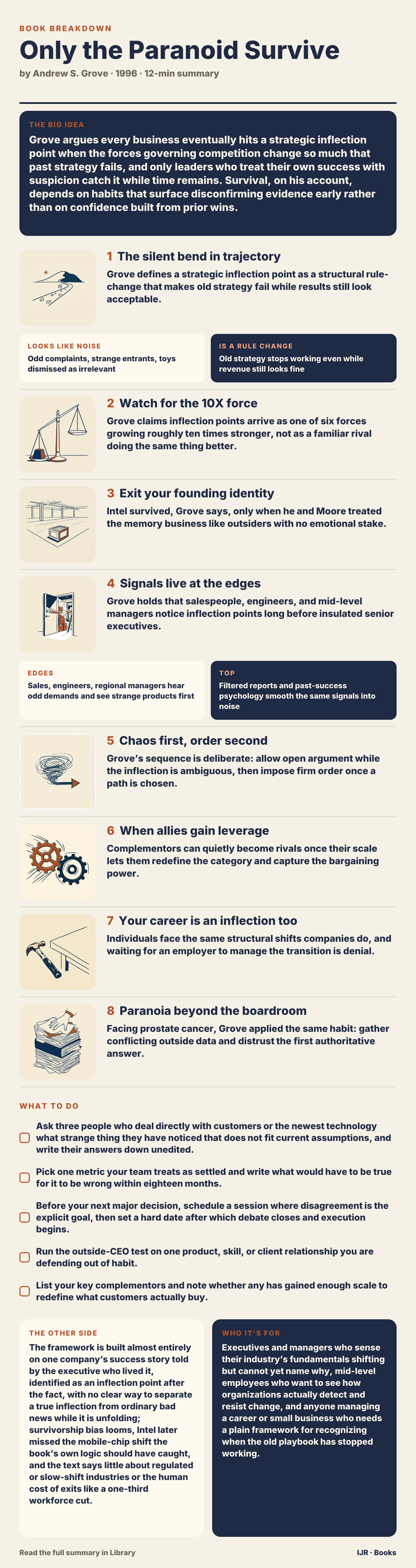
The big idea
Grove argues every business eventually hits a strategic inflection point when the forces governing competition change so much that past strategy fails, and only leaders who treat their own success with suspicion catch it while time remains. Survival, on his account, depends on habits that surface disconfirming evidence early rather than on confidence built from prior wins.
The book in brief
Grove starts from a blunt problem: a business can be executing its old playbook well and still be dying, because an unnoticed structural shift has rewritten the rules of competition. By the time the shift is obvious, most of the useful response window is already gone. He names that moment a strategic inflection point and insists it is different from a bad quarter or ordinary rivalry.
He adapts Porter’s forces, adds complementors as a sixth, and argues the real threat almost always shows up as a 10X change in one of them—a competitor on a different cost structure, a customer buying a different category, a technology that redefines the product. Managers trained to watch incremental intensity miss the qualitative break.
The central case is Intel in the mid-1980s. Memory chips were the company’s identity, yet Japanese makers had achieved higher quality and lower costs Intel could not match with efficiency tweaks. After years of loss, Grove and Gordon Moore asked what a new outside CEO would do, then did it themselves: exit memories in 1985, cut roughly a third of the workforce, and pour resources into microprocessors that had been secondary. That bet, Grove says, made Intel the dominant PC supplier through the 1990s.
He then turns to how signals actually travel. Cassandras at the edges—sales, engineering, regional managers—hear the odd complaint and see the strange entrant first. Formal planning softens bad news; senior success blinds. His fix is unstructured time several levels down and treating contradictory anecdotes as data. On process he insists on a hard sequence: let chaos reign in debate while the situation is ambiguous, then rein in chaos once a direction is chosen so execution is not undermined.
He extends the lens to complementors that can flip from ally to power center (the Wintel dynamic), to individual careers that face the same 10X skill and industry shifts without employer help, and finally to his own prostate-cancer diagnosis, where he gathered conflicting outcome data rather than accept the first specialist’s plan. The arc closes on a transferable discipline: refuse to let authority or past success substitute for current evidence.
Context
Andrew S. Grove, longtime CEO of Intel, published the book in 1996 around the company’s near-fatal move from memory chips to microprocessors. He writes as the executive who lived the transition, using that single history as the framework’s proof case and later testing the same mental habit on his prostate-cancer decisions.
The key ideas

1
The silent bend in trajectory
Grove defines a strategic inflection point as a structural rule-change that makes old strategy fail while results still look acceptable.
Looks like noise
Odd complaints, strange entrants, toys dismissed as irrelevant
Is a rule change
Old strategy stops working even while revenue still looks fine
Grove separates this moment from ordinary competitive pressure or a rough quarter. The shift is structural: a new technology, a new kind of rival, or a change in what customers actually buy can make the previous formula for winning irrelevant. Revenue and share may hold for a while, which is exactly why the danger is easy to miss.
He stresses that inflection points almost never announce themselves. They arrive as noise—an odd customer complaint, a strange entrant nobody takes seriously, a technology dismissed as a toy. Mainframe and minicomputer makers, he notes, first treated the personal computer as underpowered and irrelevant before it ate their markets.
What blinds the company, on his account, is its own success. The metrics and habits that produced past wins keep looking valid right up until they stop. The title’s claim follows: only leaders who treat that success with suspicion, who assume some version of the shift is already underway, still have time to act.
This is not free-floating anxiety. It is a discipline of building habits that surface disconfirming evidence before it becomes undeniable—because by then competitors who saw it earlier have already moved.
In practice: Mainframe makers dismissed the PC as a toy until networks of PCs replaced what they had spent decades perfecting.

2
Watch for the 10X force
Grove claims inflection points arrive as one of six forces growing roughly ten times stronger, not as a familiar rival doing the same thing better.
He adapts Michael Porter’s five-forces model and adds a sixth: complementors—businesses whose products make yours more valuable, such as software relative to hardware. A strategic inflection point, he argues, almost always shows up as one of these forces intensifying by an order of magnitude.
A 10X competitor is not merely cheaper; it runs on a different cost structure or model. Japanese memory makers in the early 1980s combined government-backed capital, manufacturing discipline, and thin or negative margins American chipmakers could not match with incremental gains. A 10X customer shift changes what is being bought at all, as when corporate buyers moved from mainframes to PC networks. A 10X technology change makes a different category of product, as digital photography did to film.
Managers are trained to watch ordinary competitive intensity. That training becomes a liability when the threat is qualitatively different. Grove’s analytical task is simple and unnatural: ask, force by force, whether any looks ten times different from a year or two ago, instead of assuming danger will arrive through the channel the company already knows how to watch.
In practice: Japanese memory chip makers’ capital, discipline, and margin willingness formed a 10X competitor Intel could not answer with efficiency tweaks.

3
Exit your founding identity
Intel survived, Grove says, only when he and Moore treated the memory business like outsiders with no emotional stake.
By the mid-1980s Intel’s identity was memory chips, yet Japanese manufacturers had higher quality and lower costs through 10X-level investment and support. The memory business lost money and share for years while the company kept fighting for it because memory was tied to its sense of self.
The practical break Grove describes is a conversation with Gordon Moore. He asked what a fresh outside CEO would do. Moore said get out of memories. Grove asked why they should not do exactly that themselves. Reframing the company as if it belonged to someone without attachment to its history is the tool he offers for breaking denial.
In 1985 Intel exited memory chips, laid off roughly a third of its workforce, and redirected engineering and capital to microprocessors—a line that had existed inside the company for years without the resources or priority memory commanded. That business then made Intel the dominant PC supplier through the 1990s.
The hardest part, he insists, is emotional rather than analytical: seeing that identity and profitable future may no longer be the same, and that clinging to the former can destroy the latter.
In practice: After asking what a new CEO would do, Grove and Moore exited memories in 1985 and bet the company on microprocessors.

4
Signals live at the edges
Grove holds that salespeople, engineers, and mid-level managers notice inflection points long before insulated senior executives.
Edges
Sales, engineers, regional managers hear odd demands and see strange products first
Top
Filtered reports and past-success psychology smooth the same signals into noise
Inflection points are usually visible at the organizational edges first. Sales hears customers ask for something the company does not make. Engineers see a competitor solve a problem in a fundamentally different way. Regional managers spot order-pattern shifts that headquarters dashboards smooth into noise.
He calls people willing to voice unwelcome observations Cassandras. Information flowing upward gets filtered and softened at each layer: middle managers have career reasons to present manageable news, and senior executives have psychological reasons to discount data that contradicts a strategy they own.
Grove’s own experience, he writes, is that he learned how serious the memory decline was largely through informal talks with salespeople and engineers, not through formal planning still built on dead assumptions. His prescription is unglamorous: spend unstructured time several levels down, ask open questions, and treat contradictory anecdotes as data worth investigating.
That means giving weight to junior judgment over polished planning consensus, and admitting the senior vantage point may be the worst place from which to see change coming.
In practice: Grove learned the memory business’s real decline from informal conversations with Intel sales and engineering, not from the planning process.
5
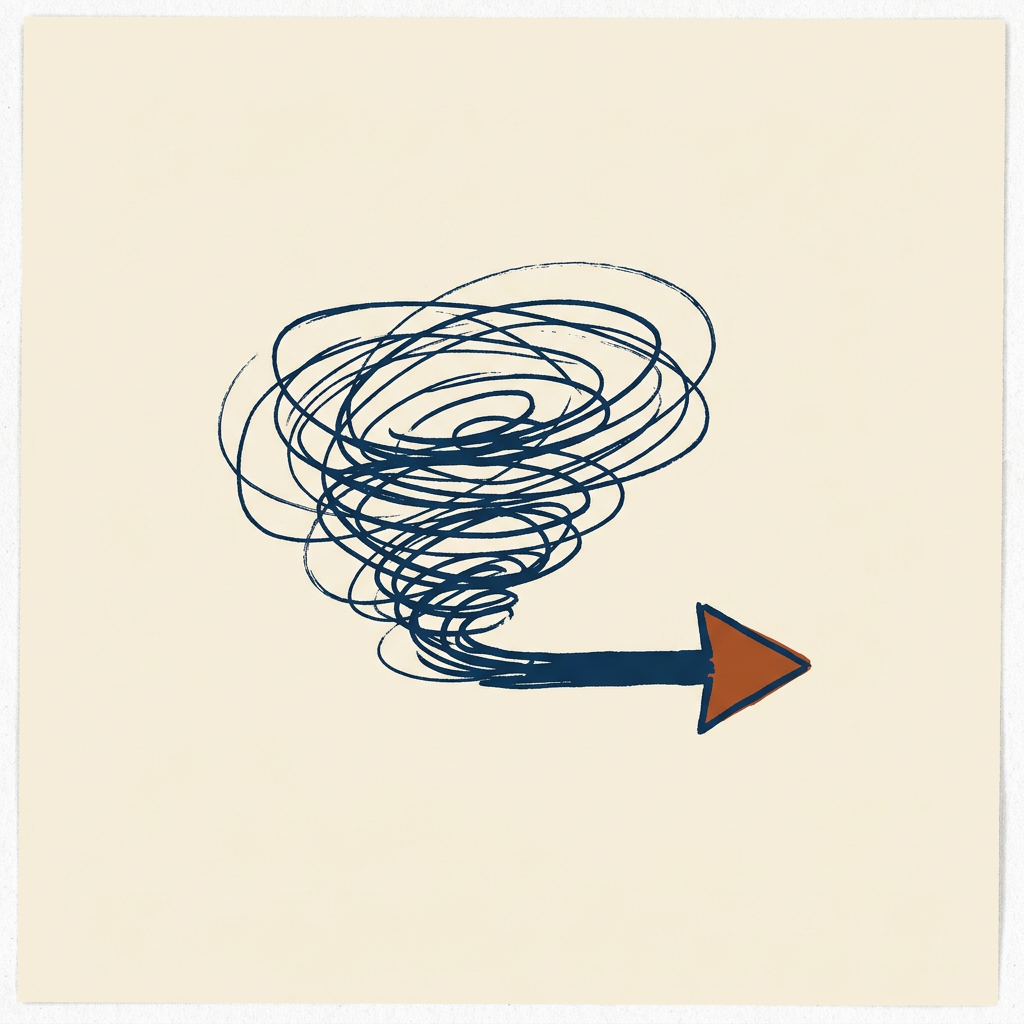
Chaos first, order second
Grove’s sequence is deliberate: allow open argument while the inflection is ambiguous, then impose firm order once a path is chosen.
His phrase is let chaos reign, then rein in chaos. A genuine strategic inflection point is ambiguous while it is happening. No single person, including the CEO, has enough information to be confident, so suppressing disagreement early to look decisive raises the odds of picking the wrong path.
Intel’s memory exit was not quick or unanimous. It followed prolonged, heated debate about whether memory could still be saved and what would replace it. Grove treats that friction as necessary, not as a management failure.
The danger flips at the next stage. Once a direction is chosen, prolonged debate becomes destructive: it signals the decision is still open, undermines execution, and lets resistance pockets persist. Leadership must then switch modes—communicate clearly, reallocate decisively, and stop tolerating the open argument that was valuable a month earlier.
The skill is matching style to phase. The wrong mode at the wrong time yields either a rushed bad decision or a well-considered decision nobody executes.
In practice: Intel’s memory exit followed heated executive debate; once chosen, Grove argues the same open argument had to be shut down for execution.

6
When allies gain leverage
Complementors can quietly become rivals once their scale lets them redefine the category and capture the bargaining power.
Grove’s sixth force captures relationships standard analysis misses because complementors begin as allies. Microsoft’s operating system made Intel’s processors useful; Intel’s processors made Microsoft’s software run on affordable machines. The pairing became known as Wintel, and neither would have grown as fast alone.
The alliance was never symmetric or permanent. As Microsoft’s software became what customers cared about and hardened toward a standard, its bargaining power over hardware makers grew beyond a pure complementor relationship. Compaq and other assemblers similarly depended on Intel chips yet could commoditize the systems around them and push margin pressure back onto suppliers.
Any company leaning on a complementor, he argues, should periodically ask whether the partner’s scale is converting mutual benefit into dependency, and whether that partner could redefine the category in a way that sidelines the original firm—the way mobile operating-system makers later captured value that once accrued to chipmakers.
Monitor complementor power with the same seriousness as competitor power. The relationship can flip without either side changing its stated intentions.
In practice: As Microsoft’s software became the standard customers cared about, its leverage over hardware makers grew far past a simple complementor role.
7
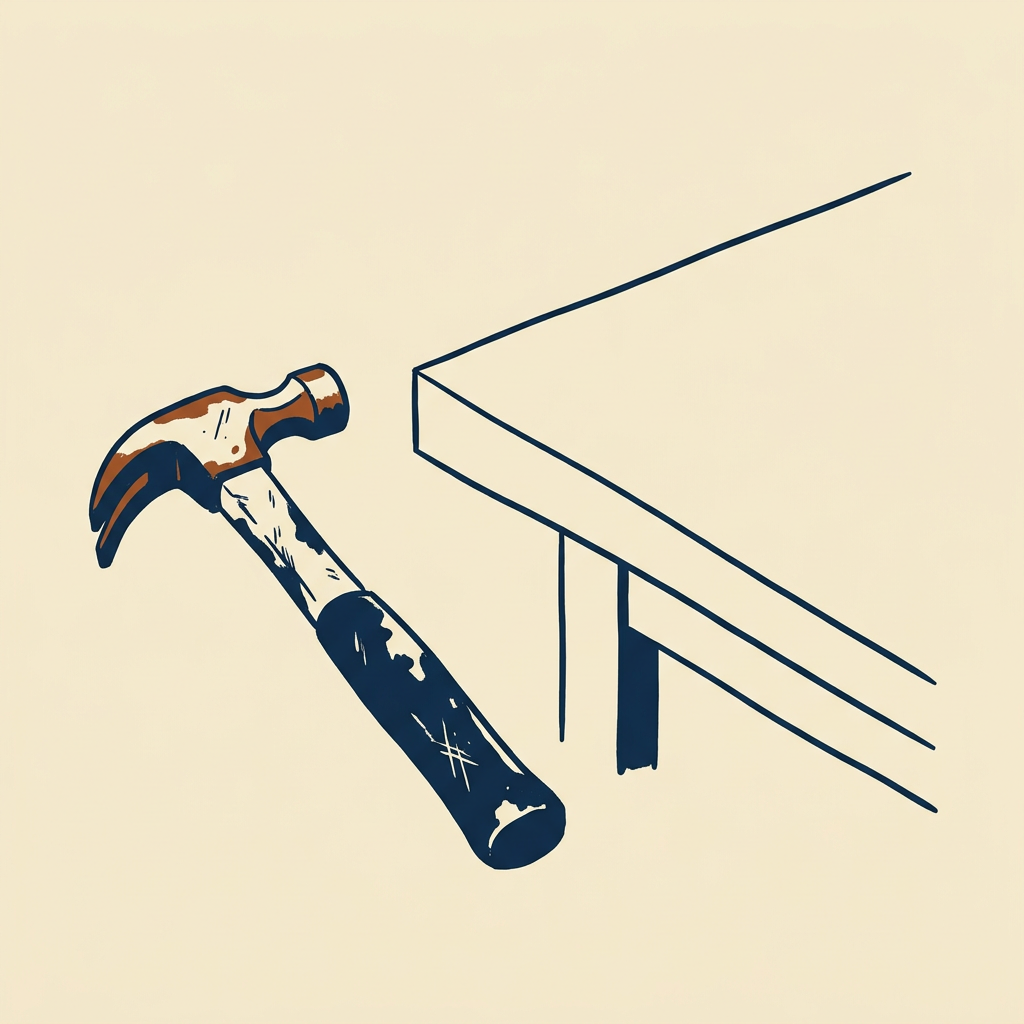
Your career is an inflection too
Individuals face the same structural shifts companies do, and waiting for an employer to manage the transition is denial.
Grove extends the framework to careers: a person’s skills, industry, or employer can undergo the same kind of break that made memory a losing business. A worker whose value rests on a technology or process being displaced faces Intel’s choice—keep investing in the declining asset out of loyalty and sunk cost, or redirect effort toward where value is shifting.
Companies, even well-run ones, will not manage that transition for employees. Their incentive is to extract value from existing skills as long as possible, not to fund a move to a different, possibly competing, set of skills. Responsibility sits with the individual.
The same diagnostics apply: is a 10X force reshaping the industry you depend on; are people close to the work noticing first; are you discounting disconfirming evidence because it is uncomfortable. He suggests periodically treating your career the way he treated the memory business—imagine being replaced by a new hire with no attachment to your path, and ask what that person would do.
The frame is unsentimental. Career security built on a single skill set is fragile because it assumes a stable environment—the same assumption that failed Intel’s memory business.
In practice: Grove advises imagining a replacement hire with no loyalty to your current path and doing what that person would do.

8
Paranoia beyond the boardroom
Facing prostate cancer, Grove applied the same habit: gather conflicting outside data and distrust the first authoritative answer.
In the closing turn he tests the framework on a personal medical crisis. After a prostate-cancer diagnosis he did not simply accept the first specialist’s recommended treatment. He built a comparative data set of outcome statistics across approaches and consulted multiple experts whose views conflicted.
He treated the medical establishment’s confident recommendation the way he would treat a division head’s confident but possibly outdated plan. That required overriding the deference patients usually extend to specialists—much as detecting an inflection point requires overriding deference to the most senior voices.
The chapter is evidence for the central claim outside business. Paranoia, in his specific sense, is not free-floating anxiety but a decision discipline: refuse to let authority or past success substitute for current evidence. He does not claim the analogy is perfect, yet argues the mental habit of seeking disconfirmation generalizes to any domain where the cost of being wrong is high and the first answer may be outdated or self-serving.
In practice: Grove collected conflicting treatment outcome statistics and multiple expert views instead of accepting the first specialist’s plan.
Key terms
- strategic inflection point A structural shift in the forces governing a business so large that the old strategy stops working even if execution is still good.
- 10X change One of the six competitive forces growing by an order of magnitude, not a modest uptick in familiar pressure.
- Cassandras People at the edges—sales, engineering, mid-level managers—who notice unwelcome signals early and are often disbelieved.
- complementors Firms whose products make yours more valuable; they can later gain enough scale to become a power threat.
- let chaos reign, then rein in chaos Allow open debate while the situation is ambiguous; once a direction is chosen, impose firm order and stop the argument.
- Wintel The shorthand pairing of Microsoft software and Intel processors that began as mutual boost and shifted bargaining power over time.
- outside-CEO test Asking what a new leader with no emotional attachment to the company’s history would do, then doing that yourself.
What to do
- Ask three people who deal directly with customers or the newest technology what strange thing they have noticed that does not fit current assumptions, and write their answers down unedited.
- Pick one metric your team treats as settled and write what would have to be true for it to be wrong within eighteen months.
- Before your next major decision, schedule a session where disagreement is the explicit goal, then set a hard date after which debate closes and execution begins.
- Run the outside-CEO test on one product, skill, or client relationship you are defending out of habit.
- List your key complementors and note whether any has gained enough scale to redefine what customers actually buy.
Questions to think with
- Which of the six forces looks most different in your world than it did two years ago, and who at the edges noticed first?
- If a new leader with no attachment to your history took over tomorrow, what would they stop funding this quarter?
- Where are you still rewarding open debate after the direction has already been chosen?
- Which complementor relationship has quietly shifted from mutual boost toward dependency?
- What disconfirming evidence about your own skills are you discounting because it is uncomfortable?
The other side
The framework is built almost entirely on one company’s success story told by the executive who lived it, identified as an inflection point after the fact, with no clear way to separate a true inflection from ordinary bad news while it is unfolding; survivorship bias looms, Intel later missed the mobile-chip shift the book’s own logic should have caught, and the text says little about regulated or slow-shift industries or the human cost of exits like a one-third workforce cut.
Who it's for
Executives and managers who sense their industry’s fundamentals shifting but cannot yet name why, mid-level employees who want to see how organizations actually detect and resist change, and anyone managing a career or small business who needs a plain framework for recognizing when the old playbook has stopped working.