




Originality is practiced behavior, not a fearless trait
Managers tired of silent meetings, founders waiting for confidence, and anyone who has buried a good idea will get a research-backed map of how creative dissent actually spreads.
IJR · Oct 27, 2026 · 12 min read
In 60 seconds
- Grant holds that people who champion new ideas are as anxious and doubtful as everyone else; originality is a decision to act, not a personality.
- Success comes from generating volume, hedging risk across domains, framing ideas as consistent with existing values, and cultivating a small committed minority.
- Creators are often poor judges of their own best work, so external testing beats personal conviction.
- Being first is frequently a disadvantage; calculated delay and incubation can improve originality.
- Fear is managed, not erased, through techniques like reframing anxiety as excitement and rehearsing worst cases.
- These habits can be grown in childhood through values-based discipline and scaled at work by structures that formally invite dissent.
The big idea
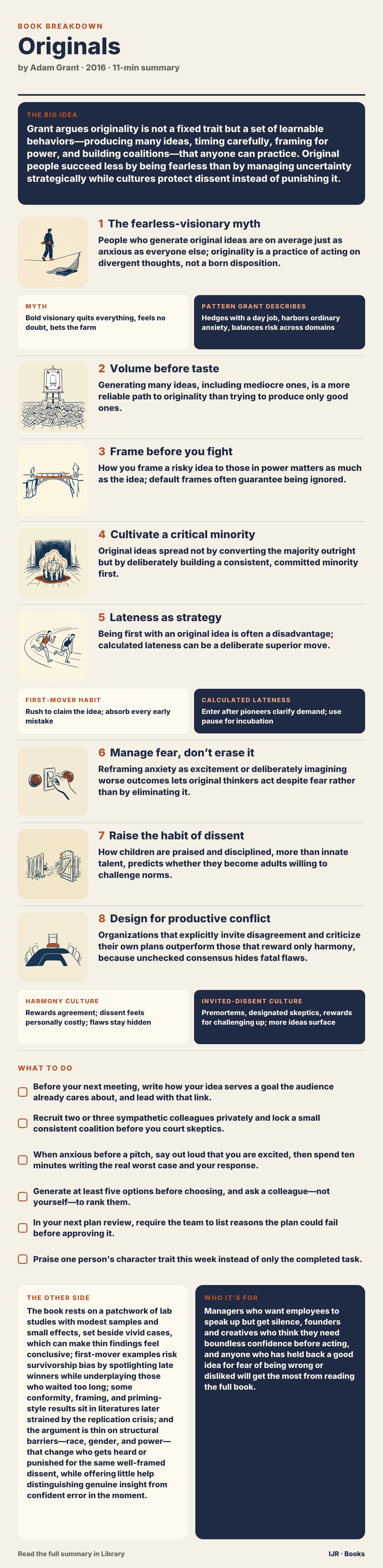
Grant argues originality is not a fixed trait but a set of learnable behaviors—producing many ideas, timing carefully, framing for power, and building coalitions—that anyone can practice. Original people succeed less by being fearless than by managing uncertainty strategically while cultures protect dissent instead of punishing it.
The book in brief
Grant starts by dismantling the image of the bold, unhesitating innovator. He shows that people who eventually produce original work often hedge bets, keep day jobs, delay full commitment, and feel ordinary doubt; risk in one domain is typically balanced by caution in others. Originality, on this view, is the choice to act on a divergent thought rather than a gift some are born with.
He then turns to how good ideas are found among bad ones. Quality tracks quantity because volume raises the odds of novelty, and because originators themselves are unreliable judges of which of their ideas will land. Expert peers and external tests outperform personal conviction, so the practical edge is a pipeline that generates many options before filtering them.
Even a solid idea dies if it is never voiced or is voiced badly. Grant examines hierarchy and voice: framing a proposal as continuous with existing goals works better than presenting it as radical rupture; middle-status people often conform most because they have the most to lose; critics gain competence points when they pair challenge with credible agreement. Once voiced, ideas rarely convert a majority by force of argument alone. Change agents recruit a small, consistent minority—often people with weaker ties to the center—then expand outward rather than attacking the hardest skeptics first.
Timing cuts against the cult of speed. First movers fail more often than later entrants who learn from early mistakes; deliberate pause can incubate more original associations than forced immediate generation. Internally, original action still requires emotional work: reframing arousal as excitement, or rehearsing worst cases so risk feels bounded, lets people move without waiting to feel fearless.
The arc closes on formation and institutions. How children are praised and disciplined—values explanations over blanket rules, character praise over act-only praise, fewer rigid rules—predicts adult willingness to challenge norms. Organizations that require premortems, reward challenges to superiors, and seed designated dissenters surface better decisions than cultures that prize harmony. Originality scales only when structures protect the behaviors the earlier chapters describe.
Context
Adam Grant’s Originals (2016) pushed back against the myth of the fearless visionary with a research-backed account of how creative dissent spreads inside organizations and societies. It drew on studies of entrepreneurs, activists, and inventors to show that timing, framing, coalition-building, and calculated risk management matter more than boundless confidence.
The key ideas

1
The fearless-visionary myth
People who generate original ideas are on average just as anxious as everyone else; originality is a practice of acting on divergent thoughts, not a born disposition.
Myth
Bold visionary quits everything, feels no doubt, bets the farm
Pattern Grant describes
Hedges with a day job, harbors ordinary anxiety, balances risk across domains
Grant opens by rejecting the stock image of the unhesitating innovator. Entrepreneurs who kept stable day jobs while starting businesses were substantially more likely to survive the early years than those who quit and went all in. Doubt, delayed commitment, and hedging are common among people who later produce original work, not evidence they lack the right temperament.
He treats risk as a portfolio: unconventional moves in one domain are often paired with caution in another, such as personal finances. From the outside this can look reckless; from the inside it is selective exposure, not total gamble.
The reframe drives the rest of the book. If originality is a decision rather than a trait, it can be studied, taught, and practiced. Fear and uncertainty are managed strategically while the person still moves on ideas others dismiss or never notice.
In practice: Phil Knight kept working as an accountant while building what became Nike; Warby Parker’s founders nearly abandoned the idea after a lukewarm response and continued mainly because a professor pushed further testing.

2
Volume before taste
Generating many ideas, including mediocre ones, is a more reliable path to originality than trying to produce only good ones.
Grant presents creative-output research, including on composers such as Beethoven and Mozart, showing celebrated works emerged from a much larger body that included forgettable pieces. Quantity raises the odds of novelty and gives the process more raw material to test.
Creators are often poor judges of which of their own ideas will succeed. Studies in which entrepreneurs and executives predicted their best pitches or products found predictions frequently wrong, sometimes worse than chance. Attachment and proximity cloud judgment.
Expert peers are often better positioned to evaluate potential. Organizations and individuals should therefore resist early harsh filters and build pipelines that generate many options before evaluation. The edge is process—produce more, submit to outside judgment—not innate taste.
In practice: Analysis of major composers showed their most celebrated works sat inside a much larger output that included many forgettable pieces; originators’ own rankings of their ideas were unreliable.

3
Frame before you fight
How you frame a risky idea to those in power matters as much as the idea; default frames often guarantee being ignored.
Grant turns from idea generation to why so many ideas die unvoiced. Research on whistleblowers, dissenting employees, and authority challengers shows that presenting an idea as consistent with existing values and goals raises the odds it will be heard, compared with casting it as radical departure.
Successful dissenters often acknowledge the reasoning behind the current approach before offering an alternative. Audiences also judge critics as more competent when criticism is paired with at least one credible point of agreement with the group being challenged.
Status shapes who speaks. Middle status often produces the most conformity, because people in the middle have the most to lose and the strongest incentive to protect position. Those with little left to lose, or with already secured status, are freer to dissent. Even a well-tested idea fails without regard for audience psychology; originality is inseparable from social strategy.
In practice: An employee at a financial firm seeking to warn leadership about a flawed decision is more effective acknowledging the plan’s rationale first than attacking it head-on.

4
Cultivate a critical minority
Original ideas spread not by converting the majority outright but by deliberately building a consistent, committed minority first.
Grant moves from individual voice to scale. Studies of social movements and organizational change show successful originals rarely win majorities through sheer argument. Change agents start with a small set of already sympathetic allies, sometimes people on the margins rather than at the center, because central figures are more invested in existing norms.
A minority position held consistently and confidently over time can shift majority opinion more than a wavering larger bloc; consistency of the signal matters more than initial size. Classic conformity research extended into organizations underpins this claim.
The common instinct to persuade the most resistant skeptics first wastes energy and can harden opposition. A stabler path is to lock a core, then work the movable middle. Framing gets the idea voiced; coalition strategy is what keeps it alive.
In practice: Civil-rights and internal corporate-reform cases show early recruits often had weaker ties to the mainstream, making them more willing to break from it.

5
Lateness as strategy
Being first with an original idea is often a disadvantage; calculated lateness can be a deliberate superior move.
First-mover habit
Rush to claim the idea; absorb every early mistake
Calculated lateness
Enter after pioneers clarify demand; use pause for incubation
Grant challenges the assumption that originality rewards speed. Data comparing pioneers to improvers across industries, including market-entrant studies, show first movers fail at a notably higher rate than companies that enter later, after early mistakes have clarified what customers want. Later entrants can avoid costly errors and capture more share.
At the individual level, procrastination sometimes serves incubation: experimental work assigning people to generate creative solutions immediately versus after a delay found delayed groups produced more original outcomes, as unstructured time allowed divergent associations to surface.
He distinguishes this from chronic avoidance. The useful form is a deliberate pause by someone already committed to acting, waiting until coalition, market, or thinking has matured enough that survival odds improve. Patience in deployment is part of risk management, not the opposite of originality.
In practice: Consumer-technology and retail cases where later entrants avoided pioneers’ costly errors and took more market share; delayed-generation experiments yielded more original solutions than immediate ones.

6
Manage fear, don’t erase it
Reframing anxiety as excitement or deliberately imagining worse outcomes lets original thinkers act despite fear rather than by eliminating it.
Once idea, timing, and coalition are in place, internal emotional work remains. Research on anxiety reappraisal found subjects told to relabel pre-performance nervousness as excitement performed better than those told to calm down, because excitement and anxiety share arousal and reframing works with the body rather than against it.
A second technique, linked to defensive pessimism, has people mentally rehearse worst-case outcomes in detail. Paradoxically this reduces anxiety by making risk feel bounded and planned for instead of open-ended and catastrophic. Entrepreneurs and dissenters have used such rehearsal before high-stakes launches or confrontations.
Emotional regulation and practical hedging are two sides of the same coping strategy. They extend how long someone can tolerate uncertainty and still move. The temperament required is not fearlessness; it is trainable cognitive technique.
In practice: Subjects who relabeled nerves as excitement outperformed those trying to calm down; entrepreneurs steadied themselves before launches by writing out worst cases and responses.

7
Raise the habit of dissent
How children are praised and disciplined, more than innate talent, predicts whether they become adults willing to challenge norms.
Grant shifts to lifetime cultivation. Studies comparing families of morally exceptional individuals—including rescuers who sheltered people during the Holocaust—with comparable families who did not act found the former parents used explanations grounded in values and impact on others, rather than blanket rule enforcement or punishment-based discipline.
Praise research showed that praising character traits (calling a child helpful) produced more consistent later value-driven behavior than praising the specific act alone. Households of unusually creative or independent-minded people often imposed fewer explicit rules, leaving room for internal standards instead of pure external compliance.
If independent thought is seeded by specific parenting and educational practices rather than genetics, originality is even more clearly a product of environment and habit. Companies face an analogous choice: rigid rules that produce compliance versus shared values that produce judgment—and the latter is more likely to yield employees who raise problems and new ideas.
In practice: Holocaust-rescuer families emphasized values and effects on others over punishment; character praise outperformed act-only praise in producing lasting helpful behavior.

8
Design for productive conflict
Organizations that explicitly invite disagreement and criticize their own plans outperform those that reward only harmony, because unchecked consensus hides fatal flaws.
Harmony culture
Rewards agreement; dissent feels personally costly; flaws stay hidden
Invited-dissent culture
Premortems, designated skeptics, rewards for challenging up; more ideas surface
The final substantive move applies individual findings to organizational design. Leaders who built structures for productive conflict required teams to generate reasons a plan might fail before proceeding—a premortem-style practice. Research showed groups instructed to debate and criticize proposals produced better outcomes than groups told to be agreeable, even when members of critical groups found the process less pleasant.
Bridgewater Associates’ radical transparency, which formally rewards challenging superiors, illustrates an institution that lowers the personal risk of voice. Normalizing dissent increases the volume of ideas surfaced, which—per the quantity chapter—raises the odds of finding valuable ones. Leaders can also seed internal skeptics or designated dissenters into decision groups to counter the pull toward consensus.
Most organizations claim to want original thinking while incentives, meetings, and promotion criteria punish it. Changing that takes concrete mechanisms, not stated values alone. Individual habits only scale when institutions protect and amplify them.
In practice: Teams required to list ways a plan could fail before going ahead, and groups ordered to criticize proposals, outperformed agreeable groups despite less pleasant process ratings.
Key terms
- Portfolio of risk Taking a bold bet in one domain while staying cautious in others, so originality is not an all-in gamble.
- Voice Speaking up inside a hierarchy with a challenge or new idea, shaped by status and framing.
- Critical minority A small, consistent group of allies whose steady signal can shift the majority over time.
- Calculated lateness Entering or speaking after pioneers have revealed mistakes, using delay as strategy rather than fear.
- Anxiety reappraisal Relabeling nervous arousal as excitement so you work with the body’s state instead of fighting it.
- Defensive pessimism Mentally rehearsing worst cases in detail so risk feels bounded and planned for.
- Premortem A required exercise to list why a plan might fail before it launches, surfacing hidden flaws.
- Character praise Praising the kind of person a child is (e.g., helpful) rather than only the single act, to lock in later behavior.
What to do
- Before your next meeting, write how your idea serves a goal the audience already cares about, and lead with that link.
- Recruit two or three sympathetic colleagues privately and lock a small consistent coalition before you court skeptics.
- When anxious before a pitch, say out loud that you are excited, then spend ten minutes writing the real worst case and your response.
- Generate at least five options before choosing, and ask a colleague—not yourself—to rank them.
- In your next plan review, require the team to list reasons the plan could fail before approving it.
- Praise one person’s character trait this week instead of only the completed task.
Questions to think with
- Where are you still waiting to feel fearless before you act on an idea you already believe has merit?
- Which of your current proposals is framed as a break from the group’s values when it could be framed as serving them?
- Who are three people already leaning your way whom you have not yet asked to stand with you consistently?
- Is your urge to move first solving a real window, or skipping the incubation and market learning that later entrants use?
- Does your team’s meeting design punish dissent in practice while your stated values claim to welcome it?
The other side
The book rests on a patchwork of lab studies with modest samples and small effects, set beside vivid cases, which can make thin findings feel conclusive; first-mover examples risk survivorship bias by spotlighting late winners while underplaying those who waited too long; some conformity, framing, and priming-style results sit in literatures later strained by the replication crisis; and the argument is thin on structural barriers—race, gender, and power—that change who gets heard or punished for the same well-framed dissent, while offering little help distinguishing genuine insight from confident error in the moment.
Who it's for
Managers who want employees to speak up but get silence, founders and creatives who think they need boundless confidence before acting, and anyone who has held back a good idea for fear of being wrong or disliked will get the most from reading the full book.