




Stress plus rest equals growth in any demanding field
Athletes and overworked professionals get the stress-rest equation that turns hard effort into durable capacity instead of quiet burnout.
IJR · Oct 29, 2026 · 12 min read
In 60 seconds
- Growth in body or mind only happens when genuine stress is paired with real recovery; cutting rest for constant work suppresses the adaptation it aims to produce.
- Elite coaches periodize load in build-and-consolidate cycles rather than permanent max effort; spaced practice in learning works by the same consolidation logic.
- Single-pointed focus beats multitasking because task switches leave attention residue that degrades the next effort.
- True recovery is active—nature, meditation, light movement—while passive scrolling often fails to restore the nervous system.
- Identity balanced on one role collapses under setbacks; a multi-pillared self and a purpose beyond personal gain keep stress usable instead of existential.
- Career-scale burnout often comes from treating a whole decade like one unbroken training block with no sabbaticals or lower-intensity seasons.
The big idea
Stulberg and Magness argue that peak performance in any field follows one pattern: stress plus rest equals growth. They claim people who sustain excellence for decades treat recovery, purpose, and identity as seriously as effort, rejecting the always-on habit of equating more hours with more output.
The book in brief
A hard workout leaves microscopic tears in muscle. The body only rebuilds those fibers stronger during the rest that follows.
Stulberg and Magness start from that physiology and widen it to minds and careers. Insufficient recovery, not stress itself, blocks growth. Even one poor night of sleep dents reaction time and decision quality on a scale comparable to mild intoxication. From there they show how elite coaches vary intensity across weeks and months so capacity rises without permanent max effort, and how spaced practice helps students retain more because spacing forces the same kind of consolidation.
Attention gets the same treatment. Switching tasks leaves residue that quietly lowers the next effort, so protected deep-focus blocks matter—yet even those fray without recovery. Recovery itself has to be active. Nature, meditation, and light movement lower stress hormones; passive scrolling often keeps the nervous system mildly switched on.
Identity and purpose then explain who can actually follow the pattern. A self balanced on one job title or race result turns ordinary pressure into existential threat and blocks full recovery. A larger purpose changes how discomfort is read and sustains effort when pure willpower runs dry. Routines lock the system down by cutting trivial decisions, though the ego-depletion studies behind that advice later failed large-scale replication.
The final move scales the equation to decades. Careers that never build in sabbaticals or lower-intensity seasons burn out the way a runner burns out without an off-season. Sustainable excellence is a designed cycle at every time scale, not a constant state.
Context
Brad Stulberg and Steve Magness published the book in 2017. They draw on exercise physiology, psychology, and case studies of elite athletes and high achievers to challenge always-on culture that treats rest as optional.
The key ideas
1
The stress-rest equation
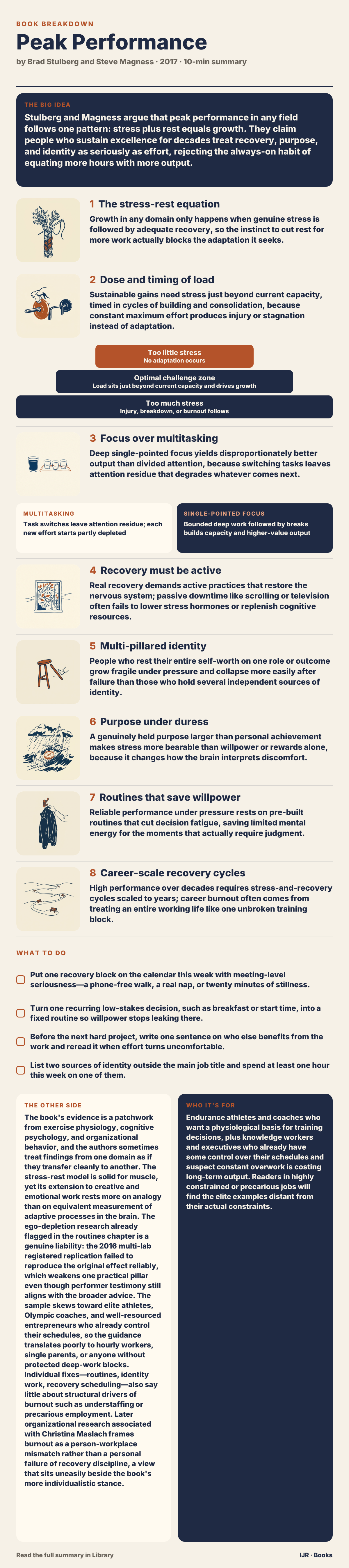
Growth in any domain only happens when genuine stress is followed by adequate recovery, so the instinct to cut rest for more work actually blocks the adaptation it seeks.
A hard workout creates microscopic damage in muscle. The body rebuilds that tissue stronger only during the rest that follows. Stulberg and Magness take this model and apply it to cognitive and creative work as well.
They point to cardiac-muscle stress research and the supercompensation cycles exercise physiologists use to time competition peaks. The claim is blunt: stress is not the enemy. Insufficient recovery is.
Even one night of poor sleep produces measurable drops in reaction time and decision quality, comparable to mild intoxication. Anyone chasing improvement must apply stress on purpose and then guard the recovery window with equal discipline.
Rest is not a reward after the real work. It is half of the growth mechanism. Past a certain point, extra stress without recovery yields diminishing or negative returns.
In practice: In interval running, the rest between hard efforts is not dead time; it is the window through which the body adapts to the load.
2
Dose and timing of load
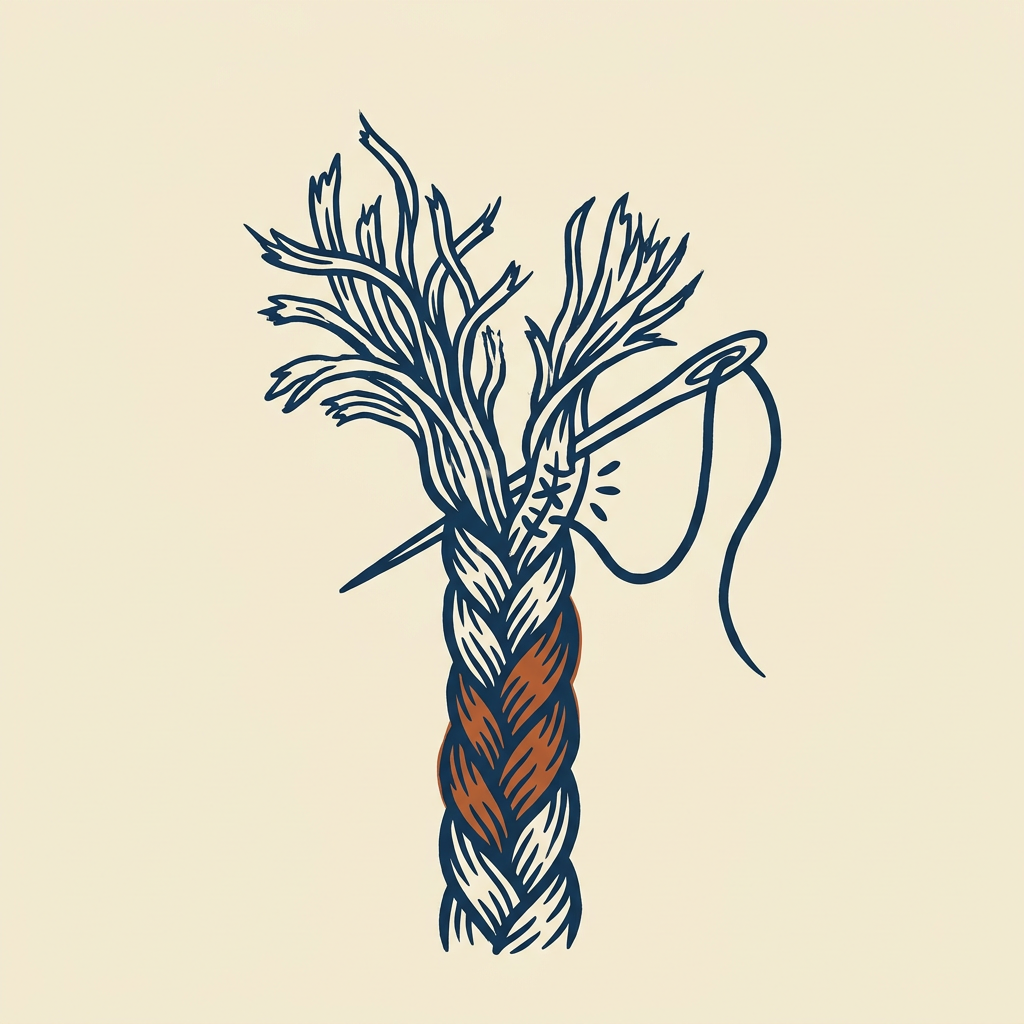
Sustainable gains need stress just beyond current capacity, timed in cycles of building and consolidation, because constant maximum effort produces injury or stagnation instead of adaptation.
- Too little stressNo adaptation occurs
- Optimal challenge zoneLoad sits just beyond current capacity and drives growth
- Too much stressInjury, breakdown, or burnout follows
Elite coaches refuse to ask athletes to peak every week. They use periodization: intensity rises and falls across weeks and months so the body never stays locked at permanent max effort.
The same pattern appears in learning research on spaced practice and interleaving. Students who space study sessions retain more than those who cram, because spacing forces retrieval and consolidation the way physical rest follows exertion.
Talent alone does not explain elite results. What does is years of load management that keeps stress inside the optimal challenge zone. Too little stress and nothing adapts. Too much and the system breaks.
Performers and organizations should track cumulative load, not just today’s effort, and schedule recovery as a planned block rather than something taken only when exhaustion forces it.
In practice: Olympic training programs vary intensity across months so athletes arrive at competition recovered enough to actually peak.

3
Focus over multitasking
Deep single-pointed focus yields disproportionately better output than divided attention, because switching tasks leaves attention residue that degrades whatever comes next.
Multitasking
Task switches leave attention residue; each new effort starts partly depleted
Single-pointed focus
Bounded deep work followed by breaks builds capacity and higher-value output
The mind follows the same stress-rest pattern as the body. Sustained undivided focus is itself a stressor that builds concentration capacity, but only when it is bounded and followed by breaks.
Research on attention residue shows that part of the mind stays stuck on the previous task after a switch. That leftover attention quietly lowers performance on the new one. Constant email checks during deep work therefore cost more than the minutes they consume.
Top performers treat interruptions as a managed cost. They protect solitary blocks rather than accepting fragmentation as inevitable. Flow—the state of full absorption—cannot be forced, yet it can be invited by clearing distraction and matching difficulty to skill.
Without recovery from focused work, even well-protected concentration eventually frays.
In practice: Writers and scientists often wall off early morning hours before email and meetings, using the least depleted part of the day for their hardest thinking.

4
Recovery must be active
Real recovery demands active practices that restore the nervous system; passive downtime like scrolling or television often fails to lower stress hormones or replenish cognitive resources.
Many people feel exhausted after hours of supposed rest because the activities they chose never actually recovered them. Sedentary screen time can keep the nervous system mildly activated even while the body sits still.
Practices that engage the parasympathetic system—meditation, time in nature, light movement—lower stress hormones more effectively. Attention restoration research suggests natural environments replenish depleted cognitive resources in ways urban settings do not.
Hospital patients with views of nature have been observed to recover faster. The point is not luxury. It is physiology.
Naps timed to circadian rhythms, brief phone-free walks, and short meditation sessions belong on the performance plan as scheduled components, not indulgences squeezed in when mood allows.
In practice: Hospital patients whose rooms looked out on nature recovered faster than those facing walls or urban scenes.
5
Multi-pillared identity
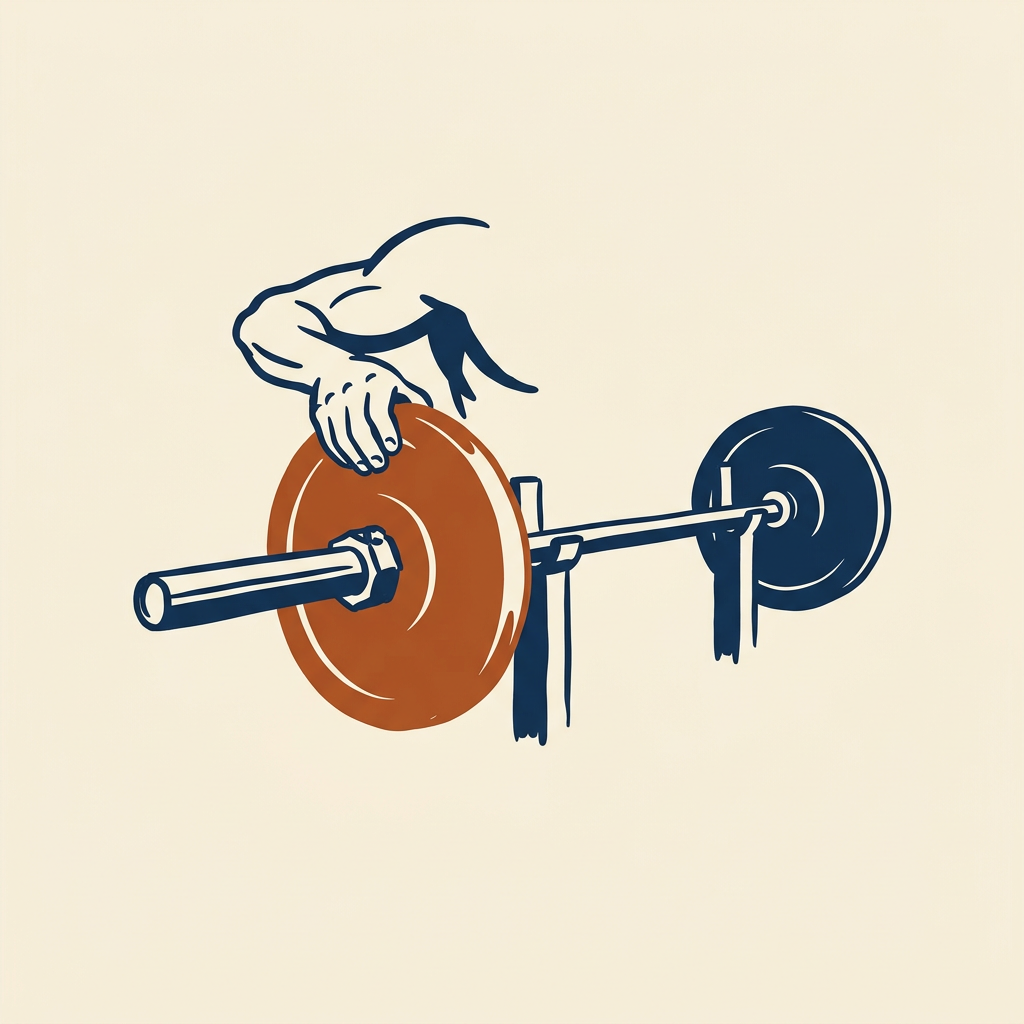
People who rest their entire self-worth on one role or outcome grow fragile under pressure and collapse more easily after failure than those who hold several independent sources of identity.
Stulberg and Magness describe an unstable house of self-worth: confidence balanced on a single pillar such as job results or race times. When that pillar wobbles, the whole structure of esteem falls, and the resulting anxiety further degrades performance.
Studies on contingent self-esteem find higher depression and anxiety after setbacks among people whose worth hinges on external validation. Athletes and executives have hit severe crises after retirement or job loss precisely because nothing else held up their sense of self.
The remedy is deliberate diversification—relationships, values, and interests outside the main performance domain—so one setback does not threaten the entire person.
An unstable identity turns ordinary stress into existential threat, which keeps the nervous system from ever fully recovering. Without that groundwork, the training and focus techniques earlier in the book lose their footing.
In practice: Athletes and executives who tied identity solely to their role suffered severe crises after retirement or job loss when that single pillar disappeared.

6
Purpose under duress
A genuinely held purpose larger than personal achievement makes stress more bearable than willpower or rewards alone, because it changes how the brain interprets discomfort.
Purpose works as a specific psychological resource. People who frame hard effort as contribution to others or a larger mission report lower perceived exertion and stick with difficulty longer than those driven only by personal gain or fear of failure.
The authors discuss mattering—the sense that the work counts beyond oneself—as a buffer against the anxiety-driven drain that comes with fragile identity. Comparisons between competitors chasing external rewards such as prize money or rankings and those held by a broader mission show the latter performing more consistently through setbacks.
This is not manufactured positive thinking. Purpose has to be genuinely held or it fails to produce the described physiological benefits.
The chapter moves the argument from daily technique toward the larger life conditions that make multi-year excellence possible.
In practice: Competitors motivated by a broader mission showed more consistent performance across setbacks than those chasing prize money or rankings alone.
7
Routines that save willpower
Reliable performance under pressure rests on pre-built routines that cut decision fatigue, saving limited mental energy for the moments that actually require judgment.
Willpower behaves like a depletable resource. Psychology research on ego depletion found that people who used self-control on one task had less left for a later unrelated task. The authors note this line of work later faced replication challenges, including a 2016 multi-lab registered replication that failed to reproduce the original effect reliably, yet they still see it as broadly consistent with how elite performers describe their days and with older stress findings.
The practical response is rigid routines around preparation, meals, and pre-performance habits. Trivial choices get automated so judgment stays available for the work that matters.
Routines also lock in the deep-work windows and recovery blocks from earlier chapters instead of leaving them to mood or chance.
Structure itself becomes stress management: fewer unnecessary decisions during the day free capacity the same way fewer unnecessary training stresses free the body.
In practice: Athletes run identical pre-race routines regardless of the stakes; professionals keep mornings identical so high-value work starts without a string of small choices.
8
Career-scale recovery cycles
High performance over decades requires stress-and-recovery cycles scaled to years; career burnout often comes from treating an entire working life like one unbroken training block.
A runner who trains hard every day without an off-season eventually breaks down. Stulberg and Magness say many high achievers who flame out in their thirties or forties make the same error at career scale: no structural recovery built into the working life.
Sabbaticals, pivots, and seasons of deliberately lower intensity function like an easy training week. They are necessary because of ambition, not in spite of it.
People with multi-pillared identities can take these pauses without feeling they are falling behind. People with single-pillar identities experience any slowdown as threat and therefore never rest, which speeds their own burnout.
The book closes by joining the threads: physiology taught the pattern, focus and routine applied it to the day, identity and purpose explained who can follow it, and career design applies the same equation to decades.
In practice: Sabbaticals and deliberate lower-intensity seasons serve as the career equivalent of an easy training week that lets capacity rebuild.
Key terms
- Stress-rest equation Growth requires deliberate stress followed by genuine recovery; skip either half and adaptation stalls.
- Supercompensation The rebound that leaves the body stronger after stress-plus-rest than it was before the stress.
- Periodization Varying intensity across weeks and months so capacity builds without permanent peak effort.
- Attention residue Leftover focus that clings to a previous task after a switch and lowers performance on the next one.
- Optimal challenge zone Load just beyond current capacity that drives adaptation; too little does nothing, too much breaks the system.
- Unstable house of self-worth Identity balanced on one pillar such as job results so any wobble collapses the whole sense of self.
- Mattering The felt sense that work contributes beyond personal gain, buffering anxiety and sustaining effort.
- Ego depletion The claim that willpower is limited and spent by self-control, leaving less for later tasks—though later replications cast doubt on the original findings.
What to do
- Put one recovery block on the calendar this week with meeting-level seriousness—a phone-free walk, a real nap, or twenty minutes of stillness.
- Turn one recurring low-stakes decision, such as breakfast or start time, into a fixed routine so willpower stops leaking there.
- Before the next hard project, write one sentence on who else benefits from the work and reread it when effort turns uncomfortable.
- List two sources of identity outside the main job title and spend at least one hour this week on one of them.
Questions to think with
- Where in your week does stress pile up without a matching recovery block?
- If your main role vanished tomorrow, what other pillars would still hold your sense of self?
- Which daily decisions still burn willpower that a simple routine could eliminate?
- Does the purpose you claim for your hardest work still feel true when nobody is watching?
- At career scale, when was your last deliberate lower-intensity season?
The other side
The book's evidence is a patchwork from exercise physiology, cognitive psychology, and organizational behavior, and the authors sometimes treat findings from one domain as if they transfer cleanly to another. The stress-rest model is solid for muscle, yet its extension to creative and emotional work rests more on analogy than on equivalent measurement of adaptive processes in the brain. The ego-depletion research already flagged in the routines chapter is a genuine liability: the 2016 multi-lab registered replication failed to reproduce the original effect reliably, which weakens one practical pillar even though performer testimony still aligns with the broader advice. The sample skews toward elite athletes, Olympic coaches, and well-resourced entrepreneurs who already control their schedules, so the guidance translates poorly to hourly workers, single parents, or anyone without protected deep-work blocks. Individual fixes—routines, identity work, recovery scheduling—also say little about structural drivers of burnout such as understaffing or precarious employment. Later organizational research associated with Christina Maslach frames burnout as a person-workplace mismatch rather than a personal failure of recovery discipline, a view that sits uneasily beside the book's more individualistic stance.
Who it's for
Endurance athletes and coaches who want a physiological basis for training decisions, plus knowledge workers and executives who already have some control over their schedules and suspect constant overwork is costing long-term output. Readers in highly constrained or precarious jobs will find the elite examples distant from their actual constraints.