




How high earners can retire by thirty-one without crash damage
Kristy Shen and Bryce Leung wrote Quit Like a Millionaire for salaried pros in their twenties and thirties who want a crash-tested number plan, not vague budgeting tips.
IJR · Nov 4, 2026 · 13 min read
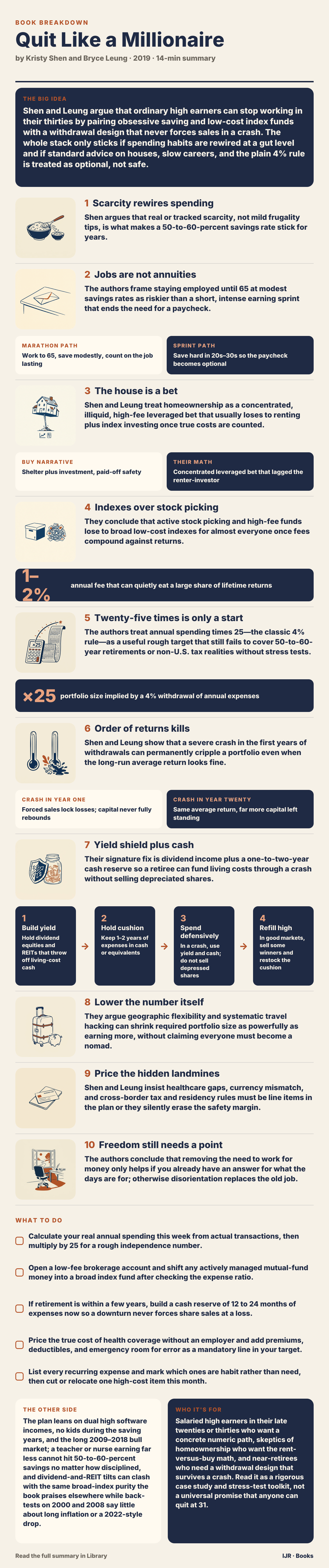
In 60 seconds
- Extreme early scarcity, not willpower lectures, is what let the authors save 50 to 60 percent of income for a decade.
- Treating the career as a short sprint beats counting on a job that can vanish in your forties or fifties.
- Once taxes, upkeep, fees, and opportunity cost are counted, renting plus index funds beat buying the house they lived near.
- The 4% rule and its 25-times-expenses target are only a rough start for a 50-year retirement and a non-U.S. tax life.
- Sequence-of-returns risk—a crash in the first years of withdrawals—can wreck a portfolio even when average returns look fine.
- A Yield Shield of dividends plus a one-to-two-year cash cushion lets you avoid selling shares while they are down.
The big idea
Shen and Leung argue that ordinary high earners can stop working in their thirties by pairing obsessive saving and low-cost index funds with a withdrawal design that never forces sales in a crash. The whole stack only sticks if spending habits are rewired at a gut level and if standard advice on houses, slow careers, and the plain 4% rule is treated as optional, not safe.
The book in brief
The book opens with Kristy Shen’s childhood hunger in rural China and the habit of ruthless quantification it left her. That scarcity engine, not middle-class discipline tips, is what later made 50-to-60-percent saving feel normal on a Canadian software salary.
From there the authors attack the idea that a long career is the low-risk path. They treat the earning years as a sprint, build taxable brokerage money alongside retirement accounts so cash is reachable before 59, and show why a late start at a modest savings rate loses the compounding race.
They next tear down homeownership-as-investment with Toronto rent-versus-buy math, then lock the portfolio into broad low-fee index funds after Shen’s own stock-picking underperformed. The independence number is framed as annual spending times 25, with their own target near one million, while the limits of the original 30-year U.S. 4% research are flagged for early and non-U.S. retirees.
The pivot is sequence-of-returns risk: identical average returns produce opposite outcomes depending on whether a crash hits year one or year twenty of withdrawals. Their answer is the Yield Shield—dividends and REITs covering part of living costs—plus a cash cushion of one to two years of expenses, rebuilt by selling high in good markets.
Later chapters shrink the target further through geographic arbitrage and travel hacking, then force healthcare, currency, and residency rules into the budget instead of treating them as afterthoughts. The close drops the mechanics and asks what the freed time is actually for once the money excuse is gone.
Context
Shen and Leung retired at 31 after dual software careers in Toronto and wrote from that lived plan. The book landed as a numbers-first FIRE case study that challenged real-estate default advice and the plain 4% rule rather than offering another generic budget pep talk.
The key ideas

1
Scarcity rewires spending
Shen argues that real or tracked scarcity, not mild frugality tips, is what makes a 50-to-60-percent savings rate stick for years.
Shen opens with rural China hunger and a grandmother forced to choose which child to feed. She treats that terror as the engine of later behavior, not colorful backstory.
Carried into Canadian adult life, the same gut fear let her save half or more of an engineering salary for a decade without feeling deprived. Typical advice assumes middle-class comfort as the emotional baseline; she says that baseline is exactly why most cuts fail.
The method is ruthless quantification applied to every life choice. Career, lifestyle, and portfolio design all become optimization problems with dollar figures attached.
Without that reprogrammed relationship to need versus habit, the rest of the math has nothing to stand on.
In practice: As a new immigrant she chose computer engineering solely because job-market data showed it paid, rejecting a more appealing lower-paying field.

2
Jobs are not annuities
The authors frame staying employed until 65 at modest savings rates as riskier than a short, intense earning sprint that ends the need for a paycheck.
Marathon path
Work to 65, save modestly, count on the job lasting
Sprint path
Save hard in 20s–30s so the paycheck becomes optional
Colleagues in tech were laid off in their forties and fifties after decades of loyalty, with severance too small to bridge to an unvested pension. A job can vanish; it is not an annuity.
Their counter-model is to save so hard in the twenties and thirties that continuous employment becomes optional. Compounding math favors the early high saver even when total dollars contributed later look similar, because the extra decade does most of the work.
Standard advice to max employer-matched accounts first is incomplete for anyone planning to stop before 59. Early-withdrawal penalties mean taxable brokerage money must sit beside the sheltered accounts.
Working longer to feel secure can therefore be the riskier path, not the safer one.
In practice: Their own portfolio deliberately grew non-registered investments alongside tax-sheltered ones so they could tap cash in their thirties without penalties.

3
The house is a bet
Shen and Leung treat homeownership as a concentrated, illiquid, high-fee leveraged bet that usually loses to renting plus index investing once true costs are counted.
Buy narrative
Shelter plus investment, paid-off safety
Their math
Concentrated leveraged bet that lagged the renter-investor
A house is sold as shelter and investment at once. As an investment it underperforms after property taxes, maintenance, insurance, realtor commissions, and the opportunity cost of the down payment.
They run the comparison with real Toronto figures: the renter who invested the difference in low-cost index funds finished ahead over a multi-decade horizon even after rent rose. A single local property is the opposite of the diversification they demand everywhere else.
Paid-off equity feels safe but earns no dividend and cannot be reallocated easily. Stability for kids or freedom from landlords is real; they insist it be named as consumption, not return.
Tying decades of savings to one illiquid address compounds the job-risk problem from the prior chapter instead of fixing it.
In practice: They rented through their entire saving years and redirected what would have been a down payment into equities.

4
Indexes over stock picking
They conclude that active stock picking and high-fee funds lose to broad low-cost indexes for almost everyone once fees compound against returns.
1–2%
annual fee that can quietly eat a large share of lifetime returns
After rejecting real estate as the core holding, the actual engine is broad-market equity index funds, with bonds added as retirement nears. Most active funds lag their benchmark over long stretches once fees are included.
A 1-to-2-percent annual management fee looks small; compounding makes it consume a large fraction of lifetime returns. The strategy’s edge requires staying invested through downturns rather than timing them.
They favor a short list of broad domestic and international equity funds plus bonds, rebalanced on a schedule, over a clutter of niche products. A portfolio bleeding fees or concentrated in a few names cannot support decades of withdrawals later.
Emotional tolerance for volatility is part of the design, not an optional personality trait.
In practice: Kristy first built a complex individual-stock portfolio from an engineer’s urge to optimize every variable, underperformed a plain index for years, and switched.

5
Twenty-five times is only a start
The authors treat annual spending times 25—the classic 4% rule—as a useful rough target that still fails to cover 50-to-60-year retirements or non-U.S. tax realities without stress tests.
×25
portfolio size implied by a 4% withdrawal of annual expenses
The Trinity-era research behind the 4% rule modeled a 30-year window on U.S. data with inflation-adjusted static withdrawals. Early retirees may need the money to last twice as long; Canadian tax rules and future global returns may not match the history.
They still use the rule as the first estimate: track real spending, multiply by 25, then pressure-test. Their own frugal dual-income habits produced a target in the rough range of one million and let them stop before either turned 32.
Real households cut spending in bad years; the original rule does not. That gap is exactly why the next chapters exist.
The number is a starting line, not a finish line.
In practice: They set their target from actual tracked annual spending far below a typical dual-income household’s, then reached roughly one million through high pay, aggressive saving, and indexing.

6
Order of returns kills
Shen and Leung show that a severe crash in the first years of withdrawals can permanently cripple a portfolio even when the long-run average return looks fine.
Crash in year one
Forced sales lock losses; capital never fully rebounds
Crash in year twenty
Same average return, far more capital left standing
Two portfolios with the same average annual return over thirty years finish in opposite places if one crash hits year one of retirement and the other hits year twenty. Withdrawals taken while prices are depressed lock in losses and shrink the capital that would have recovered.
For early retirees this is the central threat. Decades of withdrawals sit ahead and no paycheck remains as backup.
A still-employed saver can keep buying through 2008–2009; a new retiree forced to sell near the bottom cannot. Average-return comfort is therefore the wrong comfort.
Accumulation design is necessary but not sufficient; withdrawal mechanics during the bad stretch decide survival.
In practice: They use the 2008 crisis: selling equities near the 2009 bottom damaged a retiree in ways a working buyer who kept purchasing did not suffer.

7
Yield shield plus cash
Their signature fix is dividend income plus a one-to-two-year cash reserve so a retiree can fund living costs through a crash without selling depreciated shares.
- 1Build yieldHold dividend equities and REITs that throw off living-cost cash
- 2Hold cushionKeep 1–2 years of expenses in cash or equivalents
- 3Spend defensivelyIn a crash, use yield and cash; do not sell depressed shares
- 4Refill highIn good markets, sell some winners and restock the cushion
The Yield Shield structures part of the portfolio around dividend equities and REITs so a meaningful slice of annual expenses arrives as cash whether prices are rising or falling. Dividends historically hold up better than share prices in crashes.
The Cash Cushion sits beside it: one to two years of living expenses in actual cash or equivalents. During a severe downturn you spend the cushion instead of liquidating lows.
In good markets you rebuild the cushion by selling some appreciated shares and banking the cash, so replenishment happens at high prices. Back-tests against the 2000 and 2008 periods are offered as evidence the combination would have preserved portfolios the plain 4% path damaged.
Forced selling is the enemy; this pairing is built to remove it.
In practice: They describe rebuilding the cash reserve in strong years by trimming winners, then living on yield and cash through the next storm.

8
Lower the number itself
They argue geographic flexibility and systematic travel hacking can shrink required portfolio size as powerfully as earning more, without claiming everyone must become a nomad.
After fixing the target and the withdrawal mechanics, they attack the expense side. Full-time travel at lower-cost bases kept their annual spend well below a Toronto or Vancouver homeowner’s while quality of life held.
Cost of living varies enormously by place. Early retirees willing to move for stretches can support a good life on a smaller pile than one locked to a high-cost home base.
Travel hacking—credit-card bonuses and airline miles used as a system, not a hobby—cuts flight and hotel cash outlays. The same flexibility principle applies to anyone who simply chooses a cheaper region on purpose.
Spending is more elastic than most plans admit; that elasticity takes pressure off both the portfolio and the crash defenses.
In practice: Their multi-year pattern of longer stays in lower-cost countries, alternated deliberately, averaged annual spending downward.

9
Price the hidden landmines
Shen and Leung insist healthcare gaps, currency mismatch, and cross-border tax and residency rules must be line items in the plan or they silently erase the safety margin.
Losing employer health coverage is the objection that sinks many early-retirement sketches. Canadian public healthcare makes the path structurally easier; U.S. readers face individual premiums, deductibles, and emergency risk until Medicare age.
They treat those costs as mandatory budget lines, not later surprises. Currency risk appears when investments sit in one currency and spending happens in another; withdrawal taxes and residency-day rules for benefits add more friction.
Plans built only on returns and withdrawal rates are incomplete. The same margin the Yield Shield and cash cushion protect can be eaten by paperwork and premiums.
Systems the retiree lives inside matter as much as the spreadsheet.
In practice: While traveling long stretches they had to hit minimum Canadian provincial residency days to keep health coverage active.

10
Freedom still needs a point
The authors conclude that removing the need to work for money only helps if you already have an answer for what the days are for; otherwise disorientation replaces the old job.
Endless leisure is a trap image. Many early retirees hit a stretch of aimlessness once the daily structure of work disappears.
Kristy felt the loss of a clear engineering identity. They gradually built a blog and podcast not for income but for purpose and community the job had supplied.
Financial independence buys time and options; it does not automatically supply meaning. People who chase only the number often grow anxious once they arrive.
Every earlier chapter existed to remove the money obligation. The last argument is that the removal is worthless without a deliberate replacement.
In practice: They met other FIRE retirees who returned to paid or unpaid work because unstructured time without purpose proved harder than the math.
Key terms
- FIRE Financial Independence, Retire Early—the goal of building a portfolio that covers living costs so paid work becomes optional
- 4% rule Rough guide that a portfolio of 25 times annual expenses can support withdrawing 4% a year, adjusted for inflation, over a standard retirement window
- Sequence of returns risk The danger that a bad market in the first years of withdrawals permanently shrinks the capital that would otherwise recover
- Yield Shield Structuring holdings so dividend equities and REITs cover a real slice of living expenses even when share prices fall
- Cash Cushion One to two years of living expenses kept in cash or equivalents to spend during crashes instead of selling low
- Geographic arbitrage Living or staying for stretches in lower-cost places so the same portfolio supports a better or equal life
- Travel hacking Using credit-card sign-up bonuses and airline miles as a deliberate system to cut cash costs of flights and hotels
- Index investing Holding broad low-fee market funds rather than picking stocks or paying active managers who usually lag after fees
What to do
- Calculate your real annual spending this week from actual transactions, then multiply by 25 for a rough independence number.
- Open a low-fee brokerage account and shift any actively managed mutual-fund money into a broad index fund after checking the expense ratio.
- If retirement is within a few years, build a cash reserve of 12 to 24 months of expenses now so a downturn never forces share sales at a loss.
- Price the true cost of health coverage without an employer and add premiums, deductibles, and emergency room for error as a mandatory line in your target.
- List every recurring expense and mark which ones are habit rather than need, then cut or relocate one high-cost item this month.
Questions to think with
- If your job disappeared next year, how many months could your current savings actually carry you without panic selling?
- Are you calling the house an investment while quietly counting stability and status as if they were returns?
- What would your annual number drop to if you lived in a cheaper region for even six months a year?
- Which part of your plan still assumes average returns will arrive in a friendly order?
- Once the paycheck is optional, what concrete project or community would fill the days so freedom does not turn into drift?
The other side
The plan leans on dual high software incomes, no kids during the saving years, and the long 2009–2018 bull market; a teacher or nurse earning far less cannot hit 50-to-60-percent savings no matter how disciplined, and dividend-and-REIT tilts can clash with the same broad-index purity the book praises elsewhere while back-tests on 2000 and 2008 say little about long inflation or a 2022-style drop.
Who it's for
Salaried high earners in their late twenties or thirties who want a concrete numeric path, skeptics of homeownership who want the rent-versus-buy math, and near-retirees who need a withdrawal design that survives a crash. Read it as a rigorous case study and stress-test toolkit, not a universal promise that anyone can quit at 31.