




Deliberate rest produces better work than longer hours
Recovery is not leftover time after work but a structured practice that fuels higher-quality creative output.
IJR · Oct 28, 2026 · 9 min read
In 60 seconds
- Rest is a partner to work, not its opposite, and only deliberate structured recovery improves creative output.
- Most people get roughly four hours of high-quality deep focus a day; pushing past that ceiling degrades work.
- Rigid morning routines remove choice so scarce willpower goes to the hardest task first.
- Walking raises divergent thinking by about 60 percent versus sitting and helps stuck problems incubate.
- A 10-to-20-minute afternoon nap restores alertness in ways caffeine cannot once focus is spent.
- Serious unrelated hobbies and occasional sabbaticals restore capacity that passive downtime never will.
The big idea
Pang argues that rest is not the opposite of work but its essential partner, and that deliberate structured recovery produces better creative output than longer hours. Because deep concentration is a finite daily resource of roughly four hours, protecting short focused blocks and treating the rest of the day as genuine restoration outperforms unfocused grinding.
The book in brief
Pang starts from a simple problem: hustle culture treats rest as whatever is left after work, or as a reward you earn by grinding. He flips that. Rest is a partner to work, and skilled recovery is what lets creative minds keep producing at a high level for years.
He builds the case by separating passive downtime from deliberate rest that actually recharges the mind. Historical schedules of scientists, writers, and artists show short intense focus blocks followed by real recovery, not endless days. Sparse neuroscience on the brain's default mode network supplies a mechanism: when focused attention drops, another system keeps consolidating memories and synthesizing problems.
The middle of the book turns that premise into constraints and tools. Deep focus has a daily ceiling near four hours. Morning routines protect that scarce resource by removing choice. Walking and short naps become concrete instruments for insight and alertness rather than guilty pauses. Serious hobbies—deep play—restore capacity passive leisure cannot touch. Sabbaticals scale the same logic to months, creating distance that unlocks problems stuck at close range.
The arc lands on a cultural claim. Organizations that treat recovery as theft from productivity are measuring the wrong thing. Rest can be practiced as a skill at every timescale, from an afternoon walk to a year away, and doing so improves output rather than stealing from it.
Context
Alex Soojung-Kim Pang published Rest in 2016. The book mattered because it pushed back against hustle culture with historical evidence and research, reframing recovery as a skill to practice rather than a reward to earn.
The key ideas
1
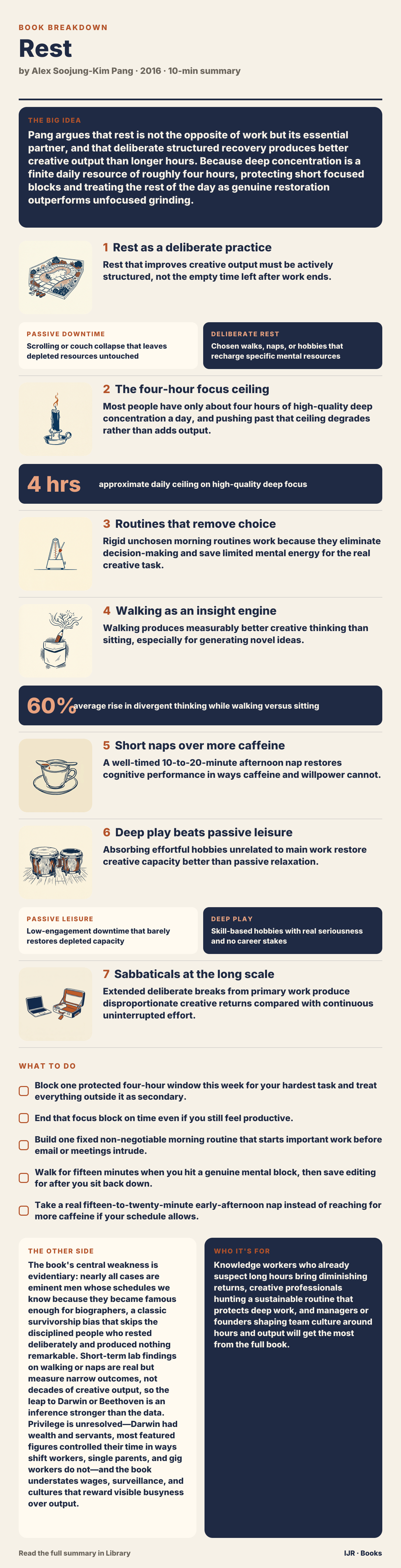
Rest as a deliberate practice
Rest that improves creative output must be actively structured, not the empty time left after work ends.
Passive downtime
Scrolling or couch collapse that leaves depleted resources untouched
Deliberate rest
Chosen walks, naps, or hobbies that recharge specific mental resources
Pang separates deliberate rest from passive downtime. Phone scrolling or collapsing on a couch is passive. A chosen walk, nap, or hobby that recharges mental resources depleted by focus is deliberate.
The same networks active during hard problem-solving stay active, in a different mode, during a walk or nap. Rest does cognitive work, just not consciously. How you rest therefore matters as much as how you work.
He leans on the brain's default mode network, identified in Marcus Raichle's early-2000s research. It switches on when you stop forcing attention and handles memory consolidation, problem synthesis, and sudden insights. A protected four-hour focused day can outproduce an unfocused eight-hour one if the remaining hours go to genuine restoration instead of fragmented email and entertainment.
In practice: Darwin worked in three 90-minute blocks totaling about four hours, then walked the sandwalk at Down House, and still produced On the Origin of Species plus a dozen other major works.
2
The four-hour focus ceiling
Most people have only about four hours of high-quality deep concentration a day, and pushing past that ceiling degrades rather than adds output.
4 hrs
approximate daily ceiling on high-quality deep focus
Across prolific figures Pang finds a recurring pattern: roughly four to five hours of concentrated work, tightly scheduled, then a firm stop. Longer days were not the secret.
He connects this to Anders Ericsson's 1990s research on top violinists at a Berlin arts university. The best practiced about four hours a day split into sessions. Practicing more did not create better violinists; it created more injuries and burnout.
Attention and willpower replenish on a daily cycle. Deep effortful thinking draws down a specific mental energy distinct from ordinary tiredness. Once it is gone, extra hours yield error-prone low-quality work rather than zero output—so overwork is actively subtractive. Protect a short sacred block for the hardest thinking and treat everything else as support for that block.
In practice: G.H. Hardy's mathematics career and Thomas Mann's writing schedule both relied on short protected work blocks that produced outsized output over decades.
3
Routines that remove choice
Rigid unchosen morning routines work because they eliminate decision-making and save limited mental energy for the real creative task.
Highly productive people often share near-identical morning patterns. The common thread is not the hour itself but the rigidity: same first task, same time, same way, every day, so beginning the hardest work never requires a decision.
Pang ties this to Roy Baumeister's research on decision fatigue and ego depletion. Each choice consumes a limited reserve of self-control. Creative work goes best while that reserve is still full—early, before other demands wear it down.
Routine and rest are not opposites here. A fixed routine that ends on schedule also protects rest by stopping work from expanding to fill every available hour. The specific clock time matters less than rigidity and placement before other obligations intrude.
In practice: Anthony Trollope wrote 250 words every 15 minutes before his post-office job; Toni Morrison rose before dawn to write before her children woke.
4
Walking as an insight engine
Walking produces measurably better creative thinking than sitting, especially for generating novel ideas.
60%
average rise in divergent thinking while walking versus sitting
Pang treats walking as a distinct tool, not generic rest. A 2014 Stanford study by Marily Oppezzo and Daniel Schwartz found that walking—indoors on a treadmill or outdoors—raised divergent thinking by an average of 60 percent compared with sitting, and the boost lingered briefly afterward.
The mechanism is rhythmic and low-cost. Walking's semi-automatic physical demand occupies just enough attention to quiet the analytical judging mind while leaving the associative default-mode network free to work. A stuck problem can be advanced by stepping away from the desk rather than grinding harder at it.
The effect is strongest for generating options, not for evaluating or refining them. Walk when you need ideas; sit when you need to edit or judge. That split turns a vague suggestion into a repeatable instrument anyone can use.
In practice: Beethoven took daily walks carrying pencil and paper; Steve Jobs ran walking meetings at Apple.
5
Short naps over more caffeine
A well-timed 10-to-20-minute afternoon nap restores cognitive performance in ways caffeine and willpower cannot.
Napping is framed as a performance intervention, not an indulgence. NASA research from the 1990s on pilot fatigue found a 26-minute nap improved performance by 34 percent and alertness by 54 percent.
Timing follows sleep architecture. Naps longer than about 20-30 minutes risk deep slow-wave sleep and the grogginess of sleep inertia on waking. The 10-20 minute range restores alertness without that cost.
American corporate stigma has engineered naps out of the workday not because they fail but because of assumptions about what productivity should look like. Biology sets the constraints; schedules can work with them or against them.
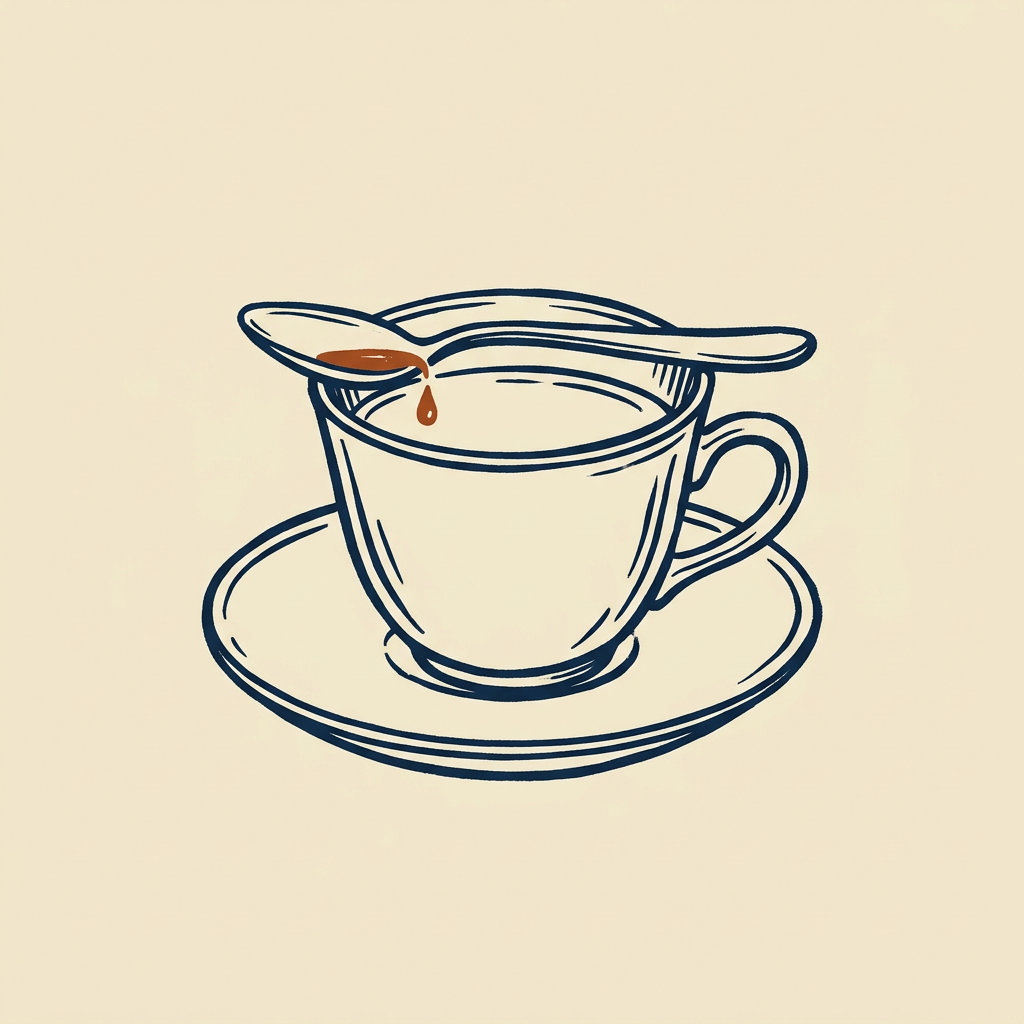
In practice: Winston Churchill treated his afternoon nap as non-negotiable even during the Blitz; Salvador Dalí napped holding a spoon over a plate so the clatter would wake him into hypnagogic imagery.
6
Deep play beats passive leisure
Absorbing effortful hobbies unrelated to main work restore creative capacity better than passive relaxation.
Passive leisure
Low-engagement downtime that barely restores depleted capacity
Deep play
Skill-based hobbies with real seriousness and no career stakes
Pang names demanding skill-based leisure deep play. It is pursued with real seriousness yet stays outside career identity. The activity has to require attention and growing mastery, not merely fill empty hours.
These hobbies engage flow states described in Mihaly Csikszentmihalyi's research from the 1970s. The absorption feels structurally like good work, but the stakes are detached from professional self-worth. That second domain of competence buffers people whose jobs involve public evaluation or failure.
Passive leisure such as television asks for little engagement and returns little restoration. Aerobic exercise can compound the gains through links to memory and mood. Walking, napping, and deep play together form a private toolkit for what rest actually contains.
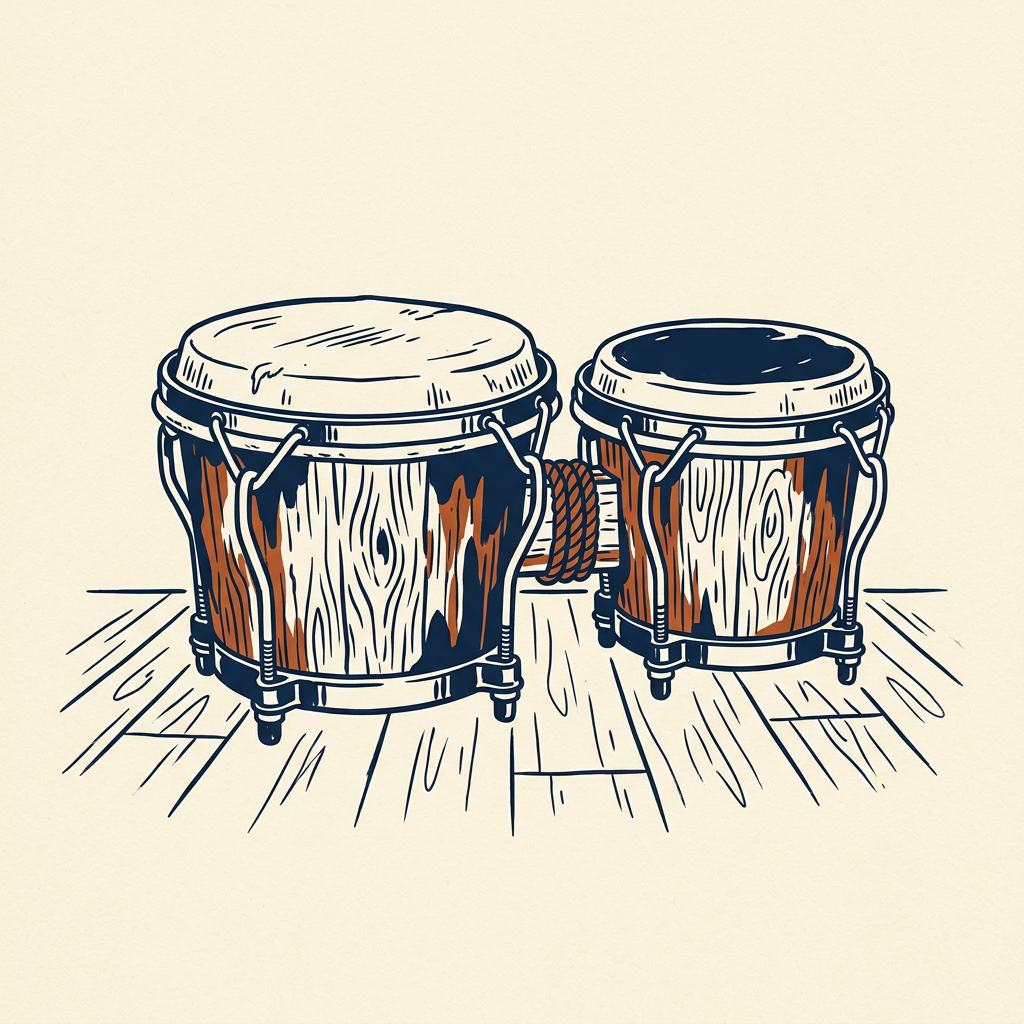
In practice: Winston Churchill laid bricks and painted in oils; Richard Feynman played bongos and picked locks as serious side crafts.
7
Sabbaticals at the long scale
Extended deliberate breaks from primary work produce disproportionate creative returns compared with continuous uninterrupted effort.
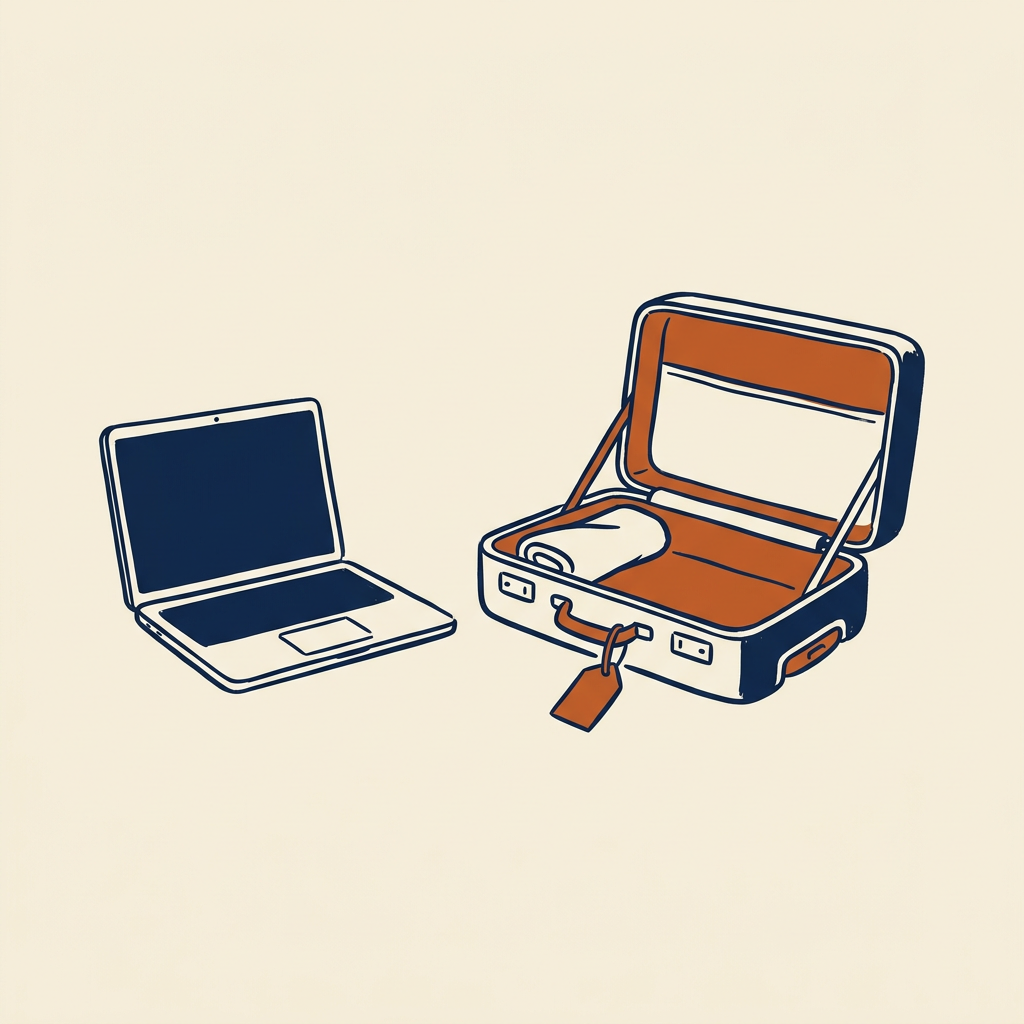
The final move scales rest from hours and days to months. A sabbatical creates identity distance: you see a field or project from outside its daily pressures, and problems that felt intractable up close can dissolve.
The mechanism differs from a nap or a walk but rests on the same principles—the four-hour ceiling, deliberate recovery, incubation—running at a longer timescale. Recovery needs happen fractally, at the scale of an afternoon, a week, and a year at once.
Pang notes sabbaticals remain a privilege concentrated in academia, tenured posts, and a handful of progressive employers. He argues for wider institutional adoption rather than treating them as purely personal choices. Organizations that count rest as theft from productivity are, on his account, measuring the wrong thing.
In practice: Adobe and Genentech adopted versions of the academic sabbatical; some Nobel-winning biologists reported major breakthroughs after extended time away from the lab.
Key terms
- deliberate rest Chosen restorative activity—walk, nap, hobby—that recharges specific mental resources depleted by focus
- default mode network Brain system that activates when you are not focused on a task and supports insight, memory consolidation, and synthesis
- four-hour ceiling Approximate daily limit on high-quality deep concentration for most people before output degrades
- decision fatigue The wearing down of self-control as choices accumulate across a day
- deep play Demanding skill-based leisure pursued with real seriousness outside one's career identity
- sleep inertia Grogginess that follows waking from deep slow-wave sleep after a nap that runs too long
- divergent thinking The generation of novel ideas, which walking measurably boosts in the research Pang cites
- sabbatical An extended deliberate break from primary work that creates distance and can unlock stuck problems
What to do
- Block one protected four-hour window this week for your hardest task and treat everything outside it as secondary.
- End that focus block on time even if you still feel productive.
- Build one fixed non-negotiable morning routine that starts important work before email or meetings intrude.
- Walk for fifteen minutes when you hit a genuine mental block, then save editing for after you sit back down.
- Take a real fifteen-to-twenty-minute early-afternoon nap instead of reaching for more caffeine if your schedule allows.
Questions to think with
- Where do your scarce hours of real deep focus actually go each day?
- What would change if you treated a walk as legitimate work rather than a break from it?
- Which hobby could become deep play instead of another form of passive downtime?
- What structural pressures at your job make deliberate rest hard to practice?
- If four focused hours beat eight scattered ones, what would you stop doing first?
The other side
The book's central weakness is evidentiary: nearly all cases are eminent men whose schedules we know because they became famous enough for biographers, a classic survivorship bias that skips the disciplined people who rested deliberately and produced nothing remarkable. Short-term lab findings on walking or naps are real but measure narrow outcomes, not decades of creative output, so the leap to Darwin or Beethoven is an inference stronger than the data. Privilege is unresolved—Darwin had wealth and servants, most featured figures controlled their time in ways shift workers, single parents, and gig workers do not—and the book understates wages, surveillance, and cultures that reward visible busyness over output.
Who it's for
Knowledge workers who already suspect long hours bring diminishing returns, creative professionals hunting a sustainable routine that protects deep work, and managers or founders shaping team culture around hours and output will get the most from the full book.