




Founders lose leverage when they miss how VC funds work
Anyone raising venture money needs the fund clocks, partnership votes, and term-sheet fine print that decide real ownership and control.
IJR · Nov 1, 2026 · 14 min read
In 60 seconds
- VCs manage limited partners' capital on a roughly ten-year clock under classic 2-and-20 fees, so portfolio math—not product love—drives every check.
- A partner's enthusiasm often dies in a partnership vote founders never see; ask how decisions actually get made.
- Early-stage investors underwrite team adaptability and market size more than the slide plan, because most startups pivot.
- Liquidation preferences, board seats, protective provisions, and anti-dilution rights matter more than headline valuation.
- Dilution compounds: ownership near 80% after seed can fall to 10-15% by Series C through ordinary financing math alone.
- Down-round anti-dilution, board-fund conflicts, and referral-gated access are structural features to price in from the first term sheet.
The big idea
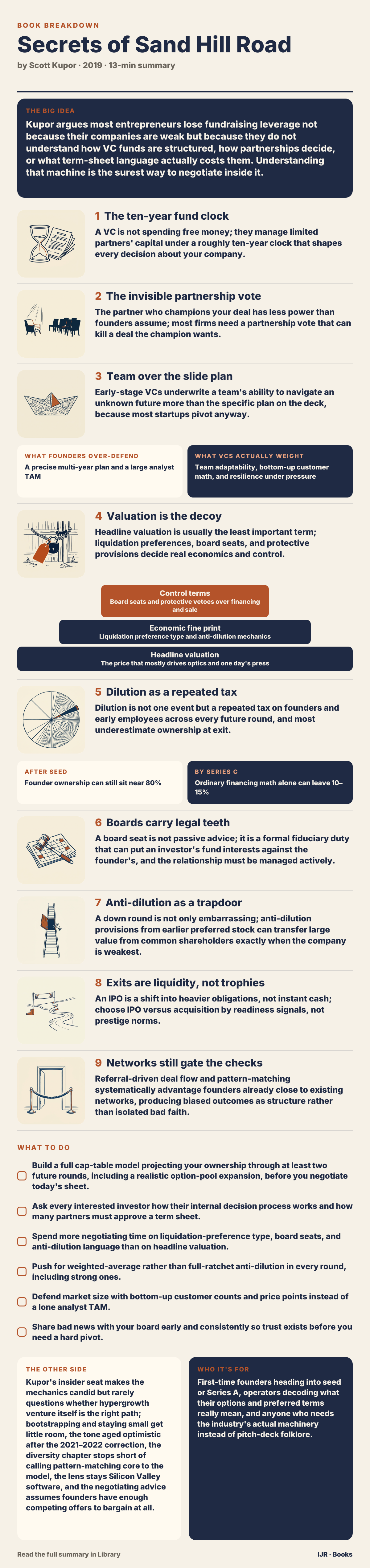
Kupor argues most entrepreneurs lose fundraising leverage not because their companies are weak but because they do not understand how VC funds are structured, how partnerships decide, or what term-sheet language actually costs them. Understanding that machine is the surest way to negotiate inside it.
The book in brief
Kupor starts by dismantling the myth that VCs are wealthy individuals gambling free money on hunches. Most capital comes from limited partners—endowments, pensions, sovereign wealth, fund-of-funds—who commit for roughly ten years. The firm charges a 2% annual management fee on committed capital and takes 20% of profits. Money must be deployed in the first three to five years; returns must appear before the fund closes. A partner in year eight needs faster exits than one in year one. LPs judge funds by IRR and multiple on invested capital, so a $100 million fund needs at least one company that returns the whole fund. Nine failures are expected; the tenth must be enormous. That arithmetic, not greed for its own sake, creates the obsession with billion-dollar outcomes.
A single enthusiastic meeting still means little. Most firms require an investment-committee or full-partnership vote. The champion presents; colleagues who never met the founder probe market, team, and risk. Unanimous or near-unanimous support is often required before a term sheet. Silence after a warm meeting often means the partner lost an internal fight. Some senior partners can write small checks alone, but that is rarer. The founder's job is arming the champion with data rooms, references, and bottom-up market logic for a fight the founder will not attend.
What gets underwritten early is not the five-year plan. Products, markets, and models change. VCs weight team and market size: is the market still big if the plan is wrong, and can this team find the right plan after failure. Bottom-up sizing with real customer counts and price points beats a large analyst TAM. Reference calls test how founders handle adversity, disagreement, and failure.
The real negotiation is the term sheet. Valuation is usually the least important term. A 1x non-participating liquidation preference returns investor capital first then stops; participating preferred lets investors double-dip. Board seats and protective vetoes hand control even with minority ownership. The option-pool shuffle expands the employee pool pre-money so dilution lands on existing holders, not the new investor. Pro-rata rights can crowd later rounds. Model the cap table across future rounds: 80% after seed can become 10-15% by Series C without strategic mistakes.
After the check, board seats carry fiduciary duties to the whole company that can collide with a fund's exit clock. Share bad news early; confidence for a hard pivot is built over many meetings, and boards can replace a CEO when that confidence erodes. Down rounds trigger full-ratchet or weighted-average anti-dilution that transfers ownership from common to preferred exactly when the company is weakest—terms set in good times. Exits split between acquisitions (faster liquidity, preference stacking risk) and IPOs (roadshow, S-1, underwriters, typically 180-day lockups before insiders sell). Mega-rounds let companies stay private longer, delaying liquidity and colliding with the ten-year LP clock.
Kupor closes on access. Pattern-matching and warm introductions systematically favor founders who already resemble past winners—often white or Asian men with elite credentials and prior startup or big-tech experience. Women-led and Black-led startups receive a small share of dollars. Open-application efforts exist but remain small relative to the gap. Biased outcomes follow from referral structure and return pressure, not only individual bad faith.
Context
Scott Kupor is a managing partner at Andreessen Horowitz. Published in 2019, the book opened venture's black box for founders who had to raise from people whose incentives they rarely understood, treating fund structure and term-sheet mechanics as leverage rather than insider lore.
The key ideas

1
The ten-year fund clock
A VC is not spending free money; they manage limited partners' capital under a roughly ten-year clock that shapes every decision about your company.
Kupor dismantles the image of VCs as rich individuals tossing personal cash at hunches. Most venture dollars come from limited partners—university endowments, pension funds, sovereign wealth funds, and fund-of-funds—who lock capital into a fund for about ten years. The general partner firm typically charges a 2% annual management fee on committed capital and takes 20% of profits above a return hurdle, the classic 2-and-20 structure.
That structure creates a hard lifecycle. Capital has to be deployed in the first three to five years. Returns need to materialize before the fund closes. A partner evaluating a pitch in year eight behaves differently from one in year one because the older fund needs faster exits. Limited partners score performance through IRR and multiple on invested capital.
Portfolio math follows. A $100 million fund needs at least one company that returns the entire fund to justify the risk of the other nine expected failures. Steady singles rarely clear that bar. The industry's hunger for billion-dollar outcomes is fund arithmetic, not free-floating greed.
Reframe the pitch room with that math. You are not only selling a product; you are being scored against a portfolio where nine losses are priced in and only the tenth has to be enormous. That is why a solid moderate business can lose to a riskier bet with a thinner shot at a giant outcome.
In practice: Kupor notes that a $100 million fund still needs one outsized winner that returns the whole fund, which is why VCs pass on clean moderate businesses and fund asymmetric long shots instead.

2
The invisible partnership vote
The partner who champions your deal has less power than founders assume; most firms need a partnership vote that can kill a deal the champion wants.
Building on fund mechanics, Kupor explains why a warm first meeting so often goes quiet. Most firms run an investment committee or full-partnership vote. The sponsoring partner must persuade colleagues who never met the founder.
The ritual is familiar inside the firm and invisible outside it. The champion presents the deal. Other partners probe market size, team, and competitive risk. Many firms require unanimous or near-unanimous support before a term sheet appears. The partner who seemed thrilled may have lost the room on valuation or timing.
Some firms let certain senior partners write checks unilaterally up to a threshold. That path is faster and rarer. For everyone else, the founder's real job is understanding whose approval the person across the table still needs.
Treat data rooms, reference calls, and market-sizing decks as ammunition for a fight you will not attend. Ask directly what the decision process looks like and how long it usually takes so you can read silence correctly.
In practice: A partner promises to 'get back soon,' then vanishes—not because the pitch failed in the room, but because colleagues blocked the deal in a partner meeting the founder never saw.

3
Team over the slide plan
Early-stage VCs underwrite a team's ability to navigate an unknown future more than the specific plan on the deck, because most startups pivot anyway.
What founders over-defend
A precise multi-year plan and a large analyst TAM
What VCs actually weight
Team adaptability, bottom-up customer math, and resilience under pressure
Once fund and partnership mechanics are clear, Kupor turns to what the room is actually scoring. Early-stage investing differs from later private equity because product, market, and even business model are likely to change before the company matures.
Given that instability, team and market size outweigh the precision of a ten-slide roadmap. Experienced VCs ask whether the market is still big enough if the current plan is wrong, and whether this team can find the right plan once the first one fails. Well-known cases where the winning product barely resembled the original pitch make that discount rational.
Market sizing splits into top-down and bottom-up. A founder who defends numbers with actual customer counts and price points is more credible than one waving a large total addressable market from an analyst report. Reference checks go further: former colleagues and even competitors get called less to confirm pitch facts than to gauge how the founder handles adversity, disagreement, and failure.
Spend less pitch time defending five-year precision. Spend more showing adaptability, market conviction, and evidence the team has already learned and changed course.
In practice: Kupor points to companies whose eventual winning product bore little resemblance to the original pitch, a pattern common enough that VCs discount roadmap specifics and bet on team and market instead.

4
Valuation is the decoy
Headline valuation is usually the least important term; liquidation preferences, board seats, and protective provisions decide real economics and control.
- Control termsBoard seats and protective vetoes over financing and sale
- Economic fine printLiquidation preference type and anti-dilution mechanics
- Headline valuationThe price that mostly drives optics and one day's press
With evaluation logic set, Kupor moves to the document that locks it in. Founders fixate on price. He argues the compounding terms are liquidation preference, board composition, protective provisions, and anti-dilution rights.
Liquidation preference decides who gets paid first in a sale. A standard 1x non-participating preference returns the investor's money before common shareholders, then stops. Participating preferred lets investors take their preference back and also collect a pro-rata share of what remains—the double dip. Simple arithmetic shows a modest exit can leave founders with almost nothing once participating preferred stacks across rounds, even when the original headline valuation looked generous.
Board seats sound minor next to a big number. Two of five seats can decide firings, future financings, and exit timing. Protective provisions—vetoes over raising new money or selling the company—hand effective control even with a minority board presence.
Negotiate hardest on terms that compound across future financings. A high valuation with punitive downstream language is often worse than a lower price with clean standard terms.
In practice: Kupor shows how a company sold for a modest amount can leave founders nearly empty-handed when participating preferred from earlier rounds double-dips, despite a once-celebrated headline valuation.

5
Dilution as a repeated tax
Dilution is not one event but a repeated tax on founders and early employees across every future round, and most underestimate ownership at exit.
After seed
Founder ownership can still sit near 80%
By Series C
Ordinary financing math alone can leave 10–15%
Kupor builds straight from the term sheet into the capitalization table—the ledger of who owns what after each financing. Every new round issues shares that dilute anyone who does not buy pro-rata.
The option-pool shuffle is a common tactic. A VC insists the employee option pool expand before the new money comes in. Because the pool is carved from the pre-money valuation, the dilution lands entirely on existing founders and employees, not on the new investor's shares. A headline Series A pre-money number can hide a sharp drop in founder ownership once a large pool—Kupor illustrates with a 20% pool—is added.
Pro-rata rights let existing investors keep their percentage in later rounds and can crowd out room for new investors or employees. The deeper mistake is modeling only the round in front of you.
Build a full cap-table model before every negotiation. Test multiple future scenarios so you see the trajectory today's sheet sets in motion, not just today's percentage.
In practice: Kupor walks a simplified case where a company raising Series A at a flashy pre-money valuation sees founder ownership fall far harder than expected once a 20% option pool is carved from that pre-money number.

6
Boards carry legal teeth
A board seat is not passive advice; it is a formal fiduciary duty that can put an investor's fund interests against the founder's, and the relationship must be managed actively.
Once money changes hands, governance begins. Board members owe fiduciary duties to the company and its shareholders as a whole, not to the fund that appointed them. That sounds clean until the same board member still faces the return clock from the earlier fund-lifecycle chapters.
Quarterly meetings, approvals for major financings and executive hires, and friction over growth pace versus exit timing become routine. A founder's long vision can collide with a fund that needs a faster or larger liquidity event.
Trust is built in the materials and the candor pattern. Share bad news early and consistently rather than only in crisis. A board's willingness to back a hard pivot depends on that track record. Founder removal is rare, yet boards hold the legal power to replace a CEO, and that power is more often used after confidence erodes across many meetings than after one bad quarter.
The protective provisions and board seats negotiated at term-sheet time are exactly what get exercised here. Paper terms become lived governance.
In practice: Kupor notes boards are more likely to replace a founder after confidence has drained across repeated meetings than after a single disappointing quarter, which is why early candor is a survival practice.

7
Anti-dilution as a trapdoor
A down round is not only embarrassing; anti-dilution provisions from earlier preferred stock can transfer large value from common shareholders exactly when the company is weakest.
Kupor extends dilution into the harder case of raising at a lower price than a prior round. Full-ratchet and weighted-average anti-dilution clauses, written into earlier preferred terms, automatically adjust the conversion price of old shares when the new round prices lower.
Full ratchet, though rare, is severe: it reprices all of an earlier investor's shares as if they had bought at the new low price, mechanically moving ownership from founders and common holders to make the earlier investor whole. Weighted average is more common and less punishing; it adjusts by a formula that factors how much new stock is issued relative to old, still hitting common but less brutally.
Down rounds are more common than press coverage suggests because most companies never announce them unless a later filing forces disclosure. The trap is timing: you negotiate anti-dilution language in the good-news moment of an earlier raise, not in the bad-news moment of the down round.
Push for weighted-average rather than full-ratchet terms in every round, even when the company is hot. Today's generous sheet from an eager investor can become tomorrow's transfer mechanism if the market turns.
In practice: Under a full ratchet, earlier preferred shares reprice as if purchased at the new lower round price, shifting ownership away from founders and employees to hold the prior investor harmless.

8
Exits are liquidity, not trophies
An IPO is a shift into heavier obligations, not instant cash; choose IPO versus acquisition by readiness signals, not prestige norms.
Kupor closes the lifecycle with the two main paths to liquidity: acquisition and initial public offering. An IPO brings a roadshow, S-1 filing, underwriters, and lockup periods that typically block insiders from selling for 180 days after going public. Paper wealth does not become cash on ringing day.
Acquisitions can close faster and deliver immediate liquidity. They also usually cap independent upside and can trigger the liquidation-preference stacking discussed earlier, so common shareholders may take home less than the headline deal value implies.
The choice should turn on concrete readiness: predictable recurring revenue, a management team that can handle quarterly public scrutiny, and a business model outside investors can model reliably—not on the symbolism of a Nasdaq bell. Later-stage private mega-rounds from crossover investors and mutual funds have let companies stay private longer, moving price discovery and delaying when employees and early investors see liquidity.
That delay collides with the ten-year fund clock from the opening chapters. Limited partners eventually need distributions, which is one reason later-stage VCs sometimes push exits harder than the founders who built the company.
In practice: Kupor flags the typical 180-day post-IPO lockup: founders and early employees often cannot sell when the bell rings, so the IPO is a reporting regime change before it is a cash event.

9
Networks still gate the checks
Referral-driven deal flow and pattern-matching systematically advantage founders already close to existing networks, producing biased outcomes as structure rather than isolated bad faith.
In a more self-critical turn, Kupor asks who gets into the room at all. The same pattern-matching instincts used to evaluate teams tend to favor founders who resemble prior winners—often white or Asian men with elite university credentials and earlier startup or big-tech experience.
Warm introductions remain the dominant path to a meeting. Who you already know at a top firm or portfolio company often decides whether you are heard. That loop reinforces existing networks instead of opening them. Kupor cites the well-documented small share of venture dollars that reach women-led and Black-led startups.
Some firms, including his own, have tried more open applications and outreach. He is candid that those efforts stay small relative to the access gap. Return pressure from limited partners pushes VCs toward patterns they treat as risk reducers, even when the patterns are mostly familiarity proxies rather than proven predictors of capability.
His claim is structural: the referral system yields biased outcomes as a natural consequence of how deal flow works, so fixing it takes deliberate changes in sourcing, not only individual goodwill.
In practice: Kupor links the access gap to warm-intro deal flow itself—who you know at a firm or portfolio company often determines whether a first meeting happens at all.
Key terms
- Limited partners (LPs) Institutions that commit capital to a VC fund for roughly ten years and judge it by returns.
- 2-and-20 Typical VC economics: about 2% annual management fee on committed capital plus 20% of profits above a hurdle.
- Liquidation preference Rules for who gets paid first, and how much, when the company is sold.
- Participating preferred Investors reclaim their preference and also take a pro-rata share of remaining proceeds—the double dip.
- Option pool shuffle Expanding the employee option pool pre-money so the dilution hits existing holders, not the new investor.
- Anti-dilution Clauses that reprice older preferred shares if a later round comes in lower; full ratchet is harshest, weighted average milder.
- Pro-rata rights Existing investors' right to buy enough in future rounds to keep their ownership percentage.
- Fiduciary duty A board member's legal duty to the company and all shareholders, not only to the fund that appointed them.
What to do
- Build a full cap-table model projecting your ownership through at least two future rounds, including a realistic option-pool expansion, before you negotiate today's sheet.
- Ask every interested investor how their internal decision process works and how many partners must approve a term sheet.
- Spend more negotiating time on liquidation-preference type, board seats, and anti-dilution language than on headline valuation.
- Push for weighted-average rather than full-ratchet anti-dilution in every round, including strong ones.
- Defend market size with bottom-up customer counts and price points instead of a lone analyst TAM.
- Share bad news with your board early and consistently so trust exists before you need a hard pivot.
Questions to think with
- Given this partner's fund year, what exit timing do they actually need from a company like mine?
- Which term-sheet clauses will still control economics and power three rounds from now?
- Am I giving my champion the ammunition to win a partnership vote I will never attend?
- If the next round priced lower, what would our anti-dilution language do to common ownership?
- Is venture capital the right tool for this business, or am I optimizing for a system I may not need?
The other side
Kupor's insider seat makes the mechanics candid but rarely questions whether hypergrowth venture itself is the right path; bootstrapping and staying small get little room, the tone aged optimistic after the 2021–2022 correction, the diversity chapter stops short of calling pattern-matching core to the model, the lens stays Silicon Valley software, and the negotiating advice assumes founders have enough competing offers to bargain at all.
Who it's for
First-time founders heading into seed or Series A, operators decoding what their options and preferred terms really mean, and anyone who needs the industry's actual machinery instead of pitch-deck folklore.