




Growth is a choice that often kills what made you great
Founders who refuse profitable expansion are often protecting the asset that made their companies distinctive.
IJR · Nov 1, 2026 · 11 min read
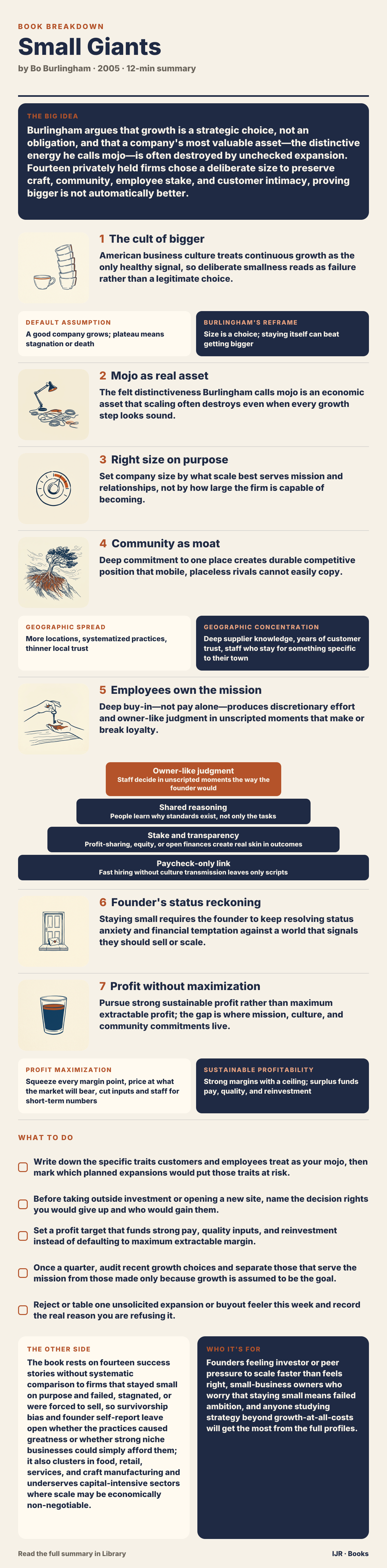
In 60 seconds
- American business culture treats continuous growth as the default sign of health, so deliberate smallness looks like failure of nerve.
- The intangible energy Burlingham calls mojo is a real economic asset that scaling frequently destroys through systems and layers.
- Fourteen privately held companies set size by what served mission and relationships, then stopped even when further growth was profitable.
- Deep local roots create moats—supplier knowledge, customer trust, staff ownership—that placeless national competitors cannot copy quickly.
- Treating employees as co-owners of purpose, not just paychecks, produces the unscripted judgment customers experience as passion.
- Staying small demands repeated personal resistance to buyouts, peer status cues, and advisors who equate modest size with underachievement.
The big idea
Burlingham argues that growth is a strategic choice, not an obligation, and that a company's most valuable asset—the distinctive energy he calls mojo—is often destroyed by unchecked expansion. Fourteen privately held firms chose a deliberate size to preserve craft, community, employee stake, and customer intimacy, proving bigger is not automatically better.
The book in brief
Burlingham starts from a quiet American assumption: a good company grows, and one that stops is stagnant or dying. Investors, banks, media, and MBA programs reward revenue, headcount, and market share, so founders drift toward expansion by default. He met owners who turned down wildly profitable deals not from timidity but because growth would standardize away the qualities that made them special.
He names that fragile distinctiveness mojo—an alive, specific feel customers and staff both notice—and treats it as a balance-sheet asset. Mojo drives loyalty and referrals marketing cannot buy, yet it depends on scale-sensitive acts: a founder tasting every batch, staff knowing regulars by name, fast personal decisions. Each locally rational expansion can cumulatively erase the premium the company was built on.
The profiled firms protected mojo by treating size as a decision variable. Several grew, sometimes a lot, then stopped at a chosen scale. Staying privately held—often family or closely held—kept the option alive; outside investors import time horizons that structurally push maximum growth. Ownership structure, not just ambition, decides whether right-sizing remains possible.
Rootedness becomes strategy. Companies tied to one neighborhood or region reinvest locally, train staff into ownership, and build supplier relationships outsiders cannot replicate. In trust- or freshness-driven categories, geographic concentration defends value that thin national spread turns generic. Internally, the same logic applies to people: transparency, decision involvement, and real stake produce discretionary effort no script can force. Culture transmission has a speed limit; hiring faster than that limit dilutes the asset.
The choice is psychological as much as strategic. Founders face recurring buyout offers, banker pressure, and status cues that cast modest size as failure. They must maintain an internal success definition that does not map to standard metrics—and remake the decision against a culture that never stops signaling otherwise. Finally Burlingham separates being highly profitable from maximizing extractable profit. The gap funds better pay, costlier inputs, and community commitments. The book lands on a reframe: size is a variable to set on purpose, and staying small can be the harder path.
Context
Bo Burlingham's 2005 book profiles fourteen privately held companies that capped growth to keep what made them excellent. It mattered because it gave language and legitimacy to owners who wanted to run good companies rather than big ones, in a mid-2000s moment before later stakeholder and B-corp frameworks hardened the same ideas.
The key ideas

1
The cult of bigger
American business culture treats continuous growth as the only healthy signal, so deliberate smallness reads as failure rather than a legitimate choice.
Default assumption
A good company grows; plateau means stagnation or death
Burlingham's reframe
Size is a choice; staying itself can beat getting bigger
Success gets scored by revenue, headcount, market share, and valuation—measures that reward size no matter what growth does to the company's original distinctiveness. Banks, investors, media, and business schools treat a plateau as a problem to fix. Founders absorb the assumption without hearing it stated.
Once bigger is equated with better, refusing expansion looks irrational. Burlingham's puzzlement at founders who walked away from profitable deals exposes the hidden value function: they were optimizing for something other than scale. Growth typically demands standardizing, delegating, and diluting deep product knowledge, personal customer ties, and tight staff culture.
A company can win by getting larger or by staying itself. Few founders are told this is a real fork, so most drift toward growth pulled by advisors, competitors, and the sense that turning down money is weak. Naming the cult is what opens the rest of the argument.
In practice: Zingerman's Delicatessen founder Ari Weinzweig refused wildly profitable expansion deals because he held a different definition of what he was building.

2
Mojo as real asset
The felt distinctiveness Burlingham calls mojo is an economic asset that scaling often destroys even when every growth step looks sound.
Mojo is the alive, specific quality customers and employees both sense—an employee's enthusiasm explaining a product, loyalty that survives price hikes, a founder's personal stake in each transaction. Burlingham treats it as more than mood: it drives repeat business, referrals, and retention that marketing budgets cannot replicate.
It is fragile because it rides on scale-sensitive practices. Founder attention, staff who know regulars, and fast responsive decisions get replaced by systems, management layers, and standardized processes needed for volume consistency. Those replacements are locally rational and cumulatively corrosive.
Most growth models never put the loss on the ledger. Reframing mojo as a balance-sheet item, not sentiment, is what lets staying small count as serious strategy rather than lifestyle romance.
In practice: Righteous Babe Records stayed small and personal so the label could keep a direct relationship with its audience that larger labels structurally cannot offer.

3
Right size on purpose
Set company size by what scale best serves mission and relationships, not by how large the firm is capable of becoming.
Right-sizing is not a blanket refusal to grow. Several of the profiled firms expanded—sometimes substantially—then stopped at a chosen ceiling even when more growth was available and profitable. Size becomes a governance decision revisited over time, not a one-time founding vow.
Ownership structure decides whether the choice stays real. Taking venture money or going public imports investors whose horizons and risk preferences push maximum growth regardless of side effects on culture or mission. Staying privately held, often family or closely held, preserves control over pace, sourcing, and benefits outsiders might override.
Capital is not always wrong; the trade must be named. Money and growth capacity are exchanged for control over the conditions that produced mojo. Founders who skip that recognition discover later that the choice is no longer theirs.
In practice: Clif Bar founders Gary Erickson and Kit Crawford bought out a partner to keep the company private and retain control over ingredient sourcing and employee benefits.

4
Community as moat
Deep commitment to one place creates durable competitive position that mobile, placeless rivals cannot easily copy.
Geographic spread
More locations, systematized practices, thinner local trust
Geographic concentration
Deep supplier knowledge, years of customer trust, staff who stay for something specific to their town
Many of the fourteen firms bind themselves to a neighborhood, city, or region. Burlingham reads this as strategy with payoffs, not mere civic virtue. Local reinvestment, staff trained into ownership stakes, and long ties to nearby suppliers build knowledge and trust that take years to grow and do not transfer.
National-scale logic multiplies customer base by spreading. In categories where trust, freshness, or personalization drive value, that spread sacrifices the specificity customers actually buy. Personal relationships and informal local knowledge become generic systems at twenty locations.
The community-bound firm is not settling for a smaller market. It defends a kind of value a dispersed competitor is structurally unequipped to offer, betting defensible depth beats undefended reach. The same trade-off hits any business whose offer rests on relationship depth rather than transaction volume.
In practice: Zingerman's built a cluster of food businesses in Ann Arbor instead of franchising, reinvesting locally and tying itself to area farmers and staff with ownership paths.

5
Employees own the mission
Deep buy-in—not pay alone—produces discretionary effort and owner-like judgment in unscripted moments that make or break loyalty.
- Owner-like judgmentStaff decide in unscripted moments the way the founder would
- Shared reasoningPeople learn why standards exist, not only the tasks
- Stake and transparencyProfit-sharing, equity, or open finances create real skin in outcomes
- Paycheck-only linkFast hiring without culture transmission leaves only scripts
Across the profiled companies the pattern is involvement in decisions, financial transparency, and often profit-sharing or equity, not high wages by themselves. Staff learn the reasoning behind standards so they can judge like owners instead of following scripts.
In service and craft work the loyalty moments are unscripted: comping a dish, spending twenty minutes with a confused customer. No manual anticipates them. Only people who feel genuine stake make the call the founder would want. That causal chain—ownership feeling to better ground decisions to customer loyalty—is what outsiders misread as magic.
Conventional scaling hires faster than culture can transmit, turning the relationship into a paycheck. Small giants hire and promote slowly even when it caps growth because culture has a speed limit; exceed it and the judgment-capable staff disappear.
In practice: At Union Square Café under Danny Meyer and at Anchor Brewing under Fritz Maytag, staff were trained in the reasoning behind standards so they could make owner-like judgment calls.

6
Founder's status reckoning
Staying small requires the founder to keep resolving status anxiety and financial temptation against a world that signals they should sell or scale.
The decision is not made once. Buyout offers recur. Bankers and consultants push expansion. Classmates, magazine rankings, and boards equate modest size with underachievement. The pressure is social and continuous.
Resisting it takes an internal, idiosyncratic success definition that does not map onto standard wealth or status metrics. That clarity is fragile. It needs active maintenance: peers who share the frame, deliberate rejection of unsolicited offers, and conscious return to why the company was built.
Burlingham does not claim the path is easy or always happier. Several founders admit ambivalence and wonder whether money was left on the table. The narrower claim is that the choice is available and defensible, yet the psychological cost of refusing default growth is what keeps such companies rare.
In practice: CitiStorage founder Norm Brodsky describes the discomfort of watching peers who went public grow wealthy on paper while he stayed private and comparatively small despite a profitable, well-loved business.

7
Profit without maximization
Pursue strong sustainable profit rather than maximum extractable profit; the gap is where mission, culture, and community commitments live.
Profit maximization
Squeeze every margin point, price at what the market will bear, cut inputs and staff for short-term numbers
Sustainable profitability
Strong margins with a ceiling; surplus funds pay, quality, and reinvestment
Small giants are typically very profitable, some posting margins well above industry norms. They still set an internal ceiling on how far they will push profit-maximizing moves, and spend the difference on employee sharing, community reinvestment, and quality inputs that cost more than cheap substitutes.
Maximize profit and be highly profitable are different instructions. Conflating them is a common category error. A firm can earn excellent sustaining returns without pricing at the full market limit, swapping down inputs, or laying people off in slow periods just to dress short-term numbers.
Those restraints cost money in the maximization sense and buy loyalty, supplier trust, and goodwill with real if hard-to-quantify payback. Profit becomes necessary fuel, not the sole objective. Leadership processes that weigh employee and community impact beside return make the distinction operational.
In practice: Reell Precision Manufacturing built decision processes that weighed employee and community impact alongside shareholder return, treating profit as fuel rather than the only target.
Key terms
- mojo The felt, specific energy and distinctiveness of a company that drives loyalty and cannot be bought with marketing once scaling erases it.
- small giants Privately held companies that deliberately choose a limited size to protect craft, community, culture, or customer intimacy.
- cult of bigger The unspoken American assumption that continuous growth is the only mark of a healthy firm and that plateauing equals failure.
- right-sizing Setting company scale by what best serves mission and relationships, then stopping even when more growth is available.
- ownership structure Whether the firm stays closely held or takes outside investors—the factor that decides if choosing size remains possible.
- profit without maximization Aiming for strong lasting profits while refusing to extract every possible margin point so mission costs can be funded.
- community moat Competitive protection built from deep local supplier knowledge, customer trust, and staff ties that dispersed rivals cannot copy quickly.
What to do
- Write down the specific traits customers and employees treat as your mojo, then mark which planned expansions would put those traits at risk.
- Before taking outside investment or opening a new site, name the decision rights you would give up and who would gain them.
- Set a profit target that funds strong pay, quality inputs, and reinvestment instead of defaulting to maximum extractable margin.
- Once a quarter, audit recent growth choices and separate those that serve the mission from those made only because growth is assumed to be the goal.
- Reject or table one unsolicited expansion or buyout feeler this week and record the real reason you are refusing it.
Questions to think with
- What would your company lose—concretely, in customer feel and staff judgment—if you doubled headcount in two years?
- Which outside voices currently define success for you, and what internal metric would have to replace them?
- If you stayed private forever, what ceiling on size would still let you keep the relationships that earn your premium?
- Where are you already trading mojo for growth without putting that cost on any ledger?
- Would your best employees still make owner-like calls if they only had a paycheck and a script?
The other side
The book rests on fourteen success stories without systematic comparison to firms that stayed small on purpose and failed, stagnated, or were forced to sell, so survivorship bias and founder self-report leave open whether the practices caused greatness or whether strong niche businesses could simply afford them; it also clusters in food, retail, services, and craft manufacturing and underserves capital-intensive sectors where scale may be economically non-negotiable.
Who it's for
Founders feeling investor or peer pressure to scale faster than feels right, small-business owners who worry that staying small means failed ambition, and anyone studying strategy beyond growth-at-all-costs will get the most from the full profiles.