




Stillness, not frantic activity, separates clear judgment from collapse
Stillness Is the Key argues that inner quiet is the discipline that makes sustained excellence and contentment possible.
IJR · Oct 26, 2026 · 13 min read
In 60 seconds
- Holiday argues that clear judgment under pressure, not frantic activity, is what separated Kennedy’s Cuban Missile Crisis choice from the airstrikes his advisors urged.
- He treats unlimited information intake as a structural threat to deep thinking, with Montaigne’s curated tower withdrawal as the model for protecting mental space.
- Outward discipline without inner stillness can still produce collapse, which is how he reads Tiger Woods’s public control paired with private chaos.
- Lasting calm, in his account, comes from aiming ambition at others’ good, accepting mortality, and protecting sleep and small routines.
- Stillness only holds long-term, he claims, when daily surroundings are simplified so mind, spirit, and body support rather than undermine each other.
The big idea
Big Idea
Holiday argues that stillness—clear-headed, undistracted calm—is not passivity but the discipline that makes great work and a good life possible. He treats it as a state built across mind, spirit, and body, because success itself generates the noise that erodes judgment.
The book in brief
Book in Brief
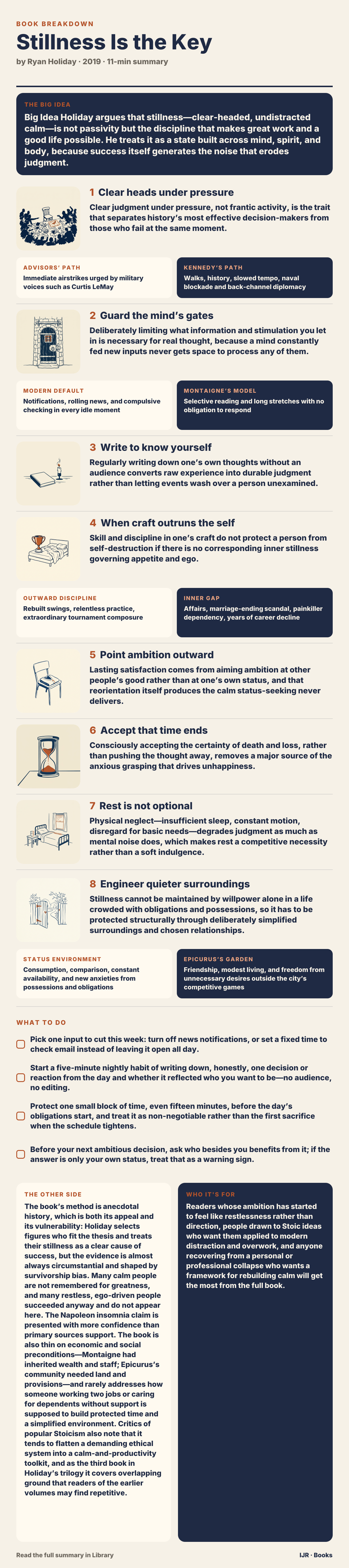
Holiday opens with the Cuban Missile Crisis of October 1962. Most of Kennedy’s military advisors, especially General Curtis LeMay, pushed for immediate airstrikes on Soviet missile sites in Cuba. Kennedy slowed the room, took walks, read history, and chose a naval blockade with back-channel diplomacy that avoided nuclear war. From that episode he claims human beings do their best work, relationships, and thinking when they are still—not inactive, but clear, steady, and free of useless noise.
He maps the fight across three domains. The mind must be protected from overload. The spirit must be anchored beyond ego. The body must be sound enough to carry the other two. Historical cases, inspiring and cautionary, run from ancient Rome to modern boardrooms and locker rooms to show the need never changes.
On the mind he turns first to Montaigne, who at 38 shut himself in a tower library and curated exposure so he could think rather than merely consume. Marcus Aurelius then supplies the practice that fills protected time: private notebooks written after days of war, plague, and politics, catching distorted thinking before it became action. Limiting inputs creates space; journaling converts that space into judgment.
The spirit section pivots on the gap between outer skill and inner life. Tiger Woods had extraordinary outward discipline aimed only at performance, with nothing comparable governing appetite and ego; Holiday reads the resulting scandal, dependency, and lost years as proof that unexamined desire grows with success. Fred Rogers is the counterexample—slow, service-focused, refusing spectacle—whose calm presence itself produced trust. Seneca’s letters on death and Aurelius facing the Antonine Plague then loosen anxious grasping by treating time and outcomes as finite.
Finally he treats body and environment as structural supports. Napoleon’s chronic insomnia and strain are set against Toni Morrison’s protected pre-dawn writing window to argue that rest is a competitive necessity, not a soft reward. Epicurus’s garden community outside Athens closes the arc: internal disciplines only hold if daily surroundings—possessions, friendships, availability—are built to support stillness instead of constant comparison and noise.
Context
Context
Ryan Holiday draws on Stoic, Buddhist, and Christian contemplative thought and on figures from Marcus Aurelius to Fred Rogers. As the third book in a trilogy after The Obstacle Is the Way and Ego Is the Enemy, it reuses an anecdote-per-principle structure and covers overlapping ground, which readers of the earlier books may find repetitive rather than additive.
The key ideas
1
Clear heads under pressure
Clear judgment under pressure, not frantic activity, is the trait that separates history’s most effective decision-makers from those who fail at the same moment.
Advisors’ path
Immediate airstrikes urged by military voices such as Curtis LeMay
Kennedy’s path
Walks, history, slowed tempo, naval blockade and back-channel diplomacy
Holiday opens with the Cuban Missile Crisis of October 1962 as the book’s organizing example. Most of John F. Kennedy’s military advisors, especially Air Force General Curtis LeMay, pushed for immediate airstrikes against Soviet missile sites in Cuba. Kennedy resisted the pressure to act instantly. He took walks, read history, slowed the tempo of the room, and chose a naval blockade paired with back-channel diplomacy—a slower path that avoided nuclear war.
From this he builds the claim that runs through Stoicism, Buddhism, Epicureanism, and Christian contemplative practice: people are best at their jobs, relationships, and their own minds when they are still. He defines stillness not as inactivity but as mental clarity, emotional steadiness, and freedom from useless noise.
That condition has to be built and defended, especially by the ambitious and successful, because success itself generates the noise that erodes it. The rest of the book follows the battle across mind, spirit, and body, with cases chosen to show the need is constant across eras and fields.
In practice: Kennedy’s quieter blockade-and-diplomacy path, chosen against LeMay’s airstrike pressure, is Holiday’s proof that the crisis was resolved by whoever stayed calm enough to see clearly.
2
Guard the mind’s gates
Deliberately limiting what information and stimulation you let in is necessary for real thought, because a mind constantly fed new inputs never gets space to process any of them.
Modern default
Notifications, rolling news, and compulsive checking in every idle moment
Montaigne’s model
Selective reading and long stretches with no obligation to respond
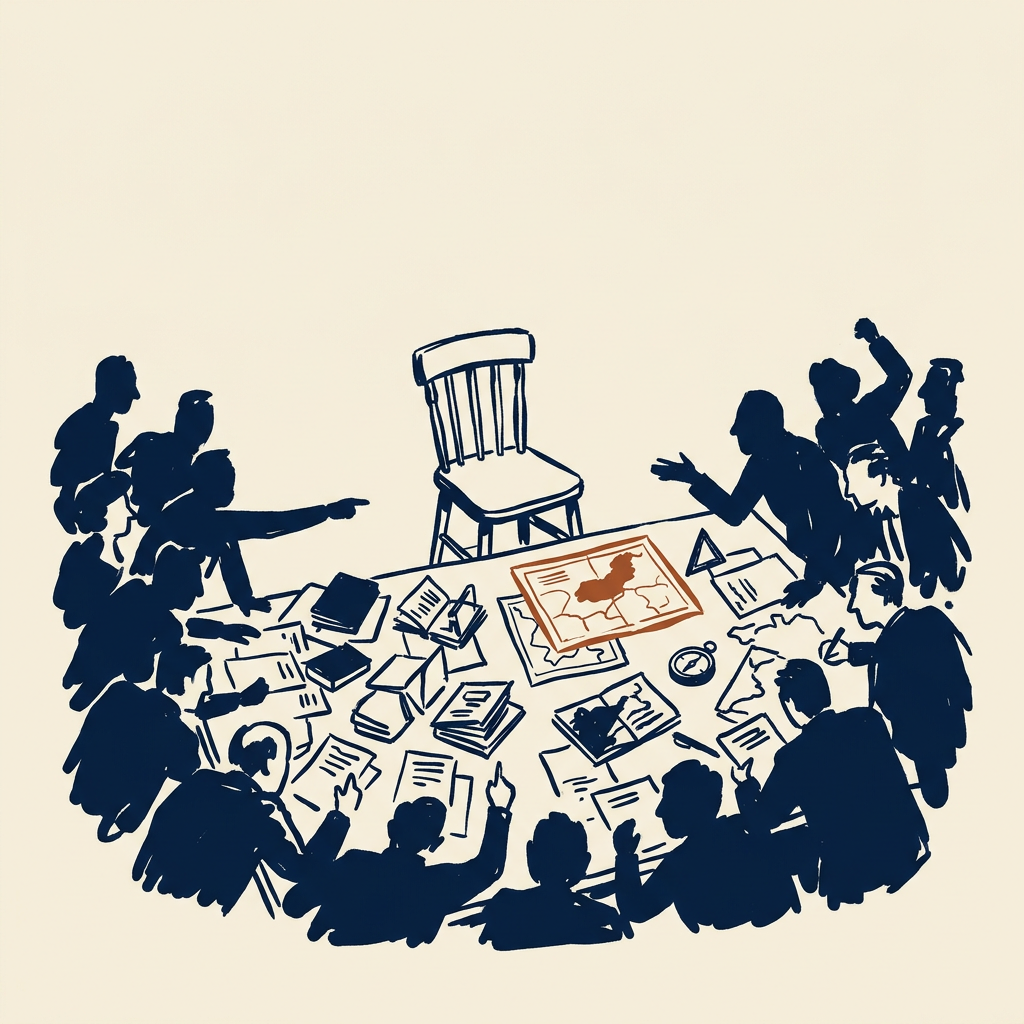
Holiday turns to Michel de Montaigne, the sixteenth-century French essayist who at 38 withdrew from public life and shut himself in a tower library on his estate. Montaigne did not eliminate the world; he curated exposure, reading selectively and giving himself long unbroken stretches with no obligation to respond. The essays produced there became foundational not because he consumed more than his contemporaries but because he consumed less and thought more.
Holiday contrasts this with the modern default of notifications, rolling news, and compulsive checking that fills every idle moment. He treats that pattern not as a minor bad habit but as a structural threat. Reaction and reflection compete for the same mental space, and reaction almost always wins by default.
The warning aims at people who mistake busyness for productivity—executives who answer every email the moment it arrives, leaders who make policy from the latest headline. Unlimited input access is a modern condition, not a natural one. Serious thinkers historically treated information the way they treated food: chosen deliberately rather than consumed indiscriminately.
In practice: Montaigne’s tower practice produced foundational essays by protecting unbroken thinking time rather than maximizing information intake.

3
Write to know yourself
Regularly writing down one’s own thoughts without an audience converts raw experience into durable judgment rather than letting events wash over a person unexamined.
The central example is Marcus Aurelius, Roman emperor from 161 to 180 CE, whose private notebook—never intended for publication—survives as the Meditations. Aurelius wrote to himself, often at night after exhausting days managing wars, plague, and court politics. He reinforced principles he already knew: anger is a choice, other people’s opinions are not his business, death is natural and not to be feared.
Holiday’s point is that Aurelius held the most powerful position in the ancient world and still needed the practice. Flattery, fear, and fatigue would otherwise corrupt judgment. Journaling here is not therapeutic venting but ongoing accounting—a way of catching errors in thinking before they become errors in action.
He extends the claim to anyone most exposed to distortion: the powerful, the famous, the constantly observed. Nothing about public life will supply that check for them. Limiting inputs creates the space; private writing is what fills it with actual insight rather than mere rest.
In practice: Aurelius wrote the Meditations at night after days of war, plague, and politics, reinforcing known principles so judgment would not be corrupted by flattery or fatigue.

4
When craft outruns the self
Skill and discipline in one’s craft do not protect a person from self-destruction if there is no corresponding inner stillness governing appetite and ego.
Outward discipline
Rebuilt swings, relentless practice, extraordinary tournament composure
Inner gap
Affairs, marriage-ending scandal, painkiller dependency, years of career decline
Holiday uses Tiger Woods as the book’s central cautionary tale. Woods was, by any measure, one of the most disciplined athletes in history—a swing rebuilt multiple times, relentless practice from early childhood, extraordinary tournament composure. Yet that discipline was aimed entirely outward, at performance, with nothing comparable cultivated inwardly.
The result, as Holiday narrates it, was a life split between extreme public control and private chaos: affairs, a scandal that ended his marriage, painkiller dependency, and a decline that cost him years of his career. This was not ordinary failure of willpower—Woods clearly had willpower—but failure of the specific self-governance stillness provides.
That governance is the ability to sit with desire without acting on every instance of it, to be at peace without needing the next win, conquest, or hit of attention. A mind trained to focus on a golf swing is not automatically trained to examine its own appetites. Outward achievement without an inner anchor does not merely fail to satisfy; it creates conditions for collapse, because unexamined desire grows with success rather than being quieted by it.
In practice: Woods’s outward athletic discipline coexisted with private chaos—affairs, scandal, painkiller dependency—which Holiday reads as stillness never applied to appetite and ego.
5
Point ambition outward
Lasting satisfaction comes from aiming ambition at other people’s good rather than at one’s own status, and that reorientation itself produces the calm status-seeking never delivers.
Fred Rogers is Holiday’s counterexample to Woods. In 1969, Rogers testified before a Senate subcommittee to defend federal funding for public television. Rather than argue with statistics, he read the lyrics of one of his songs about a child’s anger, speaking slowly and without theatrics. Senator John Pastore, initially impatient, was visibly moved, and the funding was preserved.
Holiday reads the moment as characteristic of Rogers’s whole career: refusal to chase ratings, speed, or spectacle, paired with almost singular focus on the wellbeing of the children watching. Rogers turned down brand expansions that would have compromised the show’s slow pacing. He treated the fifteen minutes before taping as private time for prayer and reflection.
Holiday claims Rogers’s stillness was not incidental to his effectiveness but the source of it. Calm, unhurried presence is what made children trust him, and that trust could not have been manufactured by someone still chasing advancement. The restless self-focus driving so much ambition is, paradoxically, what blocks the meaning ambitious people usually want.
In practice: Rogers’s slow 1969 Senate testimony—reading song lyrics about a child’s anger—moved Senator Pastore and helped preserve public-television funding.

6
Accept that time ends
Consciously accepting the certainty of death and loss, rather than pushing the thought away, removes a major source of the anxious grasping that drives unhappiness.
Holiday turns to Seneca, whose letters to Lucilius return repeatedly to death—not morbidly, but as a fact to integrate rather than avoid. Seneca argued that most people live as if they have unlimited time and are therefore careless with the time they actually have. Only by keeping mortality in view does a person use days deliberately.
He pairs this with Marcus Aurelius governing through the Antonine Plague, which killed a significant portion of the Roman population during his reign, including possibly his co-emperor Lucius Verus. Aurelius faced it without abandoning his stated principles about accepting what cannot be controlled.
Once time and achievements are accepted as finite and not fully controllable, the anxious striving in the Woods chapter loses grip. There is no infinite future to protect or permanent legacy to secure. Holiday frames this as acceptance, not resignation: the goal is to act without the desperate attachment to outcomes that makes people erratic, defensive, or cruel. That shift also makes rest, health, and simple daily pleasures legitimate uses of time rather than distractions from more urgent business.
In practice: Seneca’s letters treat death as a fact to integrate so time is used deliberately; Aurelius held his principles through the Antonine Plague rather than abandoning them.

7
Rest is not optional
Physical neglect—insufficient sleep, constant motion, disregard for basic needs—degrades judgment as much as mental noise does, which makes rest a competitive necessity rather than a soft indulgence.
Holiday examines Napoleon’s declining performance in later campaigns. He argues that chronic insomnia and physical strain contributed to errors of judgment in the Russian campaign of 1812 and the defeat at Waterloo in 1815. Historians treat the claim as plausible but not definitively provable, since health in that period is documented mostly through secondhand and retrospective accounts.
He sets this against Toni Morrison’s writing routine. She rose before dawn for years to write before job and family obligations began, protecting a small, consistent window of quiet rather than waiting for large free blocks that never arrived. Physical routine, in this contrast, is not heroic exertion but consistency small enough to sustain.
Holiday extends the point to sleep. Deprivation impairs decision-making and emotional regulation, so treating rest as optional is a category error common among ambitious people who believe willpower can replace physiological recovery. A still mind and a directed spirit are undermined if the body enforcing them is exhausted. All three domains have to be maintained together.
In practice: Morrison protected pre-dawn writing for years before job and family demands; Holiday contrasts that sustainable window with Napoleon’s strained later campaigns.

8
Engineer quieter surroundings
Stillness cannot be maintained by willpower alone in a life crowded with obligations and possessions, so it has to be protected structurally through deliberately simplified surroundings and chosen relationships.
Status environment
Consumption, comparison, constant availability, and new anxieties from possessions and obligations
Epicurus’s garden
Friendship, modest living, and freedom from unnecessary desires outside the city’s competitive games
Holiday closes with Epicurus, who founded a community outside Athens in the fourth century BCE organized around friendship, modest living, and freedom from unnecessary desires, set apart from the city’s competitive status games. The garden is presented not as withdrawal from life but as an engineered environment where stillness did not have to be fought for constantly because the surroundings were not working against it.
He contrasts this with wealthy figures who, after material success, found new possessions and obligations generating fresh anxieties that canceled the security wealth was supposed to provide. He also notes the tension in Seneca’s own life—a large fortune as Nero’s advisor while writing essays that praised simplicity—which he acknowledges without fully resolving.
Most environments are not neutral. They are organized around consumption, comparison, and constant availability. Stillness requires building an alternative: trimming possessions, choosing friendships that do not run on status competition, protecting unstructured time the way Montaigne protected his tower. Internal disciplines of mind, spirit, and body only hold long-term if daily surroundings support them.
In practice: Epicurus’s garden community outside Athens was built around friendship, modest living, and freedom from unnecessary desires so stillness did not have to be constantly forced.
Key terms
- stillness Mental clarity, emotional steadiness, and freedom from useless noise—not inactivity, but a state that must be built and defended.
- mind The domain that must be protected from overload so real thought and judgment remain possible.
- spirit The domain that must be anchored beyond ego through service and acceptance of mortality.
- body Sleep, routine, and basic physical care treated as the foundation that supports clear judgment in the other domains.
- journaling Private writing without an audience used as ongoing accounting to catch thinking errors before they become action.
- curated exposure Deliberately limiting and choosing inputs rather than consuming information indiscriminately.
- inner anchor Self-governance of appetite and ego that outward craft discipline alone does not supply.
What to do
- Pick one input to cut this week: turn off news notifications, or set a fixed time to check email instead of leaving it open all day.
- Start a five-minute nightly habit of writing down, honestly, one decision or reaction from the day and whether it reflected who you want to be—no audience, no editing.
- Protect one small block of time, even fifteen minutes, before the day’s obligations start, and treat it as non-negotiable rather than the first sacrifice when the schedule tightens.
- Before your next ambitious decision, ask who besides you benefits from it; if the answer is only your own status, treat that as a warning sign.
Questions to think with
- Where do you currently mistake busyness or instant reaction for actual judgment?
- What desire or appetite has grown rather than quieted as you have succeeded?
- If you aimed one current ambition at someone else’s good this month, what would change about how you pursue it?
- Which parts of your daily environment—possessions, relationships, constant availability—actively work against calm?
- What would it mean to treat rest this week as a competitive necessity rather than a reward you have not yet earned?
The other side
The book’s method is anecdotal history, which is both its appeal and its vulnerability: Holiday selects figures who fit the thesis and treats their stillness as a clear cause of success, but the evidence is almost always circumstantial and shaped by survivorship bias. Many calm people are not remembered for greatness, and many restless, ego-driven people succeeded anyway and do not appear here. The Napoleon insomnia claim is presented with more confidence than primary sources support. The book is also thin on economic and social preconditions—Montaigne had inherited wealth and staff; Epicurus’s community needed land and provisions—and rarely addresses how someone working two jobs or caring for dependents without support is supposed to build protected time and a simplified environment. Critics of popular Stoicism also note that it tends to flatten a demanding ethical system into a calm-and-productivity toolkit, and as the third book in Holiday’s trilogy it covers overlapping ground that readers of the earlier volumes may find repetitive.
Who it's for
Readers whose ambition has started to feel like restlessness rather than direction, people drawn to Stoic ideas who want them applied to modern distraction and overwork, and anyone recovering from a personal or professional collapse who wants a framework for rebuilding calm will get the most from the full book.