




Most talks fail because we are having different conversations
Anyone stuck in circular work or family fights should care: Duhigg argues failures are mismatched types—practical, emotional, or social—not missing facts, though his tidy three-box scheme is more teaching device than settled science.
IJR · Oct 21, 2026 · 12 min read
In 60 seconds
- Supercommunicators are practiced diagnosticians who spot whether a talk is about decisions, feelings, or identity, not born charismatics.
- Practical talks stall when unspoken goals differ; naming what a good outcome looks like unsticks them faster than piling on more data.
- Offering solutions during an emotional conversation makes people feel more alone because they are asking to be understood, not fixed.
- People filter messages through identity and belonging, so technically accurate claims get rejected when they threaten group standing.
- Good connection shows up as measurable brain and body synchrony; matching pace and tone helps create the shared ground persuasion needs.
- Looping—ask, restate in your own words, confirm—makes understanding visible and is what finally opens people to other views.
The big idea
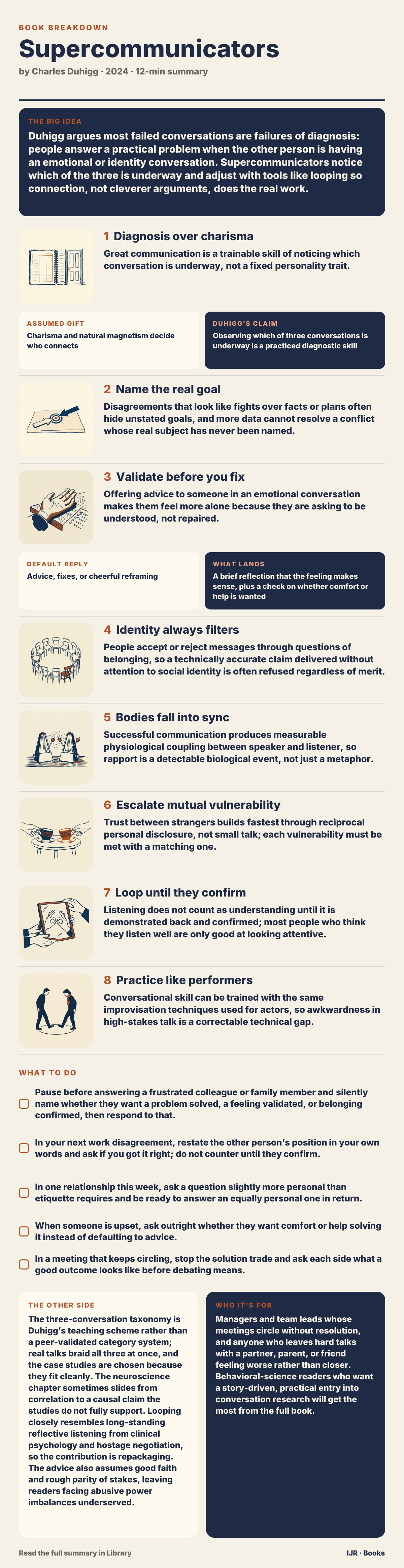
Duhigg argues most failed conversations are failures of diagnosis: people answer a practical problem when the other person is having an emotional or identity conversation. Supercommunicators notice which of the three is underway and adjust with tools like looping so connection, not cleverer arguments, does the real work.
The book in brief
Duhigg starts by dismantling the myth that easy connection is innate charisma. He frames skilled talkers as observant diagnosticians who pause to ask what the other person actually needs from the exchange before they answer. Nearly every conversation, he claims, is one of three kinds running underneath the words: a practical talk about what to do, an emotional talk about how we feel and whether those feelings are seen, or a social talk about who we are to each other and where we belong. Most people default to the practical mode even when the other person is somewhere else, and that mismatch—not a lack of empathy or smarts—is what makes talks fail.
The middle chapters walk each type in turn. Practical conversations stall when people share a topic but not a goal; one side optimizes for speed while the other guards against risk, and neither says so. Emotional conversations collapse when listeners rush to fix or reframe while the speaker only needs the feeling recognized. Social conversations look like fights over facts or ideology but are often contests over identity and in-group standing; accurate information still gets rejected if it feels like a threat to belonging.
Duhigg then anchors the behavioral advice in lab work showing that successful exchange produces measurable physiological synchrony—aligned brain patterns, pace, even blink rates—between speaker and listener. He treats matching energy and tone as a mechanism for shared understanding rather than mere politeness. From there he turns to two portable techniques: a structured escalation of mutual vulnerability that builds trust faster than small talk, and a three-step loop that forces listening to be demonstrated and confirmed before anyone argues back.
The closing move is optimistic and practical. Drawing on improvisation training used with scientists who could not explain their own work, he argues that conversational skill is teachable the same way stage presence is teachable. Awkwardness in hard talks is a technical gap, not a fixed trait. The book lands on a single repeatable habit: slow down long enough to name which conversation is actually happening, then meet it.
Context
Charles Duhigg, known for The Power of Habit and Smarter Faster Better, synthesizes neuroscience, negotiation research, and case studies into a usable conversation framework. The book’s contribution is less a new discovery than a clear organizing scheme for skills good listeners have long practiced instinctively.
The key ideas

1
Diagnosis over charisma
Great communication is a trainable skill of noticing which conversation is underway, not a fixed personality trait.
Assumed gift
Charisma and natural magnetism decide who connects
Duhigg’s claim
Observing which of three conversations is underway is a practiced diagnostic skill
Duhigg opens by rejecting the idea that some people are simply born magnetic. The real obstacle, he says, is failing to notice what kind of exchange is actually happening in front of you.
He treats every talk as one of three underlying conversations. A practical one asks what we should do. An emotional one asks how we feel and whether you understand those feelings. A social one asks who we are to each other and where we belong. People usually answer the type they assume is happening—most often the practical one—even when the other person is somewhere else.
That mismatch, not missing intelligence or goodwill, is what makes conversations fail. Supercommunicators are not more talkative or likeable; they are more observant about the actual stakes, and they treat that observation as the first move.
The rest of the method follows from this detective stance: name the conversation in real time, then adjust to meet it rather than forcing your preferred mode.
In practice: A CIA case officer recruiting informants succeeded less by clever pressure than by noticing a source’s hesitation was about feeling unseen by his own government, then addressing that need directly.

2
Name the real goal
Disagreements that look like fights over facts or plans often hide unstated goals, and more data cannot resolve a conflict whose real subject has never been named.
Practical conversations are meant to solve a problem or reach a decision, yet they drag when participants hold different quiet pictures of success. One side may be optimizing for speed while the other is minimizing risk; both argue numbers without ever saying what a good outcome would look like.
Duhigg’s fix, drawn from negotiation research, is to surface the goal before debating the means. Ask what a good outcome looks like to you, rather than jumping straight to solutions. Skilled negotiators spend disproportionate time on priorities first because a solution that satisfies an unnamed goal will keep looking irrational.
The visible fight is treated as a symptom. Once the underlying aim is on the table, the practical bargaining often becomes straightforward because the two people are no longer negotiating past each other.
This move recurs through the book: look underneath the stated topic for the conversation that is actually driving the resistance.
In practice: A couple kept arguing over a home renovation budget until one partner’s unspoken goal—reassurance that the marriage’s finances were stable—was named; the dollar negotiation then simplified.

3
Validate before you fix
Offering advice to someone in an emotional conversation makes them feel more alone because they are asking to be understood, not repaired.
Default reply
Advice, fixes, or cheerful reframing
What lands
A brief reflection that the feeling makes sense, plus a check on whether comfort or help is wanted
In emotional conversations the often-unstated request is empathy. Listeners, however, default to solutions or optimistic reframing. Research Duhigg cites shows speakers who are venting are usually testing whether their feelings will be recognized, while listeners assume they want a fix.
A short phrase that reflects the emotion—that a situation sounds frightening or exhausting—does more relational work than sound practical advice. False empathy backfires too: claiming you understand without checking leaves the speaker feeling unheard while the listener pretends otherwise.
The corrective is small and direct: ask whether the person wants comfort or help solving the problem instead of guessing. That question itself signals the attentiveness most emotional talks lack.
Applying practical logic to an emotional conversation is not merely unhelpful; Duhigg argues it actively damages the relationship because it denies the logic the other person is using.
In practice: Someone navigating a family member’s serious illness found well-meaning friends exhausting; every friend rushed into treatment tips or bright reframes when she only needed to hear that her fear made sense.

4
Identity always filters
People accept or reject messages through questions of belonging, so a technically accurate claim delivered without attention to social identity is often refused regardless of merit.
Social conversations concern group membership, status, and identity rather than pure facts or feelings. Many disputes that look ideological—politics, religion, family tradition—are contests over who counts as inside the group and whose values get respect.
Duhigg links this to identity-protective reasoning: the tendency to reject accurate information that threatens group standing and to accept weaker arguments that reinforce it. Identity is always present whether anyone names it or not.
Skilled communicators do not abandon their message. They choose language, examples, and framing that let the listener remain a member in good standing of their own identity group while still absorbing new information. Ignoring identity simply guarantees resistance.
Progress requires letting the other person redefine the ‘we’ so the new fact is an inclusion rather than a rupture.
In practice: A father struggling with his son’s coming out kept collapsing the talk until the son found language that let the father enlarge family identity to include the new fact instead of experiencing it as a break.

5
Bodies fall into sync
Successful communication produces measurable physiological coupling between speaker and listener, so rapport is a detectable biological event, not just a metaphor.
Duhigg turns to neuroimaging, especially Uri Hasson’s work, to show that engaging, clear storytelling causes listeners’ brain activation patterns to mirror the speaker’s with a short lag, particularly in meaning-making regions. The coupling weakens when the language is unknown or attention drifts.
The same alignment appears outside the scanner: synchronized vocal pitch, matched speaking pace, and aligned blink rates during natural conversation. Supercommunicators often adjust rhythm and focus without conscious effort, bringing another nervous system into closer alignment with their own.
He notes the research shows correlation more than proven causation in every case, yet treats it as strong support for a practical habit: match the other person’s energy, pace, and tone rather than imposing your own. That matching is not submission; it is a mechanism for the shared understanding the rest of the talk requires.
The chapter serves as the book’s evidentiary anchor for the behavioral advice around it.
In practice: In Hasson’s experiments, listeners’ brain patterns began to mirror an engaging storyteller’s and lost that coupling when the story was told in a language they did not understand.

6
Escalate mutual vulnerability
Trust between strangers builds fastest through reciprocal personal disclosure, not small talk; each vulnerability must be met with a matching one.
Duhigg draws on Arthur Aron’s closeness research, originally the ‘fast friends’ procedure of increasingly personal questions. Pairs who followed the sequence reported feeling closer after a short structured exchange than many people feel toward long-standing acquaintances.
The specific questions matter less than the principle: closeness follows a reciprocal exchange of vulnerability. One person’s willingness to share something slightly more personal than the moment requires invites the other to match it.
One-sided versions fail. Oversharing without return, or probing without offering anything, produces discomfort rather than connection. The exchange has to stay balanced.
In ordinary settings—a first business meeting or a new friendship—a slightly more personal question asked with real curiosity, plus readiness to answer one in return, does more than hours of safe surface talk because it signals willingness to be known.
In practice: Aron’s pairs exchanging escalating answers felt closer in forty-five minutes than many people feel toward longtime acquaintances.

7
Loop until they confirm
Listening does not count as understanding until it is demonstrated back and confirmed; most people who think they listen well are only good at looking attentive.
Looping for understanding is Duhigg’s practical mechanism that works across all three conversation types. The steps are simple: ask a genuine question about what the other person means or feels, restate what you heard in your own words, then ask whether you got it right and adjust until they say yes.
Most listening is passive—nodding and waiting to speak—which leaves the speaker with no evidence of being understood, only of not being interrupted. People become persuadable, Duhigg claims, only after they feel understood. Skipping confirmation and moving straight to counterargument tends to entrench disagreement.
The same loop can confirm a goal, a feeling, or a sense of identity. It is the single repeatable behavior that ties the earlier chapters together.
Because the restatement uses your words rather than theirs, it also reveals whether you actually grasped the point or only the vocabulary.
In practice: In a contested jury deliberation, a holdout was not moved by better arguments but by a juror who restated her reasoning with enough precision that she felt heard, after which she could consider views she had dismissed.

8
Practice like performers
Conversational skill can be trained with the same improvisation techniques used for actors, so awkwardness in high-stakes talk is a correctable technical gap.
Duhigg closes with Alan Alda’s work after years of interviewing scientists. Alda concluded that brilliant researchers often could not explain their work because they lacked conversational training, not clarity of thought.
His institute borrowed theatrical improv exercises, especially games of unconditional acceptance—saying yes and building on a partner’s contribution rather than blocking it. Participants who once delivered flat, jargon-heavy explanations became more responsive and clearer once they learned to treat listener reactions as live data.
The point is general. Actors are not born knowing how to hold attention; scientists are not born knowing how to turn expertise into shared understanding; ordinary people are not born knowing how to run a hard talk with a colleague or spouse.
Matching conversation type, validating emotion, respecting identity, and looping are therefore learnable through deliberate practice in the same way improv or public speaking is learnable. That is the book’s answer to readers who assume good communicators are simply built differently.
In practice: Scientists in Alda’s improv-based program shifted from scripted, jargon-heavy delivery to real-time adjustment once they practiced reading audience confusion and interest as data.
Key terms
- Practical conversation A talk about decisions and what we should do next
- Emotional conversation A talk about feelings and whether those feelings are recognized
- Social conversation A talk about identity, belonging, and who we are to each other
- Looping for understanding Ask, restate in your own words, then confirm until the speaker agrees you got it
- Neural coupling Measurable alignment of brain activity, pace, and tone between speaker and listener during successful exchange
- Identity-protective reasoning The tendency to reject accurate information that threatens group belonging and accept weaker claims that protect it
- Reciprocal vulnerability Matching personal disclosure so trust builds through balanced risk rather than one-sided probing or oversharing
What to do
- Pause before answering a frustrated colleague or family member and silently name whether they want a problem solved, a feeling validated, or belonging confirmed, then respond to that.
- In your next work disagreement, restate the other person’s position in your own words and ask if you got it right; do not counter until they confirm.
- In one relationship this week, ask a question slightly more personal than etiquette requires and be ready to answer an equally personal one in return.
- When someone is upset, ask outright whether they want comfort or help solving it instead of defaulting to advice.
- In a meeting that keeps circling, stop the solution trade and ask each side what a good outcome looks like before debating means.
Questions to think with
- Which of the three conversations do you default to even when the other person is somewhere else?
- When did a technically correct point of yours get rejected, and what identity stake might have been in play?
- How often do you restate someone’s meaning and wait for confirmation before you argue?
- Where in your week could a slightly more personal, reciprocal question replace safe small talk?
- Which hard relationship assumes good faith and equal stakes, and which does not?
The other side
The three-conversation taxonomy is Duhigg’s teaching scheme rather than a peer-validated category system; real talks braid all three at once, and the case studies are chosen because they fit cleanly. The neuroscience chapter sometimes slides from correlation to a causal claim the studies do not fully support. Looping closely resembles long-standing reflective listening from clinical psychology and hostage negotiation, so the contribution is repackaging. The advice also assumes good faith and rough parity of stakes, leaving readers facing abusive power imbalances underserved.
Who it's for
Managers and team leads whose meetings circle without resolution, and anyone who leaves hard talks with a partner, parent, or friend feeling worse rather than closer. Behavioral-science readers who want a story-driven, practical entry into conversation research will get the most from the full book.