




Why change fails and how rider, elephant, and path fix it
In Switch, Chip and Dan Heath give managers, parents, and reformers a behavioral-science toolkit for why mandates and willpower stall—and what actually moves people.
IJR · Oct 16, 2026 · 11 min read
In 60 seconds
- Chip and Dan Heath contend change fails not from laziness but from overloading the rational Rider while ignoring the emotional Elephant and the Path.
- Direct the Rider with scripted critical moves and a vivid destination postcard, not vague aspirations.
- Motivate the Elephant through feeling, small visible wins, and a growth identity rather than more data.
- Shape the Path so the right behavior is the easy default; willpower is depletable and fails under stress.
- Lock gains in with habits tied to existing routines and social proof from peers and bright spots.
- When change stalls, diagnose which of the three levers is missing instead of blaming character.
The big idea
The Heaths maintain lasting change needs three coordinated forces: crystal-clear direction for the rational Rider, feeling and confidence for the emotional Elephant, and an environment that makes the desired behavior easier than the alternative. Failed change is usually a missing lever among these three, not a flaw in people's character.
The book in brief
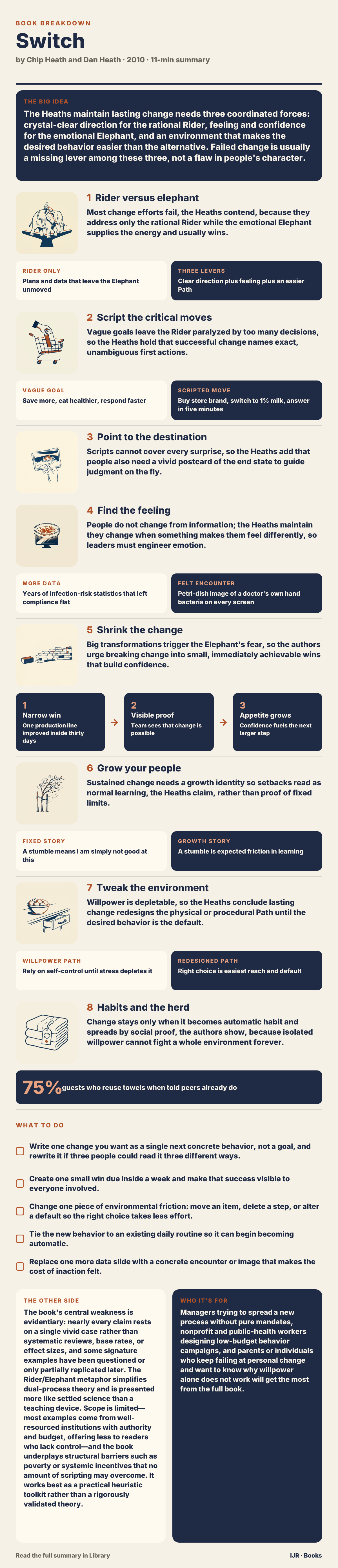
Switch by Chip and Dan Heath opens by rejecting the usual blame for stalled change. People are not mainly lazy or stubborn; change agents misunderstand how minds work. The authors borrow the image of a Rider (rational planner) perched on an Elephant (emotional, instinctive driver) traveling a Path (the surrounding environment). The Rider holds the reins, but the Elephant weighs six tons—so when they disagree, the Elephant wins. Slide decks and strategic plans often fail because they feed only the Rider.
The Rider toolkit comes first. Vague goals such as “be more collaborative” or “eat healthier” leave the Rider improvising under stress and defaulting to old habits. The fix is to script critical moves—exact behaviors like buying the store brand or switching to 1% milk—and to supply a destination postcard, a concrete picture of success such as Fanatical Support or becoming the best place to give birth in the state, so people can improvise when no script covers the moment.
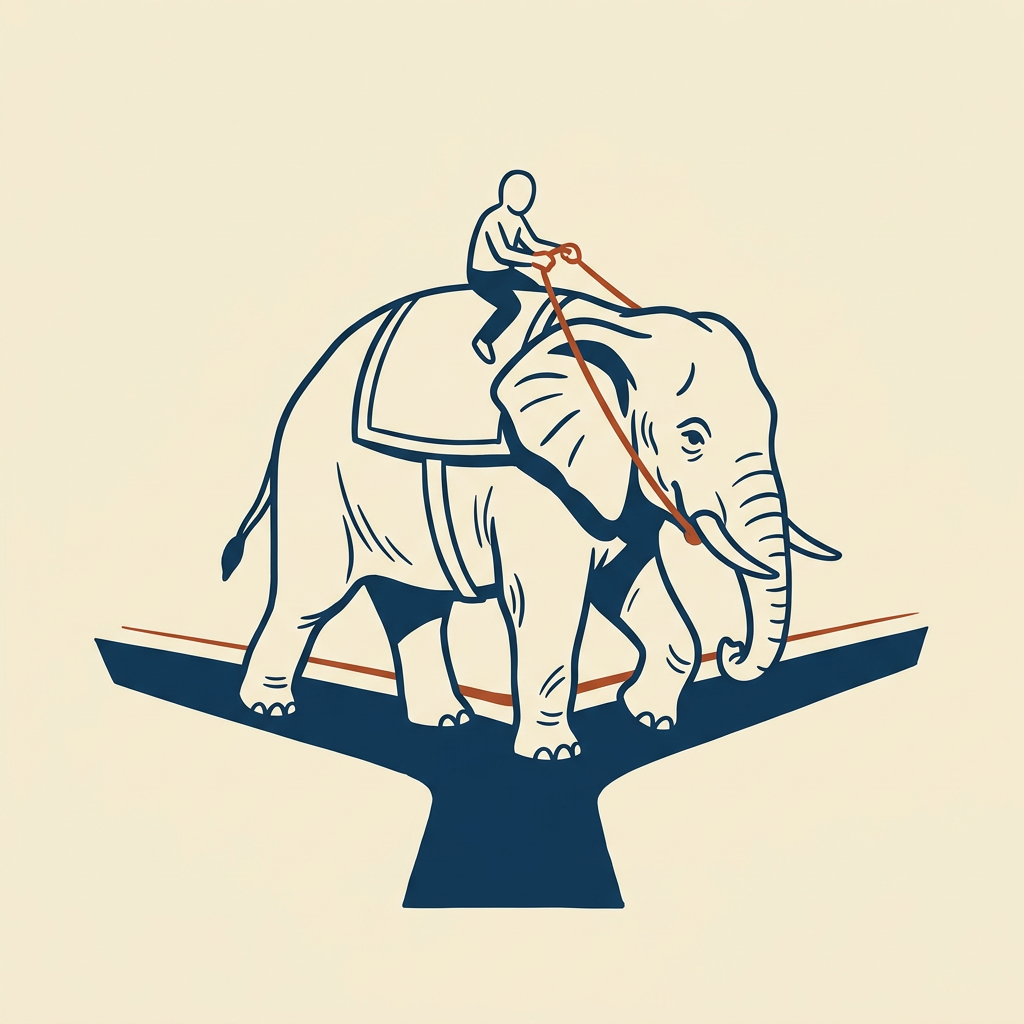
Attention then turns to the Elephant. Information alone rarely moves anyone; feeling does. After years of infection statistics left hospital hand-washing flat, a petri-dish image of bacteria from a doctor's own unwashed hand, shown as a screensaver, raised compliance. Large transformations also scare the Elephant, so the Heaths urge shrinking the change into immediate wins—one production-line improvement inside thirty days, or a 30-day milk trial—and installing a growth identity so setbacks read as normal learning rather than fixed limits.
The Path closes the model. Willpower depletes across tasks, making pure self-control a losing long-term bet. Redesigning the setting—fruit at eye level in a cafeteria, the correct tool placed within easiest reach—makes the right behavior the path of least resistance. Habits formed by linking new acts to existing routines, plus social proof such as peer towel-reuse rates, turn temporary effort into self-sustaining norms.
The book lands on diagnosis, not a single silver bullet. A brilliant plan without emotional buy-in stalls; inspired motivation without clear direction or a supportive environment burns out. The lasting contribution is a practical checklist: stop blaming character and ask which force—Rider, Elephant, or Path—is missing.
Context
Chip Heath and Dan Heath published Switch in 2010 after their earlier work Made to Stick. It mattered because it translated behavioral science into a concrete toolkit managers, parents, nonprofit staff, and reformers could use without research credentials, speaking to anyone tired of mandates and willpower lectures.
The key ideas
1
Rider versus elephant
Most change efforts fail, the Heaths contend, because they address only the rational Rider while the emotional Elephant supplies the energy and usually wins.
Rider only
Plans and data that leave the Elephant unmoved
Three levers
Clear direction plus feeling plus an easier Path
The authors borrow psychologist Jonathan Haidt's image of a Rider perched on an Elephant. The Rider is deliberate and analytical. The Elephant is instinctive, driven by immediate reward and fear. The Rider holds the reins, yet the Elephant weighs six tons; disagreement ends with the Elephant winning.
That mismatch is why detailed plans and persuasive decks so often go nowhere. They give the Rider more to think about while leaving the Elephant cold or actively resistant. Every change effort therefore has three jobs: direct the Rider with clear instructions, motivate the Elephant with feeling, and shape the Path so the environment itself favors the right move.
Without this frame, people default to character blame—calling resistance laziness or stubbornness. The real cause is usually a Rider without direction or an Elephant with no reason to walk. Diagnosing which force is missing is the first task of anyone leading change.
In practice: A hospital reduced errors not by lecturing on statistics but by giving nurses a simple checklist and speaking-up script paired with visceral stories of patient harm.

2
Script the critical moves
Vague goals leave the Rider paralyzed by too many decisions, so the Heaths hold that successful change names exact, unambiguous first actions.
Vague goal
Save more, eat healthier, respond faster
Scripted move
Buy store brand, switch to 1% milk, answer in five minutes
The Rider plans well but improvises poorly under stress. Told to collaborate more or eat healthier, it has no moment-to-moment instruction and falls back on old habits, draining the willpower needed to steer the Elephant.
Scripting removes that fog. Name the behavior, not the aspiration. Ambiguity is the enemy of change: when a goal can be read many ways, people interpret it differently or treat it as optional.
This is how directing the Rider becomes operational rather than abstract. A scripted move needs no interpretation at the exact moment willpower is weakest.
In practice: A low-income budgeting program told families to buy the store brand instead of the name brand; a West Virginia campaign asked people to switch from whole milk to 1% milk; a hospital required every page returned within five minutes.

3
Point to the destination
Scripts cannot cover every surprise, so the Heaths add that people also need a vivid postcard of the end state to guide judgment on the fly.
Critical moves handle the next step. Real environments throw up situations no script anticipated. A destination postcard—a specific image of what success looks like—lets people ask whether an action moves them closer to that picture.
The postcard must be concrete enough to steer judgment yet broad enough for local adaptation. A bland mission statement is usually too abstract to guide anything; a pure script is too narrow when conditions shift.
Together, critical moves plus destination form the full Rider toolkit. A well-aimed Rider still needs an Elephant willing to walk.
In practice: Rackspace replaced a bland service mission with Fanatical Support, concrete enough that an employee overnighted pizza to a customer working late on a server migration; a hospital administrator framed the aim as becoming the best place to give birth in the state.
4
Find the feeling
People do not change from information; the Heaths maintain they change when something makes them feel differently, so leaders must engineer emotion.
More data
Years of infection-risk statistics that left compliance flat
Felt encounter
Petri-dish image of a doctor's own hand bacteria on every screen
Analysis can freeze the Elephant while emotion gets it moving. Change leaders often over-invest in the business case—spreadsheets, forecasts, ROI slides—because that convinces the Rider. The Rider was rarely the bottleneck; the Elephant was uninspired or afraid.
Finding the feeling can mean surfacing an emotion already present but buried under abstraction, or creating a genuine encounter such as bringing staff face to face with a harmed customer instead of describing the harm in a memo.
A perfectly scripted plan with a clear destination still fails if nobody feels compelled to start. Emotional engineering is a distinct lever, not decoration on a rational case.
In practice: Hospital hand-washing compliance stayed low despite years of infection statistics until a researcher displayed a petri dish cultured from a doctor's own unwashed hand as a computer screensaver; compliance jumped.
5
Shrink the change
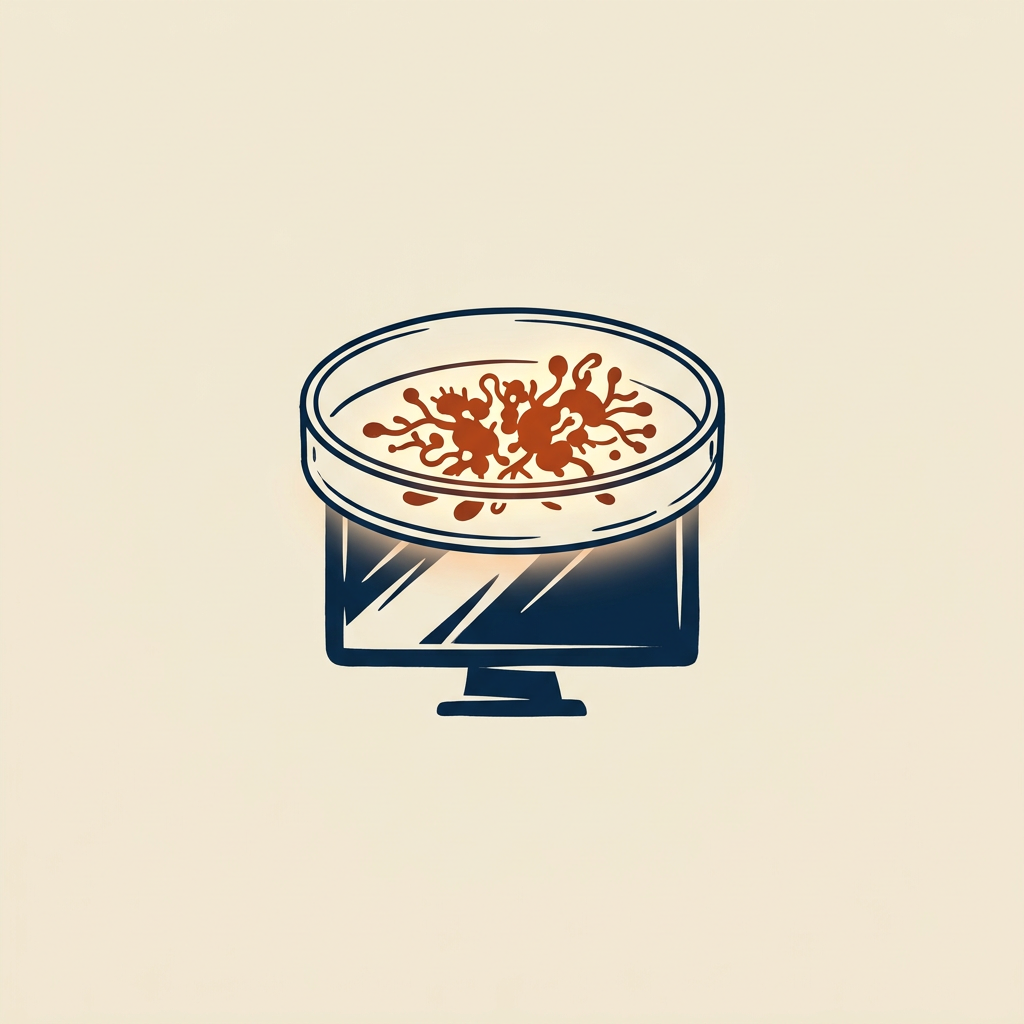
Big transformations trigger the Elephant's fear, so the authors urge breaking change into small, immediately achievable wins that build confidence.
- 1Narrow winOne production line improved inside thirty days
- 2Visible proofTeam sees that change is possible
- 3Appetite growsConfidence fuels the next larger step
The Elephant runs on immediate reward and is easily discouraged by distant abstract goals. Announcing a full overhaul at once often produces dread rather than motivation.
Small wins supply visible proof that change is possible, which then fuels appetite for a bigger step. Belief in one's ability grows through direct experience of success, not pep talks; Alcoholics Anonymous's one-day-at-a-time structure works the same way.
Where finding the feeling supplies inspiration, shrinking supplies confidence. An inspired but intimidated Elephant still refuses to move.
In practice: A demoralized manufacturing plant was asked for one narrow improvement on a single production line within thirty days; the visible win unlocked larger change. The 1% milk switch was framed as a 30-day trial rather than a permanent lifestyle overhaul.
6
Grow your people
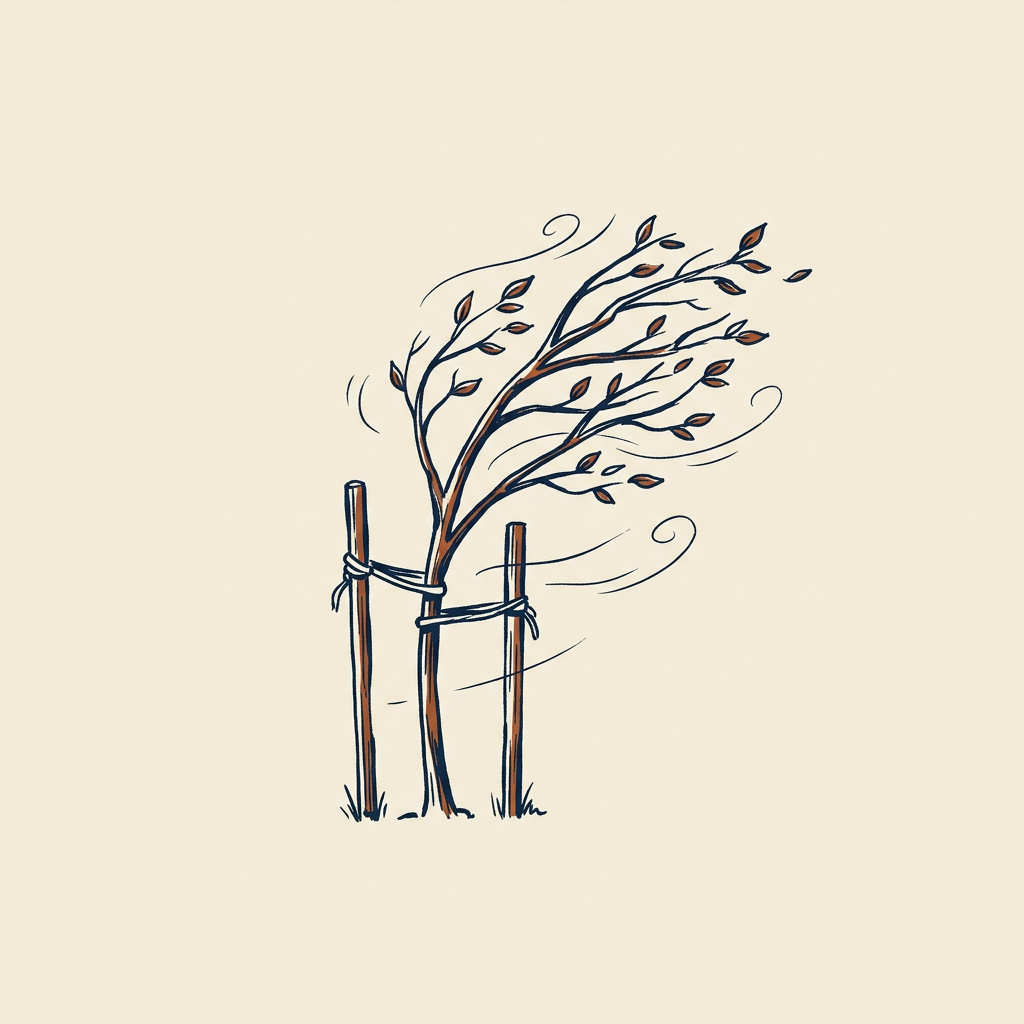
Sustained change needs a growth identity so setbacks read as normal learning, the Heaths claim, rather than proof of fixed limits.
Fixed story
A stumble means I am simply not good at this
Growth story
A stumble is expected friction in learning
How people explain failure to themselves decides whether they persist through the discomfort every change produces. A fixed stance treats a stumble as evidence of a permanent limit and kills motivation. A growth stance treats it as expected friction and invites another try.
Organizations can install that identity on purpose. Framing early struggle as documented and normal changes whether people quit when it gets hard.
Small wins matter twice: they create momentum and become evidence people use to build a growth-oriented self-story. Behavior also sticks better when tied to identity—being the kind of person who does the new thing—turning a one-time push into durable motivation.
In practice: A company told new hires that early struggle was a normal part of the first ninety days and saw measurably less early quitting than hires given no such framing.
7
Tweak the environment
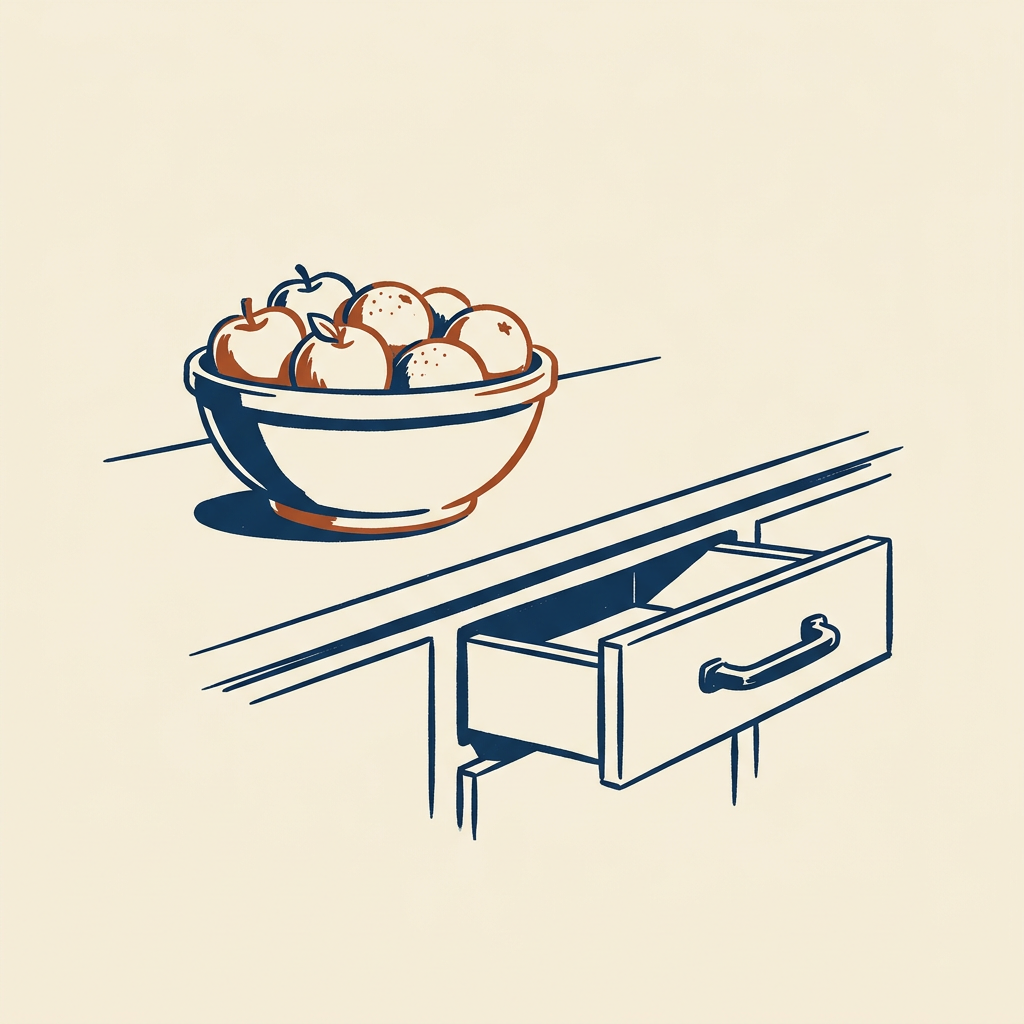
Willpower is depletable, so the Heaths conclude lasting change redesigns the physical or procedural Path until the desired behavior is the default.
Willpower path
Rely on self-control until stress depletes it
Redesigned path
Right choice is easiest reach and default
Resisting temptation in one task reduces capacity to resist in the next. Any strategy that leans on sustained self-control fights a finite resource and eventually fails under stress.
The remedy is to alter the environment so the right choice needs less willpower than the wrong one. What looks like a character flaw is often a badly designed situation; change the situation and behavior often shifts without any appeal to motivation.
Earlier Path-adjacent moves worked on perception and confidence. This one tackles architecture directly: remove friction from the desired path rather than trying to manufacture more willpower or motivation.
In practice: A school cafeteria raised fruit and vegetable consumption by moving healthy options to eye level and junk food to less convenient spots. A factory cut equipment misuse by laying out a workstation so the correct tool was the easiest to reach.
8
Habits and the herd
Change stays only when it becomes automatic habit and spreads by social proof, the authors show, because isolated willpower cannot fight a whole environment forever.
75%
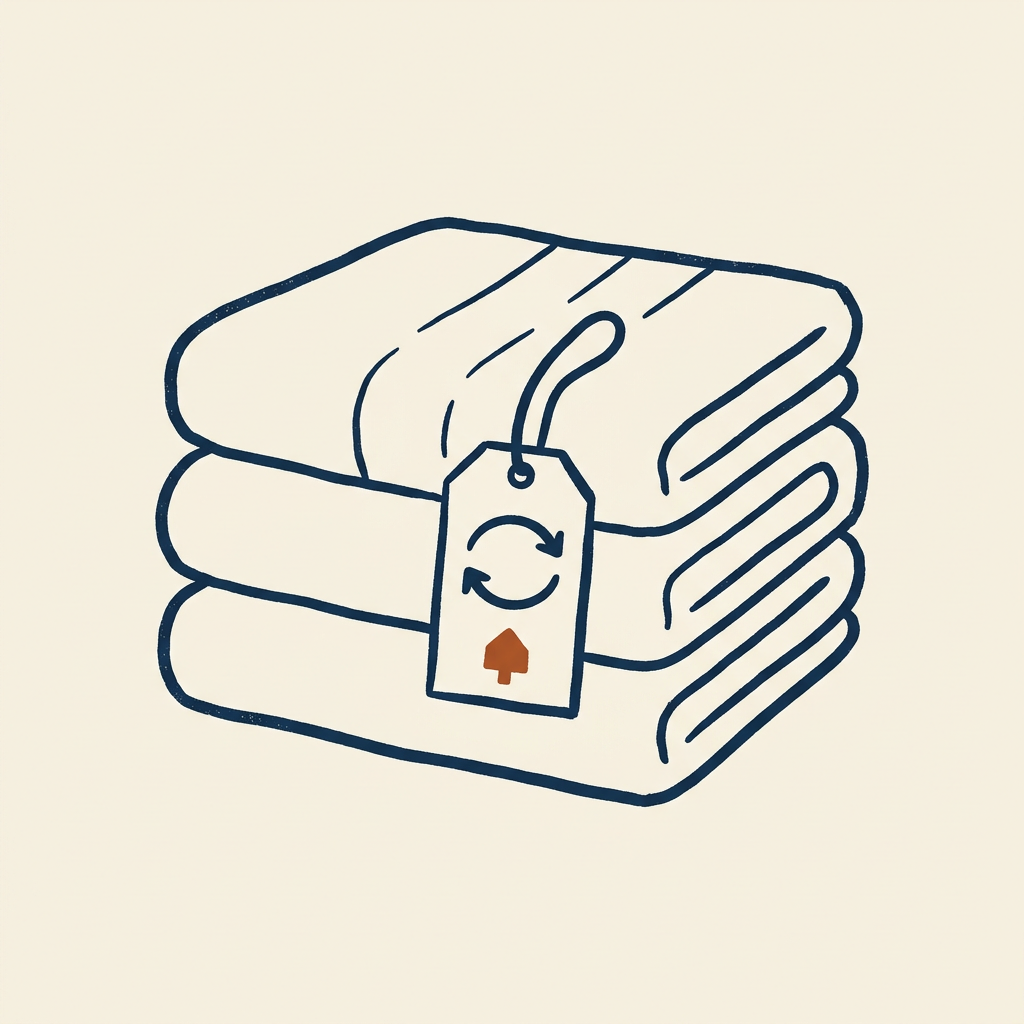
guests who reuse towels when told peers already do
Once a behavior repeats enough times in a stable context, it shifts from effortful Rider control to automatic Elephant behavior. Habits do not deplete willpower. Checklists and triggers speed that shift—tying a new action to an existing routine such as flossing right after brushing.
People also look to similar peers to judge whether a behavior is normal or safe. Visible early adopters—bright spots—turn a lonely effort into evidence the herd can follow.
Scripted moves and destinations aim the Rider; feeling, shrinking, and identity move the Elephant; environment design smooths the Path. Habit plus social proof make the system run after the initial push stops.
In practice: Hotel signs saying 75% of guests reuse their towels outperformed signs about environmental impact because they signaled a social norm rather than a value appeal.
Key terms
- Rider The rational, analytical side of the mind that plans and deliberates
- Elephant The emotional, instinctive side that supplies energy and often overpowers the Rider
- Path The physical and social environment that makes a behavior easier or harder
- Critical moves Exact, unambiguous actions scripted so the Rider need not improvise under stress
- Destination postcard A vivid, specific image of success that guides judgment when no script applies
- Shrinking the change Breaking a big transformation into small wins the Elephant can achieve right away
- Growth identity Seeing setbacks as normal learning rather than proof of fixed limits
- Bright spots Visible early successes whose example gives the rest of the herd proof it is safe to follow
What to do
- Write one change you want as a single next concrete behavior, not a goal, and rewrite it if three people could read it three different ways.
- Create one small win due inside a week and make that success visible to everyone involved.
- Change one piece of environmental friction: move an item, delete a step, or alter a default so the right choice takes less effort.
- Tie the new behavior to an existing daily routine so it can begin becoming automatic.
- Replace one more data slide with a concrete encounter or image that makes the cost of inaction felt.
Questions to think with
- Which lever—Rider clarity, Elephant motivation, or Path design—is weakest in the change you are leading right now?
- If your current goal were handed to three colleagues, would they all take the same first action?
- What small win could prove inside seven days that progress is possible?
- Where does the environment make the wrong behavior easier than the right one?
- How do people on your team explain setbacks—as fixed limits or as normal friction?
The other side
The book's central weakness is evidentiary: nearly every claim rests on a single vivid case rather than systematic reviews, base rates, or effect sizes, and some signature examples have been questioned or only partially replicated later. The Rider/Elephant metaphor simplifies dual-process theory and is presented more like settled science than a teaching device. Scope is limited—most examples come from well-resourced institutions with authority and budget, offering less to readers who lack control—and the book underplays structural barriers such as poverty or systemic incentives that no amount of scripting may overcome. It works best as a practical heuristic toolkit rather than a rigorously validated theory.
Who it's for
Managers trying to spread a new process without pure mandates, nonprofit and public-health workers designing low-budget behavior campaigns, and parents or individuals who keep failing at personal change and want to know why willpower alone does not work will get the most from the full book.