




The 12 Week Year makes urgency real before December panics you
A year is long enough to fool almost anyone into complacency, so execution sticks only when every twelve weeks runs as its own scored year.
IJR · Oct 28, 2026 · 9 min read
In 60 seconds
- A twelve-month frame creates false abundant time, so people coast until a fourth-quarter scramble leaves no runway.
- Anchor a concrete three-to-five-year vision first so twelve-week intensity does not sprint at the wrong target.
- Limit the cycle to three to five measurable goals, each broken into tactics assigned to specific weeks and written short enough to stay a working document.
- Every week, pull due tactics, score completion as a plain percentage, and track lead indicators so trouble shows while time remains.
- Report numbers first without long excuses; put attention on what changes next week.
- An honest mid-range score on hard tactics beats a gamed 100 percent, because the score only works if it tells the truth.
The big idea
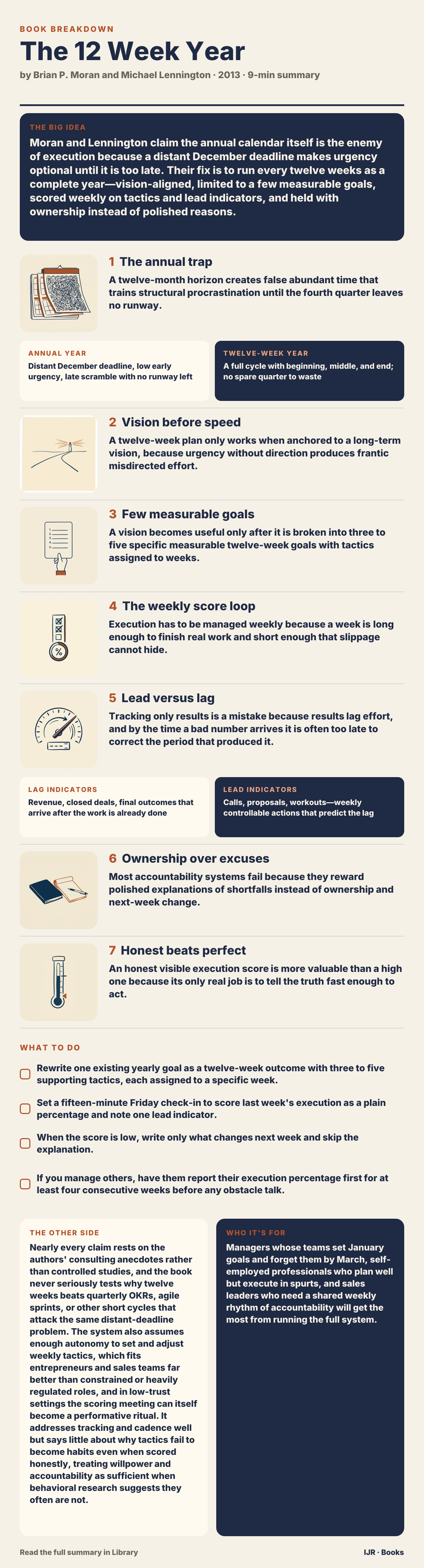
Moran and Lennington claim the annual calendar itself is the enemy of execution because a distant December deadline makes urgency optional until it is too late. Their fix is to run every twelve weeks as a complete year—vision-aligned, limited to a few measurable goals, scored weekly on tactics and lead indicators, and held with ownership instead of polished reasons.
The book in brief
The problem opens with the calendar. A year feels long enough that urgency stays optional through quiet early quarters; by the final scramble there is no runway left. The authors treat that frame, not weak goals or laziness, as the structural cause of missed plans.
They refuse to compress time without first stretching perspective. A concrete three-to-five-year vision for personal and business life becomes the filter so the coming intensity does not race toward the wrong market or metric. Only after the destination is fixed does the twelve-week plan appear.
That plan stays ruthlessly short: three to five measurable outcomes, tactics parked in specific weeks, written down so daily operations cannot erase it. Long wish-list strategies get discarded because they recreate the same diluted attention the shorter horizon was meant to cure.
The engine is weekly. Pull the tactics due, execute, score a completion percentage, adjust. Monthly reviews hide bad weeks; daily ones add overhead without clearer signal. Lead indicators—controllable actions that predict results—sit beside the score so a stall appears early enough to fix inside the same cycle.
Accountability meetings strip the theater of reasons. Numbers first, brief ownership, focus on next-week change. The score itself must stay honest; game it and the diagnostic tool collapses just when the real goal is about to be missed. The whole arc lands as a discipline of shorter, truth-telling cycles aimed at a fixed long vision.
Context
Brian P. Moran and Michael Lennington published The 12 Week Year in 2013 to close the gap most business books skip: people usually know what to do and still fail to do it consistently. It offered a concrete weekly operating system rather than another motivational slogan, aimed at managers, solo professionals, and sales leaders tired of January plans that die by March.
The key ideas

1
The annual trap
A twelve-month horizon creates false abundant time that trains structural procrastination until the fourth quarter leaves no runway.
Annual year
Distant December deadline, low early urgency, late scramble with no runway left
Twelve-week year
A full cycle with beginning, middle, and end; no spare quarter to waste
Most underperformance starts with the calendar, not with soft goals. When the target sits in December and you stand in January, distance itself lowers urgency. The authors saw the pattern across years of consulting: ambitious annual plans, quiet early quarters, then a late scramble.
Shrink the horizon to twelve weeks and the spare quarter disappears. There is no slow start left to burn. The frame itself supplies the pressure annual planning only delivers when it is too late to use.
The pattern shows up anywhere a long fiscal year lets teams coast—sales pipelines, project roadmaps, personal targets—because the psychology of abundant time, not laziness, is doing the damage.
In practice: One sales team they describe closed 80 percent of its annual revenue in the last two months, a lag the authors tie to the twelve-month frame rather than to market seasonality.

2
Vision before speed
A twelve-week plan only works when anchored to a long-term vision, because urgency without direction produces frantic misdirected effort.
Intensity needs a destination first. The authors ask for a concrete three-to-five-year picture of personal and business success, written far enough out that today's constraints do not shrink the answer.
Without that filter, a fast twelve-week engine can drive you efficiently toward the wrong segment or metric. Speed then compounds the error and burns goodwill faster than a slow plan ever could.
Use the vision as the gate for every short cycle: if a twelve-week win would not move the longer picture, it does not earn a slot.
In practice: A business owner chasing revenue growth realized, once forced to write a five-year vision, that the growth he wanted lived in a different market segment than the one his team was currently pursuing.

3
Few measurable goals
A vision becomes useful only after it is broken into three to five specific measurable twelve-week goals with tactics assigned to weeks.
Radical selectivity is the point. Three to five outcomes for the period, stated as clear results rather than activities. Increase qualified leads by a set percent counts; work on marketing does not.
Under each goal sit the concrete tactics and the weeks that own them. Long lists of fifteen or twenty initiatives give nothing real focus and recreate the dilution the shorter horizon was meant to fix.
Write the plan in that tight format so it stays a working document. Unwritten or binder-thick plans drift the moment daily operations press in.
In practice: A company that habitually produced twenty-plus-page annual strategic plans that were filed and never reopened shifted to a short tactic-by-week plan people actually kept open and used.

4
The weekly score loop
Execution has to be managed weekly because a week is long enough to finish real work and short enough that slippage cannot hide.
Each week pulls only the tactics due from the twelve-week list into a short weekly plan. At the end every tactic is marked done or not, producing a completion percentage.
Monthly reviews bury two or three bad weeks inside an average. Daily reviews add administrative noise without clearer signal. The week sits in the useful middle: trouble is visible almost immediately, yet the span is still long enough to accomplish something.
The rhythm is plan, execute, score, adjust. Teams that kept the loop showed higher execution rates within a few cycles because the feedback could no longer be postponed.
In practice: A manufacturing client's plant-level teams began posting their weekly execution percentage on a shop-floor board; visibility alone, with no formal penalty, changed behavior because gaps became impossible to ignore quietly.

5
Lead versus lag
Tracking only results is a mistake because results lag effort, and by the time a bad number arrives it is often too late to correct the period that produced it.
Lag indicators
Revenue, closed deals, final outcomes that arrive after the work is already done
Lead indicators
Calls, proposals, workouts—weekly controllable actions that predict the lag
Lag indicators are final outcomes: revenue, closed deals, weight lost. Lead indicators are the controllable behaviors that create them: calls made, proposals sent, workouts finished.
By the time a monthly sales figure lands, the behaviors that produced it are weeks old and cannot be changed. Weekly lead numbers give the early warning inside the same twelve-week window.
Pair those leads with the execution score so a manager sees a stalling pipeline in week three instead of a miss in week ten.
In practice: A sales organization that had reviewed only closed revenue monthly began tracking weekly outbound calls and proposals; managers saw pipeline trouble three or four weeks earlier and still had time left in the period to correct course.

6
Ownership over excuses
Most accountability systems fail because they reward polished explanations of shortfalls instead of ownership and next-week change.
Missed-goal talks usually spiral into reasons: market conditions, a colleague's delay, an unexpected fire. The reasons may be true and still train people to excel at explaining failure.
The alternative is a short weekly meeting where each person states execution percentage and lead numbers first, without extended justification. Attention then moves to what will be different next week; only genuine unresolved blockers get airtime.
A culture that makes a good excuse cheap quietly lowers the bar for everyone. Change what the room socially rewards and the scores follow.
In practice: One client team's meetings had become forty-five-minute obstacle discussions; once the format shifted to numbers first and tighter blocker talk, meetings shortened and execution scores rose within a few cycles.

7
Honest beats perfect
An honest visible execution score is more valuable than a high one because its only real job is to tell the truth fast enough to act.
Teams game the system by choosing easy tactics for guaranteed high percentages or by fudging completion to avoid discomfort. That destroys the diagnostic value the whole structure depends on.
Well-calibrated ambitious tactics landing in the 85 to 90 percent range signal strong execution. Consistent 100 percent usually means the tactics were too soft. Multiple weeks below 70 percent means either an execution problem or an unrealistic plan—diagnose which before the cycle ends.
Leaders must treat an honest low number as more useful than a polished perfect one, or people keep face-saving and the plan looks fine until the underlying goal is missed.
In practice: Teams the authors watched first resisted reporting low scores out of embarrassment, then shifted once leadership visibly treated a true 60 percent as better information than a dishonest 100 percent.
Key terms
- 12 Week Year Treating a twelve-week span as a complete year with its own goals, plan, and hard deadline
- Annual planning cycle The twelve-month frame that creates false abundant time and structural delay
- Lead indicators Controllable weekly behaviors that predict later results
- Lag indicators Final outcomes that show up too late to change the period that produced them
- Execution percentage The weekly score of completed tactics versus planned ones
- Weekly execution cycle Plan the week's tactics, do them, score them, adjust the next week
- Accountability of reasons The habit of explaining misses instead of owning the next change
What to do
- Rewrite one existing yearly goal as a twelve-week outcome with three to five supporting tactics, each assigned to a specific week.
- Set a fifteen-minute Friday check-in to score last week's execution as a plain percentage and note one lead indicator.
- When the score is low, write only what changes next week and skip the explanation.
- If you manage others, have them report their execution percentage first for at least four consecutive weeks before any obstacle talk.
Questions to think with
- Where does your current annual plan still allow a quiet first half?
- Which lead indicators would have warned you early about the last goal you missed?
- What would make an honest low weekly score feel safe to report on your team?
- Does your next twelve-week goal clearly ladder to a three-to-five-year picture, or is it just urgent busywork?
- Are you scoring ambitious tactics or protecting a perfect percentage?
The other side
Nearly every claim rests on the authors' consulting anecdotes rather than controlled studies, and the book never seriously tests why twelve weeks beats quarterly OKRs, agile sprints, or other short cycles that attack the same distant-deadline problem. The system also assumes enough autonomy to set and adjust weekly tactics, which fits entrepreneurs and sales teams far better than constrained or heavily regulated roles, and in low-trust settings the scoring meeting can itself become a performative ritual. It addresses tracking and cadence well but says little about why tactics fail to become habits even when scored honestly, treating willpower and accountability as sufficient when behavioral research suggests they often are not.
Who it's for
Managers whose teams set January goals and forget them by March, self-employed professionals who plan well but execute in spurts, and sales leaders who need a shared weekly rhythm of accountability will get the most from running the full system.