




Trust earned stroke by stroke beats talent alone
Nine working-class oarsmen win Olympic gold only when each man stops protecting himself and disappears into a shared rhythm called swing.
IJR · Oct 25, 2026 · 12 min read
In 60 seconds
- Joe Rantz's childhood abandonment forged a guarded self-reliance that later blocked the total commitment elite rowing demands.
- Washington recruited loggers' and farmers' sons and sorted seats by stopwatch, challenging eastern prep-school pedigree.
- Boatbuilder George Pocock treated shell-making and rowing as one craft that requires surrender of ego.
- Seat racing proved reliability under stress so trust could be measured rather than assigned.
- Swing arrives only when eight separate efforts vanish into one continuous motion through the water.
- The Berlin final was won by roughly six tenths of a second through years of mutual reliability, not lane luck or fresh legs.
The big idea
Big Idea. Brown argues the 1936 Washington crew won less from talent than from trust forged by brutal repetition and the choice to subordinate individual ambition to collective rhythm. Joe Rantz's arc from abandoned teenager to fully committed oarsman is the proof that excellence matters only once it disappears into the group.
The book in brief
Book in Brief. The story opens on Joe Rantz, left alone as a teenager in rural Washington when his father and stepmother moved away. He survives by odd jobs and fierce self-reliance, arriving at the University of Washington already skilled at enduring pain but unwilling to risk full dependence on anyone. That guardedness collides with the demands of elite rowing, which punishes any held-back effort.
Washington's program sits outside the eastern Ivy and prep-school pipeline. Coach Al Ulbrickson recruits farm and logger sons who need the team's modest support to stay in school, then sorts them with stopwatches rather than pedigree. Parallel to the men, English boatbuilder George Pocock shapes western red cedar shells and quietly mentors rowers, insisting that standing out slows the boat.
Seat racing becomes the proving ground. Ulbrickson swaps rowers between nearly identical boats and times the difference, isolating each man's real contribution. Joe lags longer than his strength predicts because he still rows with something held in reserve. Only after he commits fully, trusting the others will match him, does the eventual Olympic eight lock into place around coxswain Bobby Moch and stroke Don Hume.
The crew begins to find swing—the near-mystical state when eight oars move as one and the shell lifts clean. Brown intercuts their rise with Nazi stage-management of the Berlin Games: Goebbels, Riefenstahl, temporary removal of anti-Jewish signs. The Americans arrive underfunded, seasick, and largely unaware of the propaganda frame.
In the final they draw a rough outside lane; Hume is seriously ill. They fall behind Germany and Italy before Moch calls an early, sustained sprint that asks exhausted men to override their limits on pure trust. They win by roughly six tenths of a second. Afterward most return to ordinary Depression-era jobs, medals stored away, the values that produced the win also keeping them from turning it into lasting fame.
Context
Daniel James Brown published the book in 2013 after reconstructing the story largely through interviews with Judy Willman, Joe Rantz's daughter, conducted as her father was dying, plus letters and diaries. It recovered a faded Depression-era account of class, endurance, and craftsmanship set against Nazi Germany's use of the Games as propaganda.
The key ideas

1
Abandonment's double edge
Joe's early abandonment taught a self-reliance that made him hard to coach yet exactly the rower a boat eventually needs.
Alone
Survives by fish, odd jobs, guarded competence
In the shell
Any held-back stroke unbalances eight men
Joe grows up in rural Washington as the Depression begins. His mother dies young; his father remarries Thula, who does not want the boy. Around age fifteen the family moves and leaves him in an unfinished house with no support. He catches fish, takes odd jobs, and finishes high school while functionally homeless.
Brown presents this not as color but as the story's emotional engine. The same habits that keep Joe alive—working through pain without complaint, trusting no one—become liabilities once he joins the Washington crew. Elite rowing demands the opposite of self-protection; any held-back effort throws off the shell's balance.
The tension the rest of the book resolves is simple: a young man conditioned to expect abandonment must learn to give everything to seven other men and a coxswain. Technical success in 1936 only carries weight once the reader sees what that trust cost him personally.
In practice: Joe arrives at college able to endure isolation yet instinctively holding part of himself back, unwilling to risk fresh disappointment from teammates.

2
Rowing as class war
1930s college rowing was class hierarchy disguised as sport; Washington's stopwatch meritocracy threatened the eastern establishment.
Eastern pipeline
Prep-school pedigree and social prestige
Washington
Farm and logger sons sorted by stopwatch
Elite rowing then belonged to Ivy League schools and eastern prep pipelines where the sport carried yachting's social prestige. Washington, a public land-grant school, built its crews from farm boys, loggers' sons, and men who needed the modest stipend and dining-hall access just to stay enrolled.
California and eastern crews from Yale, Harvard, and Cornell treated rowing as inherited status. Ulbrickson instead prized measurable output, using repeated time trials to sort rowers regardless of background. That structure let someone like Joe, nearly penniless, compete for a seat against polished technique.
Material stakes were real: a losing season risked program funding; a losing rower risked the job and housing that came with the team. A Berlin win would not only be an athletic upset but evidence that a public university built on working-class labor could beat institutions built on privilege.
In practice: Washington's fiercest rivalries and the eastern establishment treated pedigree as destiny while Ulbrickson's stopwatches ignored it.
3
Pocock's single craft
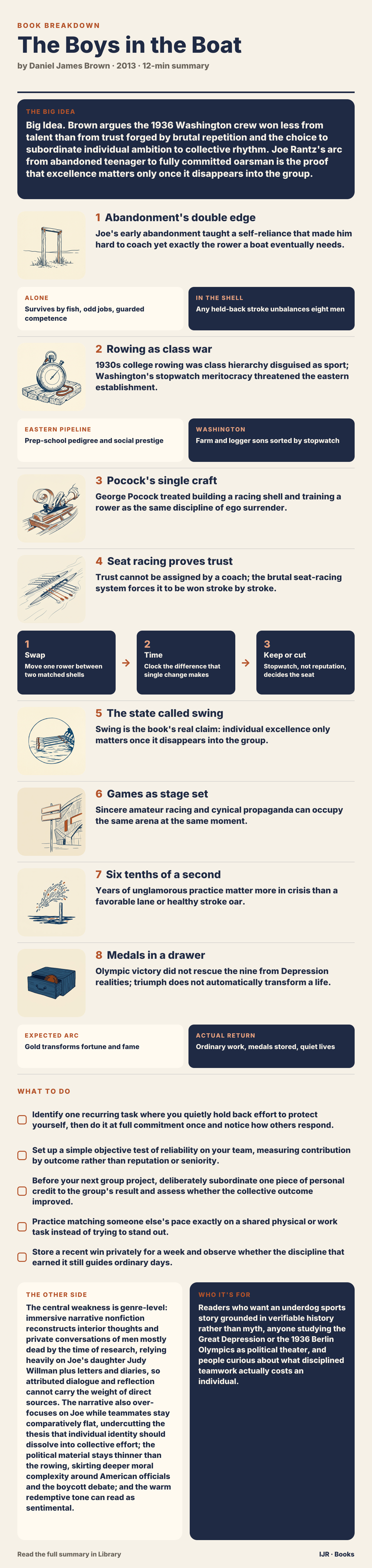
George Pocock treated building a racing shell and training a rower as the same discipline of ego surrender.
English immigrant George Yeoman Pocock worked from a loft above the Washington shell house, building the cedar racing shells American crews depended on for decades. He chose western red cedar for grain and flex the way a luthier chooses spruce, aiming for boats light enough for the men to lift yet strong enough for a sprint finish's violence.
Brown places him as the book's philosophical center. Pocock mentored rowers directly, especially Joe, offering observations about rowing that doubled as observations about character. A rower who tried to stand out, who pulled for himself rather than the boat, actively slowed everyone.
Physics backed the ethic: eight oars at slightly different times or forces create drag and instability. Individual effort had to be shaped into shared, almost invisible discipline. Pocock noticed Joe's guardedness and made clear he could not become great until he trusted crewmates enough to stop protecting himself.
In practice: Pocock tells Joe, in effect, that self-protection and great oarsmanship cannot coexist in the same shell.
4
Seat racing proves trust
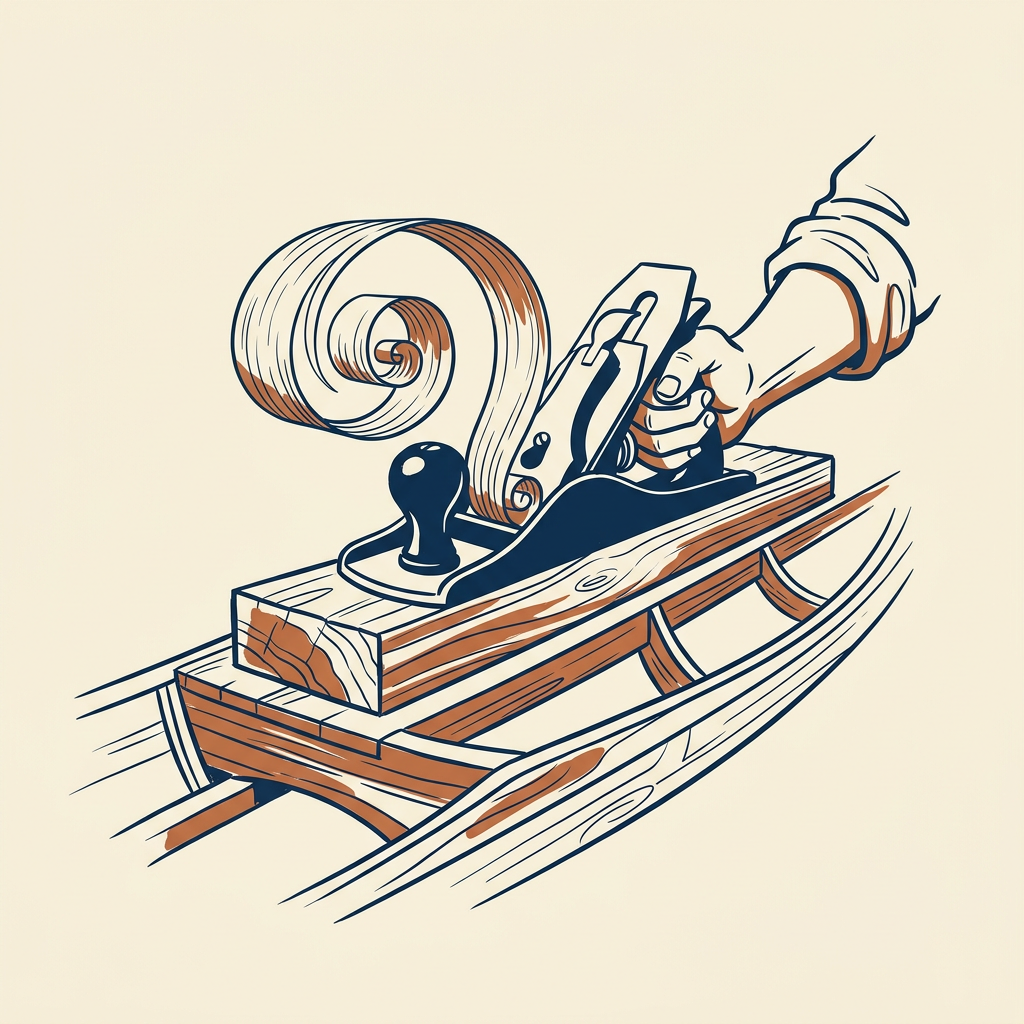
Trust cannot be assigned by a coach; the brutal seat-racing system forces it to be won stroke by stroke.
- 1SwapMove one rower between two matched shells
- 2TimeClock the difference that single change makes
- 3Keep or cutStopwatch, not reputation, decides the seat
Ulbrickson decided the varsity eight by seat racing: swap one rower between two nearly identical boats and time the result, isolating a single substitution's effect. Reputation meant nothing against the stopwatch.
Joe struggled in this system longer than raw ability predicted. He rowed cautiously, holding reserve, because a lifetime of being left behind had taught him not to commit fully to anything he might lose. Coaches and teammates sensed the hesitation even when they could not name it.
The turning point comes when Joe, helped by Pocock's intervention, learns total physical commitment on every stroke, trusting the other seven will match rather than exploit his exhaustion. The eventual boat—including coxswain Bobby Moch and stroke Don Hume—forms not from friendship or social match but from repeated trials proving no man would let the others down under maximum stress.
In practice: Ulbrickson swaps rowers and lets the clock alone decide who keeps a seat, stripping favoritism from selection.
5
The state called swing
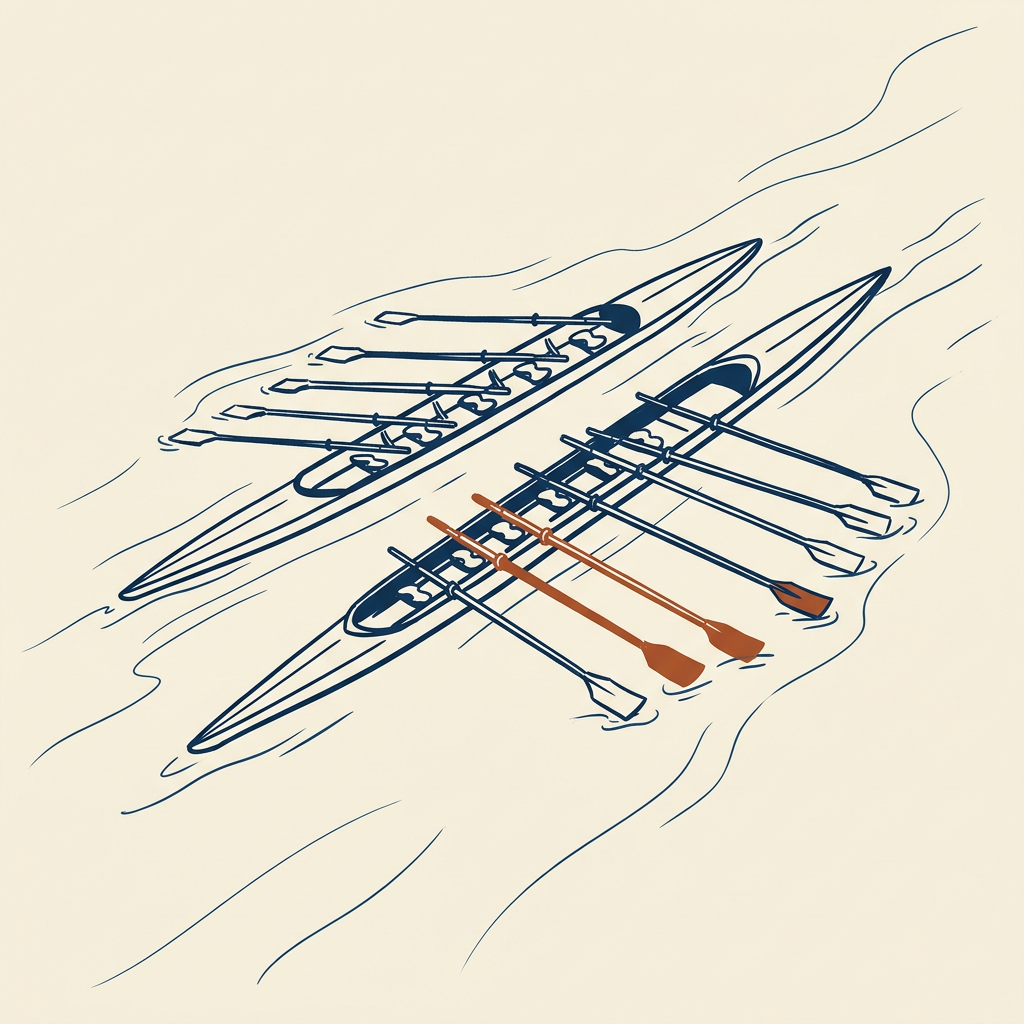
Swing is the book's real claim: individual excellence only matters once it disappears into the group.
Experienced crews describe a moment when all eight oars enter and leave the water in such precise unison that the boat seems to lift and glide with almost no resistance. Technically it happens when every recovery and drive align so the shell's motion becomes continuous rather than jerks from shifting weight.
A boat full of strong individuals can miss swing forever. It requires each rower to stop trying to row well alone and subordinate personal technique to the rhythm set by the stroke and interpreted by the coxswain. Ulbrickson and Pocock recognize it almost by feel from shore before a stopwatch confirms faster splits.
For Joe, finding swing with this crew after years of holding back resolves his personal arc: he finally trusts seven others enough to let his effort become indistinguishable from theirs. Brown measures every later race, including the Olympic final, by whether that collective disappearance holds.
In practice: Coaches sense swing from the shore by the boat's sudden clean glide before any split time proves it.

6
Games as stage set
Sincere amateur racing and cynical propaganda can occupy the same arena at the same moment.
Parallel to the crew's rise, Brown narrates the Nazi preparation of the 1936 Berlin Olympics as deliberate propaganda. Goebbels oversaw a massive new stadium and Leni Riefenstahl's filming to present Germany as modern, orderly, and welcoming even as antisemitic policies advanced. Anti-Jewish signage was temporarily removed from Berlin streets.
The American rowers arrive with almost no political awareness, more worried about seasickness and strange food than the regime hosting them. The U.S. Olympic Committee did not fully fund the trip; the team raised money through public appeals just to reach Germany, underscoring working-class athletes competing without institutional backing.
Brown does not cast the crew as politically heroic for showing up. Their unglamorous pursuit of a fair contest simply stands in unplanned contrast to a regime choreographing the entire spectacle, giving the eventual race symbolic weight beyond sport.
In practice: The crew fundraises locally for boat fare while Berlin streets are scrubbed of anti-Jewish signs for foreign eyes.

7
Six tenths of a second
Years of unglamorous practice matter more in crisis than a favorable lane or healthy stroke oar.
In the Olympic final the Americans draw the least favorable lane, more exposed to wind and rough water than those given Germany and Italy. Stroke Don Hume is seriously ill, his ability to set pace in real doubt. They fall behind early before a partisan crowd that includes Hitler.
Coxswain Bobby Moch calls for a sustained, escalating sprint earlier and longer than the crew has ever attempted, asking exhausted men to override bodily limits on pure trust in each other and their training. They win by roughly six tenths of a second over Italy, Germany close behind—a margin barely visible to spectators.
Brown treats the finish as direct payoff of seat racing and swing. The crew had neither tactical nor physical advantage that day; they extracted a final effort a less-trusting boat could not have summoned. Visible triumph is only the last brief moment of a long invisible process of earned reliability.
In practice: Moch demands a longer sprint than ever practiced; the men answer because years of seat races already proved each would not quit.

8
Medals in a drawer
Olympic victory did not rescue the nine from Depression realities; triumph does not automatically transform a life.
Expected arc
Gold transforms fortune and fame
Actual return
Ordinary work, medals stored, quiet lives
After the medal ceremony Brown deflates the expected glory narrative. The crew returns to modest recognition, not lasting fame. Most go back to ordinary working lives shaped by the same economic pressures that shaped them before Berlin.
Joe finishes his engineering degree and marries Joyce Simdars, a woman known since childhood; Brown treats their steady marriage as a quieter counterpart to the boat's earned trust. Several crewmates enter engineering, teaching, or business. Gold medals stay stored away for years, private memory rather than public credential.
This generation rarely spoke expansively about the achievement, which is why the story faded until Brown's research decades later. The values that produced the win—self-denial, discipline, tolerance for hardship—also kept the men from turning it into personal advancement. The Depression's constraints outlasted one afternoon on a German lake.
In practice: Medals remain packed away while the men resume ordinary jobs; the win never becomes a lasting public credential.
Key terms
- swing the rare state when eight oars move in such unison that the shell lifts and glides with almost no resistance
- seat racing Ulbrickson's method of swapping one rower between two matched boats and timing the difference to decide varsity seats
- stroke oar the rower who sets the pace and rhythm everyone behind must match
- coxswain the small non-rowing steersman who calls strategy and sprints in a race
- shell the narrow racing boat itself, here built of western red cedar by Pocock
- recovery and drive the two halves of a stroke whose perfect alignment across eight men produces swing
What to do
- Identify one recurring task where you quietly hold back effort to protect yourself, then do it at full commitment once and notice how others respond.
- Set up a simple objective test of reliability on your team, measuring contribution by outcome rather than reputation or seniority.
- Before your next group project, deliberately subordinate one piece of personal credit to the group's result and assess whether the collective outcome improved.
- Practice matching someone else's pace exactly on a shared physical or work task instead of trying to stand out.
- Store a recent win privately for a week and observe whether the discipline that earned it still guides ordinary days.
Questions to think with
- Where in your work do you still row with something held in reserve, and what would full commitment cost you?
- Can trust in a group be measured objectively the way seat racing measures it, or does your setting still reward pedigree and reputation?
- When have you felt a version of swing—individual effort disappearing into a cleaner group result—and what conditions allowed it?
- Does a public victory that leaves private lives unchanged still count as transformative, and for whom?
- How should amateur sport sit inside a propaganda spectacle without either ignoring politics or claiming unearned heroism?
The other side
The central weakness is genre-level: immersive narrative nonfiction reconstructs interior thoughts and private conversations of men mostly dead by the time of research, relying heavily on Joe's daughter Judy Willman plus letters and diaries, so attributed dialogue and reflection cannot carry the weight of direct sources. The narrative also over-focuses on Joe while teammates stay comparatively flat, undercutting the thesis that individual identity should dissolve into collective effort; the political material stays thinner than the rowing, skirting deeper moral complexity around American officials and the boycott debate; and the warm redemptive tone can read as sentimental.
Who it's for
Readers who want an underdog sports story grounded in verifiable history rather than myth, anyone studying the Great Depression or the 1936 Berlin Olympics as political theater, and people curious about what disciplined teamwork actually costs an individual.