




The Culture Map turns silent misfires into named scale gaps
A Swedish boss in Moscow who invited open pushback met silence his staff read as weakness—the relative map is for managers who keep misreading that kind of moment.
IJR · Oct 19, 2026 · 11 min read
In 60 seconds
- National labels like direct or hierarchical only work when two cultures sit side by side on the same scale.
- Meyer plots roughly thirty countries on eight scales covering talk, feedback, persuasion, leadership, decisions, trust, disagreement, and time.
- A one-step gap barely registers; three or four steps, such as Israeli directness against Japanese indirection, almost always produce friction.
- Everyday speech style does not predict criticism style—Americans are explicit yet wrap negative feedback in praise.
- Day-to-day hierarchy can reverse decision style: Japan is hierarchical in the room yet builds agreement through quiet nemawashi.
- Under stress and time pressure people snap back to earliest cultural defaults even after years of cross-border fluency.
The big idea
Meyer argues global workplace friction is patterned across eight measurable scales and is usually unconscious, not personal. Because every style only reads a certain way relative to the other person at the table, the useful move is locating the gap between two specific cultures so the misfire becomes speakable.
The book in brief
Managers leading across borders keep treating silence, delayed replies, or blunt notes as character flaws. Meyer starts from the opposite claim: the same person can look blunt in one country and diplomatic in another, so absolute labels fail before they start.
She builds eight bipolar scales from workshops with thousands of INSEAD executives and positions roughly thirty countries as coordinates, never as moral rankings. Small gaps rarely hurt. Wide ones need naming before anyone adjusts.
The book then walks the scales in order. Communication runs from low-context explicit messaging common in the United States to high-context layered meaning common in Japan. Feedback sits on its own axis, so Dutch plainness and American sandwich praise can blindside people who thought they already understood directness. Persuasion splits principles-first rooms that want theory before the ask from applications-first rooms that want the recommendation in the first minutes.
Leadership runs from egalitarian facilitator to visible hierarchy, yet decision-making is a separate axis—Japan stays formal in the room while circulating agreement quietly beforehand so rollout can move fast. Trust splits proof-by-delivery from proof-by-personal-bond. Disagreement and scheduling close the set: open debate versus protected harmony, linear deadlines versus flexible parallel time.
She finishes with a German-Indian venture where trust and scheduling gaps outranked communication style, which prior contact had already softened, and with the warning that shared English and internationally schooled staff do not erase defaults when pressure rises. The map's job is a neutral vocabulary for the first conversation, not a permanent type for any nationality.
Context
Erin Meyer published The Culture Map in 2014, drawing on patterns gathered from thousands of INSEAD executives across nationalities. Globalized teams took it up because it gave a shared vocabulary for friction that used to be dismissed as personality clashes.
The key ideas

1
Only relative positions count
A behavior only counts as direct or hierarchical relative to whoever sits across the table.
Absolute label
Germans are direct
Relative read
Direct beside Japan, softer beside the Netherlands
Meyer opens by rejecting absolute labels. Calling Germans direct or Chinese hierarchical means nothing alone, because every reading is comparative. An American manager feels direct next to a Japanese colleague and indirect next to a Dutch one—same habits, two verdicts.
That relativity is why expats watch reputations flip after a country move. She therefore plots cultures on eight bipolar scales so a manager can locate self, counterpart, and the gap between them.
The scales are coordinates, not rankings; no pole is superior. A one-step gap barely registers. A gap of three or four steps almost certainly produces friction unless someone names it first.
In practice: A British manager known as blunt in Tokyo was later remembered as diplomatic in Amsterdam.

2
Explicit words versus layered meaning
Whether a message must be spelled out or can stay implicit is a learned habit, not intelligence or honesty.
Low-context
Simple explicit messages; assume little shared background
High-context
Layered meaning; expect listeners to read what is unsaid
Meyer places the United States at the low-context pole: short sentences, conclusions up front, willingness to repeat the point. Japan sits at the high-context pole with much of East Asia and, more moderately, France—meaning rides on shared history, tone, and what goes unsaid.
In her account the high-context style is not less precise; it assumes both sides already hold the context. That works inside a long-tenured homogenous workforce and breaks the moment a foreign counterpart lacks the background.
She links the pattern to history. Places with many immigrant waves and regional dialects needed explicit speech. Places with long homogenous histories could keep rich implicit codes. Low-context speakers hear clarity as respect; high-context speakers hear full spelling-out as rude or needless.
In practice: American emails that detailed every supplier step struck Japanese readers as condescending, while a refusal phrased as very difficult often registered to Americans as maybe rather than no.

3
Criticism has its own dial
How bluntly a culture delivers negative feedback does not follow from how explicit its everyday speech is.
Meyer peels evaluating off general communication because the two misalign. Netherlands, Israel, Germany, and Russia sit near plain negative feedback with little positive cushion; softening can sound insincere.
The United States lands in a middle trap she flags as a major predictor error: low-context in ordinary talk yet fond of wrapping critique in praise. Japan, Thailand, and Indonesia minimize, privatize, or bury negative points until outsiders miss them.
Her practical fix is dosage, not conversion. Soften consciously toward indirect listeners. Discount perceived harshness from direct givers instead of taking the tone as a personal attack.
In practice: A French manager told a British subordinate the presentation was not structured as he would have; he meant a sharp rebuke, she heard a mild preference and changed nothing.

4
Theory first or example first
Some rooms tune out unless the concept arrives before the ask; others leave if the recommendation is not immediate.
Meyer traces French and German principles-first habits to schooling that runs through Descartes and Hegel: establish why a claim must be true, then move to application. The United States and United Kingdom lean applications-first: lead with the result, hold theory until someone requests it.
Mismatch empties rooms. Principles-first speakers sound slow and academic to applications-first listeners. Applications-first decks sound thin or salesy to principles-first listeners who wanted the rationale first.
She adds a related credibility split—some cultures treat abstract conceptual skill as proof, others want tested application. Structure the talk to the audience's order rather than your home habit.
In practice: A French executive who spent twenty minutes on historical and theoretical groundwork lost an American audience that expected the bottom line in the first two minutes.
5
Boss as facilitator or apex
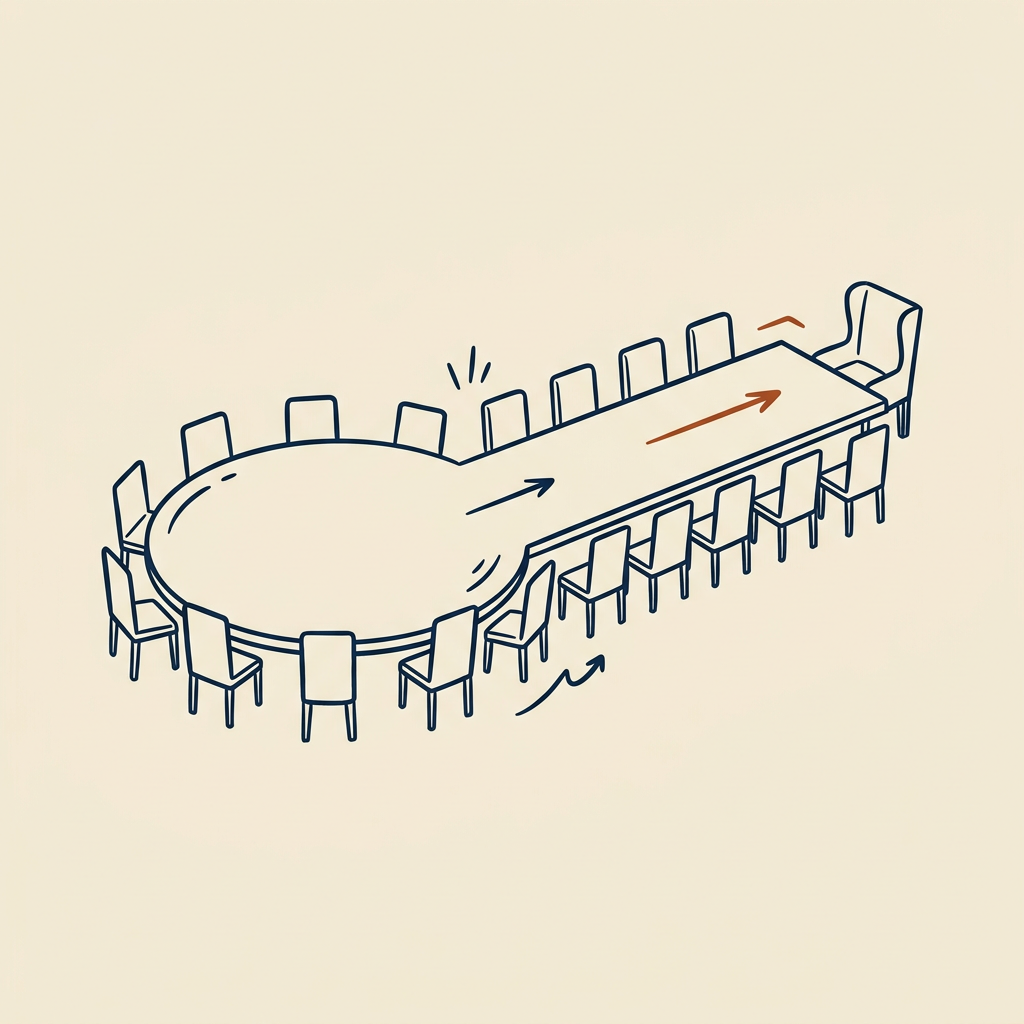
Expected distance between boss and staff shapes who speaks, who sits where, and what counts as respect.
Meyer sets Scandinavia, the Netherlands, and Israel toward the egalitarian pole: boss as facilitator, titles light, juniors free to challenge aloud. Japan, South Korea, and Nigeria sit toward the hierarchical pole: status marked by seating, address, and speaking order; public contradiction is a serious breach.
Wealth and democracy do not reliably flatten this axis—Japan remains hierarchical at work, a fact that trips assumptions that modernization erases rank everywhere.
Adaptation here is unusually visible and risky. Wrong chair or open pushback can damage a relationship before substance begins. Hierarchical client visits often demand matching seniority; sending a junior can read as disrespect regardless of competence.
In practice: A Swedish executive in Moscow kept soliciting open pushback and found silence-filled meetings marked him as weak to staff who expected a leader to state direction.

6
Authority is not the decision path
Hierarchical daily manners do not lock a culture into top-down decisions; the axes often point different ways.
Meyer separates day-to-day authority from how agreement is actually built. Japan stays hierarchical in interaction yet strongly consensual in deciding: nemawashi quietly circulates a proposal among stakeholders so the formal meeting only confirms what is already settled. Decisions form slowly, then implement fast.
The United States runs more egalitarian day to day yet often top-down in the call—one boss decides quickly, then persuades and revises during implementation. Partners misread both speeds: Americans fretting slow Japanese decisions miss the smooth rollout; Japanese partners expecting fast American execution meet renegotiation.
Germany and France add another pattern—top-down announcements after exhaustive documented analysis, quick to declare, slow to prepare. Ask two questions, not one: who holds authority, and how is buy-in built.
In practice: Under nemawashi the meeting becomes a formality because quiet rounds have already secured agreement.

7
Trust by delivery or by closeness
Cognitive trust from track record and affective trust from personal bond follow routes that stall when swapped.
Meyer distinguishes task-based trust—common in the United States, Germany, and much of Northern Europe, where delivering on commitments is enough—from relationship-based trust in China, Brazil, and much of the Middle East and Latin America, where business waits on personal bond.
Rushing the agenda in a relationship-based setting can close the door permanently. Warmth that never leaves the meeting room can look performative to managers who expect dinners, disclosure, and off-work time before real trust forms.
Her guidance is structural. Build slack for informal time early in relationship-based cultures. Heavy socializing before substance can look evasive in task-based ones. The scale neighbors communication style but does not match it one-for-one.
In practice: American executives who treated Beijing relationship dinners as wasted preamble risked deals that never opened.

8
Open clash versus protected harmony
Loud debate can signal engagement in one room and a damaged relationship in another.
Meyer runs disagreeing from confrontational to avoids-confrontation. France and Israel sit toward open clash: fierce argument over ideas is healthy and separate from the personal bond, shaped in France by schooling that rewards vigorous intellectual debate.
Japan and Indonesia sit toward avoidance, where visible disagreement—especially junior against senior—threatens group harmony and moves to private channels or intermediaries.
Americans occupy a misread middle: comfortable with debate yet bent on depersonalizing and softening it, which French colleagues can hear as thin conviction rather than courtesy.
In practice: French colleagues may argue hard over a proposal and still lunch together afterward with no leftover strain.

9
Fixed sequence versus flexible time
Punctual single-thread schedules and approximate multi-thread time suit different work, not different virtue.
Linear-time cultures such as Germany, Switzerland, and Japan treat schedules as sequential respect: finish one task, then start the next; punctuality counts. Flexible-time cultures such as India, Nigeria, and much of the Middle East run tasks in parallel, treat deadlines as approximate, and let relationship interruptions outrank the original plan.
Each side moralizes the other. Fixed sequencing looks blind to legitimate competing demands. Shifting dates look like unreliability.
Meyer notes flexible time often fits improvisational, relationship-dependent work while linear time fits standardized, process-dependent work—so fitness depends on the task, not on character.
In practice: German engineers read continual Indian date shifts as failure; Indian counterparts read German fixed sequencing as inflexible under real competing pulls.

10
Diagnose the live pairing
The widest gap on a poster is not always the gap that stalls a real team.
Meyer closes by insisting the eight scales work only in combination and only relatively—culture A versus culture B on a given axis, never a lonely point as a fixed trait.
Her worked German-Indian joint venture showed mismatches across communication, feedback, persuasion, hierarchy, decisions, trust, disagreement, and time. The gaps that actually hurt were trust-building and scheduling; communication style had already been bridged by years of prior contact.
Individual history, industry norms, and earlier cross-border years shrink or widen practical distance. Shared English and young internationally educated staff do not erase defaults; stress and unfamiliar situations send people back to earliest cultural instincts. The map's value is neutral language for friction so adjustment can begin.
In practice: In the German-Indian venture she recounts, trust and scheduling outranked communication style as the live friction sources.
Key terms
- low-context Messages should be simple, explicit, and complete on their own
- high-context Meaning is layered, partly unsaid, and drawn from shared background
- principles-first Build the argument from theory or concept before the practical ask
- applications-first Lead with the recommendation or result; supply theory only if asked
- nemawashi Quiet pre-circulation of a proposal so the formal meeting only confirms agreement
- task-based trust Confidence earned by skills, reliability, and delivered commitments
- relationship-based trust Confidence earned through personal bond, meals, and emotional openness
- linear time Schedules run sequentially; punctuality signals respect
- flexible time Tasks run in parallel; deadlines are approximate and relationships can interrupt
What to do
- Name aloud which of the eight scales your next international meeting is most likely to misread.
- Before sending critical feedback across a wide evaluating gap, ask a colleague from that culture how the phrasing will land.
- When entering a relationship-based trust culture, schedule unstructured time before the agenda instead of compressing it.
- For a principles-first audience, build the concept before the ask; reverse the order for applications-first listeners.
- Treat each national profile as a hypothesis to test against the actual person in the first few exchanges.
Questions to think with
- Which scale gap is most likely misfiring on your current cross-border team?
- When has your reputation flipped after a country or team change, and which scale explains the flip?
- Are you reading a counterpart's silence as agreement, resistance, or high-context care?
- Whose cultural norms does your partnership quietly defer to when power is unequal?
- Under deadline stress, which early cultural default do you personally snap back to?
The other side
The framework's usability is also its limit: it runs on national averages that erase huge within-country variation, and Meyer's INSEAD executive sample skews urban, university-educated, and already partly globalized, so a rural plant manager and a coastal analyst get folded into one plotted point. That is a version of the ecological fallacy that has followed Hofstede-style dimension research since the 1970s—country means say little about the specific person across the table, and the book's point-plot format invites readers to treat loose priors as forecasts. Corporate anecdotes illustrate the scales rather than prove they predict better than industry, company culture, or personality. The model also struggles with fast-changing societies and with diaspora or mixed-heritage people who do not map onto one nationality, says little about power, colonial history, language dominance, or unequal leverage that decide whose norms win, and predates large-scale remote work, where later research finds scheduling and communication scales behave differently over video and chat than in the face-to-face deals the book draws on.
Who it's for
Managers leading teams across three or more countries who keep misreading silence, feedback, or delay will get the most, as will consultants and HR designers building multinational onboarding. It also serves anyone who has worked abroad and sensed the rules change without anyone explaining the new ones.