




Death terror, not sex, drives the lives we build
The Denial of Death shows psychology and existentialism readers why Becker treats mortality fear as the hidden engine of character, culture, ambition, and love.
IJR · Oct 26, 2026 · 14 min read

In 60 seconds
- Humans alone know they will die, and Becker holds that this permanent terror is so disruptive that personality and culture exist mainly to keep it buried.
- A stable character is a vital lie: a necessary narrowing of attention that lets people function without facing full creaturely vulnerability.
- Ambition rides the causa-sui project—the wish to author oneself free of parents, biology, and decay.
- Cultures are hero systems that promise symbolic immortality through glory, afterlife, wealth, fame, or legacy.
- In secular life, partners, therapists, and leaders get loaded with a god-like guarantee no finite person can carry.
- Becker’s answer is not escaping illusion but choosing flexible ones oriented beyond the isolated self, closer to Kierkegaard’s leap than to blind routine or pure reason.
The big idea
Becker argues that the terror of mortality, not sex or aggression, is the deepest driver of human behavior, and that character, culture, religion, and ambition are elaborate systems for denying that terror. Civilization itself, he claims, is a collective structure of heroic illusion that keeps death out of ordinary awareness.
The book in brief
Becker starts from a paradox: humans are symbolic creatures who can imagine infinity yet remain trapped in bodies that age, sicken, and rot. Other animals react to danger and return to calm; humans carry death knowledge as a permanent background fact. Fully exposed awareness would paralyze, so the mind builds structures beneath consciousness to keep the fact at bay. Childhood terrors of the dark, abandonment, waste, and crushed insects are early blows of what he calls creaturely finitude, not minor quirks. Freud sensed the problem but displaced it onto sexuality; Becker treats death terror as primary and reads the rest of life as management of it.
He reframes a stable personality as a vital lie—a successful narrowing that lets people raise children, hold jobs, and plan vacations. The lie becomes visible only when it fails after illness, loss, or aging. Beneath ambition sits Rank’s causa-sui project: the wish to be self-caused, intolerant of reminders of dependency. Culture then supplies shared hero systems—warrior glory, religious afterlife, career wealth, fame, or children—that absorb individual terror by linking the person to something that outlasts the body. Money becomes a standardized ticket to significance; attacks on a culture’s hero script provoke rage far beyond practical stakes.
In a secular age the same need relocates onto romantic partners, therapists, and charismatic leaders, who are asked to serve as private cosmic guarantees and inevitably buckle. Becker rereads Freud’s Oedipus complex as the child’s discovery of bodily waste, hurt, and eventual nonexistence rather than sexual rivalry, reconnecting psychoanalysis to religion and heroism. Mental illness becomes failed heroism: ordinary defenses collapse and the sufferer voices, undisguised, the terror healthier people keep buried. Treatment that only restores functioning may leave the same fragile structure ready to fail again.
He contrasts three responses. Everyday philistine absorption in routine works until circumstances force the fear into view. Purely rational facing of mortality tends toward despair or thin stoicism because reason alone supplies no positive object of hope. Kierkegaard’s conscious leap—admitting finitude then submitting trust to a power beyond the self—Becker treats as more stable because it neither denies nor relies on unaided reason. Psychoanalysis can unmask illusions but cannot construct a sturdy communal replacement; Rank and Jung tried and fell short of what religious traditions once supplied. Becker closes that living without illusion is impossible and paralyzing. The workable path is flexible illusions held with some awareness of their constructed status and aimed at creativity and contribution beyond isolated glory.
Context
Ernest Becker’s 1973 synthesis won the 1974 Pulitzer Prize and reshaped how psychology, anthropology, and later social psychology treated death as a central rather than peripheral human concern. Drawing on Freud, Otto Rank, and Kierkegaard, it gave clinicians and existential readers a theoretical bridge for reading ambition, romance, and religion as strategies against mortality.
The key ideas
1
The animal who knows it dies
Becker treats permanent awareness of inevitable death as the psyche’s central organizing problem, so disruptive that most of personality and culture exists to manage it rather than see clearly.
Other animals
React to danger, then return to calm
Humans
Carry death knowledge as permanent background fact
Becker opens with the human paradox: a creature capable of imagining infinity yet locked inside a body that ages, sickens, and rots. Other animals meet danger and return to calm. Humans carry the knowledge of death as a standing background fact available to consciousness at any moment.
He argues that fully exposed awareness would be paralyzing, so the mind builds protective structures beneath ordinary awareness. A person can feel secure and rational while living entirely inside a filter they never examine.
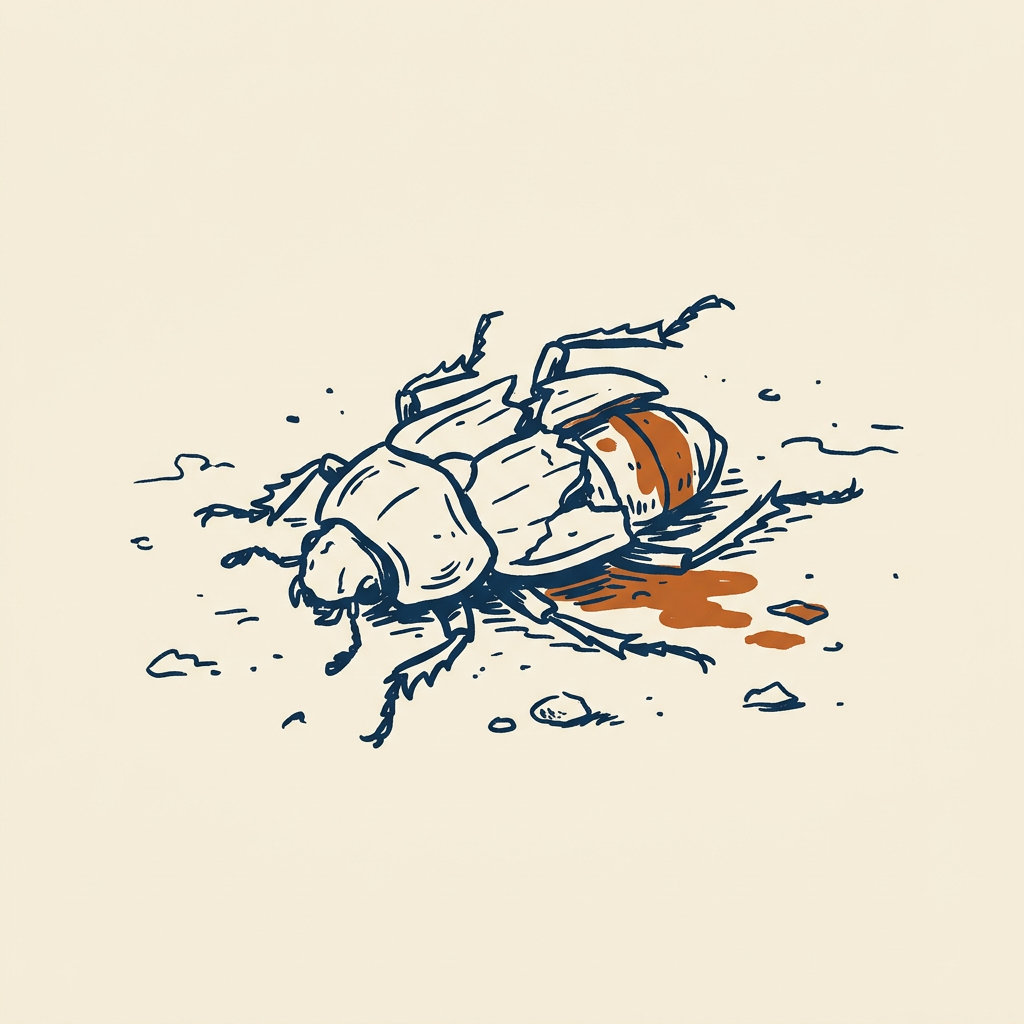
Children supply his evidence that the fear is primary rather than learned late. Terror of the dark, of being left alone, of toilet wastes, and of crushed insects or dead pets is an early confrontation with helplessness, decay, and bodily limits—what he calls the sorry finitude of creaturely existence.
Freud sensed the problem but displaced it onto sexuality. Becker relocates it: if death terror is primary, then character, ambition, love, and religion should all be readable as strategies for keeping it at bay.
In practice: A child who watches an insect crushed or a pet die is absorbing the first blow of creaturely finitude, not merely learning a biological fact.

2
Character as a vital lie
A well-adjusted personality is not neutral fact but a constructed defense—a necessary distortion that lets someone act without being overwhelmed by vulnerability.
When the lie holds
Routine, work, children, plans feel secure
When it fails
Loss or illness forces buried finitude into view
Becker extends repression past sexual content into the mechanism that keeps death out of ordinary awareness. What clinicians call a well-adjusted personality is, in his account, a successful narrowing of attention: habits and beliefs that filter out the more disturbing implications of embodiment and mortality.
He calls this narrowing a vital lie and means it literally. The lie is not incidental to living well; it is a precondition for it. A person who woke every day to undiluted knowledge of eventual nonexistence, with no protective narrowing, would likely be unable to function at all.
This reframes what normal means. The average person is not someone without illusions but someone whose illusions work well enough to raise children, hold a job, and plan a vacation. The structure stays invisible until it fails.
Breakdowns often arrive after a diagnosis, a nearby death, or an aging body forces the suppressed fact back into view—not because circumstances changed so much as because the protective narrowing could no longer hold. Becker’s question shifts from why some people are anxious to why so many manage, most of the time, not to be.
In practice: People who function smoothly through years of routine then collapse after a diagnosis or a death nearby, once the narrowing can no longer hold.

3
The wish to be self-made
Beneath ordinary ambition lies Rank’s causa-sui project: the attempt to be one’s own cause, independent of parents, biology, and decay.
Becker adopts Rank’s term for the psychological engine behind achievement of every kind. A founder building a company from nothing, an artist insisting a work is entirely original, a self-made story retold at dinner parties—all carry a charge beyond practical success. They attempt to establish that the self was not merely produced by parents and chance but authored itself.
The project’s characteristic sign is intolerance of dependency reminders. Disproportionate anger at being told one resembles a parent, or shame at accepting help, shows the causa-sui drive at work. Extreme self-discipline, radical self-transformation, and even suicide framed as final control over one’s ending can express the same wish.
The project can never fully succeed; no one escapes biological origin or mortality. Becker argues failure does not stop the pursuit; it only changes the form—sometimes toward grandiosity, sometimes toward self-punishing perfectionism.
This gives direction to the vital lie. The protective distortion is not random; it aims at the fantasy of self-authorship.
In practice: An adult who reacts with disproportionate anger to being told they resemble a parent, or who cannot accept help without shame, is showing the causa-sui project at work.

4
Culture as a hero system
Societies function less as mere economic arrangements than as systems that assign heroic roles promising a form of immortality.
Becker argues every culture, tribal or modern capitalist, offers members a script for mattering beyond their own death. A warrior culture offers glory and remembrance. A religious culture offers an afterlife contingent on conduct. A secular culture offers career achievement, wealth, fame, or the promise that children will carry something forward.
Content varies enormously; function stays constant: absorb individual terror by connecting the person to something that outlasts the body. Most people cannot tolerate living without believing their society’s hero system, even when they see its arbitrariness intellectually, because the alternative is unmediated finitude.
Money is his central modern example. Currency is not only a medium of exchange but, psychologically, a standardized ticket to significance—proof of having mattered that can be accumulated, displayed, and compared. Loss of status, job, or wealth can therefore trigger distress far beyond the material loss; what is threatened is the felt guarantee of mattering.
Ideological attacks on a culture’s hero system—from a rival nation, new religion, or competing values—provoke reactions more intense than practical stakes predict, because the system itself is the shield.
In practice: Loss of status or wealth triggers distress disproportionate to material loss because the hero system’s guarantee of mattering is what feels threatened.
5
Asking another person to be God
In a secular age the need for an all-absorbing cosmic guarantee relocates onto partners, therapists, or leaders, placing on a human a weight no person can carry.
Historical guarantee
God, cosmic order, or tribal structure
Secular relocation
Partner, therapist, or leader asked to be private religion
Becker widens the psychoanalytic term transference beyond the therapy room. Historically the need to feel connected to something infinite was met by God or by cosmic and tribal orders. As those structures weakened, the need did not disappear; it moved onto individual people.
Romantic love in particular absorbs the function. A partner is expected not merely to be a companion but to supply ultimate meaning, security, and validation—effectively a private religion. Becker calls this an impossible assignment. A human partner is finite, flawed, and mortal and cannot indefinitely play cosmic guarantor.
The pattern that follows is familiar: overwhelming idealization, then disillusionment and anger when the partner fails to deliver infinite security that was actually being demanded. The same logic extends to therapists and political or spiritual leaders whose followers develop a need for constant approval that mirrors devotion more than ordinary respect.
Becker is not arguing against love or trust. He argues that when these relationships are asked to substitute entirely for a cosmology—a felt place in a meaningful universe—they buckle under a weight they were never built to hold. When shared cultural hero systems feel thin, people improvise a private one out of another person.
In practice: Intense romance that swings from idealization to anger once the partner inevitably fails to deliver a sense of infinite security.

6
Rereading Freud through death
Becker reframes the Oedipus complex as the child’s discovery of bodily limitation, waste, and death rather than sexual rivalry with a parent.
Freud’s center
Sexual desire and parental rivalry
Becker’s center
Bodily waste, hurt, and eventual nonexistence
Becker credits Freud with discovering that early experience shapes adult character through largely unconscious processes, but argues Freud misidentified the core anxiety. Where Freud saw sexual desire for one parent and rivalry with the other, Becker, following Rank, locates the deeper crisis in discovering that one’s own body is an animal thing: it defecates, it can be hurt, it will someday not exist.
The parent becomes a figure of both comfort and threat not primarily through sexual dynamics but because the parent represents protection from creatureliness and, through discipline and eventual death, confirmation of it. Intensity of toilet-training struggles and childhood disgust reactions supply his evidence that bodily waste and decay, not sexuality, are what children first find genuinely horrifying and must manage through denial and ritual.
The reframing is not a minor technical correction. If the core anxiety is sexual, psychoanalysis stays mainly a theory of desire and its repression. If the core is death and creatureliness, it becomes a theory of how people manage existential terror—and connects directly to religion, heroism, and culture rather than remaining a theory of neurosis and libido.
This also explains why treatment sometimes helps patients see defenses clearly without making them happier. Stripping a defense against death terror, without replacing it with something else that can hold the terror, can leave a patient more exposed rather than more free.
In practice: Toilet-training struggles and childhood disgust at waste show that decay and bodily limits, not sexuality, are what children first find horrifying.

7
Mental illness as failed heroism
Severe mental illness is not simply a broken brain but a failure of the ordinary protective illusion, leaving the sufferer exposed to terror most people keep buried.
Ordinary defense
Narrowed attention plus borrowed hero system shields terror
Failed defense
Boundary collapses; raw separateness and insignificance flood in
Becker holds that existential terror is universal. What separates a person with severe mental illness from an ordinary anxious person is the failure of the usual defenses. Most people successfully narrow attention and borrow a workable hero system; some cannot make the narrowing hold.
He discusses schizophrenia as a state in which the ordinary boundary between self and world, built up through the vital lie, has weakened or collapsed. The person is left unusually exposed to raw separateness, vulnerability, and insignificance. He is careful: this is a psychological description, not a full causal account, and he does not deny biological contributions.
His interest is what the content of psychotic experience reveals. Patients who feel the world is about to annihilate them, or that they must perform impossible feats of self-protection, are voicing in undisguised form the fear healthier people successfully bury.
The striking reversal follows. In some respects the severely ill person sees more clearly than the well-adjusted one, precisely because defenses have failed rather than because perception is more distorted. Psychiatric treatment aimed only at restoring functioning, without addressing underlying terror, risks patching the same fragile structure that already failed once.
In practice: Patients who describe feeling the world will annihilate them, or that they must perform impossible self-protection, voice in raw form the fear others keep buried.

8
Kierkegaard’s leap over the alternatives
Becker ranks everyday denial as brittle, pure rational facing as despairing, and Kierkegaard’s conscious surrender to a power beyond the self as the most stable option he can offer.
- Philistine routineAbsorption in convention; brittle when fear is forced into view
- Rational secular facingStrip illusions with reason alone; tends to despair or thin stoicism
- Kierkegaard’s leapAdmit finitude, then trust a power beyond the self
Becker distinguishes three broad responses to death terror. The first is the everyday philistine response: absorption in routine, convention, and the local hero system without ever consciously confronting mortality. It works for most people most of the time but is brittle; it depends on circumstances never forcing the buried fear into view.
The second is the purely rational or secular intellectual who tries to face mortality with reason alone, stripping comforting illusions. Taken to its end, Becker argues, this tends toward despair or thin joyless stoicism, because reason alone offers no positive object to attach hope to once illusions are removed.
The third, drawn from Kierkegaard, is a conscious leap: the individual admits the full weight of finitude and helplessness, then deliberately submits trust to something beyond the self—understood in Kierkegaard’s terms as God—rather than to any human hero system. Becker treats this as superior because it does not depend on denial that will shatter, and does not depend on unaided reason that cannot supply meaning by itself.
He is explicit this is not a proof. The leap is by definition not rationally demonstrable. He offers it as the most psychologically coherent option rather than a philosophically airtight one. Here the book shifts from diagnosis to prescription, and here many readers sympathetic to the earlier analysis part ways with him.
In practice: Philistine absorption in routine works until a forced confrontation with mortality shatters the unexamined shield.

9
Therapy unmasks; it cannot replace
Psychoanalysis is built to take defenses apart but has no constructive resource to supply a new illusion sturdy enough to live by.
Having credited Freud and Rank, Becker turns critical of the field they founded. Psychoanalysis is built to analyze—to name what defenses protect against. That work is genuinely valuable, yet it leaves a gap. Once illusions are seen clearly as illusions, something must fill the space they occupied or the person is left more exposed than before.
Becker argues the method has no resources of its own to fill that space; it is analytic rather than constructive. Rank moved toward will, creativity, and spiritual language in later work, trying to make therapy do religion’s job. Jung built archetypes and personal mythology partly for the same reason. Becker treats both attempts sympathetically but as failures of scope.
A clinical or theoretical framework built from case material and comparative mythology cannot generate the binding, communal, transcendent claim that historically only religious traditions have supplied. The mismatch is structural, not a failure of intelligence or effort.
The practical implication is sobering. A course of therapy that successfully removes a person’s illusions without helping them find a replacement structure—religious or otherwise—may leave the patient technically insightful and functionally worse off.
In practice: Rank’s later spiritual language and Jung’s archetypal mythology try to make psychology supply what religion once did, and fall short of communal transcendent claim.

10
Choose a livable illusion
Full unillusioned confrontation with mortality is neither possible nor desirable; the workable path is flexible illusions held with awareness and aimed beyond isolated glory.
Brittle illusion
Single fixed guarantee of significance; shatters with status or health loss
Livable illusion
Flexible, partly conscious, aimed at creativity and contribution beyond the self
Becker rejects two false endpoints. One is the idea that full, unillusioned confrontation with mortality is possible or desirable; he has argued it would be paralyzing. The other is that any illusion will do. Some are brittle and collapse catastrophically when a person loses status, health, or a defining relationship.
Between these he argues for a middle path: illusions held with some awareness of their constructed nature, oriented toward ongoing creativity and contribution rather than a single fixed guarantee of significance. People who channel the same drives that fuel grandiose ambition into sustained creative or caretaking work—art, teaching, building institutions that outlast them—can run a healthier hero system than one staked entirely on personal glory or a single relationship.
He is careful not to oversell a cure. There is no formula that removes the underlying anxiety, only better and worse ways of living with it. His final position echoes Kierkegaard’s leap without fully endorsing a specific theology: a life lived with open eyes about its own fragility, oriented toward something beyond the isolated self, is more stable and more honest than one built on blind convention or unaided rationalism.
It is a deliberately modest ending for a book with sweeping ambitions, and Becker seems aware it will satisfy few readers looking for a concrete program.
In practice: Channeling grandiose ambition into art, teaching, or institutions that outlast the self as a healthier hero system than one staked on personal glory alone.
Key terms
- vital lie The necessary narrowing of attention and belief that keeps death terror out of ordinary awareness so a person can function.
- causa-sui project The wish to be the cause of oneself—self-authored, free of parents, chance, biology, and decay.
- hero system A culture’s script that assigns roles promising symbolic immortality and absorbs individual mortality terror.
- creatureliness The animal fact of the body: it wastes, can be hurt, ages, and will cease to exist.
- transference (widened) The relocation of the need for cosmic guarantee onto a partner, therapist, or leader who cannot carry that weight.
- philistine response Everyday absorption in routine and local hero systems without consciously facing mortality.
- Kierkegaard’s leap Consciously admitting finitude then submitting trust to a power beyond the self rather than to human hero systems.
- sorry finitude Becker’s phrase for the limits and decay of creaturely existence that children first absorb as terror.
What to do
- Notice one piece of your busyness this week—a task, goal, or purchase—and name whether it solves a practical problem or quietly proves you matter and will be remembered.
- If one relationship supplies your entire sense of meaning and security, say that out loud to yourself and add at least one other source of purpose so no single person carries that weight.
- Before starting or continuing therapy or self-improvement aimed at stripping illusions, decide deliberately what will replace them rather than leaving the space empty.
- When status, money, or recognition spikes your mood, pause and ask which hero system ticket you just collected.
- Catch one flash of shame at needing help or resembling a parent and treat it as a clue to the causa-sui project rather than a personal failing.
Questions to think with
- Which hero system am I borrowing, and what would remain if it were stripped away tomorrow?
- Where am I asking a partner, boss, or leader to supply a cosmic guarantee no human can give?
- Is my fiercest ambition solving a real problem or staging proof that I authored myself?
- If my protective narrowing failed after a loss or diagnosis, what terror would rush in first?
- Can I hold an illusion with some awareness that it is constructed and still let it orient me beyond myself?
The other side
Becker’s book is a synthesis resting on reinterpretations of Freud, Rank, and Kierkegaard plus illustrative anecdotes, not controlled evidence; it offers almost no sample sizes, comparison groups, or replication. Later terror-management experiments broadly fit the claim that death reminders intensify attachment to worldviews and self-esteem, yet effects are often modest and context-dependent and do not clearly require his full psychoanalytic architecture. His cross-cultural picture also draws mostly on older, now-dated ethnography rather than contemporary fieldwork.
Who it's for
Readers of psychology or existentialism who want the theoretical bridge between Freud, Rank, and Kierkegaard; therapists curious about death anxiety as a root of character and symptom; anyone rethinking why ambition, romance, or religion feel so urgently necessary.