




Tiny vibrating strings might reconcile physics' deepest crack
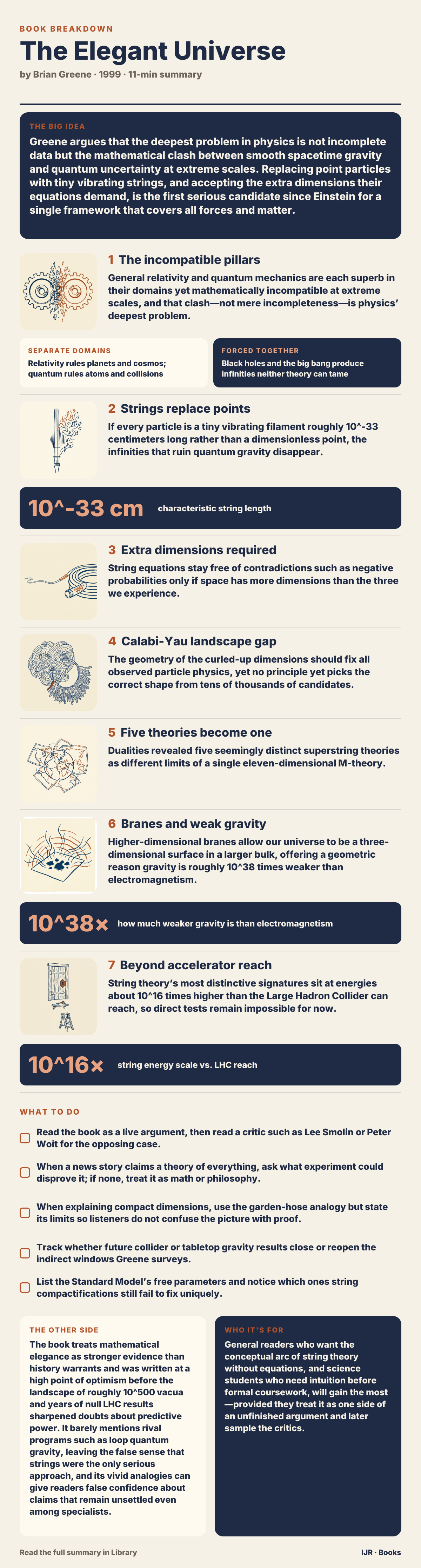
Greene argues that replacing point particles with strings could unite gravity and quantum mechanics into one framework, if nature really has extra curled-up dimensions.
IJR · Oct 22, 2026 · 12 min read
In 60 seconds
- General relativity and quantum mechanics both work in their domains but produce nonsensical infinities when forced together at black-hole or big-bang scales.
- String theory swaps dimensionless points for filaments about 10^-33 centimeters long whose vibration patterns become the particles we observe.
- Consistency forces nine space dimensions plus time; six stay curled into Calabi-Yau shapes that set particle masses and charges.
- Five separate superstring theories turned out, via dualities, to be limits of one eleven-dimensional M-theory that also contains branes.
- Distinctive string predictions sit at energies roughly 10^16 times beyond accelerators, so the theory still lacks a unique experimental test.
- Mathematical elegance is not the same as physical truth; the gap between them is where the story still sits.
The big idea
Greene argues that the deepest problem in physics is not incomplete data but the mathematical clash between smooth spacetime gravity and quantum uncertainty at extreme scales. Replacing point particles with tiny vibrating strings, and accepting the extra dimensions their equations demand, is the first serious candidate since Einstein for a single framework that covers all forces and matter.
The book in brief
Twentieth-century physics rests on two triumphs that refuse to share the same room. General relativity curves smooth spacetime into gravity at planetary and cosmic scales; quantum mechanics rules atoms and collisions through probability and uncertainty. Each is extraordinarily accurate where it belongs. Inside a black hole or at the birth of the universe, both must apply at once. Spacetime then churns so violently that gravity’s equations spit out infinities and break.
Direct attempts to quantize the graviton the way other forces were quantized failed. The book’s proposal is more radical: stop treating the basic ingredients as points. Tiny extended strings smooth the short-distance violence, cancel the infinities, and naturally produce a graviton among their vibration modes.
That fix carries a price. The equations only stay consistent in more dimensions than we see. Six extra spatial dimensions must curl up at every point into a compact geometry whose shape decides which particles and forces appear. Five apparently rival string theories later collapsed, through dualities, into facets of one deeper eleven-dimensional framework that also includes membrane-like branes. Those branes open speculative pictures of our universe as a surface in a larger bulk and of gravity leaking into unseen directions.
Yet the characteristic scale of a string lies far beyond any accelerator. Indirect searches for superpartners, millimeter-scale gravity deviations, or cosmic-microwave fingerprints have not delivered a uniquely stringy confirmation. The book therefore ends where the field still sits: a coherent, elegant candidate whose predictive uniqueness and experimental verdict remain open.
Context
Brian Greene wrote the book in 1999 for general readers who want the ideas without the equations, and for students seeking intuition before formal coursework. It appeared near the peak of post-1995 string-theory optimism that followed the unification into M-theory, before later null collider results and the landscape debate cooled some of that confidence.
The key ideas

1
The incompatible pillars
General relativity and quantum mechanics are each superb in their domains yet mathematically incompatible at extreme scales, and that clash—not mere incompleteness—is physics’ deepest problem.
Separate domains
Relativity rules planets and cosmos; quantum rules atoms and collisions
Forced together
Black holes and the big bang produce infinities neither theory can tame
Einstein’s theory treats gravity as curvature of smooth spacetime and has been confirmed to extraordinary precision on planetary and cosmic scales. Quantum mechanics treats particles through probability and uncertainty and has been confirmed in atoms and subatomic collisions. Both work brilliantly where they belong.
Trouble starts when both must apply together, as they must inside a black hole or at the instant of the big bang. Spacetime is then compressed to unimaginably small scales. Quantum uncertainty makes it churn violently, generating infinite values that wreck the equations of general relativity.
This is not a minor technical glitch. It signals that one or both theories are incomplete descriptions of nature. Physicists lived with the tension for decades by using each theory where it worked and ignoring the seams. Any final theory must smooth the small-scale violence while still recovering curved gravity at large scales and quantum rules at small ones.
Attempts to treat the graviton like other force particles and quantize gravity directly produced nonsensical infinities that could not be tamed by the tricks that work for electromagnetism and the nuclear forces. That failure is the crack the rest of the book tries to close.
In practice: Inside a black hole or at the big bang, spacetime churns so violently under quantum uncertainty that general relativity’s equations yield infinite, unusable answers.

2
Strings replace points
If every particle is a tiny vibrating filament roughly 10^-33 centimeters long rather than a dimensionless point, the infinities that ruin quantum gravity disappear.
10^-33 cm
characteristic string length
String theory claims electrons, quarks, photons, and the graviton are not points but minuscule filaments of energy far below any conceivable experimental resolution. A string vibrates in different patterns and frequencies; each pattern corresponds to a different particle with its own mass and force charge, the way different violin-string vibrations make different notes.
Because a string has extension, the violent quantum fluctuations that wreck point-particle gravity calculations get smoothed out. The mathematics no longer produces infinities. That trade—give up points, gain consistency—is the original reason theorists took strings seriously.
Earlier string-like formulas from Gabriele Veneziano once aimed at the strong nuclear force and were largely abandoned for quantum chromodynamics. Interest revived when the vibrational spectrum was seen to include a massless, spin-two particle with exactly the properties expected of a graviton. At that moment the idea shifted from a discarded nuclear model to a candidate theory of gravity itself.
Particles’ specific properties then become consequences of geometry rather than arbitrary inputs. The chapter’s core bargain is mathematical consistency plus an explanation of the particle roster in exchange for abandoning point-like fundamentals.
In practice: A massless spin-two vibration mode appears automatically in the string spectrum and matches the expected properties of the graviton, turning a failed nuclear model into a gravity candidate.
3
Extra dimensions required
String equations stay free of contradictions such as negative probabilities only if space has more dimensions than the three we experience.
When physicists demanded that strings vibrate and interact without producing negative probabilities or other inconsistencies, the equations fixed a definite number of spatial dimensions. Original bosonic strings needed twenty-five space dimensions plus time. Superstring theories that include matter particles via supersymmetry need nine space dimensions plus time—ten dimensions in all.
This was not an aesthetic preference; it fell out of mathematical consistency. Extra dimensions were not invented by string theory. In 1919 Theodor Kaluza showed that a fourth spatial dimension added to general relativity could unify gravity with electromagnetism; Oskar Klein later suggested that dimension might curl into a tiny undetectable circle—compactification.
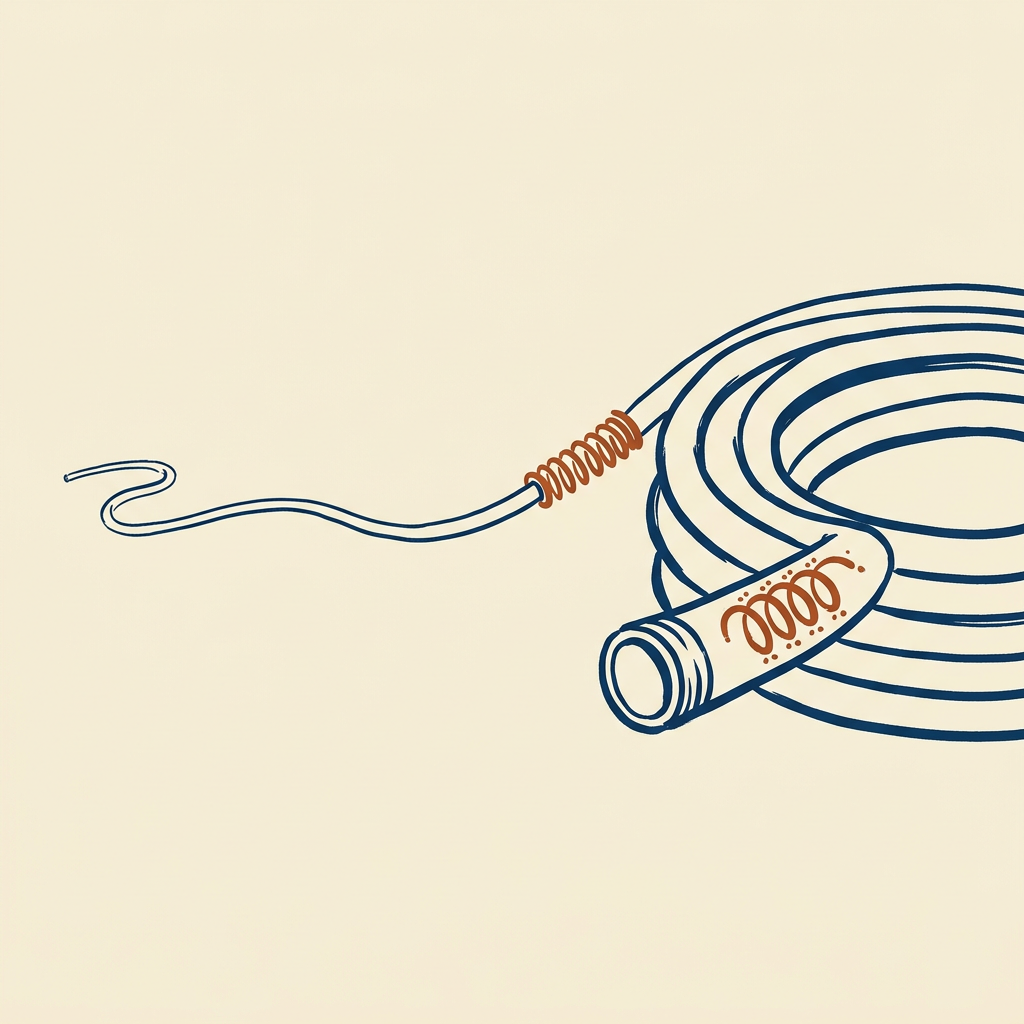
String theory scales the same trick up: six extra dimensions curl into a compact geometric shape at every point in ordinary space, leaving the three large dimensions we perceive. The exact shape is not decoration. Its geometry sets the allowed vibrational patterns and therefore the masses and charges of the particles we observe.
The properties of the physical world become questions of geometry. Finding the right theory becomes partly a search for the right six-dimensional shape.
In practice: Kaluza’s 1919 addition of one extra dimension to general relativity already hinted that electromagnetism could emerge from pure geometry, a logic string theory extends to six curled dimensions.
4
Calabi-Yau landscape gap
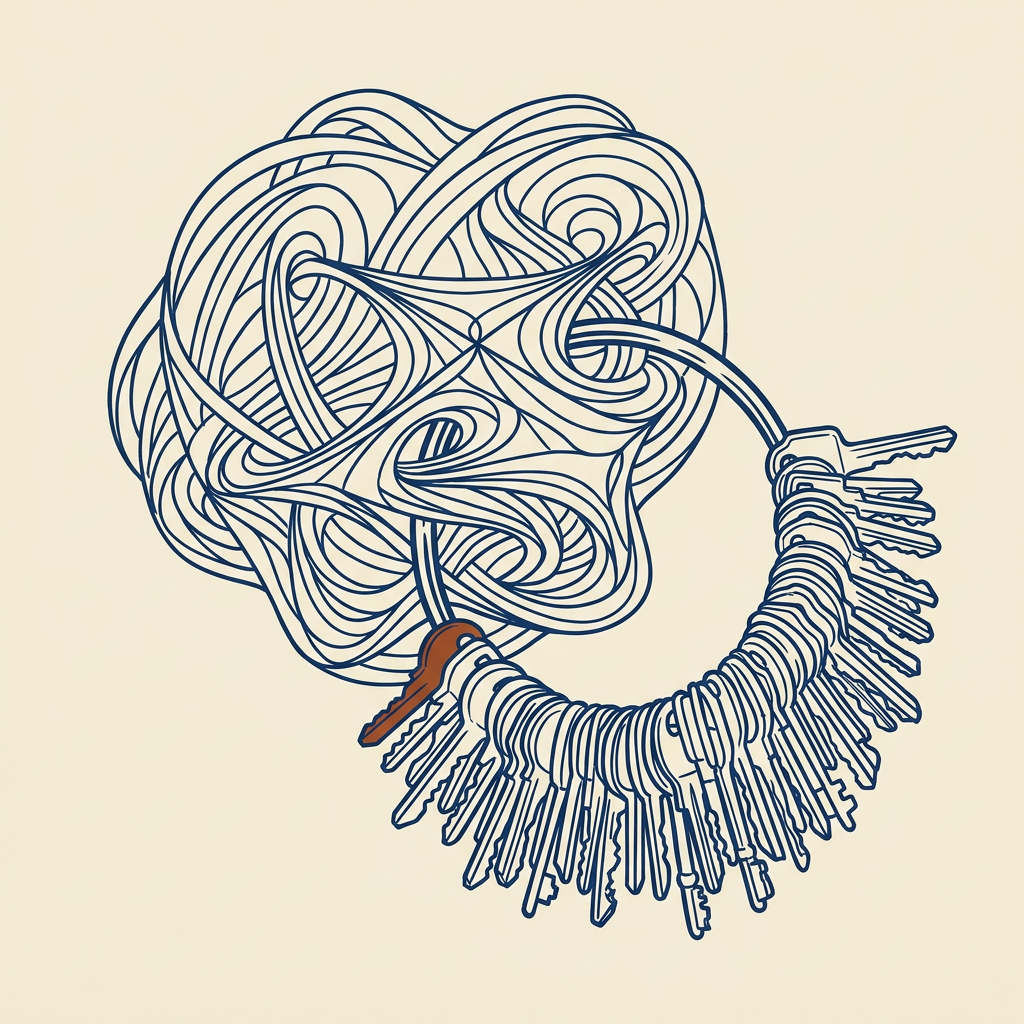
The geometry of the curled-up dimensions should fix all observed particle physics, yet no principle yet picks the correct shape from tens of thousands of candidates.
Calabi-Yau manifolds are the complex six-dimensional spaces that satisfy string theory’s constraints on the extra dimensions. They were studied by Eugenio Calabi and Shing-Tung Yau before string theorists needed them. They come in enormous variety—tens of thousands of known topological types, and far more once different sizings of internal cycles are counted.
Each choice of shape and size yields a different pattern of string vibrations and therefore a different roster of particles and forces. In principle the geometry determines everything. In practice the theory does not tell which Calabi-Yau corresponds to our universe.
Physicists hoped further mathematical constraints, or requirements such as three generations of quarks and leptons, would narrow the field to one or a few candidates. Mirror symmetry—two very different-looking Calabi-Yau shapes producing identical physics—simplified many calculations and offered encouragement; Greene himself contributed to proving it.
Narrowing the candidates until they reproduce the electron’s exact mass, the electromagnetic force’s exact strength, and the rest of the Standard Model’s roughly twenty free parameters stayed out of reach. Conceptual elegance still outran predictive power at the time of writing.
In practice: Mirror symmetry lets two dissimilar Calabi-Yau shapes yield the same physics, simplifying calculations without yet selecting which shape is ours.

5
Five theories become one
Dualities revealed five seemingly distinct superstring theories as different limits of a single eleven-dimensional M-theory.
Through the 1980s and 1990s physicists found not one string theory but five—Type I, Type IIA, Type IIB, and two heterotic versions. They differed on whether strings are open or closed and on how supersymmetry is realized. Five candidate theories of everything looked awkward, as if nature had made an arbitrary choice or theorists had missed a deeper structure.
In 1995 Edward Witten showed the five are linked by dualities: mathematical transformations that make them different limiting descriptions of one underlying eleven-dimensional theory he called M-theory. When string coupling grows large, what looked like a string in ten dimensions appears as a two-dimensional membrane in eleven dimensions viewed from a particular angle.
T-duality equates a theory compactified on a very small circle with one on a very large circle. S-duality relates strong coupling in one theory to weak coupling in another. Apparent opposites become interchangeable descriptions.
The unification did not solve which compactification is correct, yet it erased the illusion of multiplicity and restored hope for a single coherent framework—even while the full nonperturbative definition of M-theory remained only partly understood.
In practice: Witten’s 1995 dualities showed that raising string coupling turns a ten-dimensional string into an eleven-dimensional membrane seen from one angle.
6
Branes and weak gravity
Higher-dimensional branes allow our universe to be a three-dimensional surface in a larger bulk, offering a geometric reason gravity is roughly 10^38 times weaker than electromagnetism.
10^38×
how much weaker gravity is than electromagnetism
M-theory introduces p-branes—extended objects with p spatial dimensions—from points to nine-dimensional volumes. A string is simply a one-brane. Joseph Polchinski’s 1995 work on D-branes, surfaces where open strings can end, gave these objects mass, tension, and dynamical roles rather than mere mathematical status.
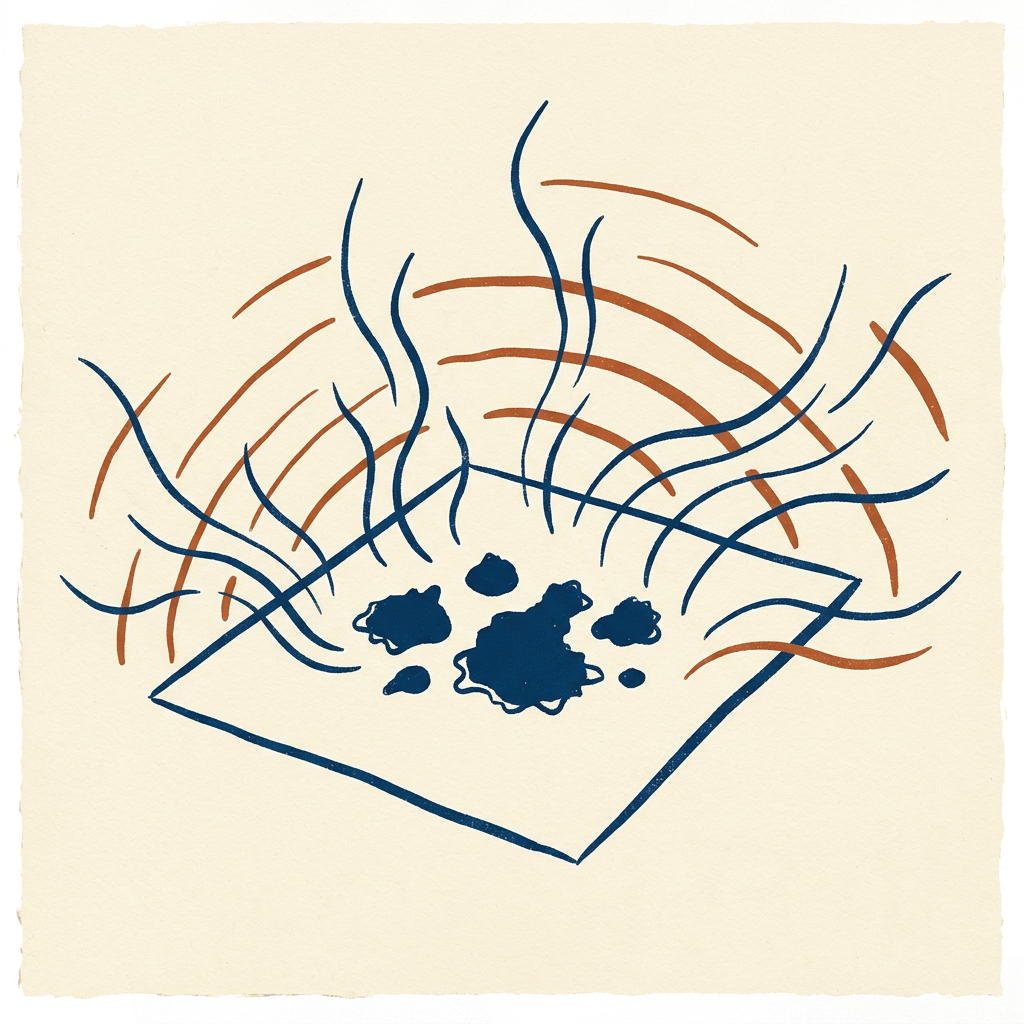
One striking possibility is the brane-world picture: ordinary matter made of open strings stays confined to a three-dimensional brane, while gravity, carried by closed strings, propagates through the full higher-dimensional bulk.
That split supplies a possible explanation for gravity’s extreme weakness relative to the other forces. Gravity’s strength is diluted because it spreads into unseen extra dimensions while the other forces remain locked on our brane. The same framework reframes cosmology, including speculative ideas that the big bang arose from a collision between branes.
None of this is experimentally confirmed. Branes follow from the mathematics; they are not established features of reality. Still, the reach of the theory now stretches from particle masses to the large-scale structure and origin of the universe, while remaining largely conjectural.
In practice: Open-string matter stuck on a three-brane while closed-string gravity leaks into the bulk would dilute gravity’s apparent strength by roughly 10^38 relative to electromagnetism.

7
Beyond accelerator reach
String theory’s most distinctive signatures sit at energies about 10^16 times higher than the Large Hadron Collider can reach, so direct tests remain impossible for now.
10^16×
string energy scale vs. LHC reach
The Planck-scale length of a string corresponds to energies far above any foreseeable accelerator. That practical barrier is the core of the testability problem. Physicists therefore hunt for indirect footprints.
Supersymmetry, required by superstring theory, predicts a heavier partner for every known particle. Finding those superpartners at achievable energies would give indirect support; their continued absence has narrowed but not closed the viable parameter space.
If some extra dimensions are larger than the Planck scale in certain brane-world variants, gravity might deviate from the inverse-square law at sub-millimeter distances. Tabletop torsion-balance experiments have so far found no such deviation. Specific patterns in the cosmic microwave background predicted by some string-inspired inflation models offer another route, also so far inconclusive.
As of the book’s writing, no confirmed, uniquely stringy experimental prediction exists. Greene’s hedged defense is that elegance and the unforced appearance of gravity still justify pursuit, while conceding that only experiment, not beauty, can finally decide.
In practice: Tabletop torsion-balance tests looking for millimeter-scale gravity deviations predicted by some large-extra-dimension scenarios have found none.
Key terms
- string A tiny filament of energy whose vibration pattern appears as a particle with definite mass and charge
- compactification Curling extra spatial dimensions into tiny shapes too small to see, leaving the three large dimensions we notice
- Calabi-Yau manifold A six-dimensional geometric shape that can hide the extra dimensions and set the particle roster by its form
- M-theory The eleven-dimensional framework that unites the five superstring theories as different limiting views
- duality A mathematical map showing two seemingly different theories describe the same physics
- brane An extended object with any number of spatial dimensions; our universe might be a three-dimensional one
- supersymmetry A required pairing that gives every known particle a heavier partner
- graviton The massless spin-two particle that carries gravity and appears automatically among string vibrations
What to do
- Read the book as a live argument, then read a critic such as Lee Smolin or Peter Woit for the opposing case.
- When a news story claims a theory of everything, ask what experiment could disprove it; if none, treat it as math or philosophy.
- When explaining compact dimensions, use the garden-hose analogy but state its limits so listeners do not confuse the picture with proof.
- Track whether future collider or tabletop gravity results close or reopen the indirect windows Greene surveys.
- List the Standard Model’s free parameters and notice which ones string compactifications still fail to fix uniquely.
Questions to think with
- If elegance and consistency are not enough, what minimum experimental result would make string theory count as physics rather than mathematics?
- Does the existence of many Calabi-Yau shapes kill predictive power, or is finding the right selection principle still a fair research goal?
- Should a theory that naturally produces a graviton keep priority over rivals even while it remains untested at its characteristic scale?
- How should popular accounts balance excitement about dualities and branes against the absence of unique, confirmed predictions?
- What would count as progress if accelerators never reach string-scale energies?
The other side
The book treats mathematical elegance as stronger evidence than history warrants and was written at a high point of optimism before the landscape of roughly 10^500 vacua and years of null LHC results sharpened doubts about predictive power. It barely mentions rival programs such as loop quantum gravity, leaving the false sense that strings were the only serious approach, and its vivid analogies can give readers false confidence about claims that remain unsettled even among specialists.
Who it's for
General readers who want the conceptual arc of string theory without equations, and science students who need intuition before formal coursework, will gain the most—provided they treat it as one side of an unfinished argument and later sample the critics.