




Think like an owner and judge every decision by intrinsic value
Sound investing and management flow from treating shareholders as partners, measuring intrinsic value over price, and refusing to act outside what you understand.
IJR · Nov 2, 2026 · 13 min read
In 60 seconds
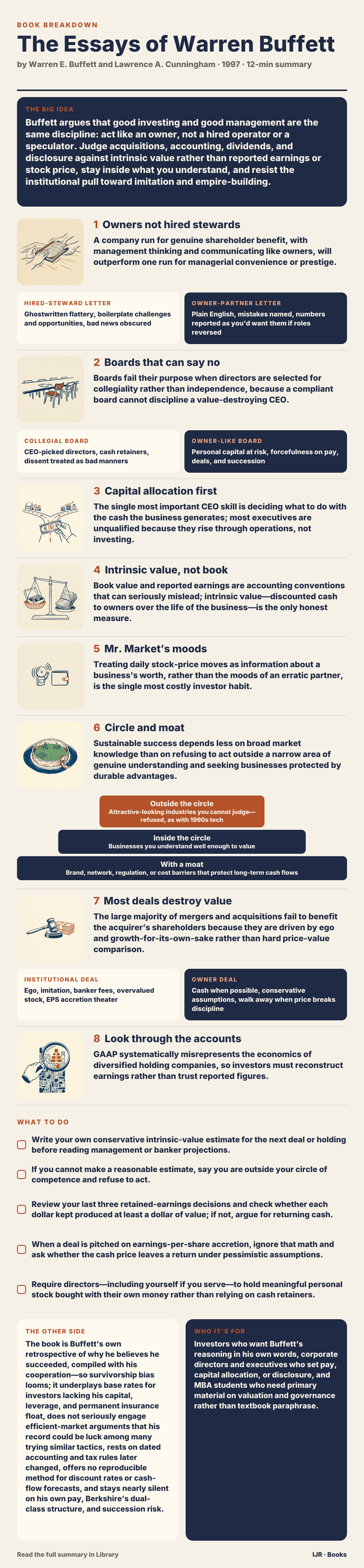
- Management should treat shareholders as full partners, disclose plainly, admit mistakes by name, and test every decision against whether a rational owner would approve.
- Boards fail when directors are chosen for collegiality and cash retainers rather than independence and personal capital at risk.
- A CEO’s central job is capital allocation: retain earnings only if each dollar kept creates at least a dollar of market value over time.
- Book value and reported earnings mislead; intrinsic value—the discounted cash a business will deliver to owners—is the only honest measure.
- Treat daily stock prices as Mr. Market’s moods, not signals of worth; price swings are opportunities once you have an independent value estimate.
- Stay inside a narrow circle of competence, buy businesses with durable moats, and walk away from most acquisitions driven by ego and banker incentives.
The big idea
Buffett argues that good investing and good management are the same discipline: act like an owner, not a hired operator or a speculator. Judge acquisitions, accounting, dividends, and disclosure against intrinsic value rather than reported earnings or stock price, stay inside what you understand, and resist the institutional pull toward imitation and empire-building.
The book in brief
The collection opens with the owner-manager relationship. Buffett insists management must treat shareholders as partners, write in plain English, admit errors by name, and test every choice—acquisitions, pay, retained earnings—against whether an intelligent owner would approve. Typical corporate letters flatter management and hide bad news; Berkshire’s candor about waiting too long to close the original textile operation is offered as proof that honesty builds trust and better decisions.
From there the argument moves to the board. Most boards fail from structure, not malice: directors picked by the CEO, paid to stay collegial, and schooled to treat dissent as bad manners. Buffett’s test is whether a director would act as forcefully as a true owner with a large stake, especially on CEO pay, deals, and succession. Cash retainers without personal stock ownership weaken the incentive to say no; rubber-stamped overpriced deals in the 1980s and 1990s show the cost.
Capital allocation becomes the central job. Most CEOs rise through operations and are unprepared to decide what to do with cash. A firm that earns high returns on existing capital but reinvests poorly eventually destroys the value operations created. Retain a dollar only if it creates at least a dollar of market value; otherwise pay dividends or buy back shares. Empire-building for its own sake is the corporate version of the institutional imperative.
Value itself is redefined. Book value is historical cost; intrinsic value is the discounted cash the business will deliver over its life. An imprecise estimate aimed at the right target beats a precise number that measures the wrong thing. See’s Candies, bought in 1972 for roughly three times book, illustrates brands and customer loyalty that cost little on the balance sheet yet throw off durable cash. Reported earnings can be distorted by acquisition accounting, one-time charges, and pension assumptions.
Mr. Market appears next: an unstable partner who quotes wildly different prices daily. Price is not value; volatility is not risk. Falling prices on unchanged intrinsic value are buying opportunities, as with continued purchases of Coca-Cola and Washington Post when markets were gloomy. Risk means permanent loss of purchasing power, not ticker swings. That distinction only works if you already have an independent value anchor.
The later chapters tighten the discipline. Stay inside a narrow circle of competence; Buffett avoided 1990s technology stocks because he could not predict durable advantage a decade out. Seek moats—brand, network, regulation, cost—as at Coca-Cola and GEICO. Most acquisitions destroy value because ego, imitation, and banker fees push prices past economics; stock-financed deals with overvalued currency are especially poor even when EPS looks accretive. GAAP systematically misstates holding-company reality, so reconstruct look-through earnings and stop treating goodwill amortization on durable brands as real economic decline. The whole arc lands on one claim: shareholder value is a discipline enforced by honest disclosure, capital allocation, and refusal to confuse activity with progress.
Context
This is a curated collection of Buffett’s Berkshire Hathaway shareholder letters, organized by law professor Lawrence Cunningham into thematic chapters on governance, capital allocation, valuation, and accounting. It mattered because it turned decades of scattered annual-report wisdom into a coherent, teachable framework used in business schools and boardrooms.
The key ideas

1
Owners not hired stewards
A company run for genuine shareholder benefit, with management thinking and communicating like owners, will outperform one run for managerial convenience or prestige.
Hired-steward letter
Ghostwritten flattery, boilerplate challenges and opportunities, bad news obscured
Owner-partner letter
Plain English, mistakes named, numbers reported as you’d want them if roles reversed
Buffett opens with a principle that sounds obvious and is rarely practiced: treat shareholders as full partners, not a distant capital source managed with minimal disclosure. He and Charlie Munger write annual letters in plain English, admit mistakes by name, and report numbers the way they would want them if roles were reversed.
Typical corporate letters are ghostwritten to flatter management and bury bad news behind boilerplate about challenges and opportunities. Berkshire’s own disclosure that Buffett waited too long to close the original textile operation that gave the company its name is offered as evidence that candor builds long-term trust and better decisions rather than undermining confidence.
The deeper claim is that owner-orientation is not a communications style but a governing logic. Every decision on acquisitions, compensation, and retained earnings should be tested against whether an intelligent, informed owner would approve. That reframes the CEO’s job away from managing the stock price toward managing the underlying business, on the premise that price follows value over time even if it lags for years.
Everything that follows—capital allocation, accounting, mergers—rests on this single test.
In practice: Buffett’s public admission that he delayed shutting Berkshire’s original textile business shows the candor he wants applied to every owner decision.

2
Boards that can say no
Boards fail their purpose when directors are selected for collegiality rather than independence, because a compliant board cannot discipline a value-destroying CEO.
Collegial board
CEO-picked directors, cash retainers, dissent treated as bad manners
Owner-like board
Personal capital at risk, forcefulness on pay, deals, and succession
Most boards fail from structural conflicts, not bad intentions. Directors are often chosen by the CEO they oversee, compensated in ways that reward continued membership over tough oversight, and steeped in a culture where dissent is bad manners. Buffett calls this institutional courtesy standing in for accountability.
His simpler test beats independence checklists: would this director act as forcefully as a true owner with a large personal stake, especially on CEO pay, acquisitions, and succession. Many boards rubber-stamped overpriced deals in the 1980s and 1990s, deferring to management enthusiasm instead of demanding a hard valuation case.
Paying directors largely in cash retainers rather than requiring them to buy stock with their own money weakens the incentive to refuse. A director who has not personally risked capital has less reason to say no.
Governance structures, not just character, decide whether shareholder interests survive management ambition. Capital allocation is where that design shows up most clearly.
In practice: Boards that rubber-stamped overpriced 1980s and 1990s acquisitions deferred to enthusiasm instead of insisting on a hard-nosed valuation case.
3
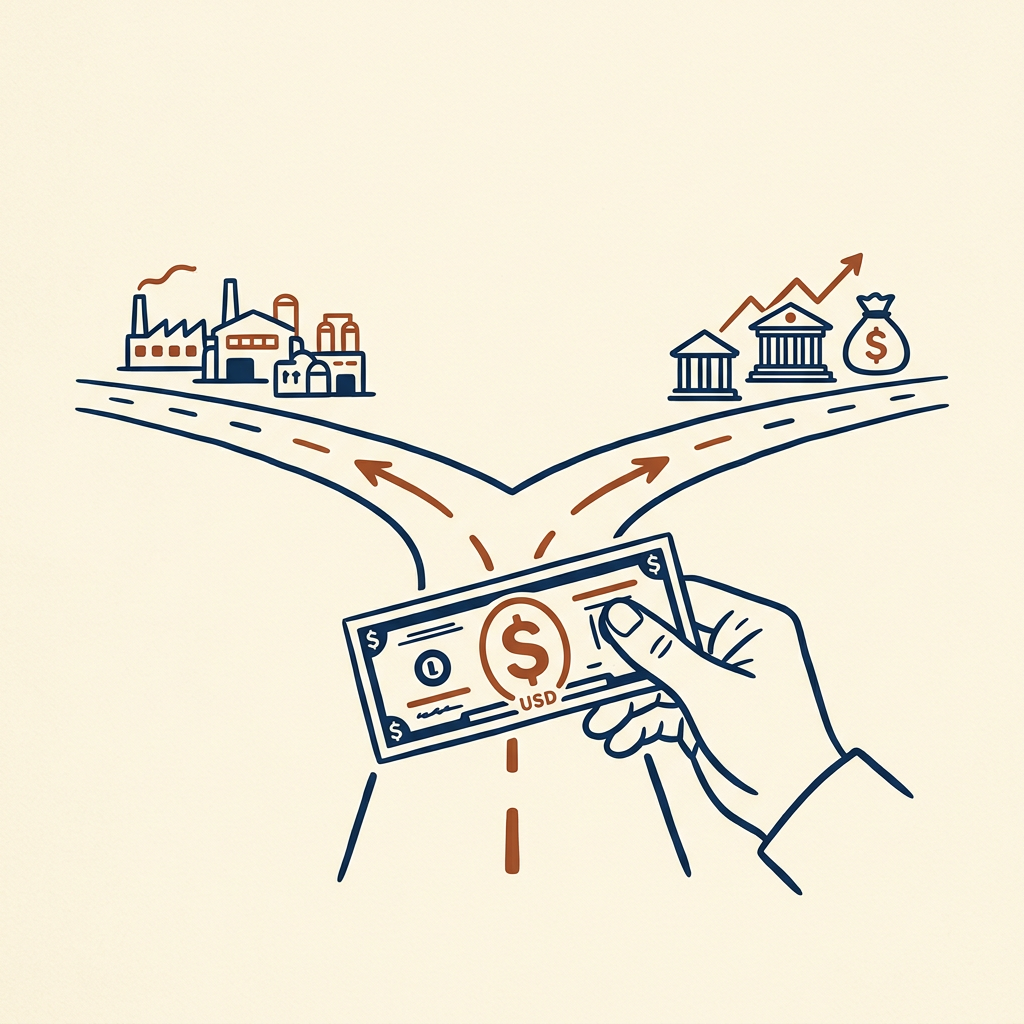
Capital allocation first
The single most important CEO skill is deciding what to do with the cash the business generates; most executives are unqualified because they rise through operations, not investing.
A company that earns high returns on existing capital but reinvests retained earnings poorly will eventually destroy the value operations created. Most CEOs reach the top through sales, engineering, manufacturing, or marketing—paths that do not teach whether a dollar retained will earn more than a dollar returned as dividends or buybacks.
Buffett’s discipline is simple: retain earnings only if the company can show, over time, that each dollar retained created at least a dollar of market value. If not, pay dividends or repurchase shares. He credits this for Berkshire’s insurance subsidiaries, where premium float is invested rather than left idle, and for skepticism toward firms that keep pouring money into the original business after growth opportunities dry up.
The instinct to expand for its own sake is the corporate world’s empire-building. A board that holds management to the one-dollar-for-one-dollar test is doing its real job; one that does not is failing.
Without a working definition of worth, the test is empty—so the next move is how an owner-manager should judge value.
In practice: Berkshire invests the float from insurance premiums rather than leaving it idle, treating capital deployment as the core management task.

4
Intrinsic value, not book
Book value and reported earnings are accounting conventions that can seriously mislead; intrinsic value—discounted cash to owners over the life of the business—is the only honest measure.
Book value rests on historical cost. Intrinsic value is the discounted cash a business will deliver to its owners over its remaining life. Buffett grants that the figure cannot be calculated with precision and depends on assumptions about future cash flows and discount rates, yet insists an imprecise estimate aimed at the right target beats a precise number that measures the wrong thing.
Businesses with valuable brands or customer relationships can cost little on the balance sheet while generating large, durable cash flows. See’s Candies, bought by Berkshire in 1972 for roughly three times book value, could raise prices without losing customers because of brand loyalty.
Reported earnings can be manipulated or distorted by acquisition accounting, one-time charges, and pension assumptions. Fixating on the earnings-per-share line without adjusting for those distortions misjudges value.
Wall Street’s short-term focus on quarterly earnings beats mistakes an accounting artifact for the thing that actually matters. Daily quoted price is at best a noisy signal of intrinsic value.
In practice: Berkshire paid roughly three times book for See’s Candies in 1972 because brand loyalty supported lasting cash flows the balance sheet understated.

5
Mr. Market’s moods
Treating daily stock-price moves as information about a business’s worth, rather than the moods of an erratic partner, is the single most costly investor habit.
Buffett popularizes Benjamin Graham’s allegory: Mr. Market shows up every day offering to buy your shares or sell his at wildly different prices depending on mood, with no obligation to transact. Price and value are different things; the job is to use manic offers opportunistically rather than be governed by them.
A falling stock price on a business whose intrinsic value is unchanged is not bad news but a chance to buy more at a discount. Buffett points to continued purchases of Coca-Cola and Washington Post Company when the broader market was pessimistic.
Institutional investors often treat price volatility itself as risk. That confuses a business’s actual risk—the chance of permanent loss of purchasing power—with mere fluctuation, which is often just noise.
Track the underlying economics: whether the moat is intact, the balance sheet sound, management still allocating capital well. Without an independent value estimate, price swings look like information instead of opportunity.
In practice: Buffett kept buying Coca-Cola and Washington Post during pessimistic markets because unchanged intrinsic value turned lower prices into discounts.

6
Circle and moat
Sustainable success depends less on broad market knowledge than on refusing to act outside a narrow area of genuine understanding and seeking businesses protected by durable advantages.
- Outside the circleAttractive-looking industries you cannot judge—refused, as with 1990s tech
- Inside the circleBusinesses you understand well enough to value
- With a moatBrand, network, regulation, or cost barriers that protect long-term cash flows
Most investment mistakes come from analyzing the wrong things—industries or models the investor does not understand well enough to judge. Buffett keeps a deliberately narrow circle of competence and will not invest outside it no matter how attractive an opportunity looks. He long avoided 1990s technology stocks because he could not confidently predict which companies would still hold a durable advantage a decade later.
Inside the circle he looks for a moat: a structural barrier protecting profits—brand loyalty, network effects, regulatory position, or cost advantages. Coca-Cola’s brand and global distribution, and GEICO’s low-cost direct model in auto insurance, are moats wide enough to survive decades of competitive pressure without eroding returns.
A moat is what makes long-term cash-flow projections trustworthy. Without a durable advantage, any earnings forecast is a guess dressed as a spreadsheet.
Straying outside the circle in pursuit of growth abandons the discipline that makes value investing work.
In practice: Buffett skipped 1990s tech stocks he could not underwrite for durable advantage, while favoring Coca-Cola’s brand moat and GEICO’s low-cost distribution.

7
Most deals destroy value
The large majority of mergers and acquisitions fail to benefit the acquirer’s shareholders because they are driven by ego and growth-for-its-own-sake rather than hard price-value comparison.
Institutional deal
Ego, imitation, banker fees, overvalued stock, EPS accretion theater
Owner deal
Cash when possible, conservative assumptions, walk away when price breaks discipline
CEOs chasing deals are often moved by the institutional imperative—an unconscious urge to imitate peers and seek the excitement and prestige of a large transaction whether or not the price makes economic sense. Investment bankers compound the problem: fees depend on closing, not on success, so they have every incentive to justify almost any price with optimistic synergy projections.
Acquisitions financed with the acquirer’s own overvalued stock are especially poor. Using inflated currency to buy a real business is a bad trade even if the deal looks accretive to earnings per share short-term, because EPS accretion says nothing about whether intrinsic value per share rose.
Berkshire’s approach is the contrast: pay cash where possible, insist on a price that leaves room for a return under conservative assumptions, and walk away from auctions where price discipline breaks down.
Many failed deals involved buying into businesses and industries the acquirer did not understand well enough to price—circle-of-competence failures dressed as growth.
In practice: Berkshire prefers cash, conservative pricing, and walking away from auctions rather than stock-financed deals justified by synergy stories and EPS accretion.

8
Look through the accounts
GAAP systematically misrepresents the economics of diversified holding companies, so investors must reconstruct earnings rather than trust reported figures.
Generally accepted accounting principles are necessary for consistency but were never designed to measure intrinsic value and often obscure it. Under the rules of the time, Berkshire’s reported earnings counted only dividends from partly owned companies and ignored the much larger share of undistributed earnings those companies retained and reinvested on Berkshire’s behalf.
Buffett’s fix is look-through earnings: add back the proportional share of retained earnings in investees. That figure comes closer to real economic progress than the official number.
Goodwill amortization on acquired businesses with durable advantages, such as See’s Candies, creates a charge against earnings with no relationship to any actual economic decline in value, artificially depressing reported returns on equity for good businesses.
Publishing and explaining these adjustments, rather than leaving investors with GAAP alone, extends the partnership philosophy of the opening chapter. Readers see how to adjust statements toward cash-generating reality.
In practice: Buffett adds Berkshire’s share of investees’ retained earnings to form look-through earnings, and rejects amortizing See’s goodwill as if the brand were wasting away.
Key terms
- Owner-orientation Managing and disclosing as if shareholders were full partners whose informed approval is the test for every major decision.
- Intrinsic value The discounted cash a business will deliver to its owners over its remaining life—not book value or reported earnings.
- Mr. Market Graham’s allegory of an emotional partner who quotes a new buy or sell price every day; useful when ignored or exploited, dangerous when obeyed.
- Circle of competence The narrow set of businesses and industries you truly understand; stay inside it even when outside opportunities look exciting.
- Economic moat A durable structural advantage—brand, network, regulation, or cost—that protects profits from competitors for decades.
- Institutional imperative The unexamined pull to imitate peers, build empires, and chase deals and growth without regard to returns.
- Look-through earnings Reported earnings plus the investor’s share of undistributed earnings retained by partly owned companies—closer to real economic progress.
- Capital allocation Deciding whether cash generated by the business should be reinvested, paid as dividends, or used for buybacks, judged by value created per dollar kept.
What to do
- Write your own conservative intrinsic-value estimate for the next deal or holding before reading management or banker projections.
- If you cannot make a reasonable estimate, say you are outside your circle of competence and refuse to act.
- Review your last three retained-earnings decisions and check whether each dollar kept produced at least a dollar of value; if not, argue for returning cash.
- When a deal is pitched on earnings-per-share accretion, ignore that math and ask whether the cash price leaves a return under pessimistic assumptions.
- Require directors—including yourself if you serve—to hold meaningful personal stock bought with their own money rather than relying on cash retainers.
Questions to think with
- Would an intelligent, well-informed owner with a large personal stake approve this acquisition, pay package, or retention of earnings?
- Am I treating today’s stock price as information about the business or as Mr. Market’s optional quote?
- Can I explain, in plain numbers, why each dollar this firm retains will create more than a dollar of intrinsic value?
- Where does this business’s moat actually come from, and what would erode it within a decade?
- Which of my holdings sit outside my circle of competence, and what would it take to admit that out loud?
The other side
The book is Buffett’s own retrospective of why he believes he succeeded, compiled with his cooperation—so survivorship bias looms; it underplays base rates for investors lacking his capital, leverage, and permanent insurance float, does not seriously engage efficient-market arguments that his record could be luck among many trying similar tactics, rests on dated accounting and tax rules later changed, offers no reproducible method for discount rates or cash-flow forecasts, and stays nearly silent on his own pay, Berkshire’s dual-class structure, and succession risk.
Who it's for
Investors who want Buffett’s reasoning in his own words, corporate directors and executives who set pay, capital allocation, or disclosure, and MBA students who need primary material on valuation and governance rather than textbook paraphrase.