




Bottlenecks, not busyness, decide if a plant makes money
A factory can hit every local efficiency target and still miss shipments while cash drains away.
IJR · Oct 20, 2026 · 14 min read
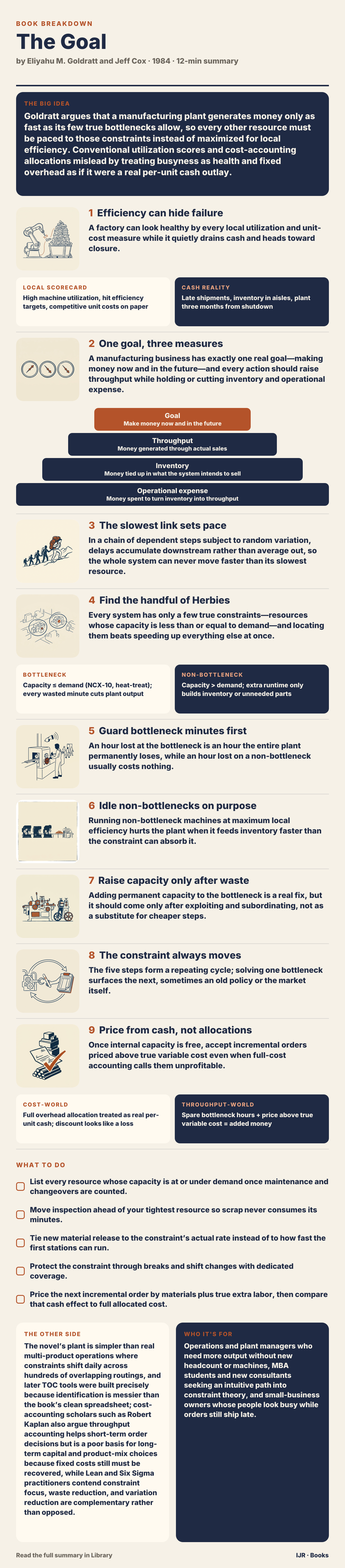
In 60 seconds
- A plant can post high machine utilization and low unit costs on paper while orders ship late and inventory chokes the floor.
- Jonah reframes the sole goal of a manufacturing business as making money now and in the future; quality, efficiency, and jobs are only means.
- Throughput, inventory, and operational expense become the three measures that test every action against real cash impact.
- In any chain of dependent steps with random variation, delays compound downstream, so the slowest resource sets the pace of the whole system.
- Managers must exploit the constraint, subordinate everything else to its beat, elevate capacity only after waste is gone, then repeat when the constraint moves.
- Once internal capacity exceeds demand, the same logic prices incremental orders against true variable cost rather than full allocated overhead.
The big idea
Goldratt argues that a manufacturing plant generates money only as fast as its few true bottlenecks allow, so every other resource must be paced to those constraints instead of maximized for local efficiency. Conventional utilization scores and cost-accounting allocations mislead by treating busyness as health and fixed overhead as if it were a real per-unit cash outlay.
The book in brief
A robot welding cell runs near-perfect efficiency around the clock. Its parts sit unsold while a rush order waits on machines kept busy only to protect their own scores.
Alex Rogo has three months before UniCo headquarters shuts his plant. Late shipments and aisles full of inventory sit beside glowing utilization reports. On a layover his old physics professor Jonah rejects quality, efficiency, customer service, technology, and employment as the goal itself, insists the goal is making money, and gives Alex three measures that translate that goal into daily decisions.
A Boy Scout hike supplies the governing analogy: dependent steps with random variation never average out, so the slowest link sets the troop’s pace. Alex locates two plant Herbies—the NCX-10 and the heat-treat furnaces—then runs the improvement cycle in order: exploit those constraints, subordinate every other resource to their beat, elevate capacity only after preventable waste is gone.
When the machining limits ease, the constraint shifts into the market. Alex applies the same three measures to price a large incremental order against true variable cost rather than full allocated overhead, landing business competitors refuse. The story closes on constraint management as a repeating loop, not a one-time checklist, carrying the same discipline from shop floor to sales.
Context
Eliyahu M. Goldratt and Jeff Cox published the novel in 1984. Goldratt uses the plant-turnaround story to attack conventional cost-accounting and local-efficiency metrics and to launch the Theory of Constraints as a management movement.
The key ideas

1
Efficiency can hide failure
A factory can look healthy by every local utilization and unit-cost measure while it quietly drains cash and heads toward closure.
Local scorecard
High machine utilization, hit efficiency targets, competitive unit costs on paper
Cash reality
Late shipments, inventory in aisles, plant three months from shutdown
Goldratt opens on the contradiction that drives the whole argument. Alex’s UniCo plant is three months from shutdown: orders ship late and inventory fills aisles and hallways, yet machines post high utilization, workers hit efficiency targets, and paper unit costs look competitive.
The robot welding cell makes the trap concrete. Management installed it with pride; it stamps parts around the clock at near-perfect efficiency. Those parts become unsold inventory because no downstream station can absorb them at that pace. The efficiency number looks great in the monthly report and does nothing for cash in the bank.
Meanwhile a rush order for an important customer sits unfinished because the machines that could finish it are busy running other jobs to keep their own scores up. The plant is drowning not from lack of activity but from excess of the wrong activity, guided by measures nobody has questioned. Alex’s strained marriage underlines that the crisis costs him at home as well as at work.
Before offering any fix, the book discredits the instinct that busier machines and higher local efficiency automatically mean a healthier business.
In practice: The robot cell runs flat out while its output sits unsold and a priority customer order waits on machines protected for their own efficiency scores.

2
One goal, three measures
A manufacturing business has exactly one real goal—making money now and in the future—and every action should raise throughput while holding or cutting inventory and operational expense.
- GoalMake money now and in the future
- ThroughputMoney generated through actual sales
- InventoryMoney tied up in what the system intends to sell
- Operational expenseMoney spent to turn inventory into throughput
On a layover Jonah asks what the goal of the plant actually is. Alex offers quality, efficiency, customer service, technology, employment. Jonah rejects each as a means, not an end: a plant can win every quality award and still go bankrupt; it can keep everyone employed and still close.
For a manufacturing business the goal is to make money. Any other objective is judged only by whether it serves that one. The reframing lets Alex discard dozens of local metrics once treated as ends in themselves.
Jonah then supplies three measurements a plant manager can track. Throughput is the rate at which the system generates money through actual sales, not production. Inventory is all the money tied up in things the system intends to sell—raw material and work-in-process included. Operational expense is all the money spent turning inventory into throughput: wages, utilities, depreciation, everything.
Running a machine faster than the plant can sell its output raises inventory, not throughput, and therefore fails the test even when it looks productive.
In practice: Jonah discards Alex’s list of worthy aims at the airport and replaces them with throughput, inventory, and operational expense as the only scoreboard that matters.

3
The slowest link sets pace
In a chain of dependent steps subject to random variation, delays accumulate downstream rather than average out, so the whole system can never move faster than its slowest resource.
Chaperoning his son’s Boy Scout hike, Alex watches the troop stretch into a long uneven line. A slow boy named Herbie falls further behind no matter how much faster boys speed up between stops; gaps keep widening rather than closing.
This is structural, not bad luck. A faster hiker ahead of Herbie can only wait; he cannot bank saved time and hand it forward because Herbie cannot walk faster than his own pace. Statistical fluctuations in a dependent chain compound rather than cancel. Unmanaged variability makes the gap behind the slowest member grow continuously.
The trail fix is concrete: move Herbie to the front so nobody outruns him, and shift the heaviest items from his pack to stronger hikers so his own pace improves. Once Herbie openly sets the line speed, the troop reaches camp together.
Alex carries the analogy back: a production line is the same kind of dependent chain, and somewhere in it sits a Herbie whose limited capacity governs how fast the entire plant turns material into shipped product.
In practice: After Herbie leads the line and his pack is lightened, the scouts arrive together instead of scattering across the trail.
4
Find the handful of Herbies
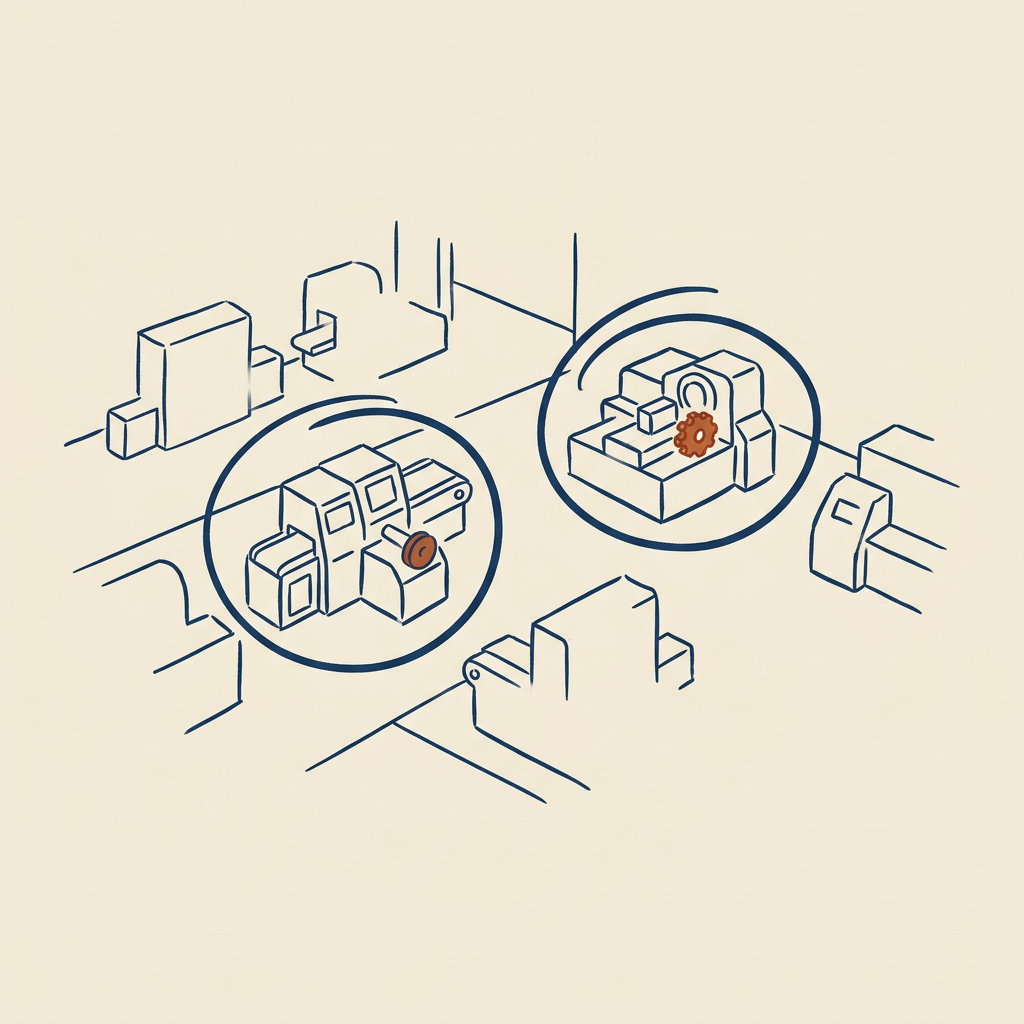
Every system has only a few true constraints—resources whose capacity is less than or equal to demand—and locating them beats speeding up everything else at once.
Bottleneck
Capacity ≤ demand (NCX-10, heat-treat); every wasted minute cuts plant output
Non-bottleneck
Capacity > demand; extra runtime only builds inventory or unneeded parts
Goldratt defines a bottleneck as any resource whose available capacity is less than or equal to the demand placed on it. A non-bottleneck has more capacity than demand requires, so it has slack whether or not anyone admits it.
Alex’s team pulls capacity data and finds two real constraints: the NCX-10 machining center and the heat-treat furnaces. Both are required by nearly every product line and both sit at or beyond available hours once maintenance and changeovers are counted. Every other machine, despite being run hard for local efficiency scores, has spare capacity relative to what the market actually demands.
Pushing a non-bottleneck to full efficiency does not raise salable output; it only piles more inventory in front of the true constraint or builds product with no order. The team also finds hidden drains on the constraint itself: parts pulled off for rework after downstream defects, quality problems earlier in the routing, and operators leaving the machine during breaks and shift changes.
None of those drains appear as a formal capacity number, yet each eats the one resource the plant cannot afford to waste. A vague sense of being behind becomes a specific target.
In practice: Capacity data pinpoints the NCX-10 and heat-treat furnaces as the only resources scheduled at or beyond available hours; the rest of the plant has slack.

5
Guard bottleneck minutes first
An hour lost at the bottleneck is an hour the entire plant permanently loses, while an hour lost on a non-bottleneck usually costs nothing.
Once the constraint is known, the next move is to exploit it: squeeze the most from existing capacity before spending on new equipment. Goldratt’s team makes low-cost changes that recover real hours on the NCX-10 and heat-treat.
They assign a dedicated operator so the NCX-10 is never idle at lunch or shift change. A minute it sits unattended is a minute of throughput the whole plant never recovers; a minute lost on a machine with spare capacity costs nothing because that extra output would not have sold anyway.
They move quality inspection before parts reach the bottleneck so defective material never wastes scarce constraint time. They pull an old slower machine from storage to take a portion of the NCX-10’s work, accepting worse efficiency per part because freed bottleneck hours matter more.
Red-tag material destined for the bottleneck must never wait; green-tag material has slack. Red-tag jobs get priority everywhere, even when that leaves other machines idle.
In practice: A dedicated operator stays with the NCX-10 through breaks, and inspection shifts upstream so scrap never consumes bottleneck time.

6
Idle non-bottlenecks on purpose
Running non-bottleneck machines at maximum local efficiency hurts the plant when it feeds inventory faster than the constraint can absorb it.
Exploiting the bottleneck is not enough. Every other resource must be deliberately paced to it—the step Goldratt calls subordination. Left alone, workers and supervisors chase their own efficiency scores and run upstream machines flat out, flooding the area in front of the NCX-10 with work-in-process that ties up cash and clutters the floor.
The team sketches a scheduling logic: the bottleneck’s processing rate sets the beat for the entire plant, a protective time buffer sits in front of it so upstream hiccups never starve it, and material release at the start of the routing is tied to that same beat rather than to how fast the first machines can run.
In practice some machines and workers show visible idle time. Supervisors trained to treat any idle machine as waste push back; a visiting union representative and the plant accountant see idle workers as a cost problem before they see shipped orders improve.
Work-in-process drops sharply, due-date performance rises because material stops queuing randomly at the constraint, and cash locked in unfinished parts starts moving. A plant optimized station by station is not a plant optimized as a whole.
In practice: Material release is tied to the bottleneck’s beat; upstream machines sit idle by design while work-in-process and late orders fall.

7
Raise capacity only after waste
Adding permanent capacity to the bottleneck is a real fix, but it should come only after exploiting and subordinating, not as a substitute for cheaper steps.
With the bottleneck exploited and the rest of the plant paced to it, the team turns to elevation—actually increasing the constraint’s capacity, which usually costs money and time.
They offload some heat-treat work to an outside vendor, freeing internal furnace hours for jobs only the plant can run. They bring back a second old machine, less precise than the NCX-10 but adequate for parts that do not need full tolerance, splitting demand across two resources. They weigh an extra shift, balancing overtime and staffing expense against the throughput it would unlock.
Goldratt sequences this deliberately. Elevating first would have spent capital to expand a bottleneck still losing hours to preventable idle time and rework—buying more of the same waste. The calculation for overtime only makes sense once existing hours are no longer squandered.
Elevation also reveals the next limit. As NCX-10 and heat-treat capacity grow, resources that once had comfortable slack approach their own ceilings. Constraint management stays iterative; a new bottleneck can form quietly.
In practice: Heat-treat work goes to a vendor and a second older machine returns to service only after dedicated staffing and upstream inspection have already stopped wasting NCX-10 hours.

8
The constraint always moves
The five steps form a repeating cycle; solving one bottleneck surfaces the next, sometimes an old policy or the market itself.
Goldratt names five steps and insists they loop: identify the constraint, exploit it, subordinate everything else, elevate if needed, then return to the first step because the constraint has likely moved.
The plant illustrates the trap he calls inertia. Once NCX-10 and heat-treat stop limiting output, policies built around them—the red-tag system, buffer sizes, release schedule—can outlive their purpose and become the new limit if nobody revisits them. After each round the team must ask whether the old rules still fit.
In the story, after the two machining constraints are brought under control, the plant can produce more than sales can sell. The constraint has shifted outside the factory floor into the market. Spare capacity sits idle for lack of orders—a success dressed as a new problem.
A company practicing constraint management never reaches a finished state. It moves from fixing internal production limits to fixing commercial ones; the discipline of finding, exploiting, and subordinating carries over unchanged even when the constraint leaves the shop floor.
In practice: After the machining bottlenecks ease, the plant’s limit becomes the sales pipeline; old red-tag rules risk becoming the new drag if left unexamined.

9
Price from cash, not allocations
Once internal capacity is free, accept incremental orders priced above true variable cost even when full-cost accounting calls them unprofitable.
Cost-world
Full overhead allocation treated as real per-unit cash; discount looks like a loss
Throughput-world
Spare bottleneck hours + price above true variable cost = added money
With production capacity exceeding orders, cost accountants using full-cost allocation argue that discounting a large new order would sell below cost. Goldratt draws a line between cost-world thinking, which spreads fixed overhead across every unit and treats the allocation as real cash per item, and throughput-world thinking, which asks only what happens to throughput, inventory, and operational expense if this order is taken.
Because operational expense is largely fixed in the short run and the bottleneck now has spare hours, an order priced above true variable cost—materials and any truly incremental labor—adds money even at a price that looks like a loss under standard cost accounting.
The plant lands a large order from the customer called Bucky Burnside at a price competitors using traditional costing refuse to match. Those competitors believe their own allocated costs make the deal a loser.
Goldratt’s point is not permanent marginal-cost pricing. It is that a specific incremental order should be judged by actual cash impact given capacity that genuinely exists, not by overhead rules built for financial reporting. The same three measures now guide a front-office decision.
In practice: The Bucky Burnside order is accepted above material and incremental labor cost but below full allocated cost; competitors using traditional costing walk away.
Key terms
- Throughput The rate at which the system generates money through actual sales, not through production alone.
- Inventory All the money currently tied up in things the system intends to sell, including raw material and work-in-process.
- Operational expense All the money the system spends to turn inventory into throughput—wages, utilities, depreciation, everything.
- Bottleneck Any resource whose available capacity is less than or equal to the demand placed on it.
- Non-bottleneck A resource with more capacity than demand requires, so it has slack whether or not it is kept busy.
- Exploit Get the maximum from the constraint’s existing capacity before spending on new equipment.
- Subordination Deliberately pace every other resource to the constraint’s rate, even if that leaves machines and people idle.
- Elevation Increase the constraint’s capacity itself—extra machines, vendors, shifts—only after exploit and subordinate.
- Throughput-world Judging a decision by its effect on throughput, inventory, and operational expense rather than by allocated full cost.
- Red-tag material Parts destined for the bottleneck; they must never wait, regardless of other machines’ efficiency scores.
What to do
- List every resource whose capacity is at or under demand once maintenance and changeovers are counted.
- Move inspection ahead of your tightest resource so scrap never consumes its minutes.
- Tie new material release to the constraint’s actual rate instead of to how fast the first stations can run.
- Protect the constraint through breaks and shift changes with dedicated coverage.
- Price the next incremental order by materials plus true extra labor, then compare that cash effect to full allocated cost.
Questions to think with
- Which local efficiency scores in your operation currently reward activity that does not raise sales?
- If you moved your slowest resource to the front of the schedule, what upstream idle time would become visible?
- Which policies built around an old bottleneck might now be the thing holding output down?
- When was the last time an order was refused on full-cost grounds even though spare capacity existed?
- What would change this week if every action had to raise throughput without raising inventory or operational expense?
The other side
The novel’s plant is simpler than real multi-product operations where constraints shift daily across hundreds of overlapping routings, and later TOC tools were built precisely because identification is messier than the book’s clean spreadsheet; cost-accounting scholars such as Robert Kaplan also argue throughput accounting helps short-term order decisions but is a poor basis for long-term capital and product-mix choices because fixed costs still must be recovered, while Lean and Six Sigma practitioners contend constraint focus, waste reduction, and variation reduction are complementary rather than opposed.
Who it's for
Operations and plant managers who need more output without new headcount or machines, MBA students and new consultants seeking an intuitive path into constraint theory, and small-business owners whose people look busy while orders still ship late.