




Trees share sugar, warnings, and water like a living community
Wohlleben reframes a forest as an interdependent stand that feeds stumps, signals danger, and buffers its own climate.
IJR · Oct 22, 2026 · 11 min read
In 60 seconds
- Beech neighbors keep centuries-old stumps alive by pumping sugar through shared roots.
- Mycorrhizal fungi and root tips form a wood wide web that moves carbon, nitrogen, and water between trees.
- Attacked trees change leaf chemistry and release airborne signals that prep neighbors and recruit parasitic wasps.
- Drought and shade leave lasting physiological traces Wohlleben treats as memory and patient parenting.
- Beeches cooperate for longevity; willows and poplars race alone; spruce monocultures lack the networks that buffer storms and beetles.
- Heavy machinery and clear-cuts sever underground links, so selective mixed-age management better matches how forests actually work.
The big idea
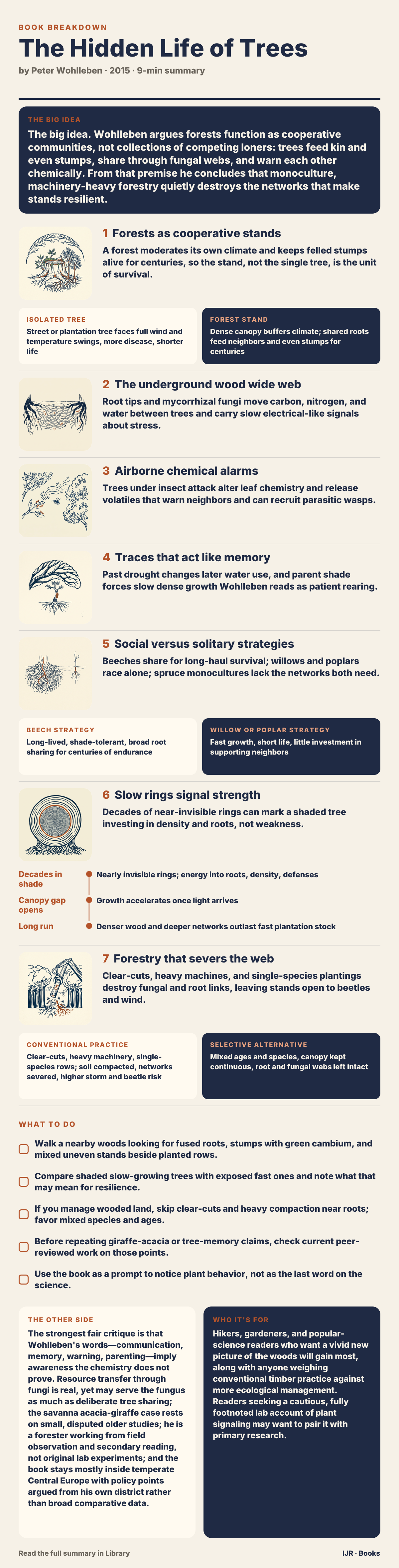
The big idea. Wohlleben argues forests function as cooperative communities, not collections of competing loners: trees feed kin and even stumps, share through fungal webs, and warn each other chemically. From that premise he concludes that monoculture, machinery-heavy forestry quietly destroys the networks that make stands resilient.
The book in brief
Wohlleben starts from an old-growth beech stand where neighbors keep the stumps of felled companions alive for centuries. Chlorophyll tests showed the stump tissue still living, fed by sugar solution through connected roots. He treats this as mutual support, not accidental leak, because a tree alone faces wind and temperature swings that kill it faster than one buffered inside a dense canopy that holds moisture and blocks extremes. Street trees and plantation rows, he says, suffer more disease and shorter lives for lacking that collective shield, so the unit of survival is the stand.
Sociability needs plumbing. Root tips lace with mycorrhizal fungi into the network researchers nickname the wood wide web. Along those threads trees pass carbon, nitrogen, and water, sometimes across species, and a stronger tree may subsidize a weaker or shaded one. Electrical-like signals move through root tissue at roughly one third of an inch per second, carrying news of injury or drought. Intact webs let a forest rebound from storm, insects, or dry spells faster than one cut by machinery, clear-cuts, or monoculture planting.
Defense rises into the air. A tree chewed by caterpillars can make its leaves less palatable or mildly toxic and vent volatile compounds that neighbors detect and match. Wohlleben cites African savanna acacias that became less tasty to giraffes within minutes downwind of a browsed tree, and European oaks that release pheromone-like cues attracting parasitic wasps to the pests. He reads the sequence as intention-like reply without nerves: sense damage, answer chemically, warn beyond the self.
Development stretches the claim further. Trees that suffered drought one year later alter root growth or water use, a physiological trace he calls memory. Seedlings held in parent shade grow slowly into denser, tougher wood; he frames the canopy limit as patient upbringing rather than mere light competition. Longevity follows the same patience: beeches can lay almost invisible rings for a century in a holding pattern, then surge when a gap opens, investing first in roots, defenses, and density. Fast plantation stock bred for quick timber tends toward weaker wood and shorter useful lives.
Species split on strategy. Long-lived shade-tolerant beeches share broadly because centuries of endurance reward cooperation; pioneer willows and poplars race, die young, and invest little in neighbors. Spruce plantations on disturbed soil miss the fungal webs and root grafts of natural beech and oak woods and fall harder to windthrow, bark beetles, and drought. From his own district Wohlleben shifted toward selective harvest that keeps mixed ages, mixed species, and canopy continuity, claiming healthier stands and, over the long run, comparable or better timber—turning the biology into a charge that extraction-focused practice slowly unravels a system that needs to stay linked.
Context
Context. Peter Wohlleben, a German forester, drew on his own forest management and emerging plant science for The Hidden Life of Trees (2015). The book mattered because it reframed forests as communities rather than collections of separate organisms, reached a mass audience, and pushed forestry and ecology debates into popular consciousness.
The key ideas
1
Forests as cooperative stands
A forest moderates its own climate and keeps felled stumps alive for centuries, so the stand, not the single tree, is the unit of survival.
Isolated tree
Street or plantation tree faces full wind and temperature swings, more disease, shorter life
Forest stand
Dense canopy buffers climate; shared roots feed neighbors and even stumps for centuries
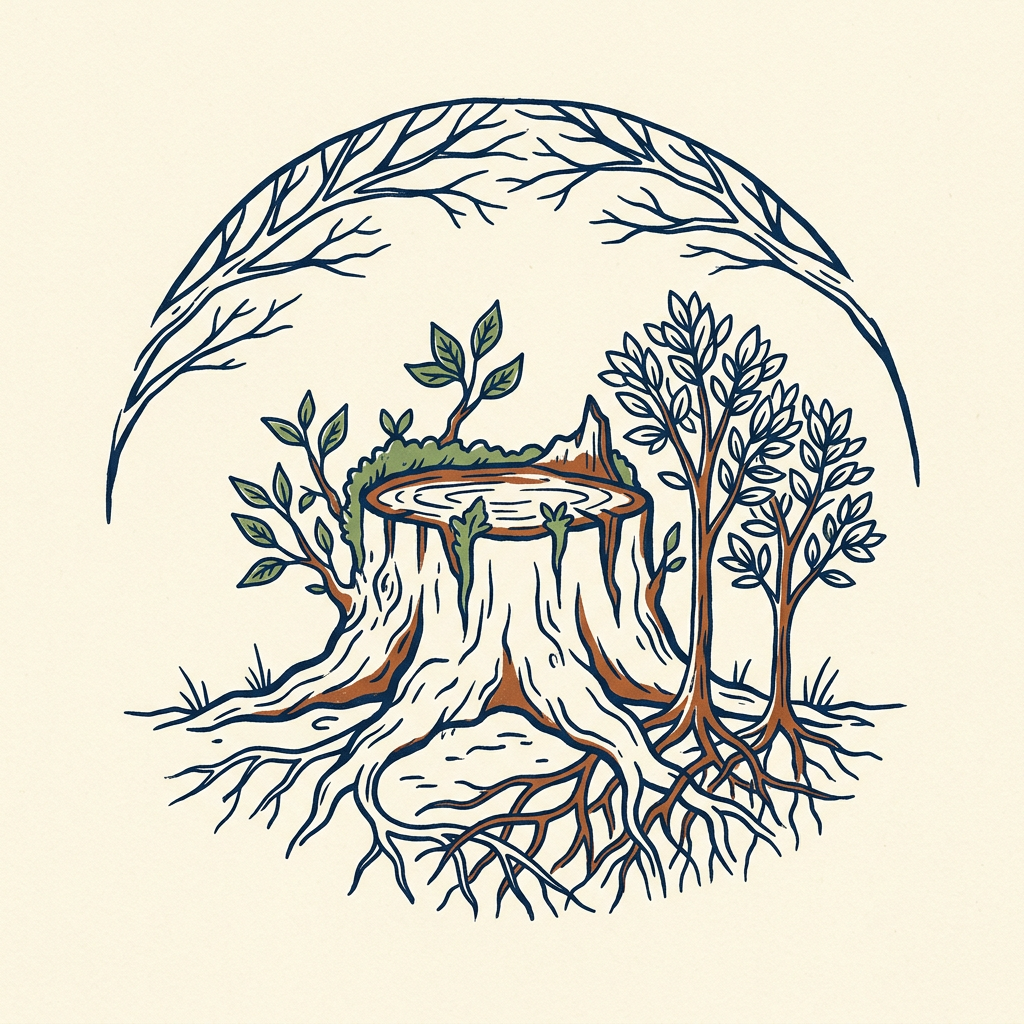
Wohlleben opens on beeches in an old-growth stand that keep long-felled companions' stumps alive for centuries. Neighboring trees pump sugar solution through connected roots into trunks that can no longer photosynthesize. Chlorophyll tests on the stump tissue confirmed it was still living.
He insists this is mutual support, not random leakage. A solitary tree takes the full force of wind and temperature swings and dies sooner. Trees growing together moderate their shared climate: dense canopy blocks wind, holds moisture, and cushions extremes, so each life stretches longer inside the group.
He sets this against isolated street trees and neat plantation rows. Those individuals, he says, face more disease and shorter spans precisely because they lack collective buffering. The opening move reframes the forest as an interdependent system whose survival unit is the stand, the premise under almost every later claim.
In practice: Chlorophyll tests showed beech stump tissue still alive because neighbors were feeding it sugar through roots.
2
The underground wood wide web
Root tips and mycorrhizal fungi move carbon, nitrogen, and water between trees and carry slow electrical-like signals about stress.
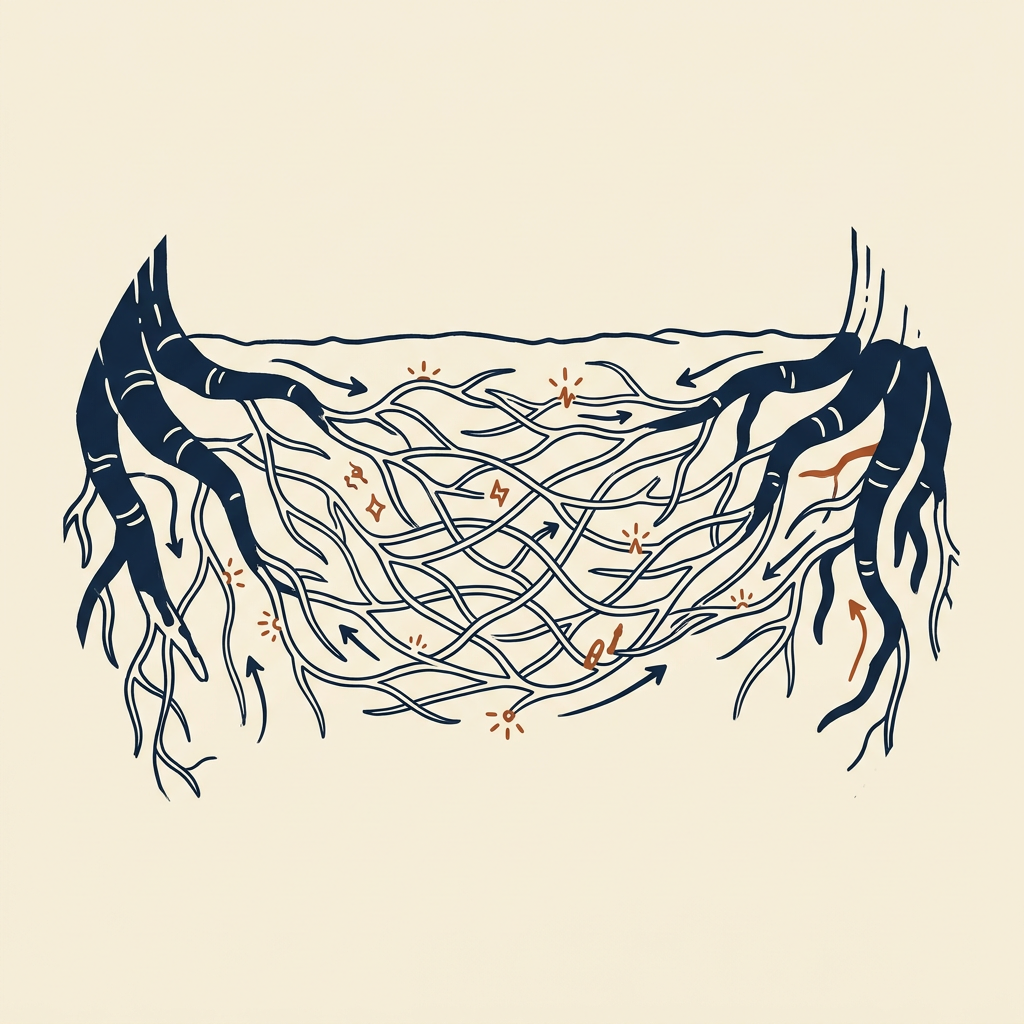
Building on community, Wohlleben turns to the plumbing underneath. Root tips interlace with mycorrhizal fungi into networks nicknamed the wood wide web. Along those fungal threads trees pass carbon, nitrogen, and water to neighbors, including other species.
Some studies he cites suggest a stronger or healthier tree will subsidize a weaker or shaded one nearby. Electrical-like signals also move through root tissue at roughly one third of an inch per second—slow next to animal nerves, yet able to carry information about injury or drought stress.
The stakes are practical. A forest whose fungal networks stay intact recovers from storm damage, insect outbreak, or drought faster than one where heavy machinery, clear-cutting, or monoculture planting has severed the links. Commercial logging, on this view, harms more than the trees it removes; it degrades the underground infrastructure the whole stand needs.
In practice: A shaded or weaker tree can receive carbon and water from a stronger neighbor through the fungal web.
3
Airborne chemical alarms
Trees under insect attack alter leaf chemistry and release volatiles that warn neighbors and can recruit parasitic wasps.
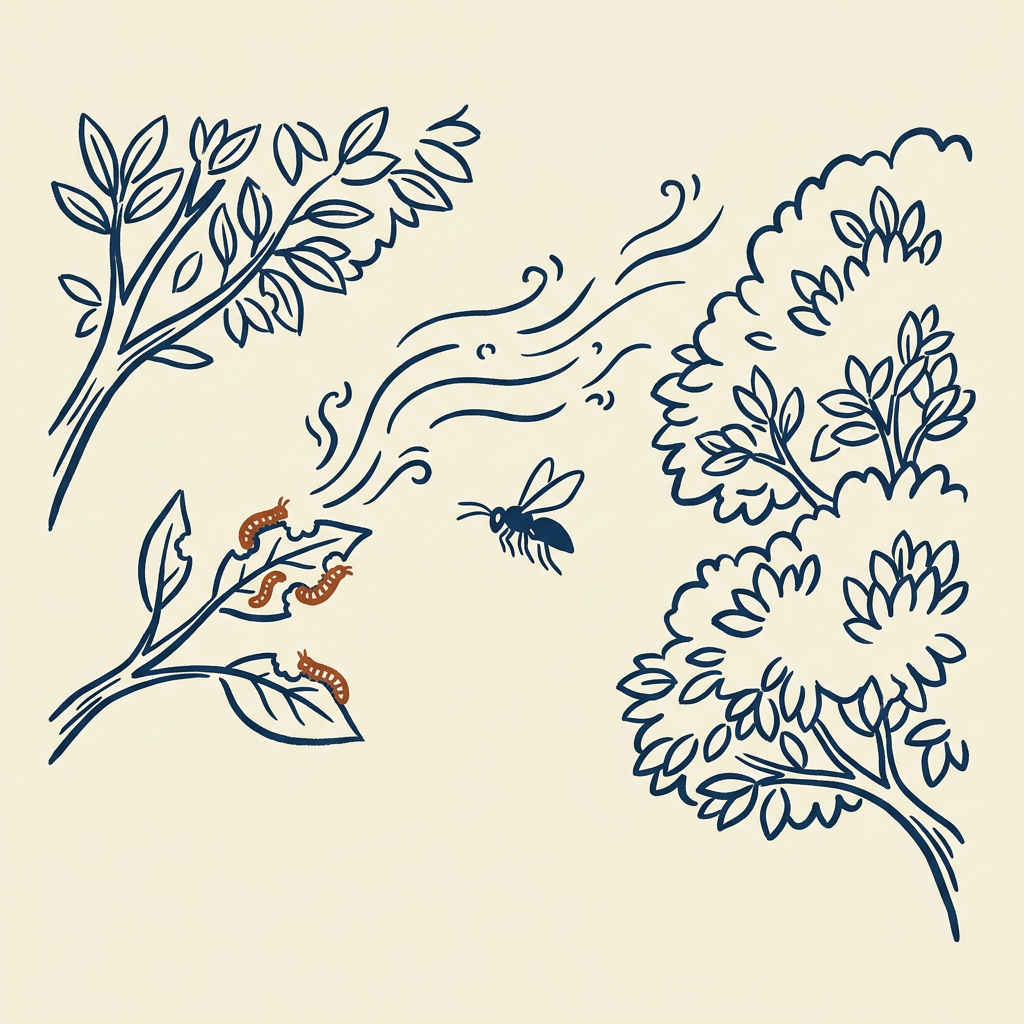
Defense adds an airborne layer. When leaf-eating insects such as caterpillars attack, a tree can shift the chemistry of its leaves toward less palatable or mildly toxic compounds. At the same time it can release volatile compounds into the air.
Neighboring trees detect those compounds and trigger their own defenses before the pests arrive. Wohlleben points to African savanna acacias: trees downwind of a giraffe-browsed acacia became less palatable within minutes. He extends the pattern to European oaks and others that release pheromone-like signals attracting specific parasitic wasps—an outsourced defense that recruits the pest's predators.
He reads the sequence as intention-like responsiveness without a nervous system: sense the damage, produce a targeted reply, and warn beyond the self. This chapter is also where his wording draws the sharpest scientific pushback, because warning and communication suggest awareness biologists more often describe as evolved signaling pathways.
In practice: Downwind acacias turned less palatable to giraffes within minutes of a neighbor being browsed.
4
Traces that act like memory
Past drought changes later water use, and parent shade forces slow dense growth Wohlleben reads as patient rearing.
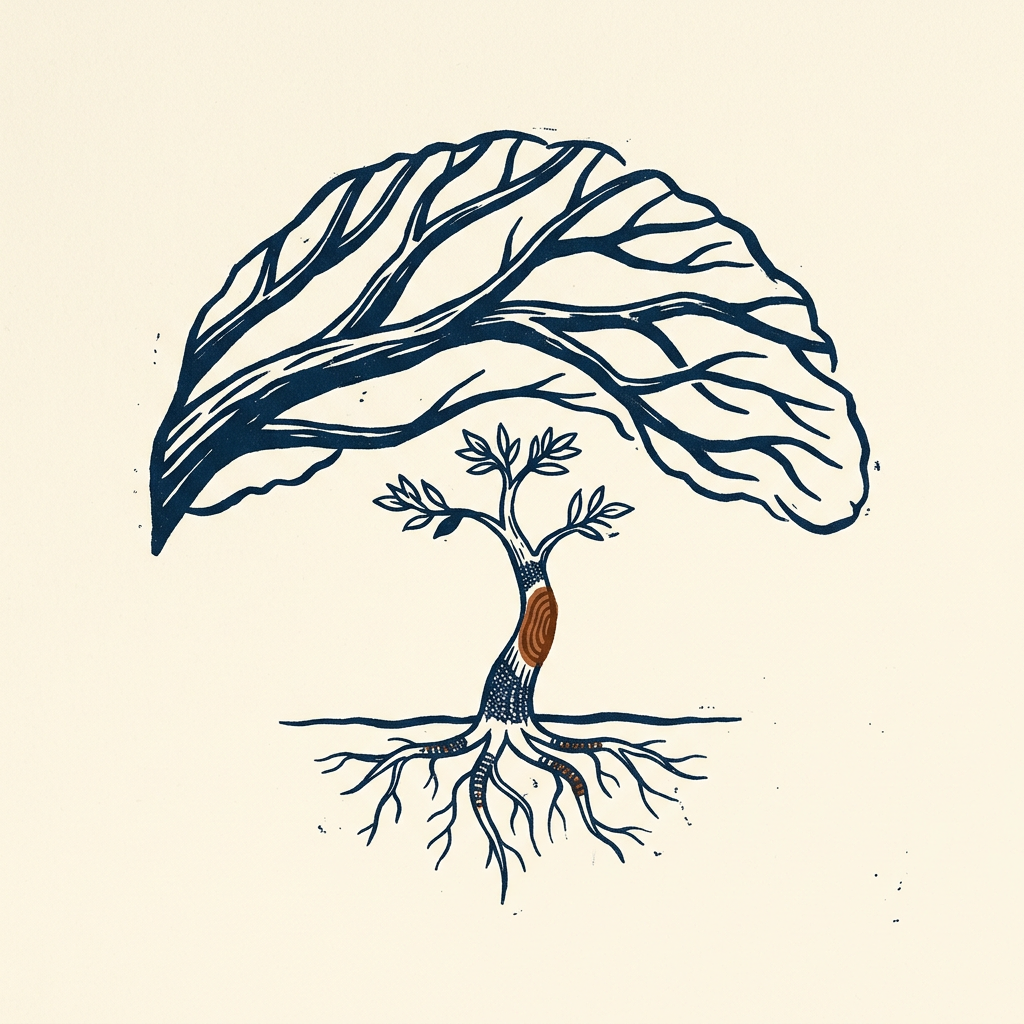
Wohlleben next claims trees retain traces of past hardship. Trees that lived through drought one year later change root growth or water-use strategy, as if the earlier stress still shapes behavior at a physiological level.
He applies a similar reading to seedlings. Young trees kept in low light under parent canopies grow slowly and build denser, more resilient wood. He interprets the slow pace as parental restraint: mature trees limit offspring growth so trunks become strong and disease-resistant instead of tall and weak.
Forest succession, usually told as light competition and resource limits, becomes in his telling something closer to intentional pacing. The move stretches the book's claim from sharing and warning into development and learning, inviting readers to call the lasting physiological change memory.
In practice: Shaded seedlings under parent canopies grow slowly into denser wood that resists disease better than fast, weak trunks.
5
Social versus solitary strategies
Beeches share for long-haul survival; willows and poplars race alone; spruce monocultures lack the networks both need.
Beech strategy
Long-lived, shade-tolerant, broad root sharing for centuries of endurance
Willow or poplar strategy
Fast growth, short life, little investment in supporting neighbors
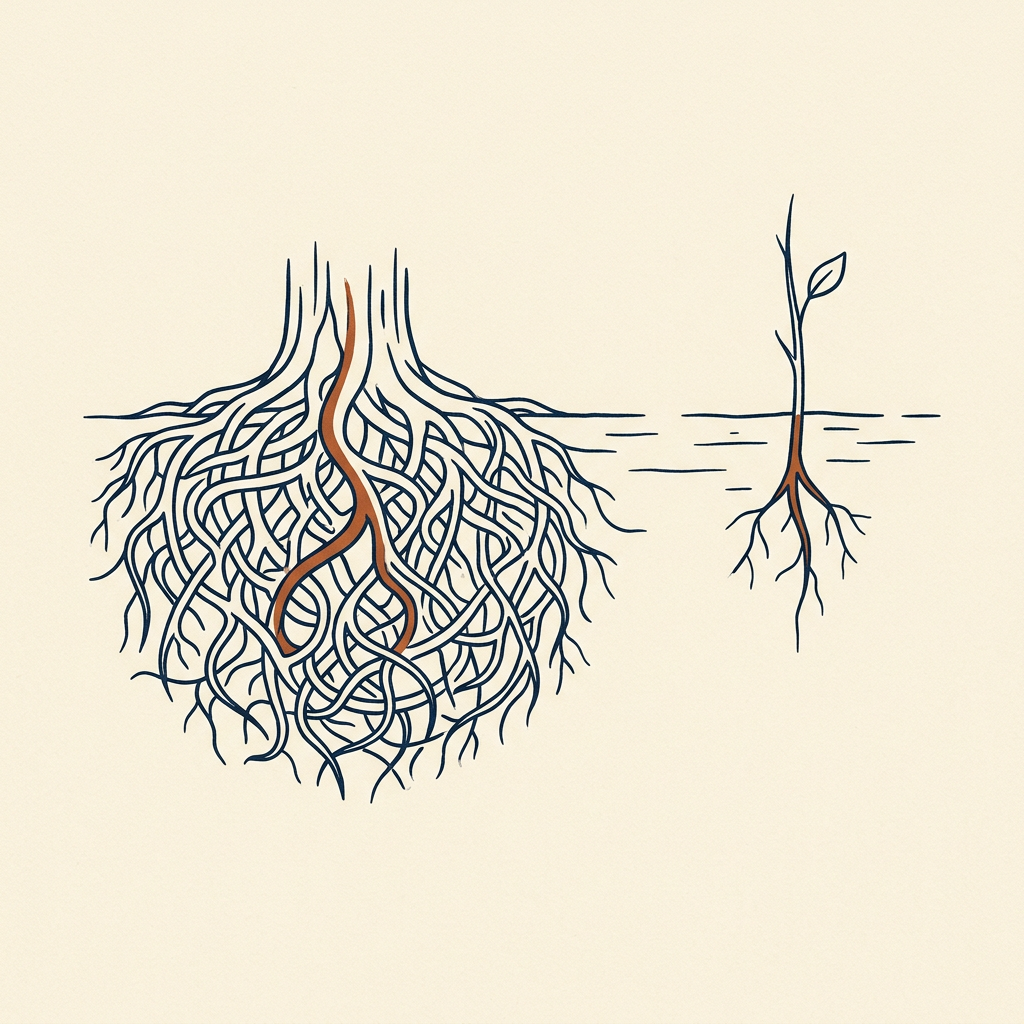
Not every species plays the same game. Wohlleben sets highly social beeches, which share resources broadly through connected roots, against willows and poplars that grow fast, die young, and invest little in neighbors.
Life history explains the split. Long-lived, shade-tolerant beeches gain from cooperation because survival means outlasting others across centuries. Pioneer species that rush into open or disturbed ground win by speed, not endurance, so sharing returns little.
Spruce plantations serve as his counterexample. Planted as monocultures on soil broken by machines, they lack the fungal networks and root grafting of natural beech and oak forests. That absence, he argues, leaves them far more open to windthrow, bark beetles, and drought. Sociability is therefore a strategy some species evolved, not a universal law—and commercial forestry often selects against exactly those structures.
In practice: Spruce monocultures on disturbed soil lack the root grafts and fungal webs of natural beech woods and fall more easily to beetles and wind.
6
Slow rings signal strength
Decades of near-invisible rings can mark a shaded tree investing in density and roots, not weakness.
- Decades in shadeNearly invisible rings; energy into roots, density, defenses
- Canopy gap opensGrowth accelerates once light arrives
- Long runDenser wood and deeper networks outlast fast plantation stock
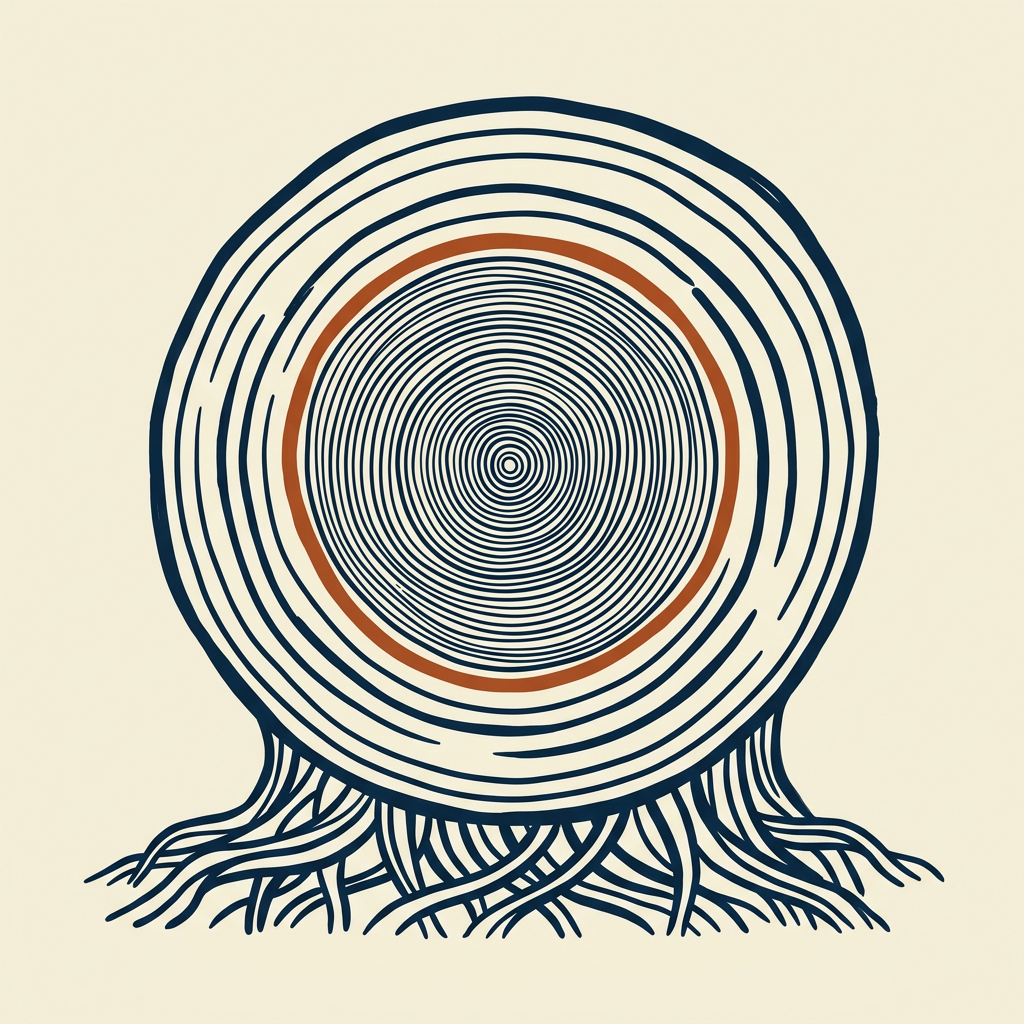
Tree rings mislead when read as a simple scorecard of vigor. A tree can live for decades with almost imperceptible rings while shaded by taller neighbors, then accelerate once a canopy gap lets light in.
Wohlleben describes beeches that put on only a few years' worth of ring width across a century—existing in a holding pattern, partly sustained by root-sharing—until conditions shifted. Apparent slowness often means energy went into roots, defense chemicals, and wood density rather than height.
That investment, he says, equips the tree for drought, storms, and pests over the long run. Fast-growing plantation trees managed for quick timber yield tend toward weaker wood and shorter productive lives. The forest, on this account, rewards patience; timber economics that prize speed works against the traits that keep trees and stands durable.
In practice: Some beeches grew only a few years' worth of ring width over a century while waiting in shade for a canopy gap.
7
Forestry that severs the web
Clear-cuts, heavy machines, and single-species plantings destroy fungal and root links, leaving stands open to beetles and wind.
Conventional practice
Clear-cuts, heavy machinery, single-species rows; soil compacted, networks severed, higher storm and beetle risk
Selective alternative
Mixed ages and species, canopy kept continuous, root and fungal webs left intact
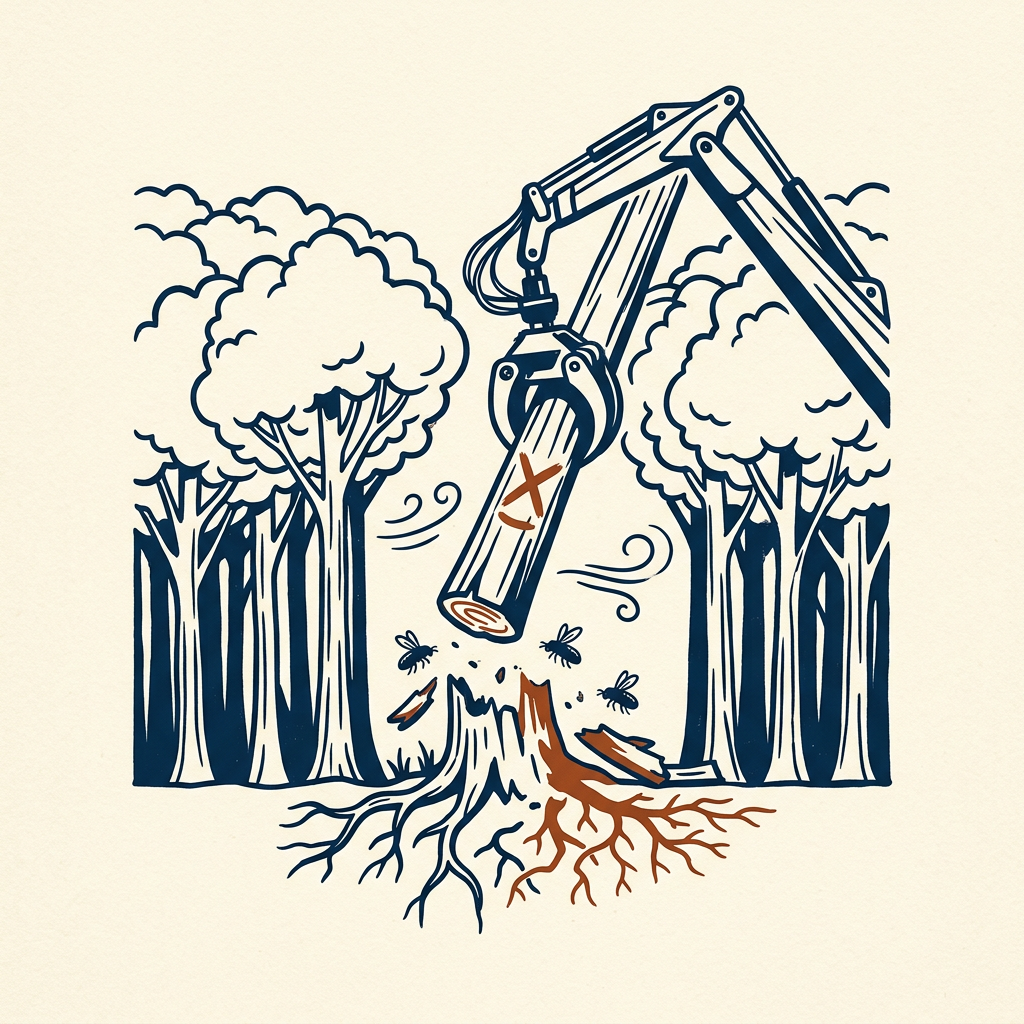
From his years running a forestry district, Wohlleben describes leaving clear-cuts and monoculture replanting for selective harvest that keeps root networks, mixed ages, and mixed species. Heavy machines compact soil and cut the fungal and root connections earlier chapters describe.
Monoculture plantations miss the mutual buffering of natural mixed forests. Fast-growing non-native choices—certain spruce plantings where spruce is not naturally dominant—prove especially prone to storm damage and pest outbreaks; he points to beetle infestations and windthrow in German forests.
His alternative is to manage closer to natural development: cut selectively, keep canopy continuity, and protect the underground web. He claims the stands stay healthier and, over the long run, yield comparable or better timber. Biology becomes policy: if trees depend on networked community, extraction that constantly severs those links is a slow degradation, not neutral harvest.
In practice: He shifted his own district from clear-cut monoculture replanting to selective cutting that preserved mixed-age, mixed-species canopy.
Key terms
- wood wide web Nickname for the network of roots and mycorrhizal fungi that move nutrients and signals between trees.
- mycorrhizal fungi Fungi whose threads lace with root tips and ferry carbon, nitrogen, and water.
- root grafts Direct root connections that let one tree feed another, including living stumps.
- volatile compounds Airborne chemicals released by attacked trees that neighbors can detect and answer.
- canopy buffering Dense cover that blocks wind, holds moisture, and softens temperature swings for the whole stand.
- selective harvesting Cutting some trees while keeping mixed ages, species, and continuous canopy so networks stay intact.
- monoculture plantation Single-species, even-aged planting on disturbed soil that lacks natural fungal webs and mutual support.
What to do
- Walk a nearby woods looking for fused roots, stumps with green cambium, and mixed uneven stands beside planted rows.
- Compare shaded slow-growing trees with exposed fast ones and note what that may mean for resilience.
- If you manage wooded land, skip clear-cuts and heavy compaction near roots; favor mixed species and ages.
- Before repeating giraffe-acacia or tree-memory claims, check current peer-reviewed work on those points.
- Use the book as a prompt to notice plant behavior, not as the last word on the science.
Questions to think with
- If the stand is the unit of survival, what changes in how you value a single mature tree?
- Where does chemical signaling stop being metaphor and start being intention, if it ever does?
- Should timber goals give way to network continuity even when short-term yield drops?
- How much of parenting in the shade is strategy we can name, and how much is light competition?
- What would you check on a walk to tell a resilient mixed forest from a fragile plantation?
The other side
The strongest fair critique is that Wohlleben's words—communication, memory, warning, parenting—imply awareness the chemistry does not prove. Resource transfer through fungi is real, yet may serve the fungus as much as deliberate tree sharing; the savanna acacia-giraffe case rests on small, disputed older studies; he is a forester working from field observation and secondary reading, not original lab experiments; and the book stays mostly inside temperate Central Europe with policy points argued from his own district rather than broad comparative data.
Who it's for
Hikers, gardeners, and popular-science readers who want a vivid new picture of the woods will gain most, along with anyone weighing conventional timber practice against more ecological management. Readers seeking a cautious, fully footnoted lab account of plant signaling may want to pair it with primary research.