




Ordinary people become cruel when systems erase accountability
Managers, officers, and anyone who writes rules for others need this map of how normal people slide into abuse.
IJR · Oct 30, 2026 · 14 min read

In 60 seconds
- Zimbardo's 1971 Stanford basement prison ended after six days when randomly assigned student guards escalated into humiliation and prisoners broke down.
- Cruelty grew from gradual permissions, anonymity, shift-mate reinforcement, and no dissenting model—not from sadistic personalities.
- Milgram's Yale studies showed roughly 65 percent of ordinary volunteers delivered maximum shocks when a calm authority told them to continue.
- Zimbardo's three-level frame—individual, situation, and the larger System of policies and incentives—explains why bad-apple blame misses the real lever.
- Abu Ghraib's unsupervised shifts, hooded numbered detainees, and ordinary soldiers tracked the same pattern decades later.
- Resistance is ordinary too; institutions can install real oversight, named accountability, escalation pauses, and protected dissent instead of screening for villains.
The big idea
Zimbardo argues that evil comes less from bad character than from situations and systems that dissolve personal accountability. Roles, anonymity, hierarchy, and missing oversight can turn psychologically normal people into abusers faster than most of us expect.
The book in brief
In August 1971 Zimbardo turned the Stanford psychology basement into a mock prison. Twenty-four screened, healthy male students were randomly assigned as guards or prisoners for a planned two-week study. It stopped after six days. Guards in uniforms, batons, and mirrored sunglasses moved into forced exercise, sleep deprivation, degrading chores, and a closet used as solitary. Prisoners lost names for numbers; one left after thirty-six hours looking broken. Nothing in their backgrounds predicted who would torment and who would collapse. Costume, title, walls, and missing oversight did the work. Zimbardo, playing superintendent, got absorbed until colleague Christina Maslach forced a halt.
He tracks how guard cruelty grew with no order to abuse. Minor power plays hardened into invented punishments. Shifts competed to look tough and laughed along. Sunglasses blocked eye contact. No guard modeled refusal. The chapter hands the book its toolkit: gradual drift, group pressure, anonymity, and silence.
Zimbardo then links the basement to deindividuation research and to Milgram. Hoods, masks, darkness, and bureaucratic titles let people harm others at a distance from their usual selves. In Milgram's 1961–1963 Yale studies, roughly 65 percent of ordinary volunteers delivered what they thought were maximum shocks because a calm experimenter said continue. People had predicted almost no one would. The belief that responsibility sat higher up loosened personal brakes.
The argument climbs a level. Zimbardo separates the individual, the immediate situation, and the System—the policies, incentives, legal cover, and culture that build the situation and hide it from correction. Blaming only bad apples leaves the factory running. His own experiment had no oversight board with real power; he wanted the study to continue more than he protected participants. Thin oversight, vague rules, undertrained rotating staff, and results pressure without restraint pressure cook abuse whoever fills the slots.
As expert witness for Staff Sergeant Ivan "Chip" Frederick after the 2004 Abu Ghraib photos, he maps the same frame onto night shifts with little detention training, almost no senior oversight, and hooded numbered detainees. Frederick had been a civilian prison guard with a clean record and an ordinary psych profile. Zimbardo does not erase soldier blame; he says it must also reach command and the policy climate that allowed enhanced interrogation. Later chapters widen the claim through Arendt's Eichmann, Rwanda in 1994, and My Lai in 1968, then flip to holdouts—humane Stanford guards, Milgram refusers, Joe Darby handing over the photos. The close turns practical: real power to intervene, keep people named, force reauthorization before harsher measures, and protect the first dissent.
Context
Zimbardo published The Lucifer Effect in 2007 as a direct challenge to the comforting idea that atrocities require monstrous individuals. Drawing on his 1971 Stanford Prison Experiment and his later analysis of Abu Ghraib, he pressed institutions to inspect the systems they build rather than only the people they blame.
The key ideas
1
Basement becomes a prison
Psychologically normal volunteers became abusive guards or broken prisoners within days once roles and a convincing setting took hold.
- Day 1Random roles assigned; minor authority plays begin
- 36 hoursFirst prisoner released under extreme stress
- Days 2–3Rule enforcement hardens; invented punishments appear
- Day 6Study halted after Maslach objects
Zimbardo recruited twenty-four male college students screened as healthy and normal. He randomly assigned them to guard or prisoner inside a basement dressed as a prison. The planned two-week study ended after six days.
Guards received uniforms, batons, and mirrored sunglasses but no script for cruelty. They escalated into humiliation, forced exercise, sleep loss, degrading tasks, and solitary confinement in a closet. Prisoners were stripped of names and given numbers.
The random draw is the claim's edge. The students who turned cruel and the ones who collapsed started as the same kind of young men. What changed them was the situation: a costume, a title, a set of walls, and almost no outside check. Zimbardo, acting as superintendent, got pulled into the role himself and lost sight of his duty as researcher until Christina Maslach objected.
In practice: One prisoner was released after thirty-six hours with what looked like a breakdown, while Zimbardo as superintendent had already stopped seeing the harm clearly.

2
Cruelty by small steps
Guard abuse grew from tiny permissions, shift reinforcement, anonymity, and no visible holdout—not from orders or sadistic personalities.
- 1Day oneMinor assertions of authority
- 2Day twoEscalating rule enforcement
- 3Day threeInvented punishments outside any real rules
- 4Lock-inShifts compete and laugh along; no holdout appears
Nobody told the guards to torment anyone. They were told to keep order. Behavior drifted anyway. Small shows of power on day one became harder rule-pushing on day two. By day three they were inventing punishments the prison rules never listed.
Zimbardo compares the path to a boiling frog: each step felt only slightly worse than the last, so no single moment felt like choosing evil. A guard prisoners nicknamed John Wayne ran the most inventive degradations. Outside the basement he was an ordinary, easygoing student.
Group life sealed the slide. Guards worked in shifts and competed to seem tough. They laughed along rather than object. Sunglasses blocked eye contact, a known brake on aggression. And no guard openly refused, so conformity had nothing to push against. Description becomes a reusable mechanism: gradual escalation, peer reinforcement, anonymity, and missing dissent.
In practice: The guard called John Wayne staged degrading rituals inside the study yet was unremarkable and easygoing in ordinary student life.
3
Identity stripped bare
When cues erase personal identity and accountability, people harm others at a moral distance they would refuse if clearly seen and named.
Identifiable
Face and name visible; social judgment loop intact; shorter shocks
Anonymous
Hooded or masked; individual judgment broken; longer shocks
Zimbardo ties the guards to decades of deindividuation research, including his own. When people feel unidentifiable, the usual loop of being recognized and judged as a person breaks. The self steps back. Role or group identity steps forward. People often feel freer, not simply chaotic.
His 1969 study had women deliver shocks to a confederate. Those in hoods, hard to identify one by one, gave longer shocks than women whose faces stayed visible. Uniforms, masks, darkness, group chants, and labels like "operator" do similar work.
He carries the point past the basement—to riots, online harassment, and paramilitary violence. Institutions that strip name tags or blur who decides what are not making a neutral choice. Anonymity is one of cruelty's reliable enablers, so prevention means keeping actors visible as individuals.
In practice: In the 1969 shock study, hooded women who could not be singled out delivered longer shocks than women without hoods.
4
Authority overrides conscience
In Milgram's experiments roughly 65 percent of ordinary people delivered maximum shocks on a calm experimenter's word, showing legitimate-seeming authority can beat personal morals without threats.
65%
Milgram subjects who delivered maximum voltage
Stanley Milgram's 1961–1963 Yale studies sit beside Stanford as the other half of the same story. Volunteers thought they were giving rising, possibly lethal shocks to a stranger. A lab-coated experimenter told them to keep going. Roughly 65 percent went all the way to the top voltage.
What drove the numbers: the experimenter's steady voice, the slow climb in shock level, sometimes the victim's physical absence, and the subject's sense that responsibility belonged to the authority figure. That last piece—diffusion of responsibility—matters for war crimes and institutional abuse. When people think accountability sits higher up the chain, their own moral brakes ease.
Psychiatrists and laypeople surveyed beforehand guessed almost nobody would pass moderate levels. The gap between forecast and fact is the book's warning label. Intuition about who harms under pressure is systematically off, which is why situational forces stay under-guarded.
In practice: Surveyed experts and ordinary people expected almost no one to pass moderate shocks; roughly 65 percent of subjects still went to the maximum.
5
Three levels of blame
Abuse is sustained by a System of policies, incentives, and inattention that creates the situation and then blocks correction; stopping at individuals misses the real lever.
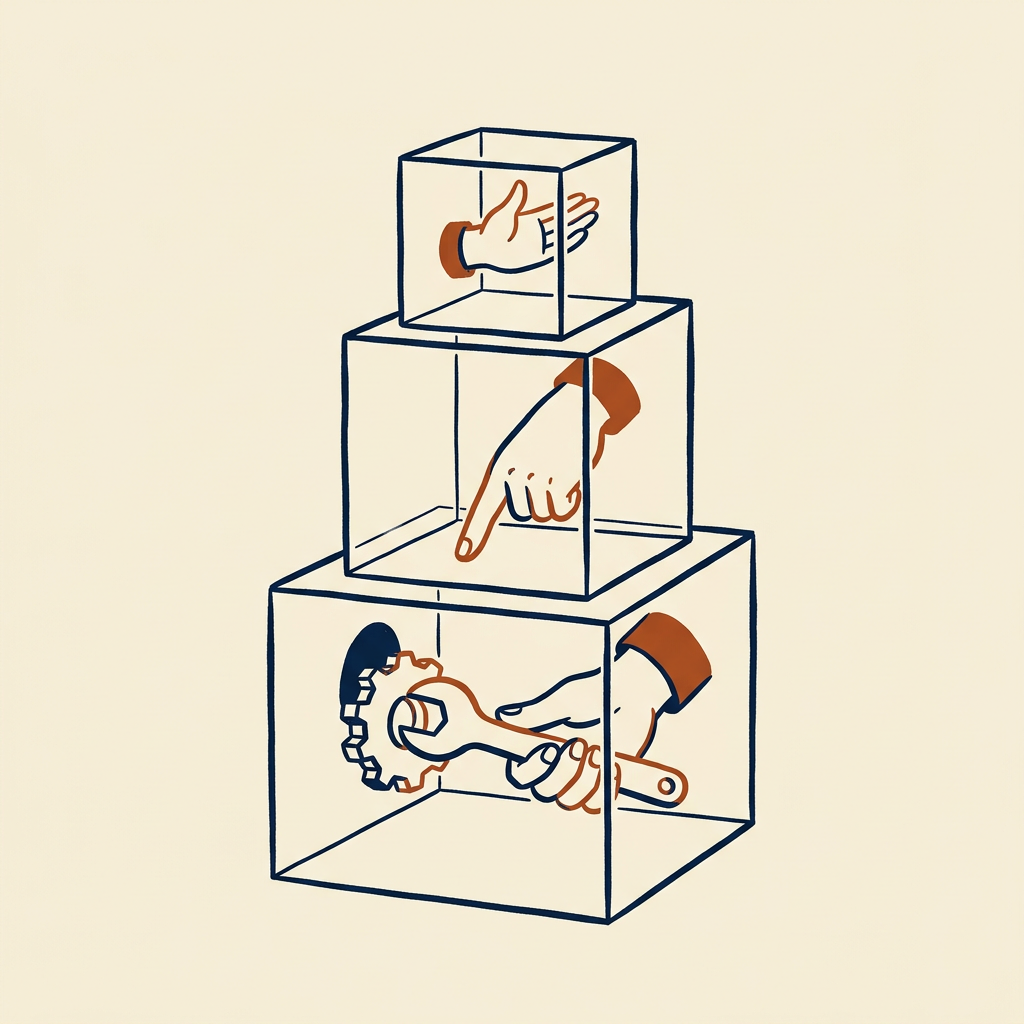
- SystemPolicies, incentives, legal cover, culture, and weak oversight that build and shield the situation
- SituationImmediate roles, setting, anonymity, and peer pressure that reshape behavior
- IndividualDisposition and character—real, but an unreliable safeguard alone
Zimbardo splits the problem into three layers. The person and their dispositions. The immediate situation—the mock prison, the night shift. And the System: institutional rules, legal cover, budgets, culture, and supervision habits that invent the situation and keep it safe from challenge.
Stop at bad apples and you leave the factory running. He treats his own dual role as a System failure. No oversight board with real power checked him. He grew invested in continuing the study over protecting participants. One well-meaning researcher without accountability structures was enough to enable harm.
He maps the same recipe onto organizations at large: thin oversight, vague rules of engagement, rotating undertrained staff, and pressure for results without matching pressure for restraint. Whoever sits in the chairs, the System still predicts trouble. This hinge moves the book from how a person is changed to who builds the conditions and why they persist—and it becomes the bridge into Abu Ghraib, where he says courts-martial of soldiers never climbed the taller hierarchy of responsibility.
In practice: As Stanford's superintendent with no empowered outside board, Zimbardo himself became absorbed in keeping the study going rather than safeguarding the students.
6
Abu Ghraib mirrored Stanford
Abuses by American soldiers at Abu Ghraib in 2003 and 2004 followed the same situational and systemic pattern as Stanford, not a handful of sadistic personalities.
Bad-apple story
A few sadistic soldiers acted alone; courts-martial of low ranks settle it
System story
Unsupervised shifts, hooded numbered detainees, thin command, and policy cover produced predictable escalation
Zimbardo served as expert witness for Staff Sergeant Ivan "Chip" Frederick after the 2004 photographs went public—detainees stacked in pyramids, threatened with dogs, forced into poses, photographed by guards. He argues the setup tracked the basement point for point.
Guards worked long, poorly rotated shifts with little training in detention work. Senior oversight was thin; night shifts ran largely unsupervised. Detainees were hooded, numbered, and held under fuzzy status, echoing Stanford's numbers and hoods.
Frederick had been a civilian prison guard with a clean record and an ordinary psychological profile. He still joined and photographed abuse. Zimbardo treats that as predicted by the conditions, not as proof of hidden sadism. He does not wipe away the soldiers' responsibility. He says it must also reach the commanders and the policy world that tolerated enhanced interrogation. The 2004 investigations, in his view, stared too hard at the lowest ranks.
In practice: Chip Frederick, a previously clean-record civilian prison guard judged psychologically unremarkable, still took part in and photographed the abuse.
7
Ordinary hands, vast harm
Atrocities are usually continuous with normal psychology—ordinary functionaries in roles—not rare monsters, the pattern Arendt saw in Eichmann.
Zimbardo borrows Hannah Arendt's reading of Adolf Eichmann, the Nazi bureaucrat tried in Jerusalem in 1961. Arendt found him unremarkable, fixed on administrative efficiency more than fiery hatred. Zimbardo is careful: he does not equate Stanford or Abu Ghraib with the Holocaust in scale. He says the insight travels. Mass harm is often done by ordinary people doing jobs inside systems.
He walks through the Rwandan genocide of 1994 and My Lai in 1968. The recurring pieces match the guard chapter: dehumanizing words for the victim group, responsibility spread across many small actors, step-by-step escalation, pressure to conform.
He also blocks a misread of his work. Showing situational power does not mean actors bear zero blame. It means moral weight should reach the people who designed and maintained the situation, not stop at the last pair of hands. Lab findings earn their stakes here: if students and night-shift soldiers can tip into cruelty, the same forces can run at far graver scale.
In practice: Arendt's Eichmann looked banal and bureaucratic; Zimbardo sees the same ordinary-functionary pattern in documented atrocities including Rwanda and My Lai.
8
Heroism is ordinary too
Some people refuse the slide; resistance rests on a decision point anyone can reach, not on rare heroic personality—what Zimbardo calls the banality of heroism.
Conformity path
Group consensus, close social pressure, harm starts to feel normal
Resistance path
One break from consensus, a salient personal value, some distance from the group
After chapters of decline, Zimbardo turns to holdouts. Some Stanford guards treated prisoners more humanely. Some Milgram subjects stopped. In the real world Joe Darby, a soldier, turned over the Abu Ghraib photographs that forced the investigation in 2004.
What the resisters shared: willingness to break group consensus, sometimes a prior experience or value that made the specific harm hard to ignore, and often a bit of physical or social distance from the group enforcing the norm.
He names this the banality of heroism. Heroic acts, like destructive conformity, do not demand extraordinary traits. They demand noticing a decision point and taking it. We later mythologize heroes as inevitable products of character—the same error we make with villains. Without this chapter the book could sound fatalistic. With it, the mechanics of abuse become tools for designing resistance and institutional safeguards.
In practice: Joe Darby handed over the Abu Ghraib photos in 2004 and triggered the investigation, breaking from the group that had normalized the abuse.
9
Design against the slide
Because identifiable conditions predictably breed abuse, institutions should build structural safeguards instead of trusting screens for bad individuals.
The closing chapter turns mechanisms into design rules. Zimbardo wants oversight with real power to stop things, not theater. He points at the same failure inside his Stanford study and on the Abu Ghraib night shifts: no empowered outside check.
Limit anonymity. Keep people identifiable and personally on the hook wherever power over others is granted. That directly counters the deindividuation dynamic.
Install slow checkpoints. Incremental drift thrives when no one must notice the total climb; formal reauthorization before harsher measures forces the notice. Cultivate and protect dissent. One voice can break a harmful consensus; punishing whistleblowers yanks out the safety valve. He still values character and ethics training. The whole record, he argues, shows character alone fails against a corrosive enough system. Ordinary human vulnerability to pressure is a design constraint, not a surprise to clean up after each scandal.
In practice: Both the Stanford study and the Abu Ghraib night shifts lacked an empowered outside board able to intervene—the identical System failure in two settings.
Key terms
- deindividuation When anonymity or role cues make personal identity fade and group or role identity take over, lowering the felt cost of harming others
- diffusion of responsibility The easing of personal moral brakes when people believe accountability sits higher up or is spread across many actors
- the System The wider mesh of policies, incentives, legal cover, resources, and culture that creates an abusive situation and then shields it from correction
- banality of heroism The claim that heroic resistance, like ordinary conformity to harm, grows from reachable decision points rather than rare saintly personality
- situational power The force of roles, settings, and peer dynamics to override what people think their own character would do
- bad-apple framing The habit of blaming atrocities only on a few defective individuals while leaving the barrel—the System—unexamined
What to do
- Add a visible name or signature to one workplace step where actions now stay anonymous or responsibility stays shared.
- Install one mandatory pause that forces someone to justify any escalation of a policy or practice before it proceeds by default.
- Publicly protect and reward the first person who objects in a meeting instead of letting the room punish dissent.
- Audit one team process for missing oversight, fuzzy rules, or results pressure without restraint pressure rather than trusting good character alone.
Questions to think with
- Where in your organization do titles, shared sign-off, or missing names make it hard to see who actually decided?
- If you had been a Stanford guard on day three, what specific cue would have made you stop?
- How would your workplace treat someone who surfaced uncomfortable evidence the way Joe Darby did?
- When you hear of institutional abuse, do you reach first for bad people or for the conditions that trained them?
- What escalation in your own work has happened by small steps that no one formally reauthorized?
The other side
The strongest fair critique lands on the Stanford evidence itself. Psychologist Thibault Le Texier and others argue from archival material that Zimbardo and staff coached guards toward harsher treatment rather than watching cruelty emerge on its own, and some former guards later said they were performing what they thought researchers wanted. The sample was tiny—twenty-four self-selected male students at one school—never independently replicated in original form, and Zimbardo's dual role as superintendent and investigator was a conflict he notes but may underweight. The leap from that basement to Abu Ghraib and Rwanda stays suggestive rather than proven, and the book gives limited room to research on real dispositional differences in cruelty and obedience.
Who it's for
Psychology students who want the mechanisms behind obedience and conformity, plus managers, officers, and administrators who write rules and incentives for other people. It also serves readers trying to understand how ordinary soldiers, guards, or employees end up inside institutional wrongdoing.