




Thinking differently about risk beats any investment formula
For investors burned by formulas who still need a way to judge when the crowd has mispriced risk.
IJR · Nov 2, 2026 · 13 min read
In 60 seconds
- Outperformance needs views that are both correct and different from consensus, because the obvious is already in the price.
- Markets stay hard to beat in widely followed liquid assets yet leave room for skill in obscure, complex, or distressed corners.
- Real risk is the chance of permanent capital loss, not volatility, and it peaks when everyone feels safest.
- Psychology-driven cycles swing between greed and fear; a rough sense of where the pendulum sits beats precise timing.
- Contrarian buys work only with independent valuation, dry powder held through good times, and patience for rare panic windows.
- No single rule works alone; value discipline, risk control, cycle sense, and forecast humility must run together.
The big idea
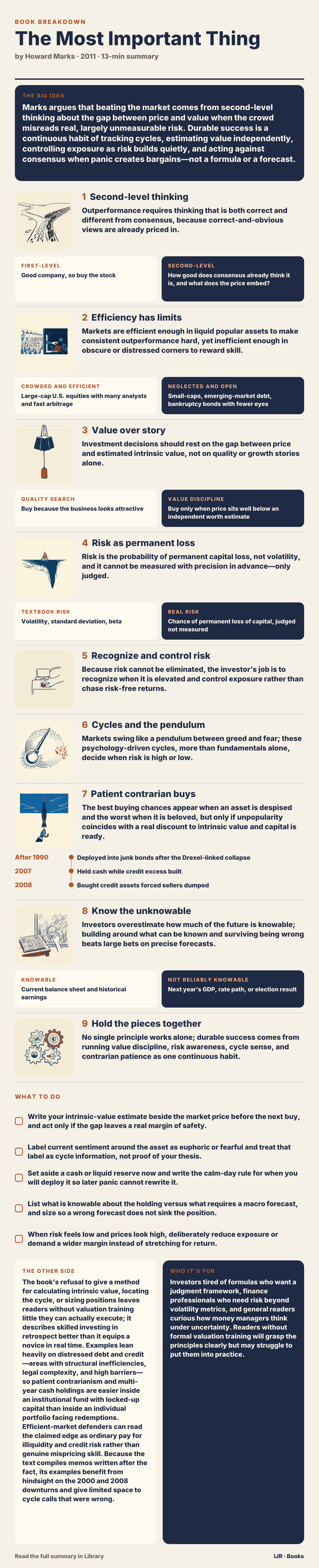
Marks argues that beating the market comes from second-level thinking about the gap between price and value when the crowd misreads real, largely unmeasurable risk. Durable success is a continuous habit of tracking cycles, estimating value independently, controlling exposure as risk builds quietly, and acting against consensus when panic creates bargains—not a formula or a forecast.
The book in brief
Most investors chase good companies, rising prices, or tidy risk numbers. Marks starts from a sharper problem: the market already prices the obvious, so correct-but-common thinking cannot outperform. The opening move is a split between first-level reactions and second-level questions about what consensus already believes and what the current price embeds.
That relative judgment only pays in certain places. In liquid, widely followed markets like large-cap U.S. equities, analysts crowd the same public data and mispricings vanish fast. In obscure, complex, or distressed corners—small-caps, emerging-market debt, bonds of companies in bankruptcy—fewer eyes watch and prices can drift far from worth. The decision rule then becomes the gap between price and an independently estimated intrinsic value, not a story about quality or growth. Momentum and narrative without that anchor, as in the late-1990s internet boom, end when prices collapse toward whatever value actually exists.
Risk itself gets redefined. Volatility is a convenient textbook proxy that treats upside swings like downside ones and says nothing about permanent loss. Real risk is the chance of losing capital for good; it cannot be measured in advance, only judged. It is highest precisely when it feels lowest, because cheap fear has been replaced by expensive confidence.
Because risk cannot be erased, the job is recognition and control. When optimism runs hot and skepticism thins, reduce exposure or demand a wider margin of safety; lean in when fear has already discounted bad outcomes. Markets behave like a pendulum driven more by collective psychology than by fundamentals, overshooting into greed and fear, loosening credit then slamming it shut. A rough sense of where the pendulum sits matters more than calling the exact turn.
The edge appears at emotional extremes if valuation discipline travels with the courage to buy what is despised and the cash to do it. Forecasting next year’s growth, rates, or elections is mostly pretense; portfolios should survive being wrong. None of the pieces works alone. A statistically cheap asset can keep cheapening in a deepening panic; an unpopular asset can stay unpopular for good reason; pure caution earns nothing. Skill is the habit of holding value, risk awareness, cycle sense, and contrarian patience together, judged only across a full cycle.
Context
Marks built the argument from decades of client memos written while running Oaktree, a firm known for distressed debt. The book landed as a practitioner’s pushback against pure efficient-market fatalism and against the industry habit of selling volatility math and precise forecasts as if they captured real danger.
The key ideas

1
Second-level thinking
Outperformance requires thinking that is both correct and different from consensus, because correct-and-obvious views are already priced in.
First-level
Good company, so buy the stock
Second-level
How good does consensus already think it is, and what does the price embed?
A first-level thinker sees a strong company and buys. A second-level thinker asks how good the crowd already thinks it is, whether that view runs too hot or too cold, and what the current price already assumes. If everyone agrees the business is great, the stock likely embeds that greatness and leaves little room to beat the market.
The hard part is not spotting quality. It is holding a view peers will call wrong until results arrive. Most participants, including professionals, still run on first-level narratives and obvious stories.
Superior investing, in this frame, is not finding good assets. It is finding assets whose price diverges from their probability-weighted value. Everything that follows—value work, risk judgment, cycle sense—only matters once that relative standard is locked in.
In practice: A hot growth stock pulls the first-level buyer because growth feels exciting; the second-level buyer asks whether that growth story is already fully priced or overpriced from sheer popularity.

2
Efficiency has limits
Markets are efficient enough in liquid popular assets to make consistent outperformance hard, yet inefficient enough in obscure or distressed corners to reward skill.
Crowded and efficient
Large-cap U.S. equities with many analysts and fast arbitrage
Neglected and open
Small-caps, emerging-market debt, bankruptcy bonds with fewer eyes
In large-cap U.S. equities and other simple, widely followed markets, so many analysts work the same public information that mispricings get arbitraged away quickly. Beating the index after costs there is usually wasted effort.
Efficiency is a matter of degree, not a universal law. In small-caps, emerging-market debt, or bonds of companies in bankruptcy, fewer people pay attention, information is harder to get and parse, and prices can drift far from underlying worth.
The practical move is honest triage: ask which markets are inefficient enough to reward analysis, then concentrate there instead of trying to out-think the most crowded securities.
In practice: Marks’s own career at Oaktree was built on distressed debt—markets other investors avoided out of complexity, stigma, or institutional rules.

3
Value over story
Investment decisions should rest on the gap between price and estimated intrinsic value, not on quality or growth stories alone.
Quality search
Buy because the business looks attractive
Value discipline
Buy only when price sits well below an independent worth estimate
Buying because fundamentals look attractive is a search for quality. Buying because the price sits low relative to calculated worth is value investing. The two get confused constantly.
A wonderful business can be a terrible investment at too high a price; a mediocre business can be an excellent one if bought cheap enough. That requires actually estimating intrinsic value—through discounted cash flows, asset value, or comparables—and treating the estimate as the anchor, not the market quote.
Rising price itself is not evidence of rising value. When narrative and momentum substitute for any calculation of worth, the later collapse simply reveals how little value was ever there.
In practice: In the late-1990s dot-com boom, companies with no earnings and speculative models traded at enormous valuations on momentum and story; when the narrative broke, many prices fell toward near zero.

4
Risk as permanent loss
Risk is the probability of permanent capital loss, not volatility, and it cannot be measured with precision in advance—only judged.
Textbook risk
Volatility, standard deviation, beta
Real risk
Chance of permanent loss of capital, judged not measured
Textbook finance equates risk with volatility—standard deviation or beta—because the math is clean. That definition treats a stock that swings up and down as equal to one that only falls, and it says nothing about the odds of losing money for good.
Real risk is a bad outcome, chiefly permanent loss of capital. It depends on future events and probability distributions that cannot be known with certainty, so it is inherently unmeasurable beforehand.
Risk is highest exactly when it feels lowest. Low perceived risk drives prices up; high prices are what create the conditions for large future losses. A smooth track record may only mean the risk has not yet been tested.
In practice: Before 2008, mortgage-backed securities looked safe, volatility appeared low, and confidence ran high—the exact conditions that quietly built enormous real risk once housing prices fell.

5
Recognize and control risk
Because risk cannot be eliminated, the investor’s job is to recognize when it is elevated and control exposure rather than chase risk-free returns.
Avoiding all risk means avoiding all return; return is pay for bearing uncertainty. The skilled move is to notice when asset prices have run up on optimism and thin skepticism, then reduce exposure or demand a larger margin of safety, and to lean in when fear has pushed prices below reasonable value.
Recognizing elevated risk is not precise market timing. It is adjusting posture to the general climate of price versus value.
Risk control stays invisible in good times and only shows up in bad ones. Managers who take hidden risk look better during a bull run; only the downturn reveals who was actually managing it. Judging skill therefore needs a full cycle, not just a rising market.
In practice: In 2007, with covenant-light loans, aggressive leverage, and complacency about defaults, Oaktree raised cash and pulled back from new commitments well before the crisis hit—not from calling the exact trigger, but because the risk-reward balance had turned unfavorable.

6
Cycles and the pendulum
Markets swing like a pendulum between greed and fear; these psychology-driven cycles, more than fundamentals alone, decide when risk is high or low.
The pendulum almost never rests at a sensible midpoint. It is nearly always swinging toward one extreme or reversing from it. Because the swings come from collective psychology, they overshoot in both directions.
Credit cycles show the pattern cleanly: good times make lenders compete, loosen standards, and lend cheaply; borrowers load up; defaults appear; lenders panic and tighten so hard that even sound borrowers starve.
The investor does not need the exact date of the turn. A working sense of where the pendulum currently sits—whether odds favor caution or aggression—is enough. Assuming today’s boom or bust will last forever is exactly what inflates bubbles and deepens panics.
In practice: The same credit dynamic has recurred from the leveraged-buyout boom of the 1980s to the subprime mortgage boom of the mid-2000s.

7
Patient contrarian buys
The best buying chances appear when an asset is despised and the worst when it is beloved, but only if unpopularity coincides with a real discount to intrinsic value and capital is ready.
- After 1990Deployed into junk bonds after the Drexel-linked collapse
- 2007Held cash while credit excess built
- 2008Bought credit assets forced sellers dumped
Crowd sentiment pushes prices away from underlying value at both extremes. Acting against the crowd means buying when news is bad and everyone around you is selling—uncomfortable, and often looking wrong for a long stretch before it looks right.
Contrarianism without valuation is as dangerous as following the herd. Unpopular alone is not a reason to buy; unpopular and cheap relative to a careful value estimate is.
Most of the time is spent waiting and watching. Concentrated action happens only in the rare windows when price and value diverge sharply. That requires holding cash through good times, when it earns little and looks like a drag, so money is there when forced sellers appear.
In practice: Oaktree raised large distressed-debt funds to deploy after the 1990 junk-bond collapse tied to Drexel’s failure, and again in 2008 when it bought credit assets panicked sellers were dumping regardless of fundamental value.

8
Know the unknowable
Investors overestimate how much of the future is knowable; building around what can be known and surviving being wrong beats large bets on precise forecasts.
Knowable
Current balance sheet and historical earnings
Not reliably knowable
Next year’s GDP, rate path, or election result
Much of the industry pretends macroeconomic and market forecasts are reliable. In practice they are frequently wrong and rarely add more than a coin flip.
Some things are knowable: a company’s current balance sheet, its historical earnings. Some are not reliably knowable: next year’s GDP growth, the path of rates, an election outcome. Strategy should lean on the first set and stay humble about the second.
That humility is not passivity. Conviction still matters, but it should attach to relative value and probability ranges, not to pinpoint predictions of events no one can see. Portfolios need margin of safety, limited leverage, and room to survive more than one macro path.
In practice: Mainstream forecasters almost universally failed to predict the severity of the 2008 crisis in advance, despite sharing the same data everyone else had.

9
Hold the pieces together
No single principle works alone; durable success comes from running value discipline, risk awareness, cycle sense, and contrarian patience as one continuous habit.
A value investor who ignores cycle position can buy statistically cheap assets that keep getting cheaper as fear deepens. A contrarian who ignores valuation can buy unpopular assets that are unpopular for good reason and never recover. A risk-conscious investor who never acts contrarian sits in cash through every opportunity and earns weak long-run returns.
The working posture is constant awareness of where the market sits in its cycle, continuous reassessment of intrinsic value as news arrives, position sizes matched to honestly judged permanent-loss risk, and the emotional and financial capacity to move countercyclically when gaps open wide.
Outcomes stay noisy. A good decision can still produce a bad short-term result; a bad decision can look brilliant through luck. Skill shows only across a long horizon and many decisions, not one trade or one year.
In practice: Marks closes by noting that many things can be called the most important thing; the real skill is integrating all of them into a coherent, repeatable process instead of hunting for one dominant rule.
Key terms
- Second-level thinking A view that is not only correct but different from what consensus already believes and has priced in.
- First-level thinking Reacting to the obvious narrative—good company, buy—without asking what the price already reflects.
- Intrinsic value An independent estimate of worth from cash flows, assets, or comparables, used as the anchor instead of market price.
- Margin of safety A wide enough gap between price and estimated value to leave room for being wrong.
- Permanent loss of capital Marks’s definition of real risk, as opposed to temporary price swings or volatility.
- Pendulum The market’s tendency to swing between psychological extremes of greed and fear rather than rest at a sensible midpoint.
- Patient opportunism Waiting with reserves through ordinary times and acting in concentrated fashion only when price and value diverge sharply.
- Dry powder Cash or liquid reserves held in good times so capital is available when forced sellers appear.
What to do
- Write your intrinsic-value estimate beside the market price before the next buy, and act only if the gap leaves a real margin of safety.
- Label current sentiment around the asset as euphoric or fearful and treat that label as cycle information, not proof of your thesis.
- Set aside a cash or liquid reserve now and write the calm-day rule for when you will deploy it so later panic cannot rewrite it.
- List what is knowable about the holding versus what requires a macro forecast, and size so a wrong forecast does not sink the position.
- When risk feels low and prices look high, deliberately reduce exposure or demand a wider margin instead of stretching for return.
Questions to think with
- Is this price embedding a consensus view that is too optimistic or too pessimistic?
- Where does the pendulum sit right now—greed, fear, or the middle—and what does that imply for posture?
- What would permanent loss look like here, and how much of it can the portfolio actually bear?
- Am I buying because the asset is unpopular, or because it is unpopular and cheap relative to a real value estimate?
- Which parts of my thesis depend on a forecast I cannot actually know?
The other side
The book’s refusal to give a method for calculating intrinsic value, locating the cycle, or sizing positions leaves readers without valuation training little they can actually execute; it describes skilled investing in retrospect better than it equips a novice in real time. Examples lean heavily on distressed debt and credit—areas with structural inefficiencies, legal complexity, and high barriers—so patient contrarianism and multi-year cash holdings are easier inside an institutional fund with locked-up capital than inside an individual portfolio facing redemptions. Efficient-market defenders can read the claimed edge as ordinary pay for illiquidity and credit risk rather than genuine mispricing skill. Because the text compiles memos written after the fact, its examples benefit from hindsight on the 2000 and 2008 downturns and give limited space to cycle calls that were wrong.
Who it's for
Investors tired of formulas who want a judgment framework, finance professionals who need risk beyond volatility metrics, and general readers curious how money managers think under uncertainty. Readers without formal valuation training will grasp the principles clearly but may struggle to put them into practice.