




Time is thinner and stranger than your clocks suggest
Rovelli argues that a shared present, a fixed rate, and a built-in arrow are human-scale artifacts, not bedrock features of the universe.
IJR · Oct 22, 2026 · 13 min read
In 60 seconds
- There is no universal 'now'; simultaneity depends on an observer's motion, and vast regions of events sit outside any clear past or future relative to you.
- Clocks tick at different rates under gravity and velocity, so time is a patchwork of local rates rather than one cosmic metronome.
- Fundamental laws run equally well backward; they contain no arrow from past to future.
- The arrow we feel is statistical entropy rising from a low-entropy past, made meaningful by our coarse-grained blur.
- In some quantum-gravity formulations the time variable drops out entirely, and time only emerges at larger scales from events and relations.
- Memory weaves a continuous self from entropic traces, so the observer of time is built from the same processes that produce its flow.
The big idea
Rovelli argues that the properties we treat as essential to time—a single present, a uniform rate, an intrinsic direction, even fundamental existence—fail under relativity, thermodynamics, and quantum gravity. What remains is a layered, relational, perspective-dependent phenomenon that emerges from entropy, blur, and memory rather than running underneath reality as a cosmic river.
The book in brief
Rovelli begins with the everyday picture of time as a uniform river that carries a shared present from past to future, then dismantles that picture one assumed property at a time. Relativity removes the cosmic now and the single rate: observers in relative motion disagree about which distant events are simultaneous, and gravity and velocity change how fast local clocks tick. The next cut is deeper. The core equations of physics work the same run backward, so the one-way feel of experience is not handed to us by fundamental law.
That gap becomes the book's central puzzle. Thermodynamics supplies Rovelli's answer: entropy tends to rise from a special low-entropy past, and that statistical drift is what we register as time's arrow. Entropy, though, is defined relative to which macroscopic variables an observer tracks. Because we only perceive blurred averages of a microscopic world, our own limited vantage helps generate the sense of a flowing present.
The argument then reaches the unsettled frontier of quantum gravity. In formulations Rovelli favors, the time variable disappears from the basic equations; reality at that level is events and relations without an external clock, and time as we know it only emerges at coarser scales. Finally the book turns from physics to the human interior. Memory links past traces to present experience and builds the continuous self that feels duration; that process itself depends on irreversible entropic change. The close is philosophical: if time is less rigid and less fundamental than intuition insists, the emotional weight of loss, aging, and mortality might loosen without denying that change and death remain real.
Context
Carlo Rovelli is a theoretical physicist working in quantum gravity. The book mattered because it translated frontier physics into a meditation on how little our felt experience of time corresponds to what the equations describe.
The key ideas
1
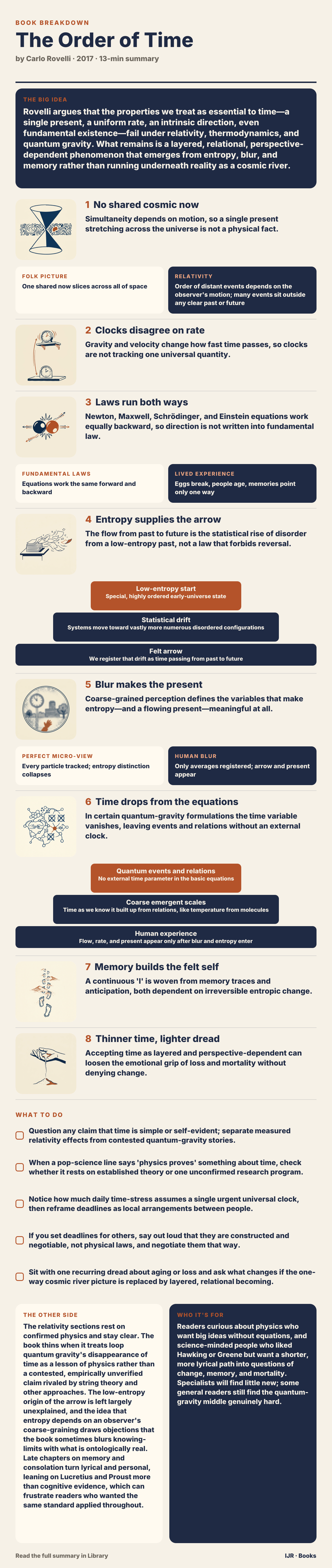
No shared cosmic now
Simultaneity depends on motion, so a single present stretching across the universe is not a physical fact.
Folk picture
One shared now slices across all of space
Relativity
Order of distant events depends on the observer's motion; many events sit outside any clear past or future
Rovelli opens by attacking the most basic assumption people carry: that one present moment exists everywhere at once. Special relativity showed that two events simultaneous for a stationary observer can fall in different orders for someone moving relative to them. This is not instrument error; it is built into spacetime.
Each event has a past light cone of possible causes and a future cone of possible effects, plus a vast region that is neither definitively past nor future relative to it. In that region temporal order is genuinely ambiguous. If there is no fact of the matter about which distant events are happening now, the folk idea of a cosmic present cannot be sustained.
What feels like an objective global now is a parochial feature of human scales, where light is so fast that simultaneity seems obvious. The chapter sets the book's method: take a natural time-intuition and show it is a product of limited vantage, not deep structure.
In practice: Two events that look simultaneous to someone standing still can appear sequential to someone moving at high speed relative to them.
2
Clocks disagree on rate
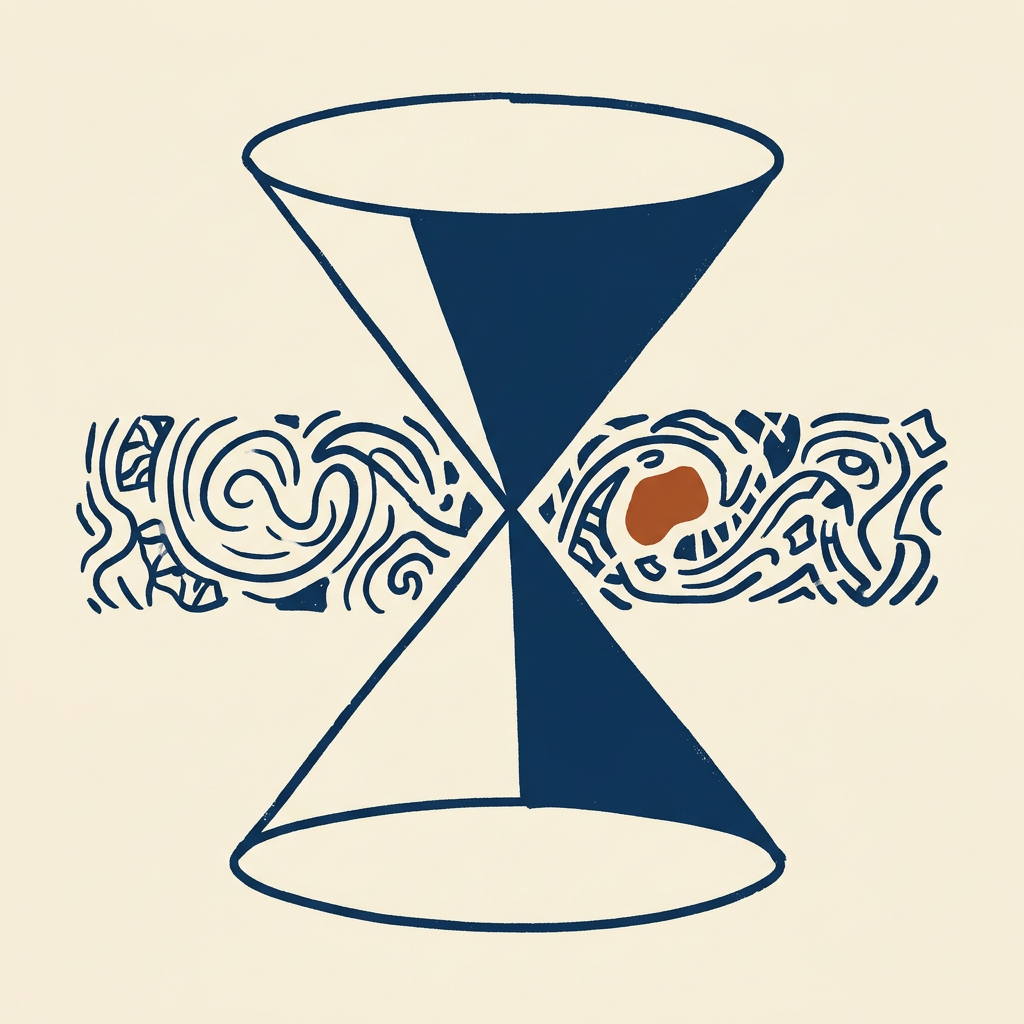
Gravity and velocity change how fast time passes, so clocks are not tracking one universal quantity.
Building on the lost universal present, Rovelli turns to rate. Gravity slows time: a clock at sea level ticks slightly slower than one on a mountaintop because it sits deeper in Earth's field. Even a clock on a room's floor runs marginally slower than one on a shelf above it. These differences have been measured with atomic clocks at different altitudes after only hours.
Velocity does the same: a moving clock runs slower than a stationary one, confirmed in particle accelerators. GPS satellites must correct their onboard clocks or navigation would drift by kilometers per day, since weaker gravity at altitude makes satellite clocks run faster than ground clocks.
The cumulative point is sharp. There is no single metronome behind the scenes that all clocks merely read. Time is a local, variable phenomenon tied to position and motion—a patchwork of rates, not one cosmic river.
In practice: GPS satellite clocks must be corrected for weaker gravity at altitude, or daily navigation would drift by kilometers.
3
Laws run both ways
Newton, Maxwell, Schrödinger, and Einstein equations work equally backward, so direction is not written into fundamental law.
Fundamental laws
Equations work the same forward and backward
Lived experience
Eggs break, people age, memories point only one way
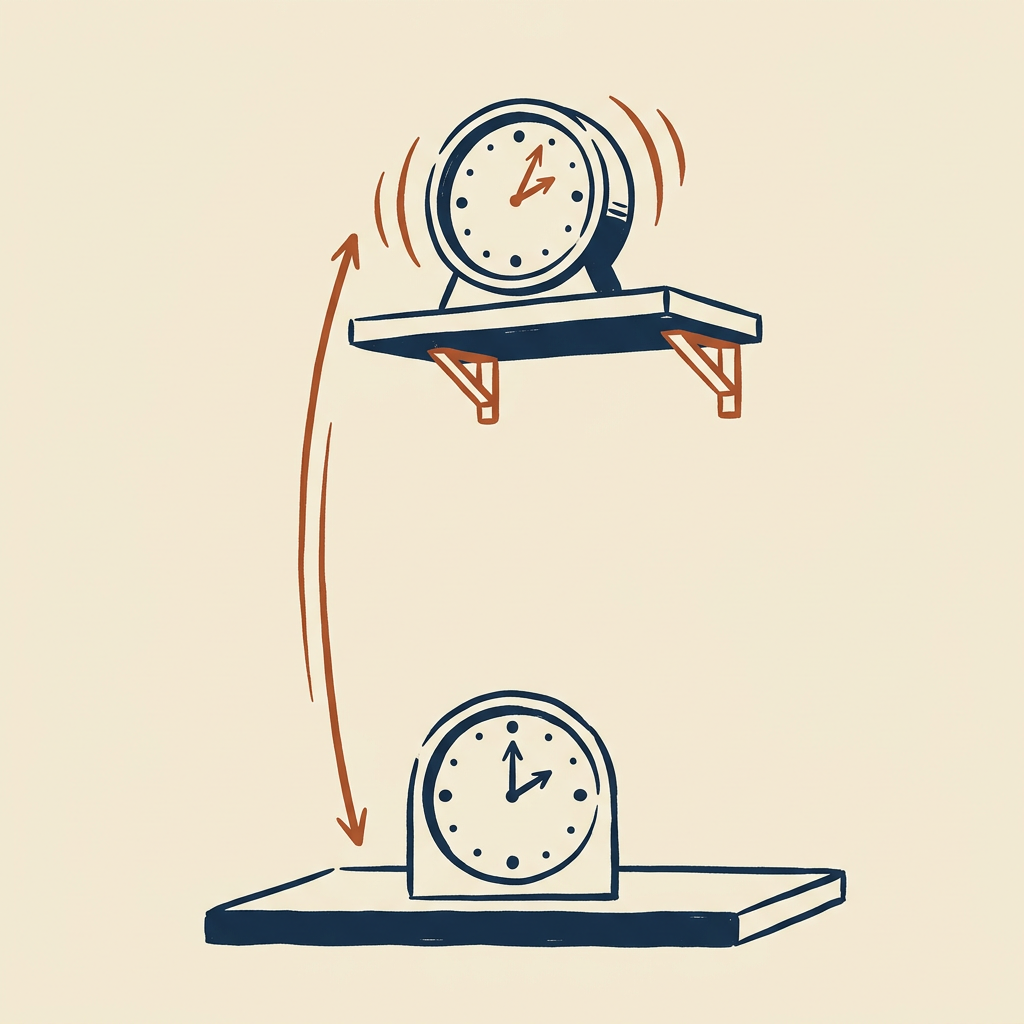
After present and rate, Rovelli attacks the arrow itself. Nearly all fundamental equations look the same run in reverse. A film of two billiard balls colliding is physically plausible forward or backward. Nothing in those laws marks which direction is correct.
Yet experience is lopsided: eggs break and do not unbreak, people age and do not grow younger, memories point only one way. Rovelli treats the asymmetry as real but insists its source is not the basic equations. He rejects the shrug that the arrow is simply obvious and needs no explanation.
The chapter is a hinge. Earlier sections showed physics stranger than intuition; this one reveals that even the most obvious property of time is not free from physics. The answer, he signals, will come from statistics and the early universe's peculiar state, not from deeper time-asymmetric laws.
In practice: A film of billiard balls colliding looks lawful whether played forward or in reverse.

4
Entropy supplies the arrow
The flow from past to future is the statistical rise of disorder from a low-entropy past, not a law that forbids reversal.
- Low-entropy startSpecial, highly ordered early-universe state
- Statistical driftSystems move toward vastly more numerous disordered configurations
- Felt arrowWe register that drift as time passing from past to future
Rovelli resolves the symmetry puzzle with thermodynamics. Entropy counts the microscopic configurations consistent with a macroscopic state. A tidy room has far fewer arrangements than a messy one, so closed systems drift toward higher entropy simply because messy configurations vastly outnumber tidy ones.
A broken egg does not reassemble not because reversal is forbidden, but because it is staggeringly improbable given the astronomical number of disordered states. Rovelli locates time's arrow here: the universe began in very low entropy, and what we call time passing is the record of entropy increasing away from that special start.
Crucially, entropy depends on perspective—on which macroscopic variables an observer chooses to track. A configuration disordered under one description can look ordered under another. The arrow is therefore partly a function of our coarse-grained way of interacting with a universe of far more detail than we can follow. This is the book's most radical thermodynamic claim: directionality is not a property of the universe as such, but an artifact of blurred viewpoint meeting a low-entropy past.
In practice: A broken egg never reassembles because disordered configurations outnumber the ordered one by an astronomical margin, not because physics forbids the reverse.
5
Blur makes the present
Coarse-grained perception defines the variables that make entropy—and a flowing present—meaningful at all.
Perfect micro-view
Every particle tracked; entropy distinction collapses
Human blur
Only averages registered; arrow and present appear
Extending the entropy argument, Rovelli names the blur at the heart of human time. We are macroscopic beings of trillions of particles. We cannot track exact microscopic states; we register averages—temperature, pressure, a face's shape, a voice—rather than every atom's position and momentum.
That blurring is what lets entropy matter. Entropy measures microstates hidden behind a macrostate. If nothing were hidden, the distinction would collapse and the increase of entropy would not apply in the same way. Limited observers therefore help generate the phenomenon of a present and a flow.
Beings that tracked every particle would not experience before-and-after as we do, because the statistical asymmetry depends on which details are left out. Time's flow is neither purely objective nor purely illusory; it is relational, emerging from a complex universe interacting with a limited observer inside it.
In practice: We feel temperature and the shape of a face rather than the position and momentum of every atom involved; that averaging is what makes entropy—and flow—show up.
6
Time drops from the equations
In certain quantum-gravity formulations the time variable vanishes, leaving events and relations without an external clock.
- Quantum events and relationsNo external time parameter in the basic equations
- Coarse emergent scalesTime as we know it built up from relations, like temperature from molecules
- Human experienceFlow, rate, and present appear only after blur and entropy enter
Rovelli pushes to his own field. In some approaches that try to unify general relativity with quantum mechanics, including loop quantum gravity, the variable for time drops out of the fundamental equations describing the quantum gravitational field. Physicists call this the problem of time.
Instead of objects existing at successive moments, the candidate picture is elementary quantum processes that relate to each other directly, without embedding in an independent ticking background. Time as we know it would then emerge only at larger, coarser scales—much as temperature emerges from molecular collectives without belonging to any single molecule.
He ties this back to entropy and blur: if time is already a product of statistical, perspective-dependent description, it makes sense that at the deepest level, where those macroscopic conditions fail, time as a distinct entity is absent. He flags the frontier as unsettled and speculative; loop quantum gravity is one candidate among several, empirically unverified, and the problem of time remains openly debated.
In practice: Formulations of the quantum state of the gravitational field can contain no time variable at all, a technical feature physicists call the problem of time.
7
Memory builds the felt self
A continuous 'I' is woven from memory traces and anticipation, both dependent on irreversible entropic change.
Having stripped time of present, rate, direction, and fundamental status, Rovelli asks why it still feels vivid and personal. His answer centers on memory and anticipation. The brain links traces of the past with expectations about the future, weaving a narrative experienced as a coherent self moving through duration.
Without memory there would be only disconnected instants. Conditions that damage memory, such as certain amnesias, show how thin the line is between a temporally extended self and its loss. Memory is itself physical and irreversible: storing a trace requires an entropic change, so the capacity to feel time flowing is a byproduct of the same one-way processes described earlier.
The loop is tight. Entropy creates an arrow; the arrow enables irreversible memory; memory creates a self that experiences the arrow as personal time. The self is not a fixed entity riding an independent river, but a process built from temporal, entropic events and inseparable from the time it seems to watch.
In practice: Certain forms of amnesia show how quickly a temporally extended self thins when memory's link between traces and present experience breaks.
8
Thinner time, lighter dread
Accepting time as layered and perspective-dependent can loosen the emotional grip of loss and mortality without denying change.
The closing movement shifts toward consolation. If time has no universal present, fixed rate, built-in direction, or basic quantum existence, then much of the dread people load onto its passage rests on a picture physics does not support.
Rovelli does not claim loss or death stop mattering. He suggests that seeing time as emergent and relational rather than an implacable cosmic force can change the emotional stance toward it. He draws on personal grief and on Lucretius, who eased fear of nonexistence by noting the symmetry between not-yet-being-born and being dead.
The scientifically grounded version is that the sharp split of past, present, and future is not deep structure. Felt one-way sweep is built from entropy, memory, and blur. Change and finality remain real, but they sit inside a relational web of happenings rather than a scene of a self carried off by a hostile independent flow. After dismantling time property by property, the last offer is a calmer posture toward aging and finitude.
In practice: Lucretius eased fear of nonexistence by pointing to the symmetry between the time before birth and the time after death.
Key terms
- light cones For any event, the past cone of possible causes and future cone of possible effects; outside them temporal order is ambiguous.
- simultaneity Whether two distant events count as 'at the same time'; relativity makes this depend on the observer's motion.
- entropy A count of microscopic configurations consistent with a macroscopic state; it tends to rise and, for Rovelli, sources time's arrow.
- blur Our coarse-grained grasp of averages rather than every particle; the limitation that makes entropy and flow show up for us.
- arrow of time The one-way feel from past to future; absent from fundamental laws and located in rising entropy plus perspective.
- problem of time In some quantum-gravity equations the time variable disappears, leaving no external clock at the fundamental level.
- loop quantum gravity Rovelli's candidate framework in which spacetime is quantized and time may not appear as a basic ingredient.
- coarse-graining Choosing which macroscopic variables to track; entropy and the arrow depend on that choice.
What to do
- Question any claim that time is simple or self-evident; separate measured relativity effects from contested quantum-gravity stories.
- When a pop-science line says 'physics proves' something about time, check whether it rests on established theory or one unconfirmed research program.
- Notice how much daily time-stress assumes a single urgent universal clock, then reframe deadlines as local arrangements between people.
- If you set deadlines for others, say out loud that they are constructed and negotiable, not physical laws, and negotiate them that way.
- Sit with one recurring dread about aging or loss and ask what changes if the one-way cosmic river picture is replaced by layered, relational becoming.
Questions to think with
- If there is no shared cosmic now, what exactly are you sharing when you agree to meet someone 'at the same time'?
- Would a being that tracked every particle still experience before and after the way you do?
- Where do you personally feel the arrow most—memory, aging, unfinished plans—and what happens if that feeling is entropic rather than metaphysical?
- How much of your fear of death depends on picturing time as an external conveyor belt rather than a relational process?
- Which of Rovelli's moves feels solid to you (relativity, entropy) and which feels like a leap (quantum gravity, consolation)?
The other side
The relativity sections rest on confirmed physics and stay clear. The book thins when it treats loop quantum gravity's disappearance of time as a lesson of physics rather than a contested, empirically unverified claim rivaled by string theory and other approaches. The low-entropy origin of the arrow is left largely unexplained, and the idea that entropy depends on an observer's coarse-graining draws objections that the book sometimes blurs knowing-limits with what is ontologically real. Late chapters on memory and consolation turn lyrical and personal, leaning on Lucretius and Proust more than cognitive evidence, which can frustrate readers who wanted the same standard applied throughout.
Who it's for
Readers curious about physics who want big ideas without equations, and science-minded people who liked Hawking or Greene but want a shorter, more lyrical path into questions of change, memory, and mortality. Specialists will find little new; some general readers still find the quantum-gravity middle genuinely hard.