




Venture capital thrives on rare outliers, not safe bets
Founders, allocators, and anyone curious about how Silicon Valley’s money machine really works get a clear map of the logic behind it.
IJR · Nov 1, 2026 · 13 min read
In 60 seconds
- Venture returns follow a power law: a few extreme winners make the fund while most bets fail or limp home.
- Arthur Rock invented equity-plus-guidance financing that banks would not offer unproven tech founders.
- Kleiner Perkins won by coaching operators; Sequoia won by sizing markets before founder charisma.
- A 1979 ERISA shift let pensions and endowments flood patient capital into the asset class.
- The same outlier logic funded Google-scale wins and Webvan’s roughly billion-dollar collapse.
- SoftBank’s giant checks produced Alibaba’s historic return and WeWork’s $47B cautionary crash.
The big idea
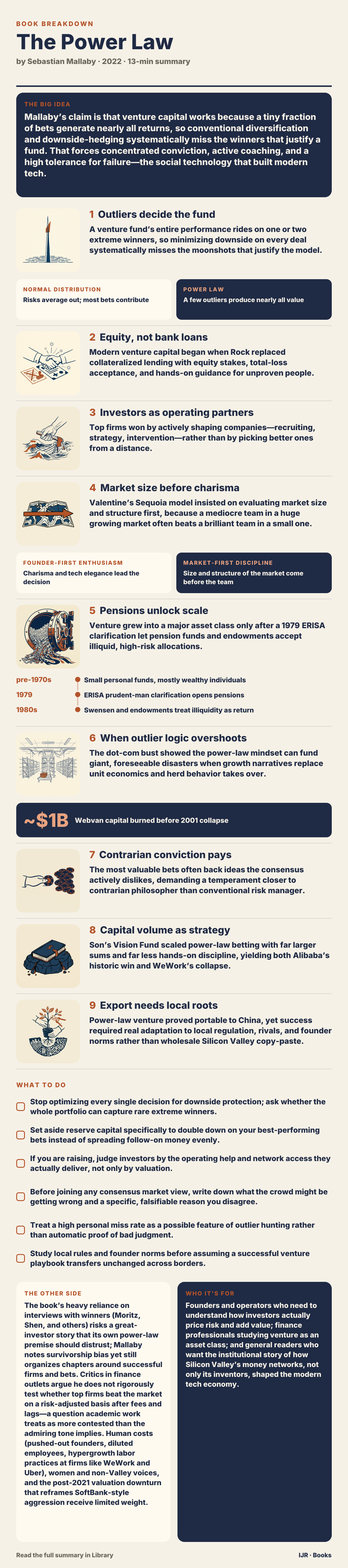
Mallaby’s claim is that venture capital works because a tiny fraction of bets generate nearly all returns, so conventional diversification and downside-hedging systematically miss the winners that justify a fund. That forces concentrated conviction, active coaching, and a high tolerance for failure—the social technology that built modern tech.
The book in brief
Mallaby starts from the statistical shape that names the book. In venture portfolios a handful of positions produce almost all the value; most fail or return little. That power-law pattern, the same one seen in earthquakes and city sizes, makes banker-style caution the wrong tool. Investors must place many bets, accept heavy losses, and pour more capital into the few that show outlier potential.
He then traces the invention of the craft. In 1957 Arthur Rock helped the Traitorous Eight leave Shockley to form Fairchild Semiconductor and later backed Intel. Banks would not lend against speculative tech with no collateral. Rock’s move was to take equity, treat total loss as normal, and give active guidance—creating a trust-based investor-founder bond rather than a loan.
The model matured on Sand Hill Road. Kleiner Perkins, founded in 1972, turned the investor into a near co-founder who recruited executives and steered strategy at Tandem and Genentech. Sequoia, also 1972, added Don Valentine’s harder market-size discipline: a mediocre team in a huge market often beats brilliance in a small one. Tension over founder control versus board rights grew as firms professionalized, later visible when Sequoia backed Google’s founders yet still installed experienced management.
Capital plumbing mattered as much as judgment. Before the 1970s funds were small and personal. A 1979 Labor Department clarification of ERISA’s prudent-man rule let pension funds and endowments treat venture as a legitimate slice of a diversified portfolio. Managers such as Yale’s David Swensen treated illiquidity as a source of extra return, scaling the industry far beyond angel checks.
The same logic produced disasters. Late-1990s money poured into Webvan and Pets.com on growth narratives rather than unit economics; Webvan burned roughly a billion dollars and collapsed by 2001. Peter Thiel’s contrarian style—backing PayPal and a 2004 half-million-dollar Facebook stake when social networking looked like a fad—showed the upside of disagreeing with the crowd. SoftBank’s Masayoshi Son pushed the model to extremes: a twenty-million-dollar Alibaba bet in 2000 became worth well over fifty billion, yet the hundred-billion-dollar Vision Fund’s flood of capital into WeWork inflated a valuation toward forty-seven billion before the failed 2019 IPO exposed the cracks. Finally the model traveled to China via Sequoia China under Neil Shen, proving the core of high-conviction outlier bets could export, but only with local adaptation of regulation, governance, and founder norms.
Context
Sebastian Mallaby’s 2022 narrative history draws on extensive access to leading venture capitalists. It arrived as a full institutional account of how a small network of investors, not only inventors, helped produce the modern tech economy across seven decades.
The key ideas

1
Outliers decide the fund
A venture fund’s entire performance rides on one or two extreme winners, so minimizing downside on every deal systematically misses the moonshots that justify the model.
Normal distribution
Risks average out; most bets contribute
Power law
A few outliers produce nearly all value
Returns in these portfolios do not follow a neat bell curve. A handful of investments produce nearly all the value; most fail outright or crawl back little. Mallaby links the pattern to the same statistical shape seen in earthquakes and city sizes—extreme events dominate the total.
The practical consequence flips ordinary finance. A banker or public-market investor who tries to protect every position against loss will avoid precisely the high-variance bets that carry the fund. The working discipline is the opposite: make many bets, treat failure as a normal feature, and keep dry powder to double down hard on the few that begin to look exceptional.
That requirement shapes investor psychology. Someone who bats .900 at avoiding losers is probably also batting away the outliers. Comfort with a high failure rate becomes a job skill, not a character flaw.
The rest of the book is essentially a history of institutions built to live inside that unpredictability.
In practice: Sequoia’s single WhatsApp position returned more than the entire fund it came from, many times over.

2
Equity, not bank loans
Modern venture capital began when Rock replaced collateralized lending with equity stakes, total-loss acceptance, and hands-on guidance for unproven people.
Commercial banks would not finance speculative technology that offered no collateral and no predictable cash flow. In 1957 Rock helped engineer the departure of the Traitorous Eight from Shockley Semiconductor to found Fairchild; in 1968 he helped finance Intel.
His real invention was the relationship itself. The financier took equity, treated wipe-out as a normal possible outcome, and offered active counsel rather than passive money. That separated venture investing from both conventional lending and public equity, both of which assumed some predictability of return.
Rock also set the personal style that defined the Valley for decades: he backed people he already trusted, often before a product, a market, or a finished plan existed. Mallaby treats this as social technology—norms and relationships that made capital available to unproven founders attempting unproven things.
Geography helped the culture stick. Stanford engineering talent and California’s reluctance to enforce noncompete agreements let engineers move freely and start their own firms.
In practice: Rock’s backing of the Traitorous Eight’s Fairchild Semiconductor and later Intel showed equity-plus-guidance where banks saw only unlendable risk.

3
Investors as operating partners
Top firms won by actively shaping companies—recruiting, strategy, intervention—rather than by picking better ones from a distance.
Eugene Kleiner and Tom Perkins launched Kleiner Perkins in 1972 with a hands-on creed. Perkins believed venture capitalists should act almost as co-founders: hire executives, set direction, and step into troubled operations.
Technical founders often lacked the managerial and commercial experience needed to scale. Firms that supplied real operating help, not just checks, produced better outcomes and could justify larger equity stakes.
The coaching edge proved hard to buy from outside. Sand Hill Road in Menlo Park became the physical cluster where deal flow, failed founders ready to try again, specialized lawyers, and recruiters concentrated. An outsider with capital still lacked that density of relationships.
Venture advantage therefore fused with geography and accumulated trust networks.
In practice: Perkins stayed deeply involved in shaping Tandem Computers; Kleiner Perkins helped turn recombinant-DNA science into commercial Genentech.

4
Market size before charisma
Valentine’s Sequoia model insisted on evaluating market size and structure first, because a mediocre team in a huge growing market often beats a brilliant team in a small one.
Founder-first enthusiasm
Charisma and tech elegance lead the decision
Market-first discipline
Size and structure of the market come before the team
Don Valentine, a former semiconductor salesman, founded Sequoia the same year as Kleiner Perkins but brought a harder analytic edge. He sized the market a startup was entering before he weighed founder charm or technical elegance.
That discipline complicated pure relationship investing. Sequoia still relied on network access to deals, yet filtered those deals through an almost financial-analyst lens on competitive position and market scale.
As firms professionalized, a second tension sharpened: investors wanted governance rights and board control to protect capital; founders wanted to keep authority over their own companies. Institutional maturity meant learning to balance market and governance discipline against enough autonomy that visionary founders would not simply walk to a rival firm.
The combination—relationship access plus ruthless market filters—became Sequoia’s signature.
In practice: Valentine’s backing of Atari and later Cisco reflected market-first logic; decades later Sequoia backed Google’s founders while still installing Eric Schmidt as experienced management.

5
Pensions unlock scale
Venture grew into a major asset class only after a 1979 ERISA clarification let pension funds and endowments accept illiquid, high-risk allocations.
- pre-1970sSmall personal funds, mostly wealthy individuals
- 1979ERISA prudent-man clarification opens pensions
- 1980sSwensen and endowments treat illiquidity as return
Early venture funds were small and personal, financed largely by wealthy individuals. That capital base could not fund the volume or size of startups that later defined the tech boom.
The Labor Department’s 1979 clarification of the prudent-man rule under ERISA changed the plumbing. Managers had feared legal liability for risky private bets; once regulators said a diversified portfolio could include high-risk venture slices without breaching fiduciary duty, institutional money began to flow.
Endowment managers, notably David Swensen at Yale from the 1980s, treated the illiquidity of ten-year-plus venture funds as a source of extra return rather than pure risk. Patient capital at scale arrived.
Mallaby treats this regulatory and institutional shift as an under-appreciated cause of Silicon Valley’s rise: individual angels and small partnerships alone could not have carried the sector’s expansion.
In practice: After the 1979 rule shift, Swensen’s Yale endowment approach helped normalize meaningful institutional allocations to venture and private equity.

6
When outlier logic overshoots
The dot-com bust showed the power-law mindset can fund giant, foreseeable disasters when growth narratives replace unit economics and herd behavior takes over.
~$1B
Webvan capital burned before 2001 collapse
In the late 1990s firms poured capital into companies such as Webvan and Pets.com on stories of rapid market capture rather than sound fundamentals. The same willingness to back improbable upside that produces a Google can also produce look-alike bets no one wants to miss.
Webvan raised enormous sums to build automated grocery warehouses years before logistics and consumer behavior could support the model. It collapsed by 2001 after burning through roughly a billion dollars. Prominent firms, including Kleiner Perkins under John Doerr, were swept into the enthusiasm.
Mallaby does not discard the power-law approach. He argues it still requires genuine judgment about which bets carry real asymmetric upside versus which are expensive lottery tickets wrapped in momentum. The crash wiped out paper wealth, pushed out weaker entrants, and left more disciplined firms to shape the next decade’s leaner Web 2.0 companies.
Failure, in this telling, is both a feature of the model and a periodic corrective when discipline slips.
In practice: Webvan’s automated warehouses and roughly billion-dollar burn ended in collapse by 2001; Pets.com followed the same growth-without-economics pattern.

7
Contrarian conviction pays
The most valuable bets often back ideas the consensus actively dislikes, demanding a temperament closer to contrarian philosopher than conventional risk manager.
Peter Thiel’s early PayPal work and later investing illustrate a distinct style inside the power-law frame: deliberate disagreement with the crowd. His guiding question—what important truth do very few people agree with you on—seeks ideas that look obviously bad or overhyped to the mainstream yet rest on a specific, defensible insight.
If the biggest returns come from rare outliers, and outliers by definition defy consensus, then agreeing with the crowd’s view of a startup is itself a warning you may be missing the extreme case.
The PayPal alumni network that followed—founders and funders who seeded many of the next decade’s major companies—also reinforced Mallaby’s earlier point about dense founder-investor webs.
He notes the survivorship trap: for every celebrated contrarian win, many equally contrarian bets fail and vanish from memory, making the philosophy hard to falsify in hindsight.
In practice: Thiel’s 2004 investment of five hundred thousand dollars in Facebook came when many still saw social networking as a fad after Friendster and MySpace.

8
Capital volume as strategy
Son’s Vision Fund scaled power-law betting with far larger sums and far less hands-on discipline, yielding both Alibaba’s historic win and WeWork’s collapse.
Masayoshi Son’s twenty-million-dollar investment in Alibaba in 2000 grew into a stake worth well over fifty billion dollars—arguably the single greatest venture return on record. That success convinced him scale itself could be the strategy: if rare giant winners drive returns, then flooding companies with unprecedented capital should manufacture more of them.
The hundred-billion-dollar Vision Fund launched in 2017 wrote checks of tens or hundreds of millions. With WeWork, SoftBank poured billions into Adam Neumann’s company despite flawed unit economics and governance, inflating valuation toward forty-seven billion dollars. The failed 2019 IPO attempt exposed the fragility, collapsed the value, and forced Neumann’s exit.
In Son’s version, the coaching and market discipline that Kleiner Perkins and Sequoia had built were replaced by sheer capital volume. Money could force market dominance; it could also insulate a founder from the ordinary checks that limit mismanagement.
Mallaby presents this as a genuine mutation of the power-law idea—one that produced enormous winners and enormous losses at once—and leaves open whether relationship-based judgment still beats pure capital intensity.
In practice: Son’s $20 million Alibaba stake became worth $50B-plus; WeWork’s SoftBank-fueled valuation neared $47 billion before the 2019 IPO failure.

9
Export needs local roots
Power-law venture proved portable to China, yet success required real adaptation to local regulation, rivals, and founder norms rather than wholesale Silicon Valley copy-paste.
Sequoia Capital China under Neil Shen and other firms that entered Chinese markets in the 2000s showed the core logic was not uniquely American. Early bets on companies that became major players in Chinese e-commerce and technology demonstrated that concentrated, high-conviction bets on people, plus acceptance of high failure rates, could travel.
Simple replication failed. Chinese investors had to navigate different state regulatory relationships, faster-moving domestic competitors, and different founder expectations around control and governance. Board structures, coaching styles, and exit paths had to flex.
This undercuts any claim that noncompete law or Stanford’s pipeline were strict necessary conditions. The portable heart is the willingness to make outlier bets and live with the miss rate; the institutional shell around that heart is local.
The same chapter notes the geopolitical turn: firms such as Sequoia China helped fund companies central to a rival technology ecosystem, complicating earlier celebratory national narratives.
In practice: Neil Shen’s Sequoia China early bets on what became major Chinese e-commerce and technology players required local navigation of state ties and founder control norms.
Key terms
- Power law The skewed return pattern where a few extreme winners produce nearly all of a venture fund’s value while most bets fail or return little.
- Coach-investor The hands-on model in which the venture firm acts like a co-founder—recruiting, strategy, intervention—not a passive check-writer.
- Prudent man rule (ERISA 1979) The regulatory clarification that let pension managers include high-risk venture allocations inside a diversified portfolio without automatic fiduciary breach.
- Contrarian conviction Backing ideas the consensus dislikes because of a specific, defensible insight that the crowd is underpricing an outlier.
- Vision Fund model Using unprecedented capital volume itself as the strategy to force market winners, with less traditional coaching and market discipline.
- Social technology The norms, trust networks, and investor-founder relationships that make capital available to unproven people doing unproven things.
- Reserve / double-down capital Dry powder kept specifically to add aggressively to the few bets that begin to show outlier potential rather than spreading follow-ons evenly.
- Founder control tension The recurring push-pull between investor governance rights that protect capital and founder autonomy that keeps visionaries from leaving.
What to do
- Stop optimizing every single decision for downside protection; ask whether the whole portfolio can capture rare extreme winners.
- Set aside reserve capital specifically to double down on your best-performing bets instead of spreading follow-on money evenly.
- If you are raising, judge investors by the operating help and network access they actually deliver, not only by valuation.
- Before joining any consensus market view, write down what the crowd might be getting wrong and a specific, falsifiable reason you disagree.
- Treat a high personal miss rate as a possible feature of outlier hunting rather than automatic proof of bad judgment.
- Study local rules and founder norms before assuming a successful venture playbook transfers unchanged across borders.
Questions to think with
- Would you rather bat .900 at avoiding losers or accept many failures to catch one fund-returning outlier?
- How much of celebrated venture success is repeatable skill versus luck and survivorship bias after the fact?
- When does flooding a company with capital create a winner, and when does it only hide broken unit economics?
- What operational help do you actually need from an investor that pure valuation terms cannot replace?
- Can the power-law core travel to any market, or do trust networks and local rules remain decisive?
The other side
The book’s heavy reliance on interviews with winners (Moritz, Shen, and others) risks a great-investor story that its own power-law premise should distrust; Mallaby notes survivorship bias yet still organizes chapters around successful firms and bets. Critics in finance outlets argue he does not rigorously test whether top firms beat the market on a risk-adjusted basis after fees and lags—a question academic work treats as more contested than the admiring tone implies. Human costs (pushed-out founders, diluted employees, hypergrowth labor practices at firms like WeWork and Uber), women and non-Valley voices, and the post-2021 valuation downturn that reframes SoftBank-style aggression receive limited weight.
Who it's for
Founders and operators who need to understand how investors actually price risk and add value; finance professionals studying venture as an asset class; and general readers who want the institutional story of how Silicon Valley’s money networks, not only its inventors, shaped the modern tech economy.