




Stop chasing wins and the score takes care of itself
Dek: Walsh argues that exhaustive daily standards, patient teaching, and visible composure produce winning as a byproduct—vital for anyone rebuilding a demoralized team.
IJR · Oct 20, 2026 · 13 min read
In 60 seconds
- Fixating on the scoreboard creates outcome-anxiety that makes people play not to lose and abandon fundamentals.
- An exhaustive written Standard of Performance—tucked shirts, phones by the third ring, punctuality—matters more than raw talent because small sloppiness trains general sloppiness.
- Leadership is teaching broken into tiny repeatable units, as with Joe Montana’s isolated footwork drills, not pep talks.
- Hire for coachability and self-control; talent without the capacity to absorb correction plateaus or becomes a discipline problem.
- Leaders must ‘act as if’ composed while privately doubting, because the organization copies their visible stress under pressure.
- The real test is succession: the system must keep performing after the leader leaves, as when Seifert won a Super Bowl the year after Walsh departed.
The big idea
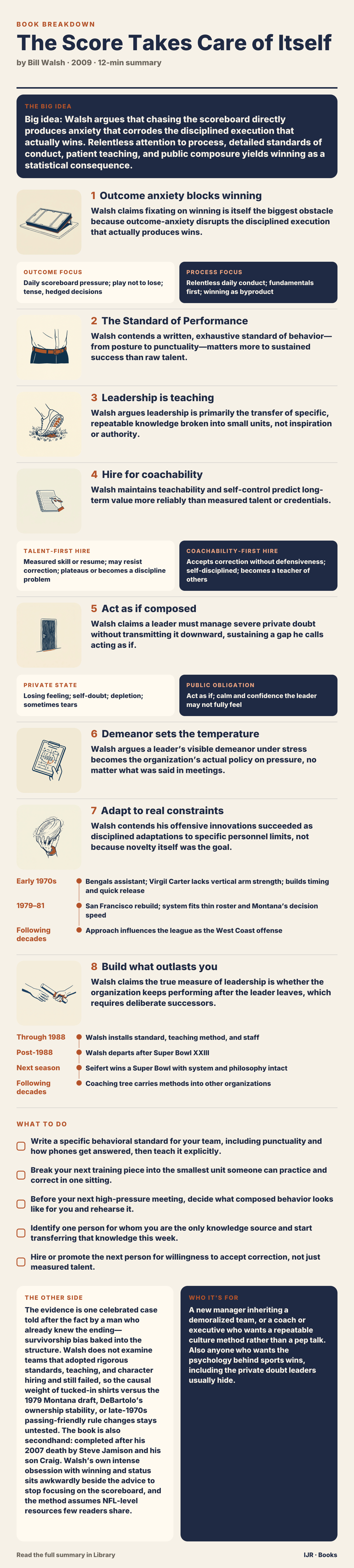
Big idea: Walsh argues that chasing the scoreboard directly produces anxiety that corrodes the disciplined execution that actually wins. Relentless attention to process, detailed standards of conduct, patient teaching, and public composure yields winning as a statistical consequence.
The book in brief
Book in brief: Walsh starts from a claim that runs against locker-room rhetoric: making winning the daily target backfires. When a team measures itself against the scoreboard, people tense up, hedge, and stop executing fundamentals. He arrived in San Francisco in 1979 to a 2-14 franchise saturated with a losing identity; talking about championships would have been noise. He redirected attention to behavior—how people practiced, how meetings ran, how the building operated—insisting sustained excellence in daily conduct produces winning, not the reverse.
The core mechanism was a written Standard of Performance covering conduct unrelated to football skill: shirts tucked in, no sitting in meetings, phones answered by the third ring, no profanity at teammates, equipment treated with care, promptness to the minute. It applied to everyone in the building. He insisted it be taught explicitly, not merely posted, because people cannot be held to expectations they were never shown. Behavioral rigor in small things, he contended, transfers to performance when it matters.
He framed leadership as teaching, not motivation. He developed Joe Montana, a third-round pick seen as too small, by isolating single mechanical elements of footwork and decision-making, then rebuilding the full motion. New offensive concepts were taught in short segments, tested immediately, corrected on the spot. That required patience with failure during learning. Hiring followed: he selected for coachability—the willingness to be corrected without defensiveness—and self-discipline, producing a coaching staff including Holmgren and Seifert who later became head coaches.
The middle of the book turns psychological. Walsh describes a private ‘losing feeling’—corrosive self-doubt even at the height of success, including the strike-disrupted 1987 season and earlier years when he nearly left coaching, sometimes to the point of tears. The obligation is not to eliminate doubt but to keep it from reaching the people who need steady direction; he calls this ‘acting as if.’ Players read body language and sideline tone faster than words, especially under pressure, so visible panic teaches panic. Scripting the first fifteen or so offensive plays was partly about play-calling and partly about visibly showing the situation was under control.
He frames the West Coast offense—high volume of short, precisely timed passes—not as novelty but as adaptation. With the Bengals in the early 1970s he had Virgil Carter, who lacked arm strength for a vertical attack, so he built timing and quick release around that constraint; in San Francisco the same logic fit a rebuilding roster and a less imposing Montana. Innovation, he argues, comes from applying known principles with unusual discipline to specific constraints.
The arc closes on succession. A leader who has not developed people capable of running the organization without him has failed at the deepest level. After Walsh left following the 1988 season and Super Bowl XXIII, Seifert won another Super Bowl the next year with the system largely intact. Indispensability, Walsh claims, is a sign of incomplete work.
Context
Context: Bill Walsh turned the San Francisco 49ers from a 2-14 team in 1979 into Super Bowl champions by 1981. The book appeared in 2009, two years after his death in 2007; the text was completed and shaped by Steve Jamison and Walsh’s son Craig from notes, interviews, and recollections.
The key ideas

1
Outcome anxiety blocks winning
Walsh claims fixating on winning is itself the biggest obstacle because outcome-anxiety disrupts the disciplined execution that actually produces wins.
Outcome focus
Daily scoreboard pressure; play not to lose; tense, hedged decisions
Process focus
Relentless daily conduct; fundamentals first; winning as byproduct
Walsh opens against standard locker-room talk. Telling people to win, or making the scoreboard the daily target, backfires. People start playing not to lose. They tense, hedge decisions, and abandon the fundamentals that create good outcomes.
He points to his 1979 arrival with a 2-14 franchise already soaked in a losing identity. Championship talk would have been empty noise. He shifted attention entirely to behavior: how players practiced, how meetings ran, how the building operated.
He wanted championships badly. The point is that wanting them moment to moment is counterproductive. Desire without a disciplined channel turns into pressure, and pressure degrades performance. Sustained excellence in daily conduct, he argues, produces winning as a statistical consequence.
In practice: On taking over the 2-14 49ers in 1979, Walsh refused to preach winning and instead rebuilt attention around practice habits and building conduct.

2
The Standard of Performance
Walsh contends a written, exhaustive standard of behavior—from posture to punctuality—matters more to sustained success than raw talent.
His central tool was a document he wrote and enforced from 1979: the Standard of Performance. It specified conduct with no direct link to football skill—shirts tucked in, no sitting during meetings, phones answered by the third ring, no profanity at teammates, equipment treated carefully, promptness to the minute.
He argued that tolerating sloppiness in small things trains people to tolerate sloppiness generally, and that habit surfaces in the fourth quarter of a close game. The standard covered everyone in the building; a culture is judged by its weakest enforced rule, not its stated values.
He insisted the standard be taught, not posted. New players and veterans were walked through it explicitly. People cannot be held to expectations they were never actually shown. He treats the leap from two wins to a Super Bowl in three seasons as evidence, while also noting the same stretch brought personnel changes and a new offense.
In practice: Phones had to be answered by the third ring and shirts stayed tucked—rules applied to the whole building, not just the roster.

3
Leadership is teaching
Walsh argues leadership is primarily the transfer of specific, repeatable knowledge broken into small units, not inspiration or authority.
Walsh described himself first as a teacher, not a motivator or disciplinarian. Most coaches, he believed, overestimate speeches and underestimate precise, repeated instruction.
The clearest case is Joe Montana, drafted in the third round in 1979 and viewed as too small and unconventional. Walsh built footwork and decision-making through drills that isolated single mechanical elements, then rebuilt the full throwing motion from those pieces instead of grinding the whole skill under game pressure.
He installed the offense the same way: short segments, immediate testing, on-the-spot correction. Teaching ability, not charisma, is what he claims separates organizations that improve yearly from those that plateau. That requires patience with failure in the learning phase—tolerating a rookie's mistakes as the cost of later competence.
In practice: Montana’s throwing motion was rebuilt from isolated footwork and decision drills rather than full-skill repetition under pressure.

4
Hire for coachability
Walsh maintains teachability and self-control predict long-term value more reliably than measured talent or credentials.
Talent-first hire
Measured skill or resume; may resist correction; plateaus or becomes a discipline problem
Coachability-first hire
Accepts correction without defensiveness; self-disciplined; becomes a teacher of others
Because the system depended on people absorbing detailed instruction and meeting a demanding standard, hiring criteria followed. He looked for coachability—willingness to be corrected without defensiveness—plus resilience under criticism and baseline self-discipline the organization would not have to manufacture.
He was skeptical of pure talent or strong resumes. Talent without the capacity to absorb correction eventually plateaus or becomes a discipline problem. The filter applied at every level; one person resistant to the standard can undermine the consistency the whole system needs.
His own staff became the illustration: assistants including Mike Holmgren and George Seifert later became head coaches, spreading his teaching methods for decades. He treats that coaching tree as validation. The evidence stays anecdotal—specific names and outcomes, no rejection rates or comparison group.
In practice: Walsh hired and developed Holmgren, Seifert, and others who became head coaches and carried the methods outward.

5
Act as if composed
Walsh claims a leader must manage severe private doubt without transmitting it downward, sustaining a gap he calls acting as if.
Private state
Losing feeling; self-doubt; depletion; sometimes tears
Public obligation
Act as if; calm and confidence the leader may not fully feel
This is the book’s most personal stretch. Walsh describes the ‘losing feeling’—private, corrosive self-doubt that hit even at the height of success, including the strike-torn 1987 season, and earlier when he nearly left coaching out of exhaustion and uncertainty, sometimes to tears. Before San Francisco he believed his career had stalled after being passed over for head jobs.
He argues this internal state is common under sustained pressure. The obligation is not to erase it but to stop it reaching people who need steady direction. Acting as if means presenting calm and confidence the leader does not fully feel, because an organization takes its emotional cues from the top regardless of the interior weather.
The harder demand is sustaining that gap for years. Walsh states the necessity; he does not inventory the personal cost.
In practice: During the difficult 1987 strike season and in earlier stalled years, Walsh felt depleted to the point of tears yet still had to project steady direction.

6
Demeanor sets the temperature
Walsh argues a leader’s visible demeanor under stress becomes the organization’s actual policy on pressure, no matter what was said in meetings.
Players and staff read body language, tone, and sideline behavior more closely than words, and the reading is fastest when stakes are highest. A coach who visibly panics in a tight fourth quarter teaches, in that instant, that panic is the appropriate response.
Walsh worked to keep his sideline presence even—not from lack of intensity, but because intensity displayed as anxiety would be copied by the players who needed to stay precise. Composure, in his account, is a skill built through preparation and repetition, not a fixed personality trait.
Thorough planning served the same end. Scripting the first fifteen or so offensive plays was partly about the calls and partly about visibly demonstrating control, which lowered collective anxiety. Any leader’s observable stress becomes functional permission for the organization to be stressed.
In practice: Walsh scripted the first fifteen or so offensive plays partly so the team would see the opening as already under control.

7
Adapt to real constraints
Walsh contends his offensive innovations succeeded as disciplined adaptations to specific personnel limits, not because novelty itself was the goal.
- Early 1970sBengals assistant; Virgil Carter lacks vertical arm strength; builds timing and quick release
- 1979–81San Francisco rebuild; system fits thin roster and Montana’s decision speed
- Following decadesApproach influences the league as the West Coast offense
He is credited with what became the West Coast offense: a high volume of short, precisely timed passes rather than deep shots or power running. He frames it as a response to constraints, not a bid to be original.
As a Bengals assistant in the early 1970s he had Virgil Carter, who lacked the arm for a vertical attack. He built timing, route precision, and quick release to compensate. In San Francisco the same approach fit a rebuilding roster and made Montana effective through decision speed and accuracy rather than arm strength.
Real innovation in a competitive system, he argues, rarely means inventing the unprecedented. It means applying known principles with unusual discipline to circumstances others have not analyzed carefully. The system was also teachable in small units, so it could be installed in players of ordinary raw talent. He presents it as portable across the league for decades, while the first decisive proof still leaned on one adaptable quarterback.
In practice: With Virgil Carter’s limited arm in Cincinnati, Walsh built short timed passes; the same logic later fit Montana in San Francisco.

8
Build what outlasts you
Walsh claims the true measure of leadership is whether the organization keeps performing after the leader leaves, which requires deliberate successors.
- Through 1988Walsh installs standard, teaching method, and staff
- Post-1988Walsh departs after Super Bowl XXIII
- Next seasonSeifert wins a Super Bowl with system and philosophy intact
- Following decadesCoaching tree carries methods into other organizations
A leader who has not developed people capable of running the place without him has failed at the deepest level, regardless of personal championships. Knowledge and standards that live only in one head are incomplete work; indispensability is a warning sign, not a badge.
He points to his own exit after the 1988 season and Super Bowl XXIII. George Seifert, his former defensive coordinator, took over and won a Super Bowl the following year with much of the same system and roster philosophy intact. Walsh treats that continuity as the fairer test of soundness than any single season.
He extends the point to the broader coaching tree: staff who became head coaches elsewhere and carried elements of the approach for decades. The arc of the book lands here—from rejecting scoreboard focus, through standards and teaching and the psychology to sustain them, to the demand that none of it matters if it dies when the leader walks out.
In practice: After Walsh left following Super Bowl XXIII, Seifert won another Super Bowl the next year with the system largely intact.
Key terms
- Standard of Performance Walsh’s written, exhaustive code of daily conduct—dress, punctuality, phone manners, meeting behavior—taught and enforced for everyone in the building.
- The score takes care of itself His anchor phrase: sustained excellence in process and conduct produces winning as a consequence; chasing the scoreboard directly backfires.
- Acting as if Presenting calm and confidence you do not fully feel so private doubt never becomes the organization’s emotional cue.
- West Coast offense High volume of short, precisely timed passes built as an adaptation to limited arm strength and rebuilding rosters, not as novelty.
- Coaching tree The lineage of assistants Walsh hired and developed who later became head coaches and spread his teaching methods.
- Losing feeling The private, corrosive self-doubt Walsh describes even at peak success, which a leader must contain rather than transmit.
What to do
- Write a specific behavioral standard for your team, including punctuality and how phones get answered, then teach it explicitly.
- Break your next training piece into the smallest unit someone can practice and correct in one sitting.
- Before your next high-pressure meeting, decide what composed behavior looks like for you and rehearse it.
- Identify one person for whom you are the only knowledge source and start transferring that knowledge this week.
- Hire or promote the next person for willingness to accept correction, not just measured talent.
Questions to think with
- Where are you still measuring the team against the scoreboard day to day, and what concrete behavior could replace that target?
- Which small sloppiness in your group would fail Walsh’s Standard of Performance test?
- Who on your team cannot yet run a critical piece of work without you, and what is the first unit of knowledge to hand off?
- When did your visible stress last become permission for everyone else to tighten up?
- Are you hiring for credentials and talent, or for the capacity to absorb correction?
The other side
The evidence is one celebrated case told after the fact by a man who already knew the ending—survivorship bias baked into the structure. Walsh does not examine teams that adopted rigorous standards, teaching, and character hiring and still failed, so the causal weight of tucked-in shirts versus the 1979 Montana draft, DeBartolo’s ownership stability, or late-1970s passing-friendly rule changes stays untested. The book is also secondhand: completed after his 2007 death by Steve Jamison and his son Craig. Walsh’s own intense obsession with winning and status sits awkwardly beside the advice to stop focusing on the scoreboard, and the method assumes NFL-level resources few readers share.
Who it's for
A new manager inheriting a demoralized team, or a coach or executive who wants a repeatable culture method rather than a pep talk. Also anyone who wants the psychology behind sports wins, including the private doubt leaders usually hide.