




Buffett's fortune grew from childhood fear and decades of patience
Schroeder's biography argues Warren Buffett's investing success cannot be separated from a childhood need for control that drove lifelong compounding.
IJR · Oct 24, 2026 · 14 min read
In 60 seconds
- Buffett's hunger for wealth began as armor against his mother's violent rages, not a pure financial calling.
- Childhood ventures fixed a preference for recurring passive income long before any investment textbook.
- He inherited Graham's margin-of-safety method wholesale, then spent decades personalizing the discipline.
- Insurance float, not stock-picking alone, supplied nearly free permanent leverage that rivals lacked.
- Munger pushed him from cheap declining businesses to fair prices for excellent ones, multiplying long-term returns.
- The same single-mindedness that built the fortune cost his marriage and was partly masked by a curated folksy image.
The big idea
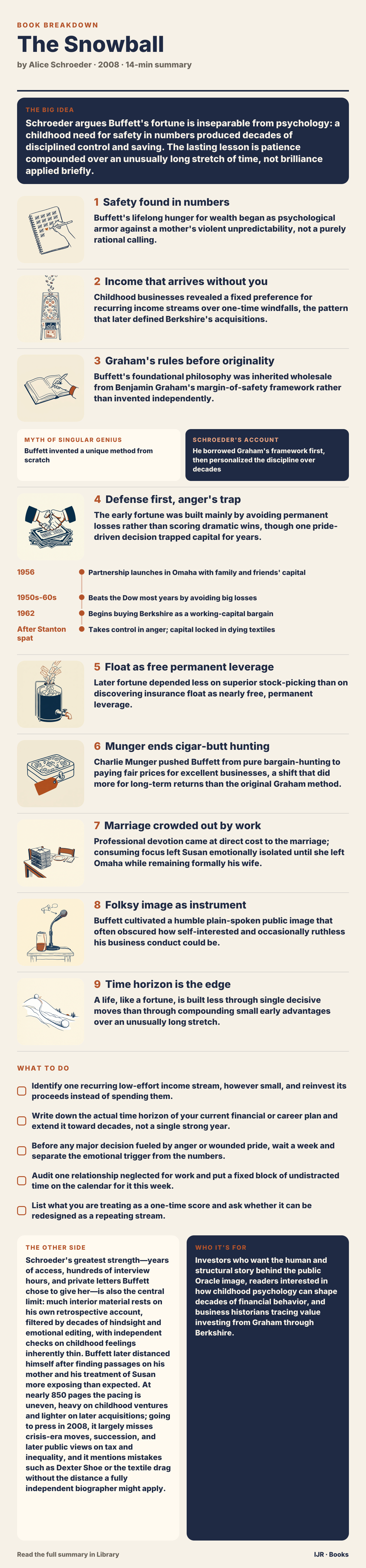
Schroeder argues Buffett's fortune is inseparable from psychology: a childhood need for safety in numbers produced decades of disciplined control and saving. The lasting lesson is patience compounded over an unusually long stretch of time, not brilliance applied briefly.
The book in brief
Schroeder begins in the Omaha household, where Leila Buffett's sudden verbal rages left Warren and his sisters never sure what would set off hours of tirade. The boy retreated into numbers that behaved—license plates, city populations, baseball stats—while his steady but often absent father left him to build his own sense of safety. Money later became a buffer against a world he had learned not to trust.
Before twenty he was already running paper routes, selling used golf balls, and splitting pinball take from barbershop machines, each venture built for modest cost and repeating nickels with little ongoing labor. By adolescence the pattern was fixed: own assets that pay whether or not you are in the room, and treat every spent dollar as security given away.
He absorbed Benjamin Graham's framework at Columbia and Graham-Newman, craving a quantifiable rule that removed emotion from decisions. Early partnership holdings were textbook bargains. Back in Omaha in 1956 he beat the Dow mainly by rarely losing in down years; a 1962 stake in failing textile firm Berkshire Hathaway began as a classic cheap play, then locked in after anger at a broken buyback promise trapped capital in a dying business for years.
The 1967 purchase of National Indemnity revealed the real machine: insurance float as permanent, nearly free capital to redeploy into stocks and whole companies. Charlie Munger, met in 1959, then dragged him off pure cigar-butt bargains toward paying up for durable advantages, with See's Candies as the proof that changed every later acquisition.
The same focus left Susan Buffett raising three children and carrying the family's social life largely alone until she moved to San Francisco in 1977, arranging a friend to care for Warren without a formal divorce. A humble Midwestern persona—same house, Cherry Coke—won trust from sellers and regulators, yet it was managed as carefully as any position. After Susan's death he pledged most of the fortune to the Gates Foundation on pure capital-allocation logic, closing on the image he gave Schroeder: a snowball that matters most for where it starts and how long the hill runs.
Context
Alice Schroeder's 2008 authorized biography drew on hundreds of hours of interviews with Buffett and private family letters no previous journalist had received. It mattered because it replaced the folksy Oracle of Omaha myth with a fuller, sometimes unflattering portrait of the psychology, marriage, and structural edges behind the fortune.
The key ideas

1
Safety found in numbers
Buffett's lifelong hunger for wealth began as psychological armor against a mother's violent unpredictability, not a purely rational calling.
Schroeder opens with Leila Buffett's sudden verbal rages that terrorized the household. Warren and his sisters never knew when a stray comment would trigger an hours-long tirade. Father Howard, a stockbroker and later congressman, was steady but often physically absent.
The boy's response was to disappear into numbers. License plates, city populations, and baseball statistics behaved; they did not turn on him. Schroeder treats this as the seed of the adult who accumulated money less for consumption than as a buffer against chaos he had learned early not to trust.
Access to family letters let her document the rages in detail for the first time, including incidents sisters had rarely spoken about. Buffett himself rarely discussed his mother publicly. The chapter reframes ticker-tape habits, compulsive deal-making, and reluctance to spend on himself as extensions of that search for control.
Buffett later told Schroeder that life is like rolling a snowball: it matters most where you start and how much snow is on the ground, because early conditions compound over a long enough hill.
In practice: Young Warren counted license plates and memorized populations so an unstable world would become predictable through numbers alone.

2
Income that arrives without you
Childhood businesses revealed a fixed preference for recurring income streams over one-time windfalls, the pattern that later defined Berkshire's acquisitions.
Before twenty, Buffett had sold Coca-Cola door to door, run multiple newspaper routes at once, sold used golf balls, and installed pinball machines in barbershops with a friend, splitting the coin take. Each venture shared the same structure: modest upfront cost, then a repeating stream that needed little ongoing labor from him.
He did not chase a single big score. He wanted machines that kept generating nickels whether or not he was in the room. Schroeder connects the pattern directly to later Berkshire holdings such as See's Candies, GEICO, and the Buffalo News—cash engines that required little day-to-day intervention from Omaha.
The preference was not a strategy learned from Graham or anyone else; it was already fixed in adolescence, before he had read a single investment text. The same chapters show compulsive ledger-keeping and resistance to purchases friends made without hesitation.
Schroeder links the saving habit to the earlier anxiety: money accumulated was security banked against future chaos, and every dollar spent was a dollar of that security given away.
In practice: By fourteen he had saved enough from these ventures to buy farmland in Nebraska and rent it to a tenant, his first passive income asset.

3
Graham's rules before originality
Buffett's foundational philosophy was inherited wholesale from Benjamin Graham's margin-of-safety framework rather than invented independently.
Myth of singular genius
Buffett invented a unique method from scratch
Schroeder's account
He borrowed Graham's framework first, then personalized the discipline over decades
Buffett read The Intelligent Investor as a student and enrolled at Columbia specifically to study under Graham. The method—buying stocks priced below the liquidation value of their assets—gave the anxious young man a defensible, quantifiable rule that removed emotion and guesswork.
After graduating he worked briefly for free at Graham-Newman before being hired, absorbing the discipline of calculating margin of safety on every purchase. Schroeder is careful to show imitation before innovation. Early partnership holdings such as Sanborn Map, trading below the value of its bond portfolio alone, were textbook Graham plays.
He also failed to win Graham's personal affection. Graham treated every employee with the same detached fairness and refused favorites, disappointing Buffett who wanted to be seen as special. That disappointment helped push him later to build his own approach rather than simply extend Graham's.
Even the most celebrated modern investor did not start from a blank slate. He found a rule system rigorous enough to trust, then spent decades personalizing it and applying it without abandoning it under pressure.
In practice: Sanborn Map was bought because the stock price sat below the value of the bond portfolio alone—a pure Graham liquidation bargain.

4
Defense first, anger's trap
The early fortune was built mainly by avoiding permanent losses rather than scoring dramatic wins, though one pride-driven decision trapped capital for years.
- 1956Partnership launches in Omaha with family and friends' capital
- 1950s-60sBeats the Dow most years by avoiding big losses
- 1962Begins buying Berkshire as a working-capital bargain
- After Stanton spatTakes control in anger; capital locked in dying textiles
In 1956 Buffett returned to Omaha and started a partnership with money from family and friends. He took a share of profits above a threshold but bore none of the losses in cash, only in reputation. Returns beat the Dow in nearly every year of the 1950s and 1960s less through spectacular winners than by rarely losing money in down years.
In 1962 he began accumulating shares of failing New England textile maker Berkshire Hathaway as a classic Graham bargain trading below working-capital value. When president Seabury Stanton reneged on a verbal agreement to buy back Buffett's shares at an agreed price, Buffett retaliated by buying enough stock to take control himself.
The decision came from wounded pride rather than careful analysis. It ultimately trapped a huge amount of capital in a dying textile business for years—an admission Buffett later made openly. Schroeder uses the episode to complicate the image of unfailing cool rationality.
The partnership years still established the lasting Berkshire pattern: steady avoidance of catastrophic loss, occasional emotional misstep, and willingness to hold while underlying value compounded quietly.
In practice: Anger at Stanton's broken buyback promise, not a fresh valuation, turned a bargain stake into multi-decade control of a declining mill.

5
Float as free permanent leverage
Later fortune depended less on superior stock-picking than on discovering insurance float as nearly free, permanent leverage.
Schroeder identifies the 1967 acquisition of National Indemnity, an Omaha insurer, as the pivot that turned Berkshire from a struggling textile company into a wealth-generating machine. Insurers collect premiums upfront and pay claims later, holding large pools of other people's money—float—that can be invested in the meantime.
Buffett saw that if underwriting stayed conservative enough to avoid catastrophic losses, float functioned like a permanent, interest-free loan for stocks and whole-company deals. That logic drove staged purchases of GEICO from the 1970s and the outright buy in 1996, plus a portfolio of specialty insurers.
Schroeder argues this float, not returns on any single stock pick, explains most of Berkshire's compounding edge over rivals who tried to match his stock record without the same structure. The insight is more structural than analytical and remains the least mythologized mechanical fact of the career.
Berkshire reads less as a stock portfolio than as an insurance-funded holding company—a distinction retail imitators who copy only the public equity picks tend to miss.
In practice: National Indemnity's premium pool gave Buffett capital he could redeploy for decades without the loan ever being called.

6
Munger ends cigar-butt hunting
Charlie Munger pushed Buffett from pure bargain-hunting to paying fair prices for excellent businesses, a shift that did more for long-term returns than the original Graham method.
Munger, a Los Angeles lawyer turned investor whom Buffett met in 1959, became his closest intellectual partner. He argued that buying mediocre or declining companies only because they were statistically cheap had a ceiling: bargains ran out or proved cheap for good reason. Buffett himself called the old habit the cigar-butt approach—picking up a discarded cigar for one last free puff.
Munger pushed toward reasonable, even full, prices for businesses with durable competitive advantages that could compound for decades. The 1972 purchase of See's Candies, a California confectioner bought for roughly three times book value, became the proof case the old Graham screen would have rejected.
See's pricing power and brand loyalty let it raise prices yearly without losing customers, generating far more cash relative to capital than any cheap textile mill. The deal rewrote the subsequent pattern: Coca-Cola shares in 1988, long-held Washington Post stock, and whole subsidiaries such as Nebraska Furniture Mart from founder Rose Blumkin.
Without Munger's push, Schroeder suggests, Berkshire would likely have stayed a mid-sized value fund rather than the conglomerate it became. The partnership itself, not any single trade, powered the second half-century of returns.
In practice: See's Candies at roughly three times book value proved a brand with pricing power beat a statistically cheaper declining mill.

7
Marriage crowded out by work
Professional devotion came at direct cost to the marriage; consuming focus left Susan emotionally isolated until she left Omaha while remaining formally his wife.
Schroeder gives extensive space to Susan Thompson Buffett as the emotional counterweight to Warren's withdrawn, work-absorbed manner. She managed the household, raised three children largely alone, and supplied the social warmth and civil-rights engagement he avoided, including Omaha integration efforts in the 1960s.
His attention rarely left business even at home. He read annual reports at the dinner table and struggled to engage the children in ways Susan repeatedly flagged as a problem. After decades of imbalance she moved to San Francisco in 1977 to pursue singing and an independent life; the couple never formally divorced.
Before leaving she arranged for friend Astrid Menks to move in and look after Warren. All three treated the arrangement as amicable; it lasted until Susan's death in 2004, after which Warren married Astrid. Schroeder resists pure scandal framing.
She presents the outcome as logical once one partner's compounding ambition left no reciprocal emotional investment, and once the people around him adapted to his limits rather than demanding change. The same single-mindedness that built the fortune produced, by conventional standards, a damaged family structure.
In practice: Susan arranged for Astrid to move into the Omaha house to care for Warren before she left for San Francisco, an arrangement that lasted decades.

8
Folksy image as instrument
Buffett cultivated a humble plain-spoken public image that often obscured how self-interested and occasionally ruthless his business conduct could be.
Schroeder examines the gap between the curated persona—the frugal Midwesterner in the same Omaha house bought in 1958, drinking Cherry Coke at meetings—and the sharper operator underneath. The image was not fraudulent, but it was managed.
The clearest test was the 1991 Salomon Brothers bond-trading scandal, when false Treasury bids forced Buffett, as largest shareholder, into the chairman's seat. He testified before Congress about wanting employees who were law-abiding and guardians of the firm's reputation, while behind the composure he forced out executives and negotiated with regulators in ways that protected Berkshire's interests as much as the firm's survival.
Smaller episodes show tough tactics with sellers of family businesses who trusted his reputation for fair dealing and sometimes accepted lower prices than another bidder might have paid simply to get a Berkshire deal. Reputation itself became a financial instrument.
Sellers, regulators, and the public extended trust a colder operator would not have received, and Buffett stayed consistently aware of and protective of that asset.
In practice: During the Salomon crisis he publicly preached reputation while privately moving to shield his own investment and standing with regulators.

9
Time horizon is the edge
A life, like a fortune, is built less through single decisive moves than through compounding small early advantages over an unusually long stretch.
Schroeder returns to Buffett's own image for the title: rolling a snowball down a hill, where the decisive factors are finding the right hill and starting early, because snow that sticks in the first rotations determines size at the bottom. She applies it first to investment returns that look unremarkable year by year yet become extraordinary through sheer repetition.
She also applies it to reputation, habits, and relationships: the childhood saving habit, the early taste for recurring income, the decades-long Munger partnership, and the accumulated trust that let sellers take Berkshire's word over a written contract all compounded the way capital did.
After Susan's death in 2004 he announced in 2006 that the overwhelming majority of his Berkshire shares would go to charity, most to the Bill and Melinda Gates Foundation rather than a monument bearing his own name. The reasoning followed investment logic: Gates already had scale and expertise, so channeling there avoided ramp-up waste; gifts came as annual stock installments so he retained a check on use.
He also stated that heirs should receive enough to do anything but not so much they can do nothing. The closing claim is that patience sustained across roughly seventy years of active investing beats a higher rate applied for only fifteen; the childhood need for control and the multi-decade discipline were inseparable.
In practice: Annual returns often in the twenty-percent range became historic only because the compounding ran across roughly seventy years almost no other investor matched.
Key terms
- Float Premiums an insurer holds and can invest after collecting them but before paying claims; Buffett treated well-run float like a permanent interest-free loan.
- Margin of safety Graham's rule of buying only when price sits well below conservatively valued assets, so mistakes or bad luck still leave a cushion.
- Cigar butt Buffett's label for buying a mediocre or declining business solely because it is statistically cheap—one last free puff, then nothing.
- Snowball Buffett's image for a life or fortune: early start plus long unbroken rolling on the right hill matters more than any single push.
- Partnership years The 1956 to late-1960s Omaha investment partnerships that compounded mainly by avoiding big losses before Berkshire became the vehicle.
- Authorized access Schroeder's years of interviews and private letters granted by Buffett himself—the source of the book's depth and of its structural limits.
What to do
- Identify one recurring low-effort income stream, however small, and reinvest its proceeds instead of spending them.
- Write down the actual time horizon of your current financial or career plan and extend it toward decades, not a single strong year.
- Before any major decision fueled by anger or wounded pride, wait a week and separate the emotional trigger from the numbers.
- Audit one relationship neglected for work and put a fixed block of undistracted time on the calendar for it this week.
- List what you are treating as a one-time score and ask whether it can be redesigned as a repeating stream.
Questions to think with
- Where did your own earliest habits around money or control actually come from, and are they still running the present?
- Are you optimizing for a brilliant decade or for uninterrupted compounding across many decades?
- Which relationships or duties have you been asking other people to adapt to, rather than rebalancing yourself?
- How much of your professional reputation is earned substance versus a curated image you now have to protect?
- If you had to give away the bulk of what you build, would you choose the most efficient deployer or the monument with your name?
The other side
Schroeder's greatest strength—years of access, hundreds of interview hours, and private letters Buffett chose to give her—is also the central limit: much interior material rests on his own retrospective account, filtered by decades of hindsight and emotional editing, with independent checks on childhood feelings inherently thin. Buffett later distanced himself after finding passages on his mother and his treatment of Susan more exposing than expected. At nearly 850 pages the pacing is uneven, heavy on childhood ventures and lighter on later acquisitions; going to press in 2008, it largely misses crisis-era moves, succession, and later public views on tax and inequality, and it mentions mistakes such as Dexter Shoe or the textile drag without the distance a fully independent biographer might apply.
Who it's for
Investors who want the human and structural story behind the public Oracle image, readers interested in how childhood psychology can shape decades of financial behavior, and business historians tracing value investing from Graham through Berkshire.