




Everyday prices reveal who really holds the power
A coffee three times dearer by the station is scarcity of land claiming almost everything a captive buyer will pay.
IJR · Nov 5, 2026 · 14 min read
In 60 seconds
- Station-side coffee costs more because scarce land lets landlords and shops extract nearly all a captive customer will pay.
- Firms sort buyers into groups and charge each what they will bear via brand tiers, coupons, and airline restrictions.
- When driving or pollution spills costs onto outsiders, prices lie until taxes force people to face the full social cost.
- Asymmetric information can empty markets of good used cars until warranties and reputation restore credible quality signals.
- Well-designed auctions of scarce public licenses can force honest bids and capture value fixed fees once left on the table.
- Weak property rights and corruption keep countries poor more than missing resources; free trade raises total wealth while leaving real losers.
The big idea
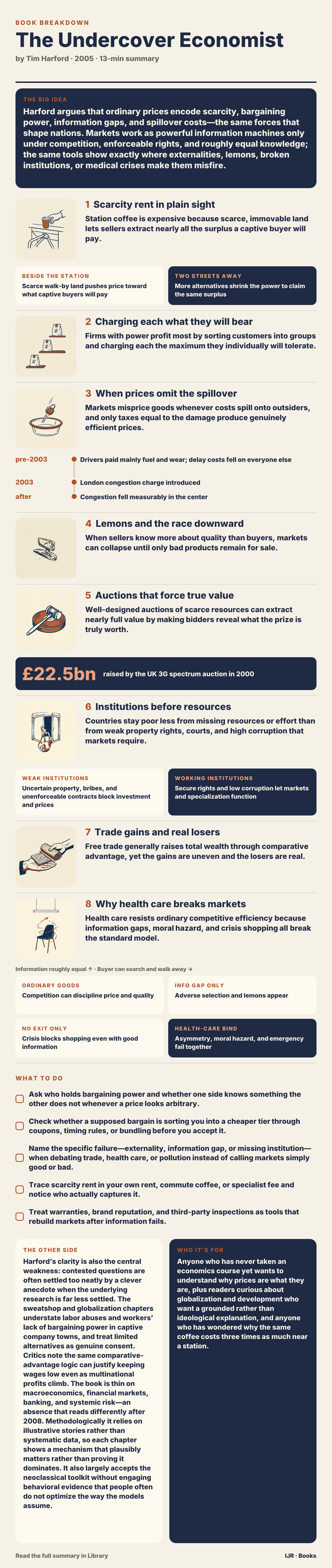
Harford argues that ordinary prices encode scarcity, bargaining power, information gaps, and spillover costs—the same forces that shape nations. Markets work as powerful information machines only under competition, enforceable rights, and roughly equal knowledge; the same tools show exactly where externalities, lemons, broken institutions, or medical crises make them misfire.
The book in brief
Harford begins with the odd prices of ordinary life and treats them as clues to who controls scarce resources and who can set terms. He shows sellers with that power going further, actively sorting customers so each pays nearer their personal ceiling.
The argument then turns to prices that mislead. When a deal imposes costs on people outside it, or when one side knows more than the other, unregulated markets produce outcomes that look efficient to the parties yet wasteful or empty for everyone else. Institutions that rebuild trust or force full costs back into the price become the fix.
From single markets he scales to the rules that allocate scarce public resources and then to whole economies. Countries stay poor, he contends, less from missing resources than from missing courts, property rights, and limits on corruption—the plumbing markets need before price signals can work at all.
Trade appears as the large-scale version of mutual specialization: total wealth rises, yet specific workers lose and politics often fails to compensate them. Health care closes the arc as the hard case where information gaps, reduced caution once insured, and the impossibility of shopping while in crisis break ordinary competitive logic.
The book lands on a diagnostic habit rather than market worship: read the price, name the exact condition that failed, and match the remedy to that failure.
Context
Harford published the book in 2005 for readers who had never taken an economics course, using coffee, cars, and supermarket shelves to make scarcity, externalities, and information failures intuitive. The summary notes its near-silence on financial markets, banking, and systemic risk reads differently after 2008, a gap he later partly addressed in The Undercover Economist Strikes Back.
The key ideas

1
Scarcity rent in plain sight
Station coffee is expensive because scarce, immovable land lets sellers extract nearly all the surplus a captive buyer will pay.
Beside the station
Scarce walk-by land pushes price toward what captive buyers will pay
Two streets away
More alternatives shrink the power to claim the same surplus
Harford opens on why a coffee steps from a train station costs far more than one two streets away when beans and cups cost the same. The answer is scarcity of land. Only a few spots sit exactly where commuters walk; landlords capture that scarcity through rent and shops pass it on. Ricardo’s scarcity rent explains why the most desirable, unrepeatable locations always command a premium no matter what is sold there.
Price is not cost plus a fair markup. It reflects bargaining position. Landowners near a station hold proximity no one else can copy. Buyers who need convenience will pay almost their personal maximum rather than walk farther, so sellers with power push toward that ceiling. Harford stresses this is not moral failure; it is what scarcity does mechanically whether the scarce resource is land, talent, or a patented drug.
He extends the logic to wages. A footballer or CEO with a rare, hard-to-replace skill earns a premium that tracks the scarcity of substitutes more than effort or virtue. The method is looking past the surface transaction to ask who can set the price and why.
Once scarcity rent is visible in coffee, it appears in city apartments, first-class seats, and specialist salaries. That habit of decoding prices as information about market structure underpins every later chapter.
In practice: An identical coffee costs far more beside the station than two streets away because the landlord and owner can claim the convenience premium captive commuters will pay.

2
Charging each what they will bear
Firms with power profit most by sorting customers into groups and charging each the maximum they individually will tolerate.
Building on sellers pushing toward what buyers will accept, Harford shows companies charging different people different prices for essentially the same product. Supermarkets sell identical coffee under three brand tiers at three markups, not because costs differ much, but to separate price-sensitive shoppers from those willing to pay for a perceived premium.
Airlines charge business travelers many times leisure fares for the same flight, using advance-purchase rules and Saturday-night stays as sorting devices because business travelers cannot plan far ahead. Coupons and loyalty cards look generous yet mainly identify the price-sensitive so they pay less while everyone else pays full price.
Three conditions make the strategy work: some market power, a way to identify or infer the buyer’s group, and barriers that stop low-price buyers reselling to high-price ones. The result is more total revenue than any single price would allow.
Harford does not treat this as sinister; it can even open goods to poorer buyers who would otherwise be priced out. It does mean market prices are strategic signals, not neutral facts.
In practice: Airlines use Saturday-night-stay rules so leisure travelers pay less while business travelers, unable to plan that way, pay far more for the same seat.

3
When prices omit the spillover
Markets misprice goods whenever costs spill onto outsiders, and only taxes equal to the damage produce genuinely efficient prices.
- pre-2003Drivers paid mainly fuel and wear; delay costs fell on everyone else
- 2003London congestion charge introduced
- afterCongestion fell measurably in the center
After scarcity and sorting, Harford turns to prices that actively lie. A driver entering a crowded road delays every other driver yet pays nothing for it. The market price of driving—largely fuel and depreciation—omits that externality, so people drive more than is socially efficient.
Pollution works the same way. A factory dumping waste into a river imposes costs on downstream users that never appear on its balance sheet. Harford invokes Pigou’s proposal: tax the activity by the amount of external damage so the price finally reflects full cost. The aim is not zero pollution but a level at which polluters weigh the real cost of their choices.
London’s congestion charge, introduced in 2003, forced drivers to pay something closer to the true social cost of their trip and reduced congestion measurably in the center. Prices inform only when they capture all costs; when they do not, unregulated markets serve the parties yet waste society’s resources.
This supplies the book’s policy edge: a diagnostic for exactly where markets misfire rather than blind faith in them.
In practice: London’s 2003 congestion charge made drivers face more of the delay they imposed on others and cut central congestion.

4
Lemons and the race downward
When sellers know more about quality than buyers, markets can collapse until only bad products remain for sale.
Harford draws on Akerlof’s 1970 used-car analysis. The seller knows whether the car is reliable or a lemon; the buyer does not. Buyers therefore offer only an average price that reflects lemon risk. That average is too low for owners of good cars, so they exit, raising the share of lemons and driving the price still lower. In the extreme the market for good used cars vanishes even though willing buyers and good sellers exist.
This failure differs from spillover costs: the market does not misprice an externality; it unravels because one side cannot verify what it is buying. Real markets answered with warranties, brand reputation, certified pre-owned programs, and third-party inspections so good sellers can credibly signal quality and the market can reassemble around trust.
The same asymmetry appears in reverse in insurance. Insurers cannot fully know an applicant’s risk, so riskier customers are more likely to buy, pushing premiums up for everyone. That is why insurers medically screen or exclude preexisting conditions.
Outcomes depend on the structure of information, not merely supply and demand curves.
In practice: Owners of good used cars stay out when buyers will pay only lemon-risk averages, leaving lots dominated by bad cars.

5
Auctions that force true value
Well-designed auctions of scarce resources can extract nearly full value by making bidders reveal what the prize is truly worth.
£22.5bn
raised by the UK 3G spectrum auction in 2000
Harford recounts the UK’s 2000 auctions for third-generation mobile spectrum licenses, designed with game theorists including Ken Binmore. Earlier fixed fees and beauty contests left enormous value uncaptured; companies with monopoly-like access to a scarce public resource paid far less than that access was worth. The UK auction, structured to block collusion and spur genuine bidding, raised around 22.5 billion pounds—far more than officials expected.
Design decided the outcome. A weak auction lets bidders signal and effectively collude on a low price, or lets one dominant bidder scare rivals away. Rules such as simultaneous rounds, information disclosure, and minimum increments forced each firm to reveal through its bids how much the license was worth to it.
Markets are designed artifacts; their rules determine who benefits. This returns to scarcity rent at public scale: when a resource is scarce and valuable, someone captures its value—either the public through good auction design or whichever private party gets lucky or plays best.
Auctions also turn private valuations into public prices through competitive pressure rather than trust or certification alone.
In practice: The UK’s 2000 mobile-spectrum auction, built to prevent collusion, raised around 22.5 billion pounds—far above what fixed fees had captured.

6
Institutions before resources
Countries stay poor less from missing resources or effort than from weak property rights, courts, and high corruption that markets require.
Weak institutions
Uncertain property, bribes, and unenforceable contracts block investment and prices
Working institutions
Secure rights and low corruption let markets and specialization function
Harford asks why some nations remain poor despite natural resources or industrious people. He rejects simple geography or culture stories and points to institutions: reliable courts, enforceable contracts, secure property rights, and limited corruption. Without them the earlier mechanisms—price signals, competitive auctions, trust against information gaps—cannot operate.
A farmer who cannot be sure the state will not seize land has little incentive to invest. An entrepreneur forced to bribe at every step faces a hidden tax that distorts every price decision. In Cameroon Harford saw bureaucratic hurdles and informal payments strangle small-business formation, unlike economies that streamlined those barriers.
Resource-rich countries often grow more slowly and suffer more corruption and conflict because wealth concentrated in state hands creates huge incentives to capture the state itself rather than build broad productive institutions. Scarcity rent reappears at national scale: whoever controls the scarce resource takes the rents, and weak politics turns that fight violent or corrupt.
Aid and resources alone cannot fix poverty if the institutional plumbing markets need remains broken.
In practice: In Cameroon, bureaucratic hurdles and informal payments choke small-business formation in ways streamlined systems avoid.

7
Trade gains and real losers
Free trade generally raises total wealth through comparative advantage, yet the gains are uneven and the losers are real.
Harford defends Ricardo’s comparative advantage: two parties gain by trading even if one is better at everything, provided each specializes in what it does relatively best. China gained employment and rising incomes by specializing in labor-intensive production while richer countries shifted toward capital- and knowledge-intensive goods; both sides ended richer than by trying to produce everything at home.
Workers in industries that lose advantage—textile workers in wealthy countries, for instance—face real job losses and dislocation even while the overall economy grows. The standard reply that winners could compensate losers often fails in practice because political systems do not actually make those transfers.
On sweatshops Harford argues, controversially, that low-wage factory jobs in developing countries, harsh by rich-country standards, often beat the rural poverty alternatives workers were leaving, and that cutting such trade to enforce rich-country labor standards can hurt the workers activists intend to help.
Trade benefits materialize only when a country’s institutions let ordinary people capture gains from new industries rather than elites siphoning them off. Aggregate value can rise while distribution and fairness stay unresolved.
In practice: China’s move into labor-intensive manufacturing raised employment and incomes there while richer countries shifted into capital- and knowledge-intensive work, leaving both sides richer overall.

8
Why health care breaks markets
Health care resists ordinary competitive efficiency because information gaps, moral hazard, and crisis shopping all break the standard model.
Information roughly equal ↑ · Buyer can search and walk away →
Ordinary goods
Competition can discipline price and quality
Info gap only
Adverse selection and lemons appear
No exit only
Crisis blocks shopping even with good information
Health-care bind
Asymmetry, moral hazard, and emergency fail together
Harford tests market logic on American health care. Adverse selection returns from the used-car case: insurers cannot fully assess individual risk, so pools attract sicker people relative to premiums, prices rise, healthy people leave, and the spiral can destabilize insurance without intervention.
Moral hazard compounds the problem. Once insured, people have less incentive to avoid costly treatment or shop carefully for cheaper options because someone else is paying. A patient in medical crisis cannot comparison-shop the way a car buyer walks away from a dealership. That breaks the basic assumption behind competitive pricing—that buyers can search and switch.
Most wealthy nations besides the US rely on universal coverage or heavy government involvement precisely because pure market provision struggles with these distortions. Government provision brings its own inefficiencies, such as rationing through waiting lists; there is no costless solution.
This is the book’s clearest statement of where markets, on their own logic, cannot deliver good outcomes, tying information failures and spillover problems into one hard case.
In practice: Insurance pools skew toward sicker applicants insurers cannot fully screen, pushing premiums up until healthier buyers drop out.
Key terms
- scarcity rent The extra price a seller can charge by controlling a scarce, hard-to-copy resource such as land next to a station.
- price discrimination Charging different customers different prices for the same product by sorting them into groups.
- externality A cost or benefit of a deal that falls on people outside it, so the market price omits it.
- Pigouvian tax A tax set equal to the external damage so the price finally reflects full social cost.
- asymmetric information When one side of a transaction knows more about quality or risk than the other.
- lemon market A market that fills with bad goods because buyers cannot judge quality and good sellers exit.
- adverse selection The tendency of higher-risk people to buy insurance, driving premiums up for everyone.
- moral hazard The weaker incentive to avoid costly choices once someone else is paying.
- comparative advantage Producing something at a lower relative cost, the basis for mutual gains from trade even when one side is better at everything.
- institutions Property rights, courts, contract enforcement, and limits on corruption that markets need before they can function.
What to do
- Ask who holds bargaining power and whether one side knows something the other does not whenever a price looks arbitrary.
- Check whether a supposed bargain is sorting you into a cheaper tier through coupons, timing rules, or bundling before you accept it.
- Name the specific failure—externality, information gap, or missing institution—when debating trade, health care, or pollution instead of calling markets simply good or bad.
- Trace scarcity rent in your own rent, commute coffee, or specialist fee and notice who actually captures it.
- Treat warranties, brand reputation, and third-party inspections as tools that rebuild markets after information fails.
Questions to think with
- When you last paid extra for convenience, who captured the scarcity rent—the seller, the landlord, or someone further up the chain?
- Does a coupon or loyalty card leave you better off, or does it mainly mark you as someone who buys only on sale?
- If a congestion charge or pollution tax raised the price of something you do, would you cut back, and who else would gain?
- Where have you watched a market thin out because buyers could not trust quality?
- Should trade policy maximize total national gains or protect specific workers who lose, and how would the difference be funded?
The other side
Harford’s clarity is also the central weakness: contested questions are often settled too neatly by a clever anecdote when the underlying research is far less settled. The sweatshop and globalization chapters understate labor abuses and workers’ lack of bargaining power in captive company towns, and treat limited alternatives as genuine consent. Critics note the same comparative-advantage logic can justify keeping wages low even as multinational profits climb. The book is thin on macroeconomics, financial markets, banking, and systemic risk—an absence that reads differently after 2008. Methodologically it relies on illustrative stories rather than systematic data, so each chapter shows a mechanism that plausibly matters rather than proving it dominates. It also largely accepts the neoclassical toolkit without engaging behavioral evidence that people often do not optimize the way the models assume.
Who it's for
Anyone who has never taken an economics course yet wants to understand why prices are what they are, plus readers curious about globalization and development who want a grounded rather than ideological explanation, and anyone who has wondered why the same coffee costs three times as much near a station.