




How shipwreck survivors and empires rewrite who is believed
The Wager reconstructs a 1741 British wreck and the rival survivor stories the Admiralty refused to settle.
IJR · Oct 26, 2026 · 10 min read
In 60 seconds
- An undermanned 1740 British raid on Spanish Pacific loot left the Wager wrecked off a chartless Patagonian coast.
- On a freezing barren island, naval order gave way to theft, faction, and lethal force from the top.
- Two survivor parties took opposite routes home and wrote irreconcilable justifications.
- Indigenous guides kept one remnant alive; British memoirs centered English suffering instead.
- Back in England the Admiralty buried murder and mutiny questions and convicted no one.
- Grann treats official history as a settlement among self-interested storytellers, not a neutral record.
The big idea
Whoever controls the story after a disaster writes the history. Institutions facing scandal pick the version that protects their legitimacy rather than the one the evidence supports.
The book in brief
In May 1741 the British warship Wager struck rocks off a desolate Patagonian coast. Roughly 145 men crawled ashore into freezing rain, dense forest, and almost no food. What followed was not only a fight to live but a fight over who would later be believed.
Grann opens with the 1740 squadron under Commodore Anson: a glory-and-treasure raid so poorly crewed that hospitals and pension rolls filled the decks. Storms off Cape Horn scattered the fleet and left Captain Cheap pressing on under months-old orders.
Ashore, command became an argument. Factions split over sailing north toward the original mission or fleeing south for Brazil. Violence from the captain ended automatic obedience. A majority rebuilt a boat under a convenient reading of wreck law and left the rest behind.
One party endured a catastrophic southern passage; the other, after losing its boat, survived through indigenous aid before Spanish captivity. Years apart they reached England and dueled in print. When a court-martial finally sat, it narrowed the question to the loss of the ship. No serious convictions followed.
Grann closes by tracking how the mess was folded into Anson's treasure-galleon fame and even into Byron family literary afterlife—the machinery that turns ambiguity into clean imperial memory.
Context
David Grann published The Wager in 2023. It mattered because it used one obscure disaster to expose how empires manufacture heroic narratives from chaos. Built from journals, memoirs, and court records, it reached readers of archival narrative nonfiction and anyone curious about the British Empire's underside.
The key ideas
1
A reckless bid for plunder
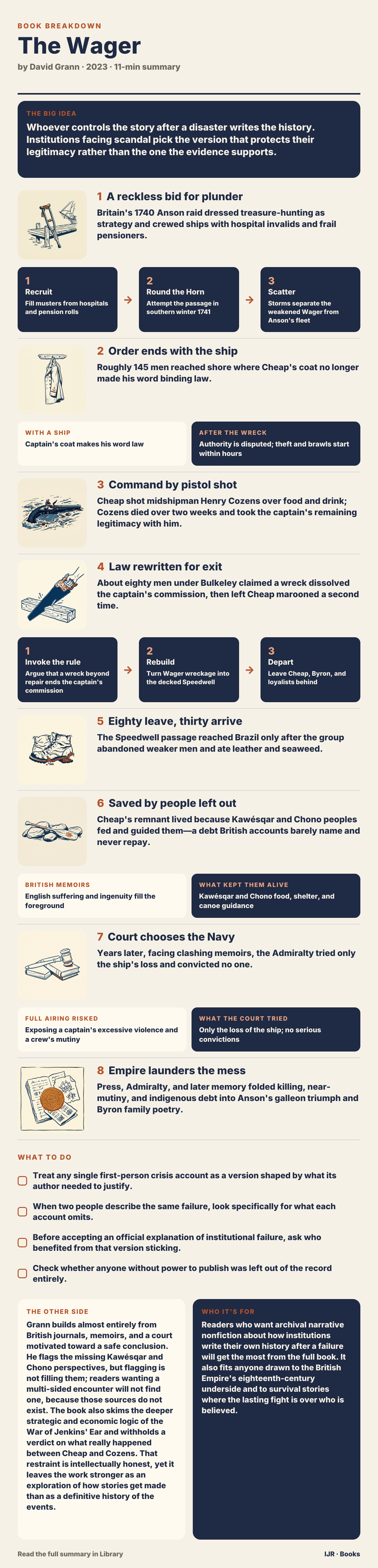
Britain's 1740 Anson raid dressed treasure-hunting as strategy and crewed ships with hospital invalids and frail pensioners.
- 1RecruitFill musters from hospitals and pension rolls
- 2Round the HornAttempt the passage in southern winter 1741
- 3ScatterStorms separate the weakened Wager from Anson's fleet
Grann frames the squadron under Commodore George Anson as less a coherent war plan than a gamble on Spanish Pacific loot during the War of Jenkins' Ear. Ships sailed undermanned and poorly provisioned. Disease and delay stacked up before any enemy appeared.
The Wager was a converted East India merchant ship, smaller than the main warships, carrying supplies and troops for an assault on a Spanish town. Administrative indifference set the terms from the start.
When the fleet tried Cape Horn in the southern winter of 1741, storms scattered the ships. Captain David Cheap pressed on with a crew barely able to work the sails, following orders issued months earlier under different conditions. Grann treats the later wreck as the visible end of decisions made by people who never faced the sea.
In practice: Crews were filled out with men pulled straight from hospital beds.
In practice: Army pensioners too old or sick for land fighting were sent aboard ships bound for Cape Horn.
2
Order ends with the ship
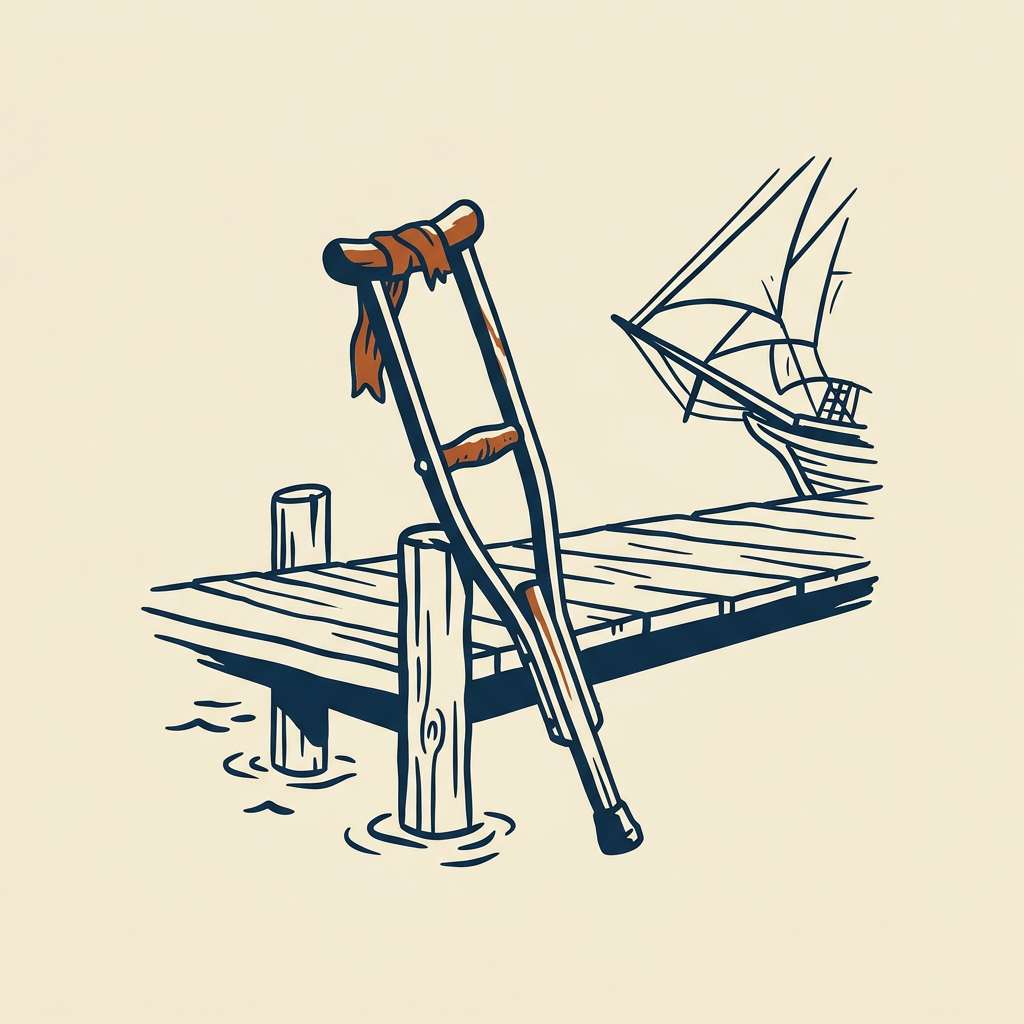
Roughly 145 men reached shore where Cheap's coat no longer made his word binding law.
With a ship
Captain's coat makes his word law
After the wreck
Authority is disputed; theft and brawls start within hours
The Wager hit rocks in the Gulf of Peñas along a coast so remote it did not appear accurately on any chart the crew possessed. Freezing rain, dense forest, and almost no game turned geography into an antagonist.
Men salvaged alcohol before officers could stop them. Drunken brawls broke out within hours. Some wandered off and died of exposure. Others stole rationed food from the weak and sick.
A few, including gunner John Bulkeley, began detailed journals as records and as evidence they sensed they might need later. Grann reads the wreck as breaking the legal fiction that had held ship society together.
In practice: Without a hull beneath them, the chain of command became an open question different men would answer differently.
In practice: Officers failed to stop the scramble for liquor in the first hours after landing.
3
Command by pistol shot
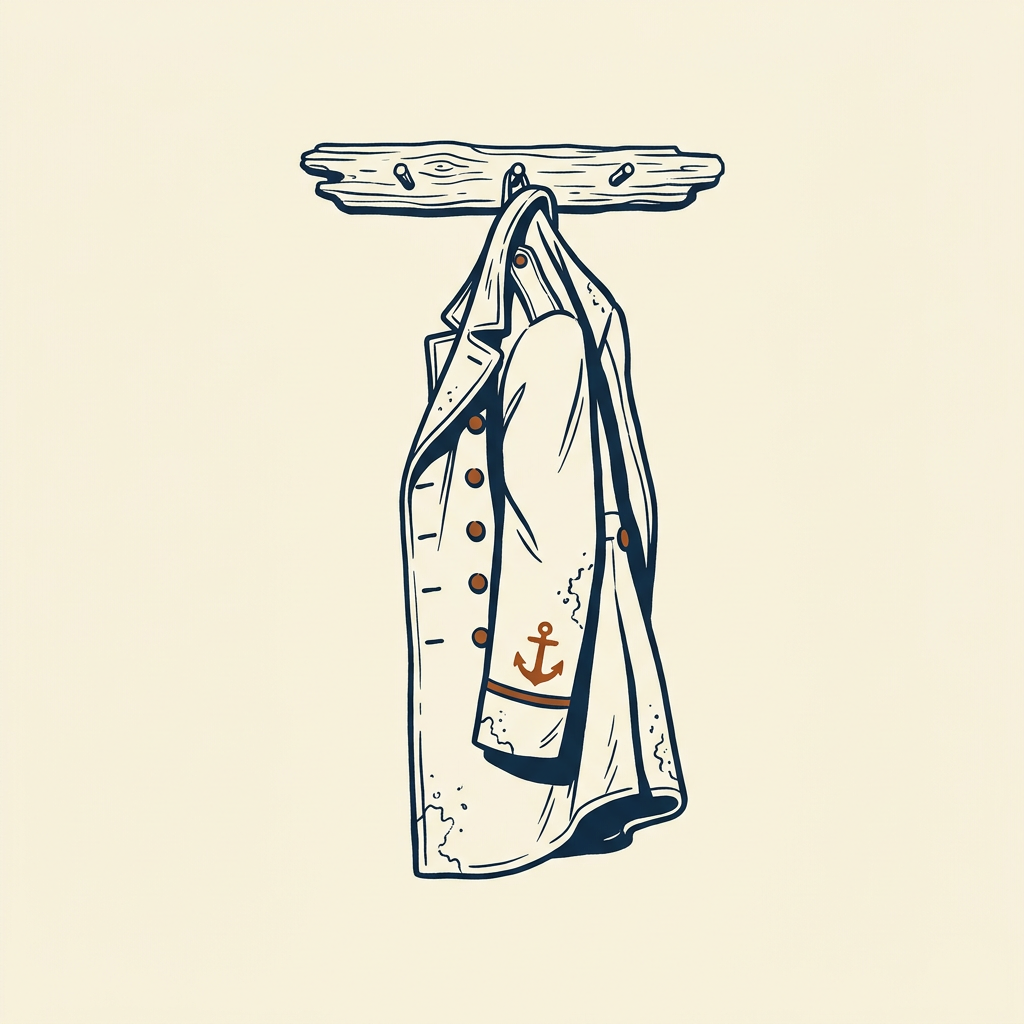
Cheap shot midshipman Henry Cozens over food and drink; Cozens died over two weeks and took the captain's remaining legitimacy with him.
Weeks on the island hardened factions. Cheap still wanted to refit a boat and sail north to rejoin Anson for the planned attack. Many men, especially Bulkeley, called that plan suicidal and pushed south through the Strait of Magellan toward Brazil.
Tensions over rations, discipline, and direction peaked when Cheap confronted Cozens over drunkenness and insubordination and shot him in the head. Grann sets this act—not the wreck itself—as the hinge that ended automatic obedience.
Cheap maintained he was enforcing discipline to prevent total anarchy. The crew saw force without consent. Grann refuses to declare one reading correct, and that refusal serves the book's larger point about irreconcilable stories.
In practice: Both the discipline reading and the tyranny reading held partial truth.
In practice: Cozens's slow death over fourteen days shattered whatever willingness remained to defer to Cheap.
4
Law rewritten for exit
About eighty men under Bulkeley claimed a wreck dissolved the captain's commission, then left Cheap marooned a second time.
- 1Invoke the ruleArgue that a wreck beyond repair ends the captain's commission
- 2RebuildTurn Wager wreckage into the decked Speedwell
- 3DepartLeave Cheap, Byron, and loyalists behind
By late 1741 the majority decided to break away. They invoked a piece of naval reasoning: once a ship is wrecked beyond repair, a captain's authority over the crew effectively ends and men may act for themselves. Grann treats the claim as untested and convenient—a cover built to match a choice already made.
Carpenters spent weeks in freezing cold rebuilding the longboat into a larger decked vessel named the Speedwell, using wood and rigging salvaged from the wreck as food dwindled. Cheap, midshipman John Byron, and a handful of loyalists were left behind.
The book now splits into two parallel survival narratives and two self-interested written records that will not reconverge until England. Grann treats that divergence in testimony as the real subject.
In practice: The wreck-rule's legal weight had never been properly tested in conditions like these.
In practice: Bulkeley's party sailed while Cheap's small group remained stranded on the same island.
5
Eighty leave, thirty arrive
The Speedwell passage reached Brazil only after the group abandoned weaker men and ate leather and seaweed.
Around eighty men crowded into a boat built for far fewer and headed south in late 1741 toward the Strait of Magellan and Portuguese Brazil. Men had to take turns lying down. Stores ran out again and again.
At brief landings, weaker or injured men were deliberately left ashore—framed as necessity, felt by everyone as abandonment. Bulkeley's journal praises discipline and resourcefulness and stays largely silent on the ethics of who was left. Grann reads that silence as an argument meant to make the voyage look like order's triumph.
Only about thirty reached Rio Grande in January 1742. Several died shortly after landfall, their bodies unable to recover. Extreme survival, on this reading, does not reveal a fixed human nature; it produces shifting ethics in which cooperation and betrayal sit inside the same group, sometimes the same person.
In practice: Survivors came ashore emaciated after months at sea.
In practice: Men chewed boot leather and seaweed when food ran out on the overloaded boat.
6
Saved by people left out
Cheap's remnant lived because Kawésqar and Chono peoples fed and guided them—a debt British accounts barely name and never repay.
British memoirs
English suffering and ingenuity fill the foreground
What kept them alive
Kawésqar and Chono food, shelter, and canoe guidance
Cheap, Byron, and the officers still with them tried north along the Patagonian coast, hoping for Spanish-held ground where they might rejoin Anson or at least survive as prisoners rather than castaways. Their boat capsized and left them with almost nothing.
Grann turns to material British sources push to the margins: indigenous peoples of the channels fed, sheltered, and guided the Englishmen despite no obligation and a long history of European mistreatment in the region. Byron's later memoir notes specific individuals who moved them by canoe, yet rarely names them or records their perspective.
Spanish colonial authorities eventually captured the group and held them as wartime prisoners before allowing passage back to Europe. Empire's self-told stories, Grann holds, systematically underweight knowledge and mercy from people it ranked beneath consideration.
In practice: European ships had a long prior record of mistreating these coastal communities.
In practice: After the boat was lost, Kawésqar and Chono guides moved the officers through the channels by canoe.

7
Court chooses the Navy
Years later, facing clashing memoirs, the Admiralty tried only the ship's loss and convicted no one.
Full airing risked
Exposing a captain's excessive violence and a crew's mutiny
What the court tried
Only the loss of the ship; no serious convictions
Bulkeley's group reached England first, in 1742, and published an account that justified the break and cast their own conduct in the best light. When Cheap, Byron, and the other officers returned years later from Spanish captivity, they found a public narrative already formed against them.
The two camps fought their case in print before any legal hearing. When the Admiralty finally convened a court-martial, too much time had passed and witnesses no longer agreed.
Grann treats the result—no one convicted of a serious crime—as the thesis made plain: institutions resolve ambiguity in the direction that preserves their authority.
In practice: Britain still needed public support for the ongoing war when the court sat.
In practice: Cheap's party came home to find their abandonment already framed as desertion and the shooting as murder.
8
Empire launders the mess
Press, Admiralty, and later memory folded killing, near-mutiny, and indigenous debt into Anson's galleon triumph and Byron family poetry.
Grann pulls back from individual survivors to the machinery that absorbed their story. The Admiralty, the press, and later historians preferred a tidy version in which British discipline and courage triumphed over hardship.
Anson returned from the wider Pacific voyage a celebrated hero after capturing a Spanish treasure galleon. The Wager disaster was folded into that triumphant narrative as a footnote rather than an indictment. Byron continued a long naval career; his grandson, the poet Lord Byron, later drew wreck imagery from the grandfather's account, turning survival ordeal into literary material detached from its original moral weight.
On Grann's reading, the difference between mutiny and lawful separation, justified killing and murder, heroism and abandonment, depends less on what happened than on who survives to write, who reads first, and what that reader needs the story to mean.
In practice: Cannibalism rumors clung to the episode yet found no clean place in the official version.
In practice: Anson's captured galleon let the Wager sit as minor hardship inside a larger tale of imperial success.
Key terms
- War of Jenkins' Ear The conflict that framed Britain's 1740 raid on Spanish Pacific holdings
- Wager Island The remote Patagonian island where roughly 145 survivors came ashore
- Speedwell The overcrowded boat rebuilt from Wager wreckage for the southern escape
- Wreck rule The claim that a captain's authority dissolves once the ship is wrecked beyond repair
- Kawésqar Indigenous people of the Patagonian channels who fed and guided Cheap's group
- Court-martial The Admiralty hearing that narrowed the case to loss of the ship and convicted no one
What to do
- Treat any single first-person crisis account as a version shaped by what its author needed to justify.
- When two people describe the same failure, look specifically for what each account omits.
- Before accepting an official explanation of institutional failure, ask who benefited from that version sticking.
- Check whether anyone without power to publish was left out of the record entirely.
Questions to think with
- Who needed each survivor's story to be true?
- What would change if a Kawésqar record of these months survived?
- When should a captain's violence count as discipline, and who decides?
- How should institutions handle scandals that implicate their own authority?
- Which modern disaster stories look tidy because the wrong people wrote the first draft?
The other side
Grann builds almost entirely from British journals, memoirs, and a court motivated toward a safe conclusion. He flags the missing Kawésqar and Chono perspectives, but flagging is not filling them; readers wanting a multi-sided encounter will not find one, because those sources do not exist. The book also skims the deeper strategic and economic logic of the War of Jenkins' Ear and withholds a verdict on what really happened between Cheap and Cozens. That restraint is intellectually honest, yet it leaves the work stronger as an exploration of how stories get made than as a definitive history of the events.
Who it's for
Readers who want archival narrative nonfiction about how institutions write their own history after a failure will get the most from the full book. It also fits anyone drawn to the British Empire's eighteenth-century underside and to survival stories where the lasting fight is over who is believed.