




Financial crises repeat because we always think this time is different
Financial crises are recurring features of credit systems, always preceded by the belief that new conditions have made old patterns obsolete.
IJR · Nov 3, 2026 · 13 min read
In 60 seconds
- The conviction that new rules, tools, or institutions have exempted the present from past crashes is itself a reliable pre-crisis warning sign.
- A dataset of sixty-six countries across eight centuries shows sovereign defaults, banking panics, currency crashes, and inflation spikes are the historical norm, not rare accidents.
- The same countries default on external debt again and again after capital-flow bonanzas reverse, pointing to durable structural habits rather than one-off bad luck.
- Domestic public debt is large and often quietly defaulted on through inflation and financial repression, making the true default record far wider than foreign-debt studies alone.
- Banking crises follow the same credit-boom, asset-price, leverage, and collapse script even in sophisticated, well-regulated economies.
- Severe crises share a uniform aftermath—housing down roughly 35 percent, equities around 55 percent, unemployment up about seven points, real government debt up about 86 percent—driven mainly by revenue collapse, and 2008 matched that signature.
The big idea
Reinhart and Rogoff argue that financial crises are a recurring species of credit and sovereign finance spanning eight centuries, not unique local accidents. Each generation’s confident claim that innovation or better policy has made this time different reliably precedes a familiar collapse.
The book in brief
The book opens on a psychological pattern that appears before almost every crash: investors, bankers, and officials convince themselves that current borrowing or growth is safe because circumstances have fundamentally changed. Real shifts—new industry before 1929, export models and fixed rates before the 1990s Asian crisis, securitization and the “Great Moderation” before 2008—are mistaken for proof that leverage, bubbles, and sudden capital reversals no longer apply.
To test that claim the authors abandon the short postwar series most macro work uses and assemble a long comparative record of defaults, banking panics, currency crashes, and inflation spikes. The longer view turns what look like modern anomalies into a repeated long-run pattern and supplies enough episodes to spot common structure instead of noise.
External default emerges as a serial habit concentrated in the same countries across centuries, usually after capital-flow bonanzas reverse. Domestic debt, long ignored because records are scarce, turns out to be large and frequently eroded by inflation or repression—politically easier than open default on foreign creditors.
Banking crises, even in advanced economies with strong institutions, follow nearly the same script of credit growth, rising collateral, leverage, shock, and simultaneous retrenchment. Currency crashes and high inflation function as default by other means; they often arrive together with banking failure as “twin crises.”
Averaging severe postwar banking crises produces a strikingly uniform aftermath of deep asset-price drops, prolonged unemployment, output loss, and large jumps in government debt driven mainly by collapsing revenue. The run-up to 2008 tracks those historical averages closely, undercutting claims that U.S. innovation had rewritten the mechanics.
Context
Carmen M. Reinhart and Kenneth S. Rogoff published the book in 2009 after building a dataset covering sixty-six countries and eight centuries. It reframed the 2008 crisis as history repeating rather than an unprecedented break with the past.
The key ideas

1
The this-time-is-different syndrome
The belief that new circumstances have exempted the present from historical crisis patterns is itself a reliable warning that a crisis is approaching.
Boom rhetoric
New technology, regulation, or policy has permanently ended old crash patterns
What follows
Leverage, bubbles, and capital reversals reassert themselves in familiar form
Reinhart and Rogoff name a recurring conviction held by investors, bankers, and officials: current growth or borrowing is sustainable because technology, regulation, or institutions have fundamentally changed. The change itself is often real; the error is concluding that leverage, asset bubbles, and capital-flow reversals have been abolished.
Before 1929, commentators pointed to new industrial productivity. Before the 1990s Asian crisis, officials cited export-led models and credible fixed exchange rates. Before 2008, many spoke of a Great Moderation in which securitization had supposedly spread risk safely rather than concentrated it.
The authors treat the rhetoric not as incidental color but as a measurable precursor. Periods in which sober analysts begin speaking confidently of a permanent “new era” cluster tightly around subsequent crises. Warning signs therefore often sit in plain sight in the boom’s own confident language.
This framing sets the book’s method: treat crises as one recurring species and ask what conditions consistently precede them across centuries, regardless of the specific innovation being celebrated.
In practice: Before 2008, the Great Moderation narrative treated decades of low volatility and the spread of securitization as proof the old boom-bust mechanics no longer applied.
2
Eight centuries of data
Crises are the historical norm rather than rare exceptions, a fact obscured because most analysis samples an unusually calm postwar interval.
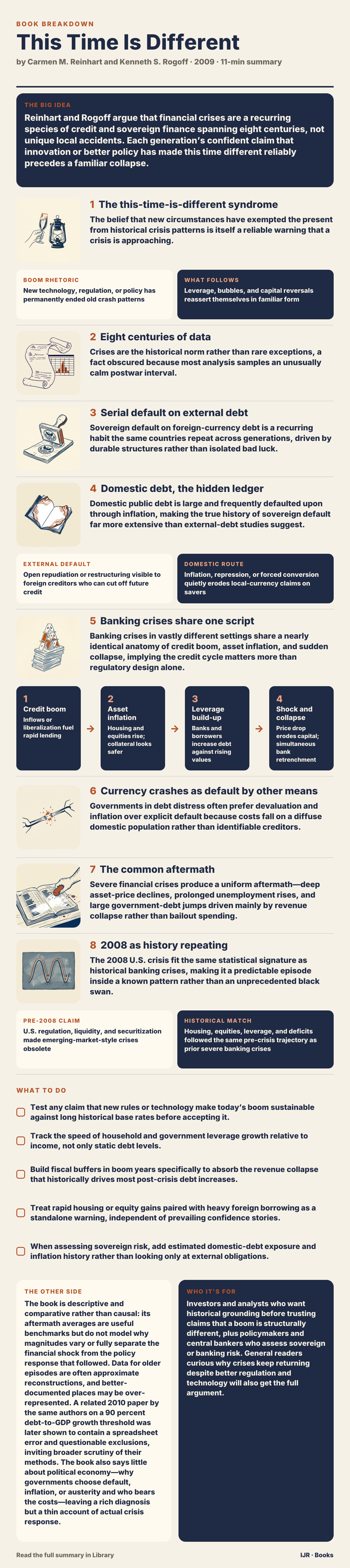
The foundation is a database built from archival records, national statistics, and earlier scholarship covering sovereign defaults, banking panics, currency crashes, and inflation spikes back to medieval Europe. Most macro research at the time started around 1950 or later—an interval the authors call unusually stable, especially in advanced economies.
Extending the record brings in England’s repeated defaults under Edward III in the 1340s, France’s serial defaults across the seventeenth and eighteenth centuries, and Spain’s repeated defaults after its silver-fueled empire. What looks like a modern anomaly becomes a long-run pattern.
Compiling required judgment calls: separating default from restructuring, setting a 15 percent annual depreciation threshold for a currency crash and 20 percent annual inflation for a high-inflation episode, and estimating incomplete domestic-debt records. The point is statistical leverage—few severe crises per country in the postwar era make cross-country and cross-century pooling the only way to see common structure.
The posture is deliberately broad, comparative, and descriptive rather than a tightly modeled causal claim.
In practice: England’s defaults under Edward III in the 1340s and France’s serial defaults in the seventeenth and eighteenth centuries sit in the same long series as modern episodes.

3
Serial default on external debt
Sovereign default on foreign-currency debt is a recurring habit the same countries repeat across generations, driven by durable structures rather than isolated bad luck.
A small set of countries defaults again and again over centuries. Spain defaulted on external debt more than a dozen times between the sixteenth and nineteenth centuries. In Latin America, Argentina, Brazil, and Mexico show clustered defaults across the nineteenth and twentieth centuries.
Repetition across long stretches, despite changes in government, ideology, and financial technology, undercuts explanations centered on any single bad policy or leader. The authors instead point to structural triggers: capital-flow bonanzas in which global lenders flood a country with credit during commodity booms or loose global liquidity, followed by sudden flight when conditions reverse.
Commodity exporters are especially exposed because revenue swings with world prices while debt-service obligations stay fixed. Defaults also cluster globally after major shifts in international capital markets—the aftermath of the Napoleonic Wars, the 1930s Depression, the 1980s debt crisis triggered by rising U.S. rates.
Global clustering supports the later claim that crises are systemic phenomena tied to international credit cycles, even though local institutions shape how painful the aftermath becomes.
In practice: Argentina defaulted in 1890, 1951, 1982, and 2001; Spain defaulted more than a dozen times from the sixteenth to the nineteenth century.

4
Domestic debt, the hidden ledger
Domestic public debt is large and frequently defaulted upon through inflation, making the true history of sovereign default far more extensive than external-debt studies suggest.
External default
Open repudiation or restructuring visible to foreign creditors who can cut off future credit
Domestic route
Inflation, repression, or forced conversion quietly erodes local-currency claims on savers
Earlier scholarship focused on debt owed to foreign creditors because bondholder associations tracked it. Reinhart and Rogoff dig into money owed to a country’s own citizens, often in local currency, and find domestic debt has historically been substantial—sometimes exceeding external debt.
Governments routinely reduce its real burden not by explicit default but by inflation, financial repression, or forced conversion into lower-yielding instruments. A nation that looks modestly indebted abroad may still carry a domestic load quietly eroded at savers’ expense.
Hyperinflation episodes supply the clearest cases: Weimar Germany’s 1920s inflation and multiple Latin American inflations in the 1980s wiped out the real value of domestic bonds, effectively defaulting on citizens rather than foreign banks.
This route is politically easier because costs are diffuse and delayed—felt by pensioners and savers rather than concentrated foreign creditors who can retaliate in credit markets. Inflation thus appears not only as monetary failure but as a historically common tool of fiscal adjustment.
In practice: Weimar Germany’s 1920s inflation and 1980s Latin American inflations erased the real value of domestic bonds held by citizens.

5
Banking crises share one script
Banking crises in vastly different settings share a nearly identical anatomy of credit boom, asset inflation, and sudden collapse, implying the credit cycle matters more than regulatory design alone.
- 1Credit boomInflows or liberalization fuel rapid lending
- 2Asset inflationHousing and equities rise; collateral looks safer
- 3Leverage build-upBanks and borrowers increase debt against rising values
- 4Shock and collapsePrice drop erodes capital; simultaneous bank retrenchment
Across advanced and developing economies the authors find a common sequence. Rapid credit growth, often fueled by capital inflows or liberalization, drives up asset prices—especially housing and equities. Rising collateral values make further lending look safe, so leverage builds inside banks.
A shock—higher rates, a terms-of-trade shift, or simple loss of confidence—triggers price declines that erode bank capital. Banks then retrench together, producing a credit crunch. The same pattern appears in the early-1990s Nordic crises in Sweden, Finland, and Norway, the U.S. savings-and-loan crisis of the 1980s, and Japan’s collapse after its 1980s asset bubble.
These episodes occurred in countries with sophisticated regulators and strong institutions, undercutting the idea that better-governed economies are structurally immune. The authors read it as a feature of credit itself: rising collateral creates a feedback loop that encourages more borrowing until the cycle reverses.
The chapter links sovereign-default history to modern advanced-economy crises, showing the same boom-bust mechanics apply whether the borrower is a government, a bank, or a household.
In practice: The Nordic banking crises of the early 1990s, the U.S. savings-and-loan crisis, and Japan’s post-1980s bubble collapse all followed the same credit-asset-leverage-collapse sequence.

6
Currency crashes as default by other means
Governments in debt distress often prefer devaluation and inflation over explicit default because costs fall on a diffuse domestic population rather than identifiable creditors.
A government that cannot or will not restructure openly can let its currency depreciate sharply or allow inflation to erode the real value of domestic debt and, sometimes, local-currency foreign debt. High-inflation episodes—from various Latin American economies in the 1980s to Zimbabwe’s collapse in the 2000s—cluster around fiscal distress the same way explicit defaults do.
Politically the route is attractive: inflation’s costs are dispersed across savers, wage earners, and pensioners rather than concentrated on foreign bondholders who might cut off credit or sue. Currency crashes and banking crises also frequently arrive together—the pattern labeled “twin crises.”
A currency collapse raises the local-currency cost of foreign-currency bank liabilities, pushing banks toward insolvency just as government finances deteriorate. That linkage explains why Mexico in 1994 and several East Asian economies in 1997 saw currency collapse and banking failure almost simultaneously.
The chapter prepares the core empirical claim that follows: all these crisis types share a common statistical aftermath.
In practice: Mexico in 1994 and several East Asian economies in 1997 experienced twin crises in which currency collapse and banking failure hit together.
7
The common aftermath
Severe financial crises produce a uniform aftermath—deep asset-price declines, prolonged unemployment rises, and large government-debt jumps driven mainly by revenue collapse rather than bailout spending.
Averaging severe postwar banking crises in the sample, the authors report housing prices fall roughly 35 percent over about six years, equity prices fall around 55 percent over roughly three and a half years, unemployment rises about seven percentage points over four years, and output falls around 9 percent from peak to trough.
Government debt rises on average by about 86 percent in real terms within three years. Crucially, that increase is driven far more by collapsing tax revenue and automatic stabilizers than by the direct cost of bank bailouts, which tends to be smaller than public perception suggests.
The finding reframes political debate over crisis response: fiscal damage comes primarily from the recession the crisis causes, not from the rescue package itself. Consistency across very different eras and settings—from Nordic crises in the 1990s to Asian crises in 1997 to earlier historical episodes—is the strongest evidence that financial crises share an underlying structure.
Because fiscal cost tracks the depth and length of the contraction, policies that shorten the downturn matter more for public finances than policies narrowly aimed at minimizing bailout outlays.
In practice: Across the severe postwar banking crises averaged in the sample, real government debt rose about 86 percent within three years, mostly from lost revenue rather than bailout checks.
8
2008 as history repeating
The 2008 U.S. crisis fit the same statistical signature as historical banking crises, making it a predictable episode inside a known pattern rather than an unprecedented black swan.
Pre-2008 claim
U.S. regulation, liquidity, and securitization made emerging-market-style crises obsolete
Historical match
Housing, equities, leverage, and deficits followed the same pre-crisis trajectory as prior severe banking crises
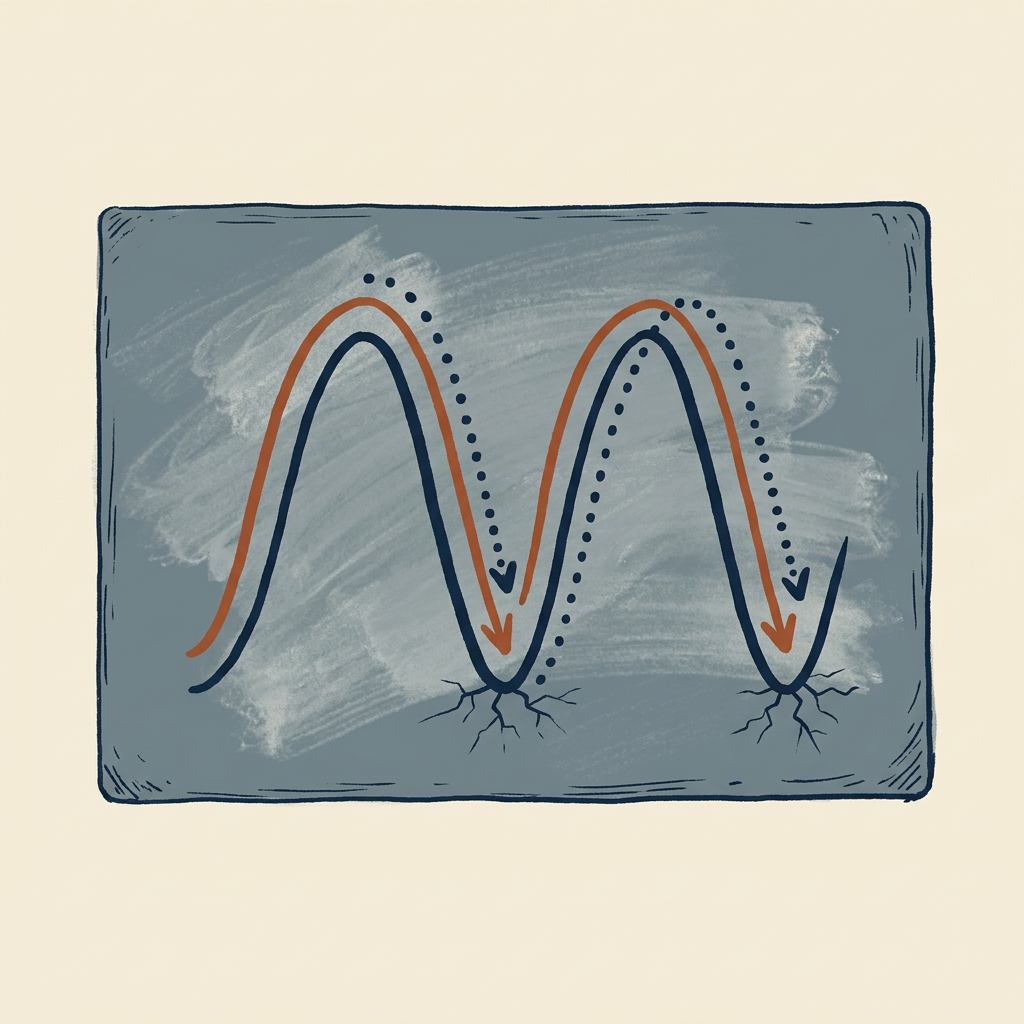
The authors compare the run-up to 2008 directly against their historical averages for banking crises and find close alignment. U.S. housing and equity prices before the crash tracked almost exactly the average trajectory of prior severe banking crises; so did the build-up in household leverage and current-account deficits.
In the years before the crash, prominent voices had argued the U.S. system was different from emerging-market cases of the 1990s—better regulated, more liquid, more innovative. The comparison undercuts that claim by showing pre-crisis U.S. data matched the profile of countries such as Spain heading into property-driven trouble and matched the credit-boom pattern of the Asian crisis a decade earlier.
They label the episode the Second Great Contraction, linking it to the Great Depression as the only comparable episode in scale and global reach among advanced economies. Had base rates been taken seriously instead of assuming American financial innovation had changed the mechanics, rapid rises in household debt-to-income ratios and surging mortgage securitization would have been read as classic pre-crisis symptoms.
The syndrome introduced at the outset was operating in real time, not only in distant historical episodes.
In practice: Pre-2008 U.S. housing prices, equity prices, household leverage, and current-account deficits tracked the average path of earlier severe banking crises.
Key terms
- this-time-is-different syndrome The conviction that new technology, rules, or institutions have made current borrowing or growth safe from historical crash patterns
- serial default The repeated external-debt defaults by the same countries across generations after capital-flow reversals
- capital flow bonanza A surge of foreign lending into a country, often during commodity booms or loose global liquidity, that later reverses abruptly
- domestic debt Public debt owed to a country’s own citizens, often in local currency, frequently eroded by inflation or repression
- twin crises The near-simultaneous arrival of a currency crash and a banking crisis, each worsening the other
- financial repression Policies that force savers into lower-yielding government claims, quietly reducing the real burden of domestic debt
- Second Great Contraction The authors’ label for the 2008 crisis, linking its scale and reach among advanced economies only to the Great Depression
- currency crash threshold The book’s working definition: a 15 percent or greater annual depreciation
What to do
- Test any claim that new rules or technology make today’s boom sustainable against long historical base rates before accepting it.
- Track the speed of household and government leverage growth relative to income, not only static debt levels.
- Build fiscal buffers in boom years specifically to absorb the revenue collapse that historically drives most post-crisis debt increases.
- Treat rapid housing or equity gains paired with heavy foreign borrowing as a standalone warning, independent of prevailing confidence stories.
- When assessing sovereign risk, add estimated domestic-debt exposure and inflation history rather than looking only at external obligations.
Questions to think with
- Where in today’s markets is “this time is different” rhetoric loudest, and what older mechanic is it claiming to have retired?
- If post-crisis debt surges are driven mainly by lost revenue, how should that change the weight given to bailout size versus recession length in policy debates?
- Which countries currently show capital-flow bonanza patterns similar to those that preceded serial defaults in the historical record?
- How should analysts adjust debt-sustainability readings once domestic debt and inflation default are treated as first-class risks?
- What would it take for a genuinely new instrument or regime to break the credit-boom feedback loop the book describes?
The other side
The book is descriptive and comparative rather than causal: its aftermath averages are useful benchmarks but do not model why magnitudes vary or fully separate the financial shock from the policy response that followed. Data for older episodes are often approximate reconstructions, and better-documented places may be over-represented. A related 2010 paper by the same authors on a 90 percent debt-to-GDP growth threshold was later shown to contain a spreadsheet error and questionable exclusions, inviting broader scrutiny of their methods. The book also says little about political economy—why governments choose default, inflation, or austerity and who bears the costs—leaving a rich diagnosis but a thin account of actual crisis response.
Who it's for
Investors and analysts who want historical grounding before trusting claims that a boom is structurally different, plus policymakers and central bankers who assess sovereign or banking risk. General readers curious why crises keep returning despite better regulation and technology will also get the full argument.