




Most startups fail from weak distribution, not bad products
First-time founders and growth leads who built something people want but still cannot acquire customers get a disciplined testing method before runway runs out.
IJR · Oct 20, 2026 · 13 min read
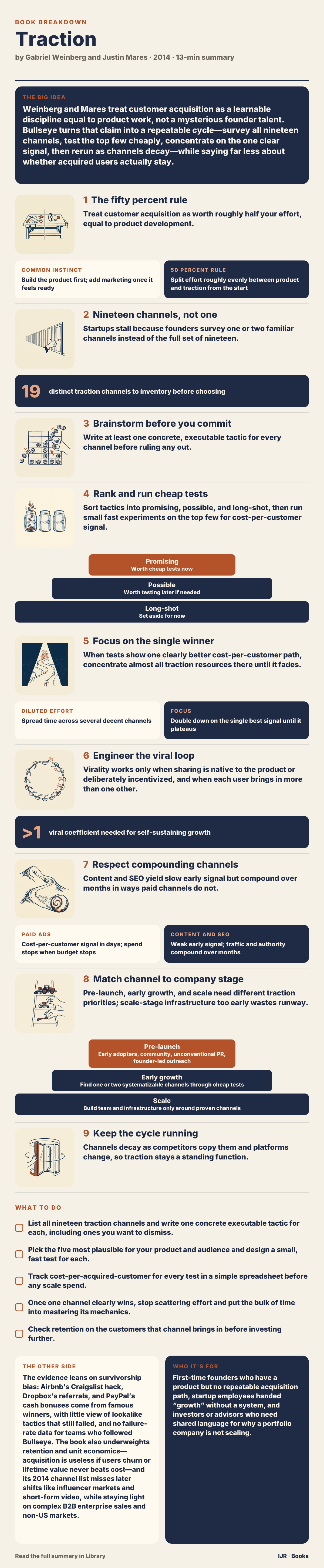
In 60 seconds
- Weinberg and Mares say most failed startups had decent products and no path to the people who wanted them.
- Founders should split effort roughly evenly between product and traction instead of treating marketing as an afterthought.
- Nineteen channels exist; bias toward the one or two you already know hides the real fit.
- Bullseye means brainstorm one concrete tactic per channel, rank by cost and plausibility, run cheap tests, then pour resources into the single clear winner.
- Virality needs a coefficient above one and sharing inside the core action; content and SEO compound too slowly for the same short test window as ads.
- Channels decay as rivals pile in, so the cycle is a permanent operating rhythm, not a launch checklist.
The big idea
Weinberg and Mares treat customer acquisition as a learnable discipline equal to product work, not a mysterious founder talent. Bullseye turns that claim into a repeatable cycle—survey all nineteen channels, test the top few cheaply, concentrate on the one clear signal, then rerun as channels decay—while saying far less about whether acquired users actually stay.
The book in brief
Most failed startups did not lack a good product. They lacked a way to reach people who wanted it. Weinberg and Mares open on that diagnosis. They point to mediocre products that won through distribution, including early Warby Parker’s press-driven launch, and strong products that died unknown. The 50 percent rule follows: spend half your time on product and half on traction. Technical founders resist it because building feels like the real work and selling feels beneath them. The authors answer that traction is an equally hard, learnable craft with its own tests and iteration cycles. Ignore it for a year and the hill only gets steeper.
Founders also fail by fixating on one familiar channel. A technical founder defaults to SEO or engineering-as-marketing. A journalism background defaults to PR. The book catalogs nineteen channels instead—viral marketing, PR, unconventional PR, search and display ads, SEO, content, email, engineering as marketing, business development, sales, affiliates, existing platforms, trade shows, offline events, speaking, community building, and more. Airbnb’s early Craigslist scraping and Dropbox’s referral program show how the non-obvious path often beats the comfortable one. Different products have different natural fits: a B2B tool may need sales; a consumer app may live or die on virality.
Bullseye is the operating method. Brainstorm at least one specific executable tactic for every channel before ruling any out. Rank the list into promising, possible, and long-shot using rough cost and time estimates. Run small cheap tests on the top three to five only to generate a cost-per-customer signal. Then concentrate almost all traction resources on the single best channel until it plateaus, and only then cycle back.
Two channel families get deeper treatment because they break common myths. Virality is engineered, not luck: inherent sharing inside the core action, or artificial incentives like Dropbox storage bonuses and PayPal’s early cash referrals, plus a viral coefficient above one and fast cycle time. Content and SEO compound slowly, so a few posts only test whether people will read and convert; full economics take months and sit awkwardly beside paid-ad tests that return signal in days.
Channel choice also tracks company stage. Pre-launch favors scrappy learning through community, unconventional PR, and founder-led outreach. Post-launch favors finding one systematizable channel. Infrastructure—a growth team, a sales department, an ad operation—comes only after cheap tests validate the channel. Hire that team too early and you lock overhead onto an unproven bet. Traction is never finished. Channels that once were cheap, from early Facebook ads to early AdWords, get crowded and expensive. Companies that keep testing while the current channel still works avoid the stall when it fades.
Context
Published in 2014, the book mattered because it reframed growth as a discipline to be tested rather than a talent some founders happen to have. It pushed startups to treat marketing and distribution with the same rigor as product development.
The key ideas

1
The fifty percent rule
Treat customer acquisition as worth roughly half your effort, equal to product development.
Common instinct
Build the product first; add marketing once it feels ready
50 percent rule
Split effort roughly evenly between product and traction from the start
Weinberg and Mares start from a blunt pattern: failed startups usually did not ship garbage. They shipped something decent that nobody ever found. The instinct on most founding teams is the opposite—build until the product feels ready, then bolt on marketing. That instinct is costly. Traction problems compound. A year spent only on product leaves a steeper climb once competitors and attention have moved on.
The 50 percent rule is deliberately provocative for technical founders who love building and find selling uncomfortable. The authors refuse the hierarchy. Distribution is not a lesser skill. It is a hard, learnable discipline with frameworks, cheap tests, and iteration loops of its own. Permission matters here. Non-marketers do not need to become traditional advertisers first; they need a method.
Equal time also changes sequencing. Traction work begins while the product is still forming, not after a big launch. Early signal on how people actually discover you feeds back into what you build.
In practice: Early Warby Parker’s press-driven launch helped a then-mediocre product category win attention while stronger products stayed invisible.

2
Nineteen channels, not one
Startups stall because founders survey one or two familiar channels instead of the full set of nineteen.
19
distinct traction channels to inventory before choosing
Background bias is the hidden failure mode. Your network and skills quietly pick the channel before any evidence does. The catalog is meant to break that habit: viral marketing, PR, unconventional PR, search engine marketing, social and display ads, offline ads, SEO, content marketing, email, engineering as marketing, business development, sales, affiliates, existing platforms, trade shows, offline events, speaking engagements, community building, and the tactics inside each.
Not every company needs all nineteen. The point is inventory before commitment. A B2B enterprise tool often lives on sales and business development. A consumer app may depend on virality or store search. The channel that feels obvious is frequently not the one with the least competition or the best fit for your audience.
Mapping the whole space first is what makes later ranking honest. Without the map, founders keep optimizing the wrong road.
In practice: Airbnb’s early scraping of Craigslist listings and Dropbox’s referral program both sat outside the default marketing toolkit their founders might have chosen by habit.

3
Brainstorm before you commit
Write at least one concrete, executable tactic for every channel before ruling any out.
The first Bullseye stage is forced breadth. “Try social media” does not count. A tactic has to be specific enough to run. Most teams skip this step because they already “know” their channel from admired companies or personal comfort. Comfort is not the same as cheapest durable customers.
Bring different backgrounds into the room. A technical cofounder and a business cofounder will invent different tactics for the same channel; both sets belong on the table. The output is not a decision. It is a long list—ideally nineteen or more testable ideas, sometimes several per channel.
Delaying commitment is the whole point. The cost of narrowing too early stays invisible until the chosen channel plateaus and no backup has been scoped.
In practice: The book’s own illustration is a specific $500 Facebook campaign aimed at new parents in Chicago, and a hypothetical local food-delivery startup that surfaces a farmers-market partnership beside SEO recipe content only because the exercise forced both onto the same list.

4
Rank and run cheap tests
Sort tactics into promising, possible, and long-shot, then run small fast experiments on the top few for cost-per-customer signal.
- PromisingWorth cheap tests now
- PossibleWorth testing later if needed
- Long-shotSet aside for now
Ranking uses whatever rough knowledge you already have—cost guesses, competitor moves, customer habits—but gut alone is not enough. Each channel needs a real if approximate cost and time estimate. Promising channels get tested soon. Possible ones wait. Long shots sit aside.
Testing comes next on the top three to five only. The goal is not volume. The goal is a cheap signal on cost per acquired customer and on how the channel actually behaves. Wrong guesses should not sink the company.
Common failure modes sit on both sides. Some teams never test and commit on assumption. Others test so large and so slow that runway dies finding out a channel does not work. Expensive full launches—a big PR push, a large ad buy—often run before any data suggests payoff. That inverts the order: signal first, investment second.
In practice: Test content with three or four blog posts and track traffic and conversion before a full calendar; test sales by manually cold-emailing twenty prospects before hiring a sales team.

5
Focus on the single winner
When tests show one clearly better cost-per-customer path, concentrate almost all traction resources there until it fades.
Diluted effort
Spread time across several decent channels
Focus
Double down on the single best signal until it plateaus
Diversification feels safe. The authors argue the opposite once real signal exists. Mastering a channel’s mechanics—the algorithm, the audience behavior, the creative format—takes sustained iteration. Spread that attention and none of the channels get deep enough to compound.
Focus is sequencing, not monogamy forever. When the primary channel’s returns diminish, return to the wider inventory and find the next one. Without earlier broad tests, founders cannot know which channel deserves this concentration. Without earlier brainstorming, the “obvious” default is often not the best available.
Concentration also clarifies org design. Headcount and budget follow the proven path instead of staffing every plausible bet.
In practice: YouTube’s early growth leaned heavily on embedding and virality; many SaaS companies scaled primarily through content marketing and SEO rather than a balanced portfolio of average channels.

6
Engineer the viral loop
Virality works only when sharing is native to the product or deliberately incentivized, and when each user brings in more than one other.
>1
viral coefficient needed for self-sustaining growth
Startup mythology treats virality as lightning. The book treats it as engineering. Inherent virality means sharing is part of the core action, like sending a calendar invite. Artificial virality means incentives layered on, such as extra storage or cash for referrals.
The viral coefficient is the number of new users each existing user brings. Above one, growth can compound on its own. Below one, virality cannot carry the business alone and must pair with another channel. Cycle time matters too. A modest coefficient with a fast invite loop can beat a higher coefficient that takes months to fire, because compounding happens more often.
Most products that “went viral” actually mixed a loop with paid acquisition or PR to reach critical mass. Measure early coefficient and cycle time before scaling the channel.
In practice: Dropbox offered extra storage for invites; PayPal paid cash bonuses for referrals because network effects made each new user worth more than the bounty.

7
Respect compounding channels
Content and SEO yield slow early signal but compound over months in ways paid channels do not.
Paid ads
Cost-per-customer signal in days; spend stops when budget stops
Content and SEO
Weak early signal; traffic and authority compound over months
Bullseye loves fast cheap tests. Content marketing and SEO refuse that timeline. A handful of posts will not prove whether organic search and audience-building will work, because those results take months, not days.
The honest workaround is to test the front half quickly: can this audience and niche produce work people read or share, and does it convert on a small scale. Full economic validation still takes longer than an ad test. That uneven fit is a real limit of the framework, not a footnote.
Paid ads return cost-per-customer signal within days. Ranking content against ads inside the same short window systematically underrates the compounding path. Plan the calendar and the patience differently.
In practice: A company that publishes consistently useful how-to content in its niche can, within a year or two, surpass rivals who leaned on paid acquisition, even if early tests looked weak.

8
Match channel to company stage
Pre-launch, early growth, and scale need different traction priorities; scale-stage infrastructure too early wastes runway.
- Pre-launchEarly adopters, community, unconventional PR, founder-led outreach
- Early growthFind one or two systematizable channels through cheap tests
- ScaleBuild team and infrastructure only around proven channels
Channel fit is not only product and audience. It is also stage. Pre-launch usually needs a base of engaged early adopters through community building, unconventional PR, or targeted outreach. Founders stay personally involved. The goal is learning, not volume.
After launch but before scale, Bullseye finds the one or two channels that can be systematized. Work still looks scrappy and manual—founders onboarding users or running sales calls themselves. Only after a channel is proven and repeatable does organizational infrastructure make sense.
A common failure is raising money and immediately hiring a marketing or sales team before any channel has cheap validation. That skips the testing stages and bets runway on an assumption. Revisit priorities at each stage transition with investment matched to how much signal actually exists.
In practice: Founders who hire a full marketing or sales team before any channel is validated lock in overhead against an unproven acquisition bet.

9
Keep the cycle running
Channels decay as competitors copy them and platforms change, so traction stays a standing function.
A working channel does not stay cheap. Rivals notice. Algorithms shift. Audiences tire. Early Facebook ads, early App Store tactics, and early Google AdWords were extraordinary until they became crowded and expensive. Stop iterating after the first win and growth stalls when the economics worsen.
The closing move is organizational habit. Someone remains responsible for testing new tactics even while the current channel still delivers. That avoids the gap when a primary path suddenly fails and no backup has been scoped.
Bullseye is therefore not a launch checklist. It becomes part of permanent operating rhythm the same way product iteration continues after version one ships.
In practice: Channels that looked like free growth early—Facebook ads, App Store optimization, Google AdWords—turned crowded and costly once the wider market copied them.
Key terms
- 50 percent rule Spend roughly half your time on product and half on getting customers.
- Bullseye Framework Brainstorm tactics across all channels, rank them, run cheap tests, then focus on the single best one.
- Nineteen channels The full menu of traction paths, from viral loops and PR to sales, SEO, trade shows, and community.
- Viral coefficient How many new users each existing user brings in; above one can sustain growth alone.
- Cycle time How long it takes one user to bring the next; faster loops compound harder.
- Inherent virality Sharing that is part of using the product itself, not an add-on reward.
- Artificial virality Growth driven by explicit incentives such as cash bonuses or extra storage for referrals.
- Compounding channels Paths like content and SEO that start slow and build on themselves over months.
What to do
- List all nineteen traction channels and write one concrete executable tactic for each, including ones you want to dismiss.
- Pick the five most plausible for your product and audience and design a small, fast test for each.
- Track cost-per-acquired-customer for every test in a simple spreadsheet before any scale spend.
- Once one channel clearly wins, stop scattering effort and put the bulk of time into mastering its mechanics.
- Check retention on the customers that channel brings in before investing further.
Questions to think with
- Which of the nineteen channels are you ignoring only because they feel unfamiliar or unprestigious?
- What would a truly cheap test look like for your current top three channel ideas?
- If your best channel doubled in cost next quarter, what backup have you already scoped?
- Are you staffing infrastructure before any channel has returned a clear cost-per-customer signal?
- Do the users you can acquire cheaply actually stay long enough to justify the spend?
The other side
The evidence leans on survivorship bias: Airbnb’s Craigslist hack, Dropbox’s referrals, and PayPal’s cash bonuses come from famous winners, with little view of lookalike tactics that still failed, and no failure-rate data for teams who followed Bullseye. The book also underweights retention and unit economics—acquisition is useless if users churn or lifetime value never beats cost—and its 2014 channel list misses later shifts like influencer markets and short-form video, while staying light on complex B2B enterprise sales and non-US markets.
Who it's for
First-time founders who have a product but no repeatable acquisition path, startup employees handed “growth” without a system, and investors or advisors who need shared language for why a portfolio company is not scaling.