




The same defiance that saves you can destroy you later
Hillenbrand shows survival as a two-stage fight: first against ocean and captors through defiance and discipline, then against trauma that willpower alone cannot dissolve.
IJR · Oct 25, 2026 · 11 min read
In 60 seconds
- Zamperini's boyhood delinquency supplied the defiance that later carried him through the Olympics, the raft, and the camps.
- On the raft, early panic over rations helped kill one man while rationing, mental routines, and blocked despair kept two alive across forty-seven days.
- Watanabe and the camp system targeted identity and symbols; breaking an Olympic leader mattered more than breaking an anonymous prisoner.
- Prisoners who guarded an inner self lasted longer than those who absorbed the guards' worthlessness labels.
- Homecoming left him free in public and at war in private—nightmares, alcohol, and a drive to kill Watanabe that nearly ended his marriage.
- A sudden conversion at a Billy Graham revival stopped the drinking and replaced revenge with forgiveness after willpower and family pressure failed.
The big idea
Big Idea
Hillenbrand argues that staying alive under extremity depends on discipline, small controllable choices, and a defiant grip on identity, yet those same inner resources can poison civilian life once the danger ends. Zamperini's war only finished when an outside framework—religious conversion—let him drop a revenge fixation that pure willpower had kept burning.
The book in brief
Book in Brief
A restless Torrance kid stole and fought until his older brother steered that energy onto a track. Louis Zamperini became a record-setting runner and reached the Berlin Olympics still in his teens. Hillenbrand treats the stubborn streak underneath as raw material: trouble in peacetime, the core of later endurance.
War turned him into an Army Air Corps bombardier. His plane went down over the Pacific on a search mission. He and two crewmates lived on inflatable rafts through shark attacks, a strafing run, starvation, and the death of one man at sea. Capture by the Japanese Navy ended the drift and opened a longer confinement.
Atoll camps and then mainland prisons at places such as Omori and Naoetsu used hunger, labor, and public degradation to strip prisoners of rank and self-respect. One guard fixed on Zamperini as a prize symbol and made his days a private campaign of torment. Small acts of refusal became how he measured whether he still existed as himself.
Surrender brought a hero's welcome in California after he had already been declared dead. Marriage, attempted racing, and public recovery sat beside nightmares, drinking, and violence the public never saw. The marriage bent toward collapse.
A revival meeting in Los Angeles cracked the fixation. He stopped drinking, released the hunt for his tormentor, started a camp for troubled boys, and later faced former captors in Japan with forgiveness instead of a weapon. Watanabe alone refused the meeting.
Context
The book mattered because it recovered a nearly forgotten story and reframed POW narratives around the long war fought after homecoming. Chronic illness kept Hillenbrand working mainly through phone interviews and archives, which limited how much Japanese perspective and camp-site detail she could gather.
The key ideas
1
Delinquency as training
Zamperini's delinquent childhood was not a detour from later toughness but the source of it.
- childhoodStealing, fighting, outrunning police in Torrance
- teen yearsPete redirects him into distance running and records
- 1936Berlin Olympics; eighth in the 5,000 meters
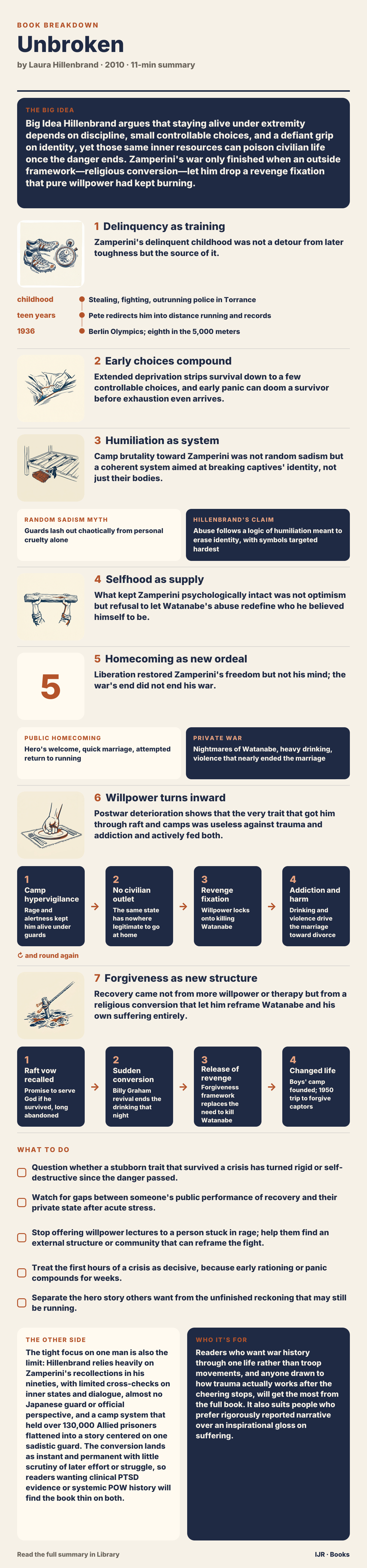
In Torrance, California, Louis stole, fought, and outran police as routine. Older brother Pete redirected that energy into distance running. Louis found he could outlast anyone through sheer refusal to quit.
National high-school records followed, then the 1936 Berlin Olympics at nineteen. He finished eighth in the 5,000 meters but ran the final lap so fast that Hitler reportedly asked to meet him. Stubbornness starts morally neutral here—a nuisance as a boy, a champion's edge as a teenager.
The book's larger claim rests on this origin. Survival, as Hillenbrand presents it, is less about strength or luck than an almost pathological unwillingness to accept defeat. Pete's early external structure also foreshadows how much later survival would depend on other people, not will alone. A four-minute-mile ambition becomes an ordinary-life anchor he would cling to in worse years.
In practice: Pete turned street defiance into track discipline, producing an Olympian whose last lap in Berlin drew Hitler's notice.

2
Early choices compound
Extended deprivation strips survival down to a few controllable choices, and early panic can doom a survivor before exhaustion even arrives.
In May 1943 the Green Hornet went down on a search mission, killing eight of eleven aboard. Zamperini, pilot Russell Allen Phillips, and tail gunner Francis McNamara survived on two inflatable rafts with almost no food or water.
They ate raw fish and birds, distilled rainwater, fought off sharks, and endured a Japanese bomber's strafing run. Hillenbrand cites weight-loss estimates and the physical effects of salt water and starvation to ground the ordeal instead of romanticizing it.
McNamara panicked right after the crash and ate the emergency rations in one sitting. That single acute-stress decision worsened everyone's odds and arguably contributed to his death at sea. Zamperini rationed with real restraint, quizzed Phillips on trivia to preserve their minds, and refused to let despair dominate even briefly. Outcomes, she argues, are shaped in the first hours and then compound for weeks.
In practice: McNamara finished the raft's emergency rations immediately after the crash; he died at sea while the other two held on.
3
Humiliation as system
Camp brutality toward Zamperini was not random sadism but a coherent system aimed at breaking captives' identity, not just their bodies.
Random sadism myth
Guards lash out chaotically from personal cruelty alone
Hillenbrand's claim
Abuse follows a logic of humiliation meant to erase identity, with symbols targeted hardest
After drifting roughly 2,000 miles, Zamperini and Phillips were seized by the Japanese Navy and moved from equatorial atoll camps to mainland prisons including Omori and later Naoetsu. Guard Mutsuhiro Watanabe, nicknamed the Bird, fixed on Zamperini for daily beatings with no infraction and once forced every prisoner in camp to punch him in the face.
Watanabe targeted him because Olympic status and natural leadership made him a symbol; breaking a symbol held more value than breaking an anonymous man. Hillenbrand distinguishes this from Nazi extermination aims: Japanese camps, in her account, pursued humiliation—erasing rank, dignity, and identity—through forced labor, starvation rations, and public degradation rituals across multiple sites.
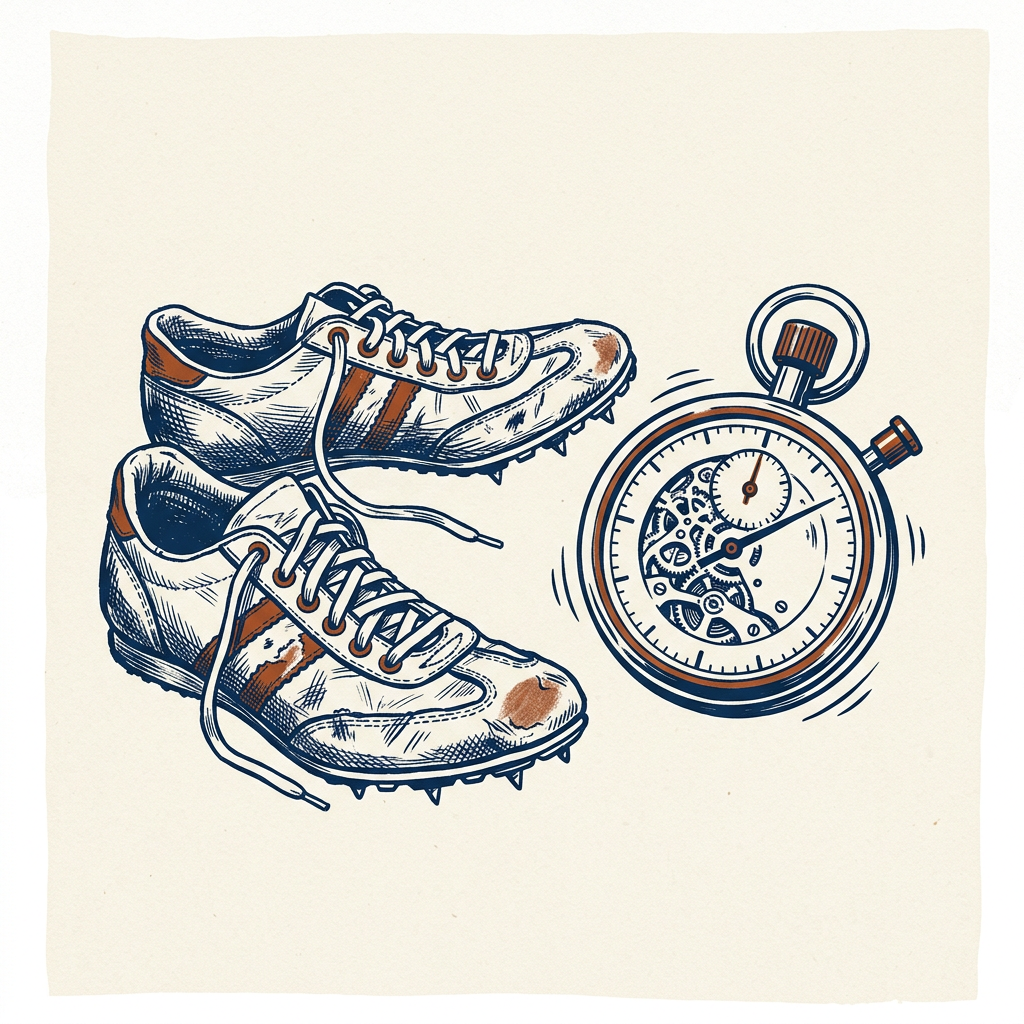
The raft's physical danger becomes secondary to psychological attrition. Resistance shifts into small signals, such as stealing a broom to prove he had not been broken, that become the primary currency of survival.
In practice: Watanabe forced every man in the camp to punch Zamperini in the face as a collective ritual aimed at the Olympic symbol.
4
Selfhood as supply
What kept Zamperini psychologically intact was not optimism but refusal to let Watanabe's abuse redefine who he believed himself to be.
Drawing on Zamperini's later recollections and other camp accounts, Hillenbrand treats identity as the central battle. Prisoners who accepted the guards' labels—worthless, subhuman, disposable—tended to deteriorate faster and die at higher rates. Men who kept an internal sense of former status or purpose held on longer.
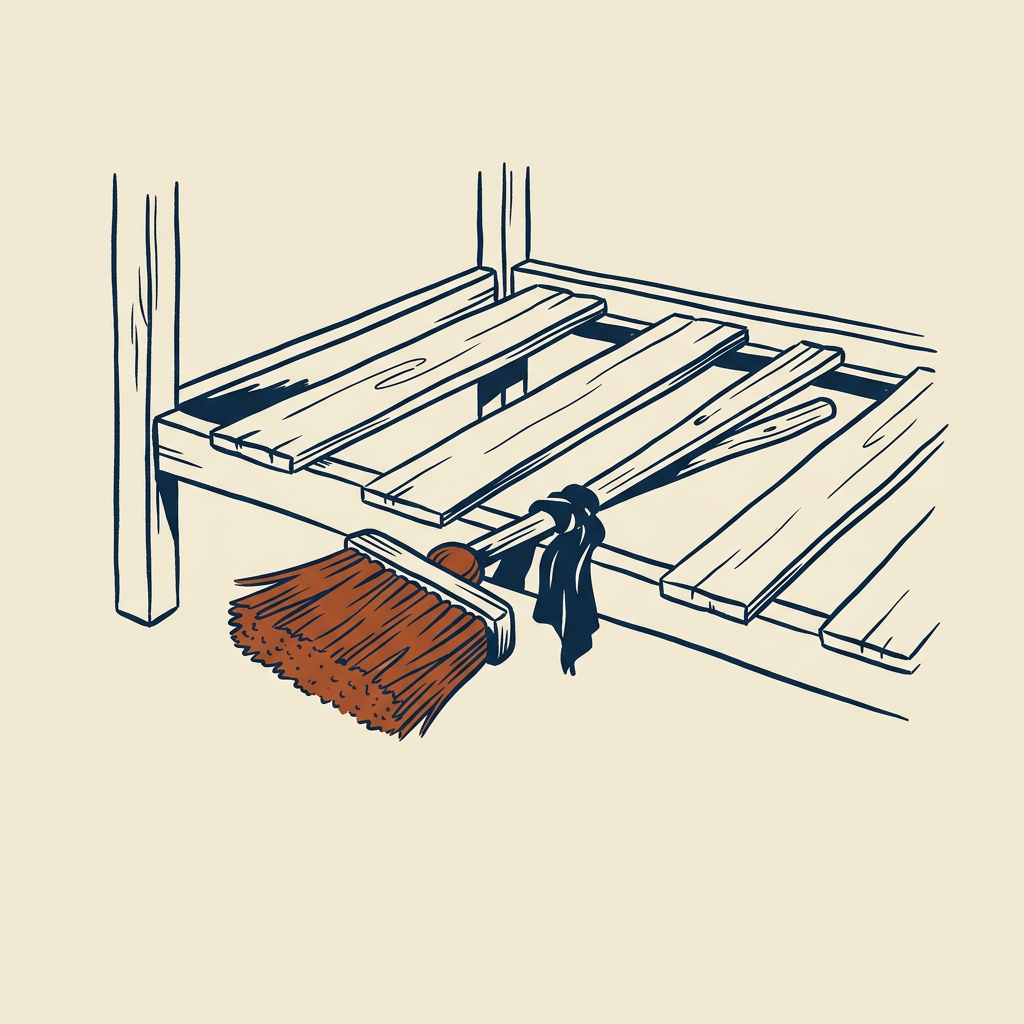
His tactic was defiance calibrated just short of getting killed: holding Watanabe's eye during beatings, once hoisting a heavy beam under forced humiliation without showing he was breaking, and organizing secret morale and small acts that mimicked ordinary dignity.
She is transparent that this rests heavily on interviews conducted when he was an old man, harder to verify than raft physiology. Still, other POW testimony and camp doctors' postwar assessments described psychological collapse as a leading cause of death independent of caloric intake. The intensity of Watanabe's targeting, she suggests, backfired by giving Zamperini a terrible clarity of significance that anonymous suffering might not have supplied.
In practice: He held the Bird's gaze through beatings and lifted a punishment beam overhead without showing the break demanded of him.
5
Homecoming as new ordeal
Liberation restored Zamperini's freedom but not his mind; the war's end did not end his war.
Public homecoming
Hero's welcome, quick marriage, attempted return to running
Private war
Nightmares of Watanabe, heavy drinking, violence that nearly ended the marriage
Japan surrendered in August 1945. After more than two years captive he reached California to a hero's welcome, having been declared dead months earlier and even given a funeral.
Hillenbrand refuses to let the arc peak there. He married Cynthia Applewhite quickly, tried to return to running, and outwardly performed recovery for a public that wanted triumph. Internally he was consumed by recurring nightmares centered on Watanabe, drank heavily, and became violent and controlling at home.
Trauma from sustained captivity, in her argument, does not resolve on the timeline of external events. It persists through unprocessed rage and an unfinished need for reckoning with Watanabe, who had escaped prosecution and was in hiding. A private second war ran beside the public survivor image, and the marriage nearly collapsed under it.
In practice: Declared dead and already funeralized, he came home a hero yet nearly strangled Cynthia in a dream he believed was about the Bird.

6
Willpower turns inward
Postwar deterioration shows that the very trait that got him through raft and camps was useless against trauma and addiction and actively fed both.
- 1Camp hypervigilanceRage and alertness kept him alive under guards
- 2No civilian outletThe same state has nowhere legitimate to go at home
- 3Revenge fixationWillpower locks onto killing Watanabe
- 4Addiction and harmDrinking and violence drive the marriage toward divorce
↻ and round again
By the late 1940s drinking was severe, the marriage near divorce, and he could not hold a job or plan past revenge fantasies against Watanabe. Hillenbrand presents this as direct continuation of camp psychology rather than a separate civilian problem.
Hypervigilance and rage that once tracked guards now had no legitimate outlet and metastasized into paranoia and violence at home. The redemptive war-hero narrative his era wanted, and that his early public appearances tried to supply, collapses here. Sheer determination—the trait celebrated in the book's first half—fueled fixation on revenge instead of release.
Cynthia filed for divorce in 1949. Surviving physical catastrophe and surviving its aftermath are different problems requiring different resources. Suffering compounds into further suffering until something external interrupts the cycle.
In practice: Cynthia's 1949 divorce filing is the narrative low point where public hero and private collapse can no longer be reconciled.
7
Forgiveness as new structure
Recovery came not from more willpower or therapy but from a religious conversion that let him reframe Watanabe and his own suffering entirely.
- 1Raft vow recalledPromise to serve God if he survived, long abandoned
- 2Sudden conversionBilly Graham revival ends the drinking that night
- 3Release of revengeForgiveness framework replaces the need to kill Watanabe
- 4Changed lifeBoys' camp founded; 1950 trip to forgive captors
In 1949 Cynthia attended a Billy Graham revival in Los Angeles and persuaded a reluctant Zamperini to go. Hillenbrand describes the conversion as sudden: at the tent he recalled a vow made on the raft to dedicate his life to service if he survived, a vow he had abandoned once home.
By his account the conversion stopped his drinking that night and he never drank again. More central to the argument, it dismantled the need for revenge by offering forgiveness as a framework that released the fixation without any face-to-face confrontation.
He founded a camp for troubled boys modeled on his own delinquent youth and in 1950 traveled to Japan to forgive former captors; Watanabe refused to meet. Hillenbrand is not arguing religion is the only exit from trauma. She is documenting what specifically worked for this one man after willpower, family pressure, and time alone had failed: an external structure that could absorb and reframe rage his own strength could not dissolve.
In practice: After the tent meeting he stopped drinking permanently by his account, then forgave captors in Japan in 1950 though the Bird would not see him.
Key terms
- the Bird Prisoners' nickname for guard Mutsuhiro Watanabe, who made Zamperini a personal target
- Green Hornet The B-24 that crashed in the Pacific with Zamperini aboard
- calibrated defiance Resistance pushed just short of getting killed, used to protect dignity
- identity as resource A sense of self that could be depleted or guarded like food or water
- psychological attrition The longer camp war meant to erase who prisoners believed they were
- two-stage survival Staying alive through the ordeal, then surviving the damage the ordeal leaves
What to do
- Question whether a stubborn trait that survived a crisis has turned rigid or self-destructive since the danger passed.
- Watch for gaps between someone's public performance of recovery and their private state after acute stress.
- Stop offering willpower lectures to a person stuck in rage; help them find an external structure or community that can reframe the fight.
- Treat the first hours of a crisis as decisive, because early rationing or panic compounds for weeks.
- Separate the hero story others want from the unfinished reckoning that may still be running.
Questions to think with
- When does refusal to quit stop being strength and start being a trap?
- What external frame, if any, has ever absorbed a rage you could not think your way out of?
- How should we read hero narratives that end at liberation and skip the years after?
- If identity is a survival resource, what quietly depletes it in ordinary life?
- Does Zamperini's religious turn prove a general path, or only one man's exit?
The other side
The tight focus on one man is also the limit: Hillenbrand relies heavily on Zamperini's recollections in his nineties, with limited cross-checks on inner states and dialogue, almost no Japanese guard or official perspective, and a camp system that held over 130,000 Allied prisoners flattened into a story centered on one sadistic guard. The conversion lands as instant and permanent with little scrutiny of later effort or struggle, so readers wanting clinical PTSD evidence or systemic POW history will find the book thin on both.
Who it's for
Readers who want war history through one life rather than troop movements, and anyone drawn to how trauma actually works after the cheering stops, will get the most from the full book. It also suits people who prefer rigorously reported narrative over an inspirational gloss on suffering.