




A near-light-speed baseball becomes a nuclear event
What If? is for curious adults and xkcd fans who want order-of-magnitude thinking made concrete and funny.
IJR · Nov 5, 2026 · 11 min read
In 60 seconds
- A baseball at 90 percent of light speed fuses with air, releases the energy of a small tactical nuclear weapon, and vaporizes the stadium before the batter is hit.
- Draining the oceans destabilizes climate through lost heat buffering; stopping Earth’s rotation flings oceans, air, and people eastward at roughly 1,000 mph.
- Everyone on Earth jumping at once barely registers against routine seismic noise; the whole population at standing density fits in Rhode Island.
- Bodies fail at specific mechanical points—cell rupture, vessel shear, oxygen loss—not vague “too much force,” and last-second elevator jumps do not help.
- Dark or tiny inbox questions get one-line deadpan verdicts, modeling when calculation adds value and when it does not.
- Fermi estimation—split a hard question into look-up-able pieces and multiply—is a skill anyone can practice, not a credential.
The big idea
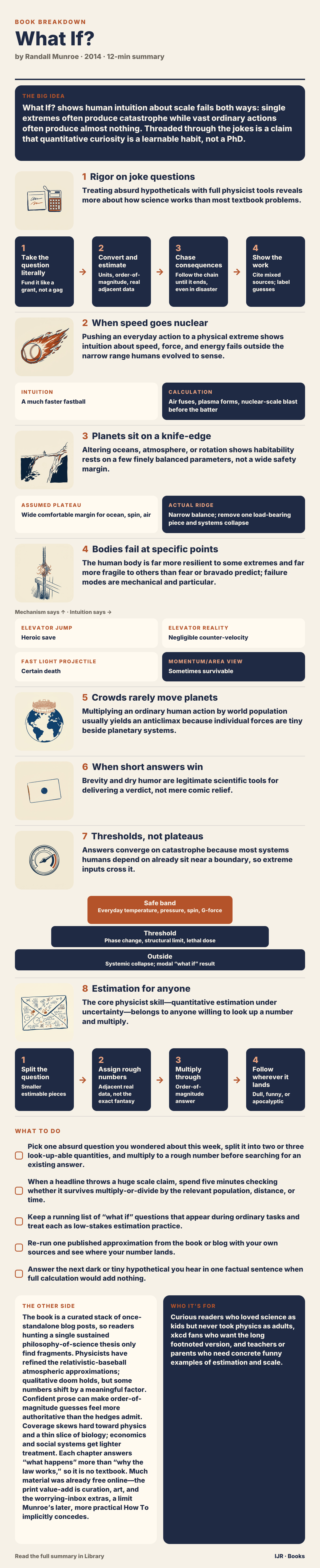
What If? shows human intuition about scale fails both ways: single extremes often produce catastrophe while vast ordinary actions often produce almost nothing. Threaded through the jokes is a claim that quantitative curiosity is a learnable habit, not a PhD.
The book in brief
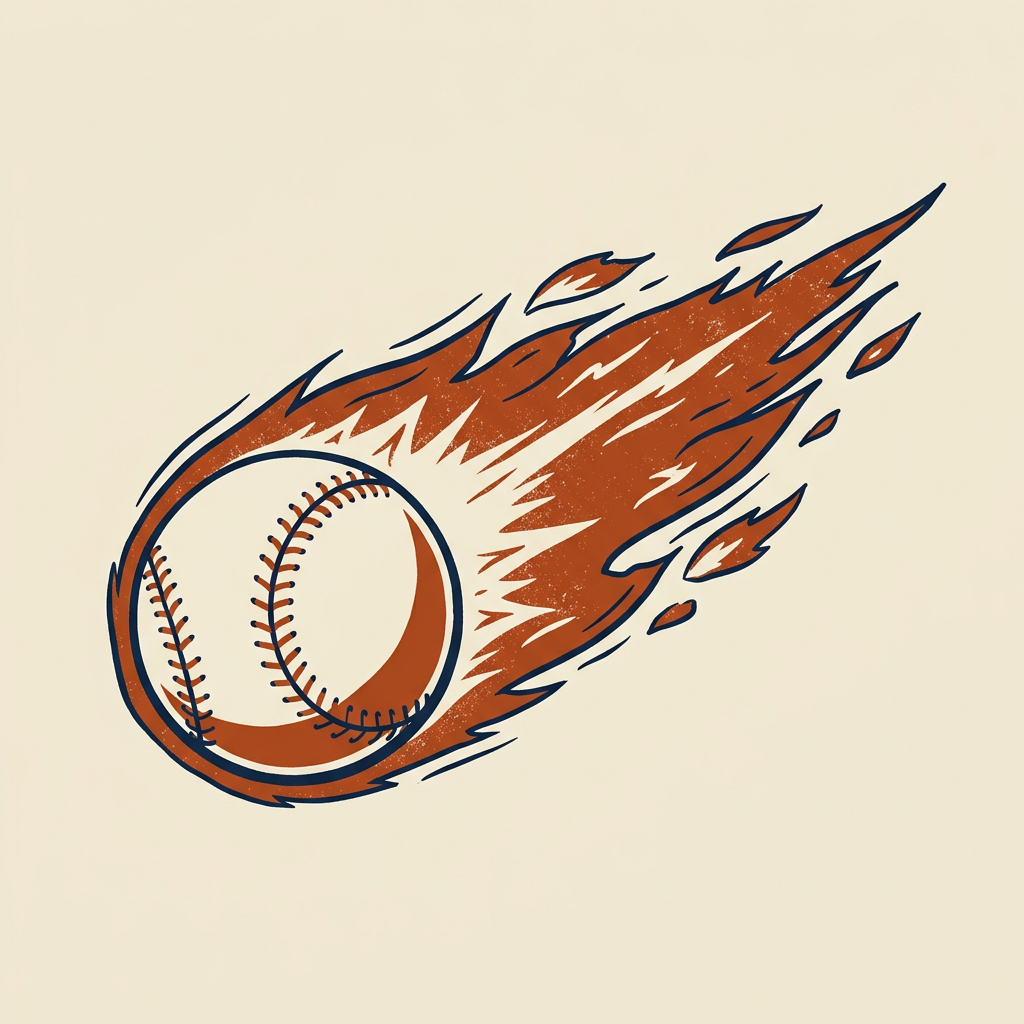
The book opens by treating reader-submitted absurdities as if a grant committee had funded them. A pitch near light speed is not a faster fastball; air fuses with the ball, a plasma of X-rays and gamma rays forms, and the release matches a small tactical nuclear weapon before the batter is reached. The pitcher lasts only until the shockwave.
From there the questions escalate in domain. Oceans are drained into another dimension, Earth’s spin is stopped cold, the Moon is moved twice as close. Ordinary forces on a human body—elevator freefall, flash-freezing, recoil on frictionless ice—are run to the same arithmetic end. Then the lens flips: every person on Earth jumps, aims a laser at the Moon, or stands shoulder to shoulder.
Between the long answers sit clipped “Weird and Worrying” inbox replies that refuse to over-explain. By the midpoint a pattern is hard to miss: most extreme pushes cross a threshold rather than glide along a smooth curve. The closing move is not a new catastrophe but a method reveal. Break the intractable into estimable pieces, assign rough real numbers, multiply, and follow the result even when it is apocalyptic or dull. Absurdity becomes the on-ramp to rigor.
Context
Randall Munroe, creator of xkcd, built the book from his blog series of the same name. It mattered because it made order-of-magnitude thinking entertaining and showed a mass audience what scientists actually do when they reason from first principles.
The key ideas

1
Rigor on joke questions
Treating absurd hypotheticals with full physicist tools reveals more about how science works than most textbook problems.
- 1Take the question literallyFund it like a grant, not a gag
- 2Convert and estimateUnits, order-of-magnitude, real adjacent data
- 3Chase consequencesFollow the chain until it ends, even in disaster
- 4Show the workCite mixed sources; label guesses
Readers submit questions from silly to disturbing. Each one gets unit conversion, order-of-magnitude estimation, and a chain of consequences chased to the end.
A speed-bump death query draws the same careful sourcing—crash data, human deceleration limits—as a peer-reviewed paper would. Footnotes mix NASA reports, entomology papers, and Wikipedia; guesses stay labeled as guesses.
The habit demystifies the work. You do not need a PhD to ask what if everyone stood shoulder to shoulder and then look up a density and multiply. The same back-of-envelope muscle later handles ballistics, thermodynamics, and physiology because the method scales with the absurdity.
In practice: How fast can you hit a speed bump before dying is sourced to NHTSA crash data and human tolerance thresholds for deceleration, not waved off as a joke.
2
When speed goes nuclear
Pushing an everyday action to a physical extreme shows intuition about speed, force, and energy fails outside the narrow range humans evolved to sense.
Intuition
A much faster fastball
Calculation
Air fuses, plasma forms, nuclear-scale blast before the batter
A baseball at 90 percent of light speed feels like an extreme fastball. Arithmetic shows it is a nuclear-physics event instead.
Air molecules ahead of the ball do not part; they fuse with surface atoms, strip electrons, and birth a plasma cloud of X-rays and gamma radiation. Kinetic energy scales with velocity squared and mass effectively rises near light speed, so the pitch dumps the energy of a small tactical nuclear weapon before the ball reaches the batter. Mound, batter, stadium, and much of the city vaporize; the pitcher dies on the shockwave a moment later.
A machine-gun bullet fired backward from a plane at exactly the plane’s forward speed does not hover. Relative velocity makes it fall. Linear extrapolation is the trap: doubling a familiar quantity rarely doubles the outcome; orders-of-magnitude jumps change the governing physics.
In practice: The near-light-speed baseball releases roughly the energy of a small tactical nuclear weapon and levels the surrounding city before home plate.
3
Planets sit on a knife-edge
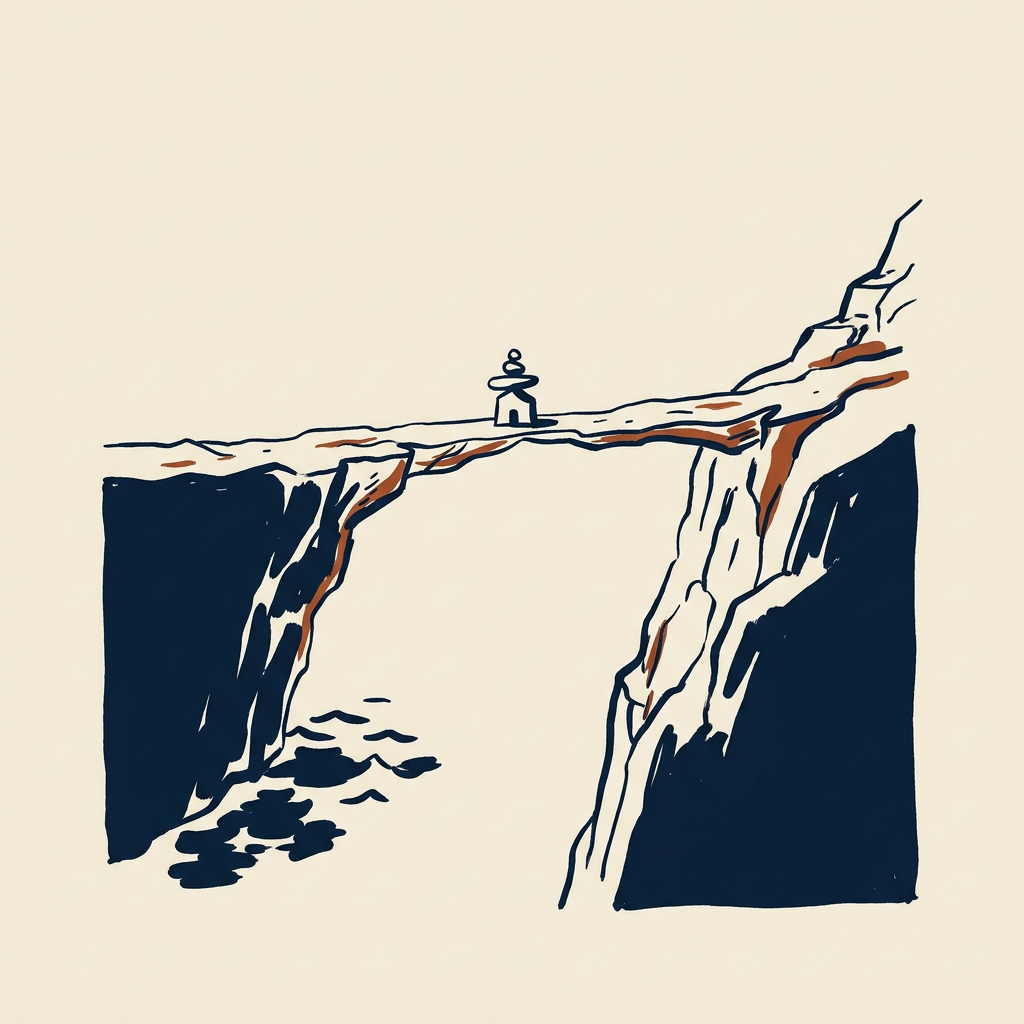
Altering oceans, atmosphere, or rotation shows habitability rests on a few finely balanced parameters, not a wide safety margin.
Assumed plateau
Wide comfortable margin for ocean, spin, air
Actual ridge
Narrow balance; remove one load-bearing piece and systems collapse
Drain the oceans through a hole into another dimension. Water carves canyons deeper than the Grand Canyon, yet the real kill mechanism is climate: lose the ocean’s heat buffer and temperature swings plus failed rainfall wipe out most remaining life faster than thirst.
Stop Earth’s rotation instantly. Everything not bolted down—oceans, atmosphere, buildings, people—flies eastward at roughly 1,000 miles per hour, the equatorial surface speed. The event is a global catastrophe of unprecedented scale.
Move the Moon twice as close and the same logic applies. Small absolute shifts in ocean volume or spin do not yield small habitability dips; they trigger systemic collapse because biology and geology are tuned to present conditions. No one has lived through the removal, so ordinary experience never builds the intuition.
In practice: Instant stop of Earth’s spin flings unsecured oceans, air, and people eastward at roughly 1,000 mph at the equator.
4
Bodies fail at specific points
The human body is far more resilient to some extremes and far more fragile to others than fear or bravado predict; failure modes are mechanical and particular.
Mechanism says ↑ · Intuition says →
Elevator jump
Heroic save
Elevator reality
Negligible counter-velocity
Fast light projectile
Certain death
Momentum/area view
Sometimes survivable
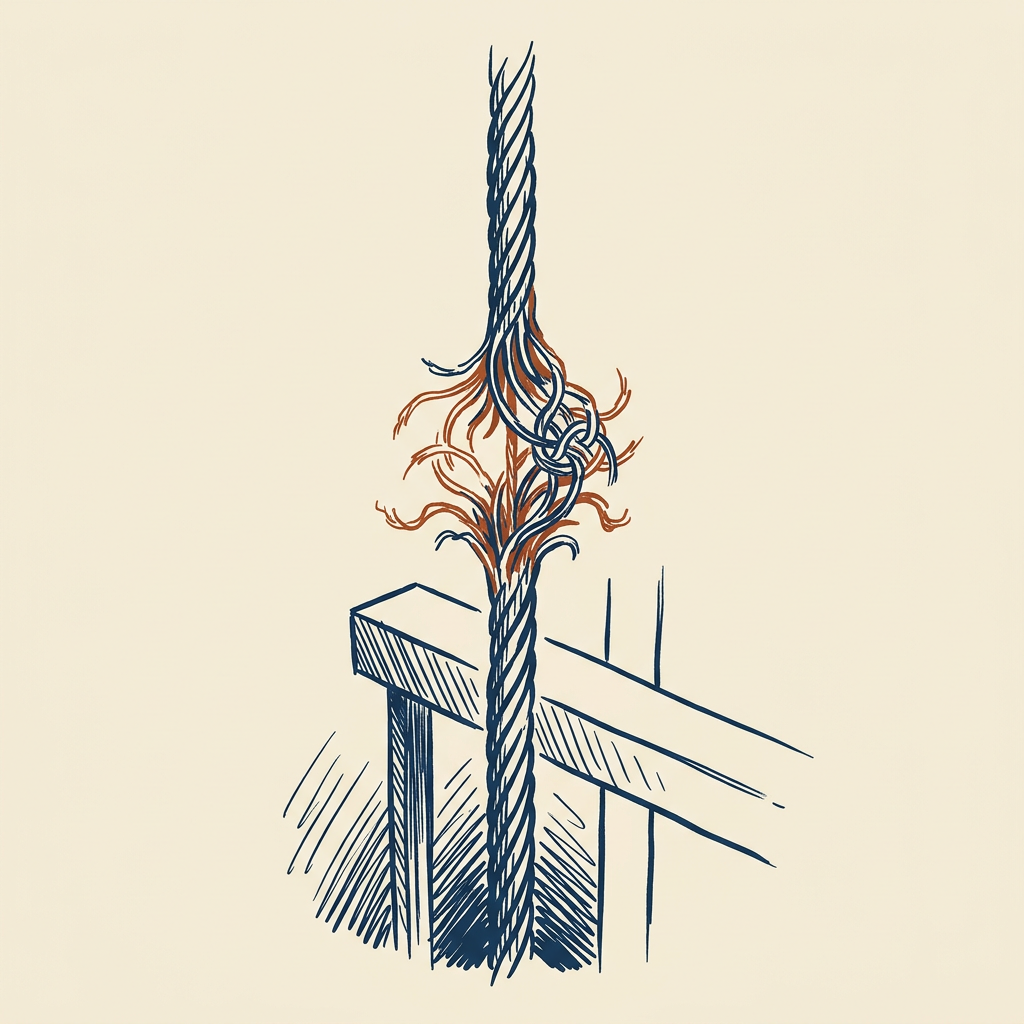
Cable snaps in an elevator. Jumping at the last second does not help in any meaningful way: the body cannot generate enough counter-velocity against a multi-story fall. Safety brakes and shaft air cushioning matter far more than passenger heroics.
Dropped into liquid nitrogen, a person does not become safely thawable even if frozen fast. Ice crystals rupture cells regardless of speed, undercutting cryonics tropes.
Other cases flip the script. A very lightweight, very fast projectile can be survivable when raw-velocity intuition says otherwise, because momentum and cross-section dominate. The useful knowledge is the actual threshold—cell rupture, blood-vessel shear, oxygen deprivation—not a vague sense of “too much force.” Predict from mechanism; do not guess from severity labels.
In practice: Jumping just before an elevator hits the bottom cannot cancel a multi-story fall; the shaft’s brakes and air cushion decide survival.

5
Crowds rarely move planets
Multiplying an ordinary human action by world population usually yields an anticlimax because individual forces are tiny beside planetary systems.
Everyone jumps at once. The ground barely notices—weaker than routine seismic noise—because human mass is negligible next to Earth’s, and everyone lands a fraction of a second later, canceling most of the pulse.
Every person aims a one-milliwatt laser at the Moon. Atmospheric diffraction and sloppy aim keep the combined beam invisible to the naked eye from the lunar surface; a sensitive telescope might just detect it.
Crowd the entire species at typical standing density and the footprint shrinks to Rhode Island. Force, light, and heat do not sum without bound; Earth’s mass, scattering, and the inverse-square law cap them. This is the mirror of the relativistic baseball: one extreme object destroyed a city; billions of ordinary ones barely register.
In practice: A simultaneous global jump produces a tremor weaker than ordinary seismic noise; standing room for everyone is about the size of Rhode Island.

6
When short answers win
Brevity and dry humor are legitimate scientific tools for delivering a verdict, not mere comic relief.
Scattered sections collect inbox questions too strange, short, or dark for full chapters—self-harm scenarios, swallowed objects, oddly specific medical hypotheticals.
Answers run one or two sentences. Dry tone signals that extended calculation would add nothing: either the result is straightforwardly fatal or the premise cannot be closed without inventing facts.
The choice itself is calibration. It separates Fermi-worthy puzzles from cases where the honest reply is blunt. Uncomfortable questions are treated as data, not sermons; the physics is answered and the lecture skipped. Later online science communicators borrowed the stance.
In practice: A dark or nonsensical medical hypothetical receives a one-line “you would die, here’s why” instead of a multi-page model.

7
Thresholds, not plateaus
Answers converge on catastrophe because most systems humans depend on already sit near a boundary, so extreme inputs cross it.
- Safe bandEveryday temperature, pressure, spin, G-force
- ThresholdPhase change, structural limit, lethal dose
- OutsideSystemic collapse; modal “what if” result
By midpoint the modal result is disaster, yet the book never set out to be apocalyptic. “Take X to its limit” almost always means crossing a phase change, structural limit, or lethal dose rather than sliding along normal behavior.
Ordinary life stays well inside narrow bands of temperature, pressure, composition, and G-force, so few people ever sample the outside. The deliberately extreme scenarios are built to reach those edges; that is why they end badly so often.
Population-scale anticlimaxes become the exception that proves the rule: everyday human actions rarely touch the governing thresholds, while the chosen thought experiments are designed to.
In practice: The same boundary logic that turns a relativistic pitch nuclear also turns an instant rotation stop into a planet-wide structural failure.
8
Estimation for anyone
The core physicist skill—quantitative estimation under uncertainty—belongs to anyone willing to look up a number and multiply.
- 1Split the questionSmaller estimable pieces
- 2Assign rough numbersAdjacent real data, not the exact fantasy
- 3Multiply throughOrder-of-magnitude answer
- 4Follow wherever it landsDull, funny, or apocalyptic
No one has fired a machine gun on frictionless ice, so the answer is rebuilt from adjacent real data: known recoil, friction coefficients, reaction times. The same technique that estimates piano tuners in Chicago or nuclear yield from a photo is made visible and repeatable.
Readers can redo the arithmetic, check it, or aim it at their own questions. Science literacy is cast as combining known facts to bound an unknown one, not memorizing trivia.
A funny question lowers the barrier to following math that might otherwise be skipped. Absurdity is not rigor’s opposite; it is often the best on-ramp.
In practice: Machine-gun recoil on frictionless ice is reconstructed from known recoil forces, friction coefficients, and human reaction times rather than pure invention.
Key terms
- Fermi estimation Break a hard question into a few look-up-able pieces, assign rough numbers, and multiply to an order-of-magnitude answer.
- Order-of-magnitude Caring about the right power of ten more than precise digits.
- Relativistic effects Near light speed, energy and effective mass stop behaving like everyday fastballs.
- Consequence chain Follow each physical result into the next until the scenario ends.
- Failure mechanism The specific way a body or system breaks—cell rupture, shear, oxygen loss—not a vague “too much.”
- Threshold The narrow boundary past which a safe band collapses into phase change, structural failure, or lethality.
- Load-bearing parameter A planetary or bodily quantity whose removal triggers systemic collapse rather than a small dip.
- Frames of reference Why a bullet fired backward at a plane’s exact speed falls instead of hovering.
What to do
- Pick one absurd question you wondered about this week, split it into two or three look-up-able quantities, and multiply to a rough number before searching for an existing answer.
- When a headline throws a huge scale claim, spend five minutes checking whether it survives multiply-or-divide by the relevant population, distance, or time.
- Keep a running list of “what if” questions that appear during ordinary tasks and treat each as low-stakes estimation practice.
- Re-run one published approximation from the book or blog with your own sources and see where your number lands.
- Answer the next dark or tiny hypothetical you hear in one factual sentence when full calculation would add nothing.
Questions to think with
- Where have you extrapolated linearly and later learned the governing physics had changed?
- Which everyday system you rely on sits closest to a hard threshold?
- When does a short blunt answer communicate a scientific verdict better than a long model?
- What question would you fund like a grant purely to watch the consequence chain?
- How would you rebuild an answer from adjacent real data if the exact experiment can never be run?
The other side
The book is a curated stack of once-standalone blog posts, so readers hunting a single sustained philosophy-of-science thesis only find fragments. Physicists have refined the relativistic-baseball atmospheric approximations; qualitative doom holds, but some numbers shift by a meaningful factor. Confident prose can make order-of-magnitude guesses feel more authoritative than the hedges admit. Coverage skews hard toward physics and a thin slice of biology; economics and social systems get lighter treatment. Each chapter answers “what happens” more than “why the law works,” so it is no textbook. Much material was already free online—the print value-add is curation, art, and the worrying-inbox extras, a limit Munroe’s later, more practical How To implicitly concedes.
Who it's for
Curious readers who loved science as kids but never took physics as adults, xkcd fans who want the long footnoted version, and teachers or parents who need concrete funny examples of estimation and scale.