




Your stress system was built for lions, not deadlines
Anyone made physically sick by worry, deadlines, or caregiving gets the plain physiology of how chronic stress becomes disease—not pep talks.
IJR · Oct 30, 2026 · 12 min read
In 60 seconds
- Humans flip on the same emergency cascade zebras use to escape lions, but over emails, mortgages, and reviews that never fully resolve.
- Cortisol and adrenaline are triage tools: protective in minutes, corrosive when they starve immunity, repair, growth, and digestion for years.
- Heart disease can be the residue of countless small spikes that abrade vessel walls, skew cholesterol transport, and raise clotting tendency.
- Ulcers are usually driven by Helicobacter pylori; chronic stress mainly weakens gut defenses and also slows healing and vaccine response.
- Damage tracks control, predictability, and social support more than raw severity—stable low rank can beat volatile mid-rank, and Whitehall lower-status workers fared worse than bosses.
- Exercise and real social connection have the strongest backing; venting anger does not reliably lower stress hormones.
The big idea
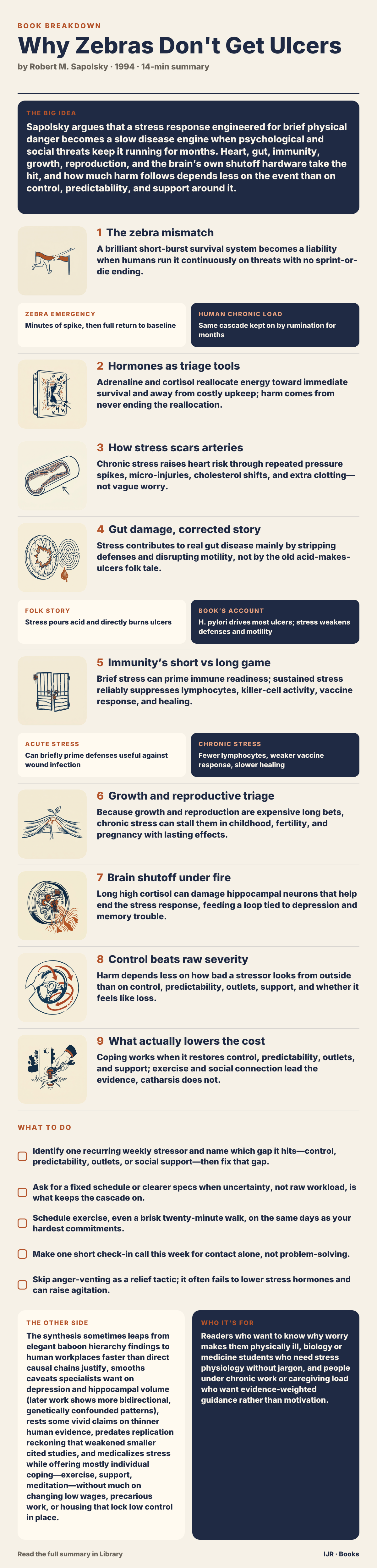
Sapolsky argues that a stress response engineered for brief physical danger becomes a slow disease engine when psychological and social threats keep it running for months. Heart, gut, immunity, growth, reproduction, and the brain’s own shutoff hardware take the hit, and how much harm follows depends less on the event than on control, predictability, and support around it.
The book in brief
The book opens on a mismatch: the cascade that saves a zebra from a lion is temporary, then shuts off. Modern humans trigger that same machinery dozens of times a day over unresolved social and psychological threats, so the emergency system never fully stands down.
It then lays out the hormonal tools—fast adrenaline and slower cortisol—as resource allocators that feed muscles now and pause digestion, growth, reproduction, and immune work. That triage is free for minutes and costly when it lasts years.
From there the argument moves organ by organ: repeated pressure spikes and clotting shifts seed arterial plaques; thinned gut protection raises vulnerability (especially where H. pylori is already present) and disrupts motility; sustained cortisol throttles lymphocytes, natural killer activity, and vaccine response even though brief stress can briefly prime defense; childhood and pregnancy stress can stunt growth, fertility signals, and fetal trajectories; and prolonged glucocorticoids can damage the hippocampus that helps turn the response off, linking stress physiology to mood and memory problems.
The later chapters shift from tissue to context. Baboon fieldwork and human job-strain and civil-service patterns show that rank, control, predictability, outlets, and social support decide whether a stressor becomes biologically expensive. The close is practical and skeptical: restore those variables; lean on exercise and connection; treat generic venting and one-size relaxation claims with caution.
Context
Sapolsky writes as a scientist who studied stress hormones in wild Kenyan baboons and the hippocampus in the lab, then synthesized stress physiology for general readers in 1994. The book mattered by turning everyday worry into a traceable, organ-by-organ disease pathway instead of a vague complaint, while still flagging how animal hierarchy work is being asked to speak to human institutions.
The key ideas

1
The zebra mismatch
A brilliant short-burst survival system becomes a liability when humans run it continuously on threats with no sprint-or-die ending.
Zebra emergency
Minutes of spike, then full return to baseline
Human chronic load
Same cascade kept on by rumination for months
Sapolsky starts from how clean the zebra’s response is: hormones spike, blood shifts to muscle, digestion and reproduction pause, the danger ends, baseline returns within minutes. Humans rarely face that kind of acute physical emergency anymore, yet they mount the identical cascade over a rude message, a mortgage, or a performance review.
The body does not distinguish lion from deadline. Anticipation, memory, and rumination can keep the system lit for months. The problem is duration, not the existence of the response.
If stress stayed acute, the evolved physiology would stay mostly adaptive. Chronic, low-grade, psychologically generated activation—traffic, a boss’s mood, a replayed argument—is what converts a lifesaver into a slow disease process. Everything that follows is an organ-level tour of that stuck-on state.
In practice: A looming review or unpaid bill can trigger the same cortisol-and-adrenaline cascade a zebra uses to flee a lion, then fail to shut it off.

2
Hormones as triage tools
Adrenaline and cortisol reallocate energy toward immediate survival and away from costly upkeep; harm comes from never ending the reallocation.
Sapolsky splits the machinery into a fast sympathetic burst of adrenaline and noradrenaline and a slower hypothalamic-pituitary-adrenal release of glucocorticoids, chiefly cortisol. Adrenaline works in seconds on heart rate, pressure, and alertness. Cortisol works over minutes to hours, breaking down stores into glucose and suppressing digestion, growth, and reproduction.
The recurring claim is triage, not simple toxicity. Systems needed now get fueled; systems that can wait get starved. Five minutes of that bargain is cheap. Five years is not: immune defense, tissue repair, reproductive function, and childhood growth accumulate damage.
He pushes back on the pop story that cortisol is merely poison. Short bursts protect and even help shut the cascade down through feedback. Disease is dysregulation—too much for too long, or a shutoff that fails—not the hormone’s existence. That mechanism then gets applied disease by disease.
In practice: In a true emergency the gut and reproductive axis can wait; under years of deadline stress those postponed systems become the site of real wear.

3
How stress scars arteries
Chronic stress raises heart risk through repeated pressure spikes, micro-injuries, cholesterol shifts, and extra clotting—not vague worry.
Sapolsky refuses a soft ‘stress is bad for the heart’ line and traces tissue-level paths. Repeated sympathetic activation jerks blood pressure up; each spike can abrade vessel linings, especially at turbulent branch points. The body patches those micro-injuries; over years, with circulating fats, the patches become atherosclerotic plaque.
Chronic stress also skews LDL-to-HDL patterns in plaque-friendly directions and raises clotting tendency—useful if you are actually bleeding, dangerous when it happens for no wound.
He brings in monkey hierarchy work where subordinates in unstable dominance systems show more atherosclerosis, and human job-strain findings (high demand plus low control) tied to higher cardiovascular risk. The chapter’s claim is cumulative: thousands of individually small responses leave residue across a lifetime, so cutting chronic strain is another route onto the same arterial tissue as diet and exercise.
In practice: Unstable low control at work, in the Karasek-style pattern, maps onto the same kind of vascular wear tracked in subordinate monkeys under unstable rank.

4
Gut damage, corrected story
Stress contributes to real gut disease mainly by stripping defenses and disrupting motility, not by the old acid-makes-ulcers folk tale.
Folk story
Stress pours acid and directly burns ulcers
Book’s account
H. pylori drives most ulcers; stress weakens defenses and motility
The title nods at a misconception: that stress directly causes ulcers by pouring on acid. In an acute response the body throttles gut blood flow and thins protective mucus because digestion can wait. Chronically, that drawdown leaves the lining more exposed.
The decisive scientific turn Sapolsky centers is Helicobacter pylori as the primary cause of most peptic ulcers—the work that won Marshall and Warren a Nobel. Stress does not conjure ulcers from nothing; it appears to raise susceptibility in carriers by weakening defenses rather than by simple acid overload.
Beyond ulcers, chronic stress scrambles motility (including irritable bowel patterns) and alters permeability and blood flow in ways that affect absorption and inflammation. Getting the mechanism right changes the fix: antibiotics address the bacterium; stress work addresses susceptibility. Mixing those up produces bad advice both ways.
In practice: Someone carrying H. pylori under long stress load faces thinned mucus protection rather than a pure ‘too much acid from worry’ story.

5
Immunity’s short vs long game
Brief stress can prime immune readiness; sustained stress reliably suppresses lymphocytes, killer-cell activity, vaccine response, and healing.
Acute stress
Can briefly prime defenses useful against wound infection
Chronic stress
Fewer lymphocytes, weaker vaccine response, slower healing
One counterintuitive finding Sapolsky stresses: acute stress is not always immunosuppressive and can briefly boost certain defenses, which makes sense if a fighting animal may be wounded. Chronic stress is different and consistent in the opposite direction.
Measures include fewer circulating lymphocytes, reduced natural killer activity, weaker antibody responses to vaccines, and slower wound healing. He points to medical students under exams, dementia caregivers, and people in divorce or bereavement versus less-stressed controls, plus deliberate cold-virus exposure work where more chronically stressed volunteers showed higher infection rates.
Mechanistically it returns to glucocorticoids: cortisol quiets inflammation and immune activity because defense can wait out a true emergency. Permanent elevation makes the postponement permanent. Autoimmune patterns are messier and timing-dependent. The plain claim stands: ‘stress makes you likelier to get sick’ is measurable physiology, not disposable folk wisdom.
In practice: Caregivers and exam-loaded students in the cited work show weaker immune markers and slower healing than comparison groups.

6
Growth and reproductive triage
Because growth and reproduction are expensive long bets, chronic stress can stall them in childhood, fertility, and pregnancy with lasting effects.
Under the same triage logic, growth and reproduction are early targets when stress stays on. Sapolsky describes psychogenic dwarfism: children in severely stressful or neglectful settings can show suppressed growth-hormone release and stunted growth that may partly rebound if the environment improves—evidence that stress hormones interfere with developmental signals, not only with mood.
On reproduction, chronic stress dampens hormones that run menstrual cycles and sperm production, linking extreme physical or psychological load to irregular cycles, reduced fertility, and lower testosterone. He extends the thread into pregnancy, with associations between maternal stress, lower birth weight, and altered offspring stress reactivity—an early framing of fetal programming ideas.
During a five-minute chase this deprioritization is a pause. In childhood or gestation it can become a developmental shift that does not fully reverse, pushing the book’s argument from individual illness into intergenerational cost.
In practice: A child moved out of a severely neglectful setting can show partial catch-up growth after stress-related hormone suppression eases.

7
Brain shutoff under fire
Long high cortisol can damage hippocampal neurons that help end the stress response, feeding a loop tied to depression and memory trouble.
Sapolsky turns to his core research territory: glucocorticoids and the hippocampus, central to memory and to telling the HPA axis to stop. The region is rich in cortisol receptors. Chronic high exposure can damage neurons and, when extended, reduce volume—work spanning ranked wild baboons and rodent lab studies.
That sets up a vicious cycle: a compromised hippocampus is worse at commanding shutoff, cortisol stays up longer, damage continues. He links the pattern to depression, where many patients show elevated cortisol and, in some studies, smaller hippocampal volume, overlapping with memory and concentration symptoms. He does not claim stress alone causes depression amid genetics and transmitter systems; he treats chronic stress physiology as one credible pathway.
Aging memory decline is another slow ledger where lifetime cortisol load is one correlated factor. Stress here does not only wear the body; it can wear the hardware that regulates stress, which is why untreated chronic load tends to worsen rather than plateau.
In practice: Rank-related cortisol patterns in baboons and lab rodent work both inform the damaged-shutoff loop he connects to human mood and memory findings.

8
Control beats raw severity
Harm depends less on how bad a stressor looks from outside than on control, predictability, outlets, support, and whether it feels like loss.
Physiology gives way to the psychology that decides whether a stressor bites. From decades with Kenyan baboons, Sapolsky shows rank predicts stress hormones, but not as simple ‘top is calm.’ Hierarchy stability and felt control matter: a low-ranking baboon in a predictable troop can run lower cortisol than a mid-ranking animal in a volatile troop of shifting alliances.
Human Whitehall civil-service patterns echo the point: lower-status workers had more heart disease than higher-status bosses even after lifestyle controls, against the myth that executives carry the worst stress burden. The driver was control and day-to-day predictability more than sheer workload.
He compresses the aggravators: little control, little predictability, few outlets for frustration, weak social support, and reading the situation as worsening or as loss. Two people can meet the same layoff or diagnosis and leave on different physiological paths. Stress becomes a function of meaning and scaffolding, not events alone—which sets up what actually helps.
In practice: Whitehall lower-rank employees showed worse cardiac outcomes than bosses; unstable mid-rank baboons can out-stress stable subordinates.

9
What actually lowers the cost
Coping works when it restores control, predictability, outlets, and support; exercise and social connection lead the evidence, catharsis does not.
Sapolsky closes skeptical of generic relaxation promises. Regular physical exercise is among the most consistent findings he reviews for lowering baseline cortisol reactivity and improving cardiovascular and immune markers. Social support gets heavy weight: stronger networks link to faster recovery and smaller hormone spikes in hard moments, likely by restoring predictability and buffering threat. Religious or community ties are treated less as doctrine than as the same scaffolding.
Meditation and relaxation get a measured nod—some physiological signal, but mixed and harder to standardize than exercise. He doubts venting anger as relief: catharsis-style outlets often fail to drop stress markers and can raise aggression without lowering cortisol.
The practical rule is targeted: interventions help insofar as they rebuild control, predictability, outlets, and support, not via a vague calm. He refuses a single formula; what restores agency is partly personal, but the biological aim is steady—shorten how often and how long the cascade runs, not only dull one peak.
In practice: Scheduling real movement on high-stress days and a short contact call for connection, not problem-solving, matches the levers he trusts most.
Key terms
- Stress response The shared emergency cascade of nerves and hormones that readies the body for short physical danger.
- Cortisol (glucocorticoids) Slower stress hormones that free energy and pause long-term upkeep; corrosive when elevation never ends.
- HPA axis The hypothalamus-pituitary-adrenal loop that releases cortisol and normally shuts itself down with feedback.
- Sympathetic surge The fast adrenaline and noradrenaline burst that spikes heart rate, pressure, and alertness in seconds.
- Job strain High demand paired with low control—the workplace pattern linked to higher cardiac risk.
- Helicobacter pylori The bacterium that is the main cause of most peptic ulcers; stress mainly raises susceptibility.
- Psychogenic dwarfism Stunted growth from suppressed growth hormone in severely stressful or neglectful childhood settings.
- Hippocampal feedback The memory-related brain region that helps turn cortisol off and can itself be damaged by chronic cortisol.
What to do
- Identify one recurring weekly stressor and name which gap it hits—control, predictability, outlets, or social support—then fix that gap.
- Ask for a fixed schedule or clearer specs when uncertainty, not raw workload, is what keeps the cascade on.
- Schedule exercise, even a brisk twenty-minute walk, on the same days as your hardest commitments.
- Make one short check-in call this week for contact alone, not problem-solving.
- Skip anger-venting as a relief tactic; it often fails to lower stress hormones and can raise agitation.
Questions to think with
- Which of your standing stressors is mostly a control or predictability problem rather than an intensity problem?
- Where is your stress response staying on after the external event has already passed?
- Which single scaffolding piece—movement, a reliable person, a clearer rule—would shorten how long your cascade runs this week?
- How would your read of a bad day change if rank and instability mattered more than ‘how hard the job is’?
- Which popular stress fix have you used that targets mood but not duration of physiological activation?
The other side
The synthesis sometimes leaps from elegant baboon hierarchy findings to human workplaces faster than direct causal chains justify, smooths caveats specialists want on depression and hippocampal volume (later work shows more bidirectional, genetically confounded patterns), rests some vivid claims on thinner human evidence, predates replication reckoning that weakened smaller cited studies, and medicalizes stress while offering mostly individual coping—exercise, support, meditation—without much on changing low wages, precarious work, or housing that lock low control in place.
Who it's for
Readers who want to know why worry makes them physically ill, biology or medicine students who need stress physiology without jargon, and people under chronic work or caregiving load who want evidence-weighted guidance rather than motivation.