




Hegseth expands Guard tools to lock down D.C. order
Oct. 29 memos let National Guard use patrol cars, Humvees and boats for the Make D.C. Safe and Beautiful mission, with hard limits on arrests and chases, as local leaders press to pull the troops.
IJR · Nov 6, 2026 · 5 min read
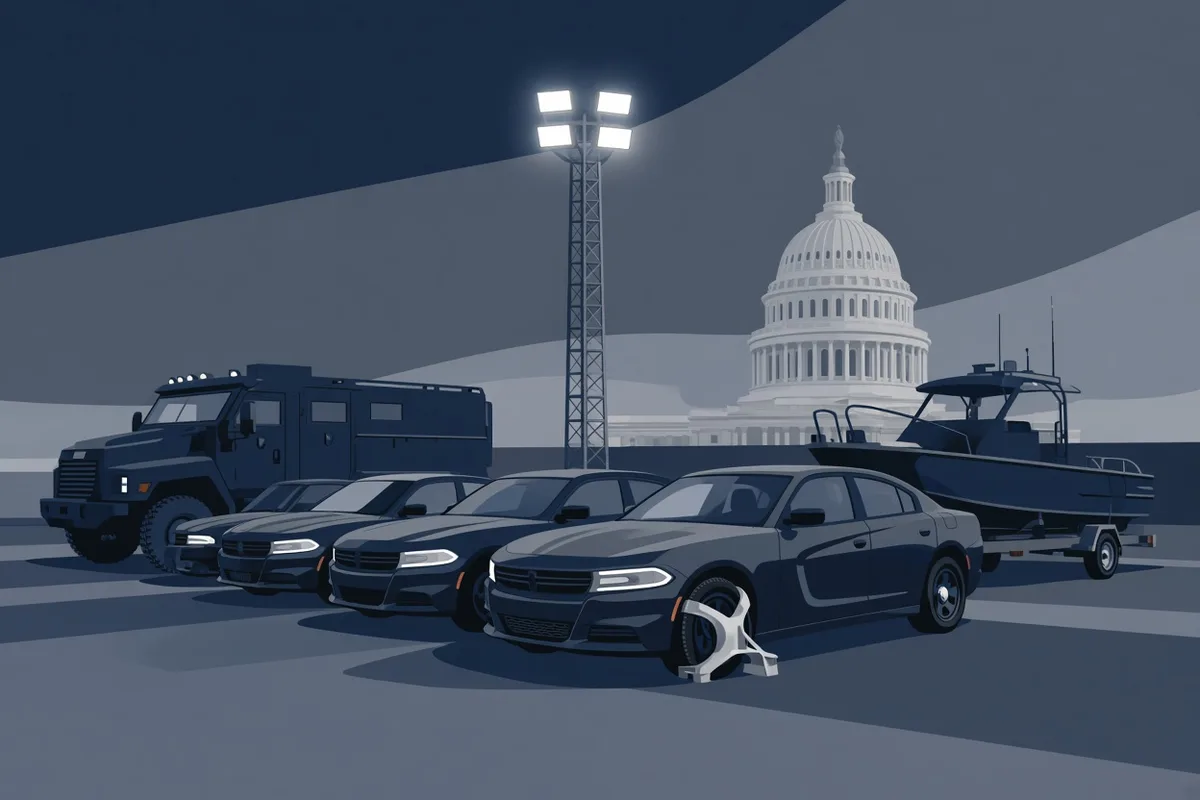
On Oct. 29, War Secretary Pete Hegseth signed two memos. They put up to 60 marked patrol cars, military tactical vehicles including Humvees and light medium tactical vehicles, up to 20 light towers and generators, and D.C. National Guard boat assets into the capital’s crime fight through the end of 2026.
The Pentagon put the decision in direct language. “The secretary of war has authorized the continued use of National Guard personnel and capabilities in support of the Make D.C. Safe and Beautiful mission.” A second statement matched the paper: “The October 29, 2026, guidance authorizes the use of up to 60 marked patrol cars, military tactical vehicles, up to 20 light towers and generators and D.C. National Guard maritime boat assets in support of federal and local law enforcement operations.”
That is a concrete expansion of tools for a mission President Donald Trump opened in August 2025, when he declared a crime emergency and sent an initial 800 D.C. National Guard troops into the city. The force now stands near 3,100 members drawn from 20 states, the Virgin Islands, Puerto Rico and the District, under a deployment the Pentagon has extended through Inauguration Day 2029. The memos keep the ceiling at 3,500, below a summertime peak near 5,000.
The rules written into the authorization matter as much as the hardware. Patrol cars must be marked “National Guard,” and troops must wear uniforms. High-speed chases are prohibited. Troops may not pursue suspects or make arrests with the military vehicles. They may carry rifles on some operations, but not inside Metro rail stations. Two patrol boats are cleared for perimeter security in Anacostia during police work against suspected gang leaders and drug traffickers; the boats are not authorized to surveil U.S. citizens, and federal officers must always be aboard to handle any arrest if a suspect tries to flee into the water. A Nov. 4 follow-on memo denied a Marshals Service request for Guard helicopters and for troops to clean up abandoned tires. The Guard is being used as a support force with a visible footprint, not as a freestanding police department.
For taxpayers and for residents who live with street crime, the case for the mission is straightforward. The capital is a federal district under the Constitution’s grant of exclusive legislative authority to Congress. When local law enforcement cannot keep order on federal ground, the president retains the tools to protect federal facilities, federal officers and the public that works and visits there. The Make D.C. Safe and Beautiful mission places Guard personnel in support of federal and local law enforcement on visibility patrols, neighborhood presence, cleanup and targeted help against gangs and drug distribution. Six analysts remain assigned to organized drug distribution inside the District. The equipment authorization deepens that support without rewriting the arrest power that stays with sworn civilian officers.
Cost figures attached to the deployment are real and should be stated without spin. Senate Homeland Security Democrats reported in February that the mission runs about $1.65 million a day for D.C. taxpayers. Other accounting places the monthly bill near $55 million and projects roughly $1.4 billion through 2029. Set against a defense budget measured in the high hundreds of billions, the multi-year total is a fraction of one percent of a single year’s authorization. The dollars fund pay, fuel, food, lodging and logistics, not a new weapons buy. The relevant comparison for a city government is not the size of the Pentagon; it is whether property crime falls, whether federal sites stay secure, and whether the alternative is a return to the conditions that produced the original emergency declaration.
Crime results in the record are mixed and should be read that way. A May study from the nonpartisan Niskanen Center found no measurable effect on violent crime while opportunistic property crimes fell 24 percent in areas the Guard was patrolling. A more recent Cato Institute review found robberies and theft down since the first deployment, no shift in homicides, and a slight rise in assaults with dangerous weapons. Declines in property crime are not trivial for shop owners, tourists and families. Flat or rising violent numbers are a reason to refine tactics, not a reason to abandon the streets.
Local opposition is open and should be quoted in its own terms. On Thursday, Ward 2 Councilmember Brooke Pinto, chair of the council’s public safety committee, held a hearing on the federal and National Guard presence. “I am very hopeful and optimistic that we now have the partners we need at the state and congressional level to push back and demand that this unnecessary, harmful and unlawful military presence be removed from the district,” she said. Pinto called on newly elected Democratic governors in Georgia, Iowa, Nevada, Ohio and Texas to withdraw the combined 628 troops she said their states have in Washington, and she urged congressional Democrats to tighten oversight of federal law enforcement in January, including identifying badges and body cameras. The District sued over the deployment in September 2025; a federal appeals court panel heard arguments Oct. 14 after a lower court sided with the city. Free D.C. answered the equipment news with a statement that read, “This is the act of an unpopular regime that is losing power by the minute and is desperate to avoid accountability. After 451 days of occupation we know these soldiers are in D.C. to protect the Trump regime, no one else.”
Those claims treat a support mission under presidential authority in the federal district as an occupation aimed at politics. The memos themselves undercut the charge. They keep arrest authority with federal officers on the boats, bar Guard pursuits and arrests from the tactical vehicles, forbid high-speed chases, require clear National Guard markings and uniforms, and withhold helicopters and tire-cleanup details the Marshals sought. the vehicles and boats were cleared, the administration refused two requests that would have widened the mission. That is restraint on paper, not a blank check.