




Sanders stumps for Nixon in Republican Florida
Bernie Sanders joined Angie Nixon at rallies across Florida ahead of early voting, as Sen. Ashley Moody framed the race as freedom versus socialism and spent millions on ads in a state with a deep Republican registration edge.
IJR · Oct 19, 2026 · 6 min read
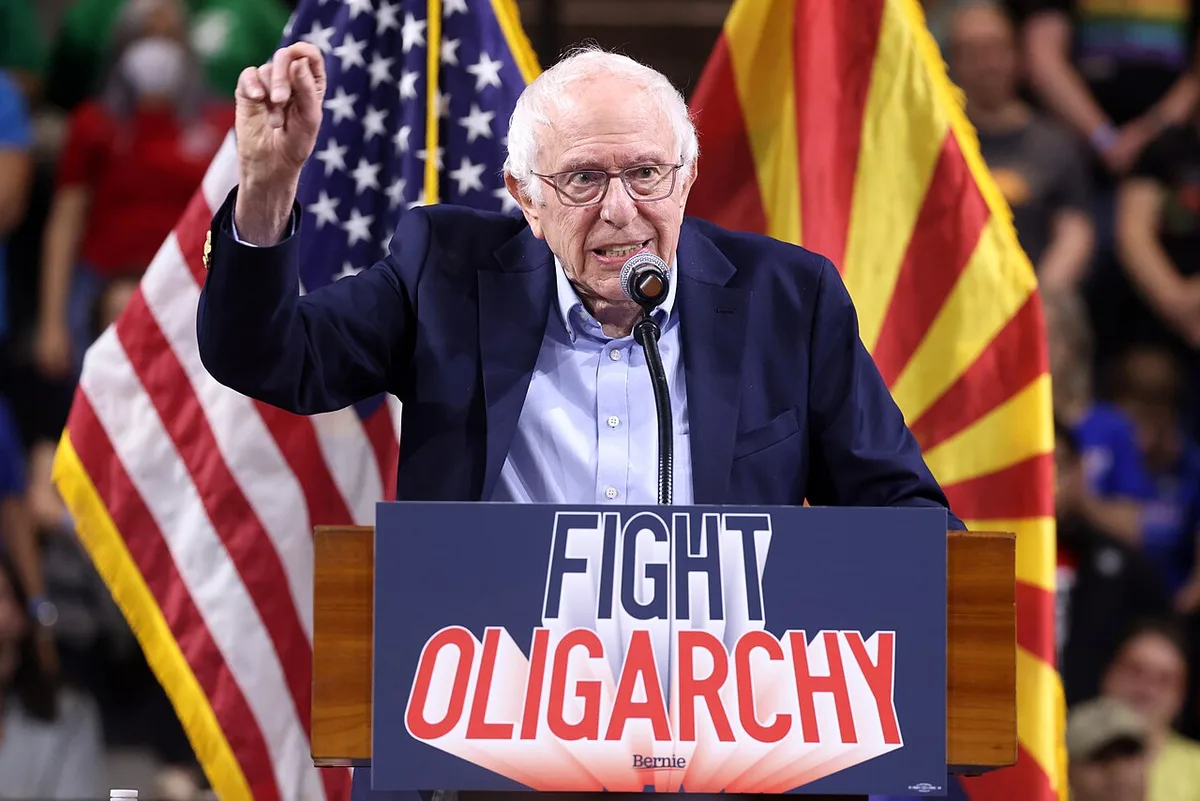
A steady rain fell Saturday on the courtyard of the Cuban Club in Ybor City as a couple of thousand people gathered to hear Sen. Bernie Sanders of Vermont campaign for Angie Nixon, the Democratic nominee for U.S. Senate in Florida.
Nixon danced onstage to warm the crowd before introducing Sanders. He told them the race stood out among the hundreds of contests in the cycle. “There have been many, many hundreds of elections throughout this country in this campaign cycle, but there is one election that seemed to me rather extraordinary,” Sanders said. He described a Democratic primary candidate outspent 15 to one, without establishment support, who built a grassroots movement of working-class people. That candidate, he said, was Nixon, and he called her the next senator.
The stop was one of four over the weekend of Oct. 17-18, 2026—Tampa, Melbourne, Gainesville and Tallahassee—on Sanders’ “Fighting Oligarchy” tour, held just before early voting began in the state. Nixon is challenging Republican Sen. Ashley Moody, appointed by Gov. Ron DeSantis to replace Marco Rubio. Florida carries a 1.5 million Republican voter registration edge over Democrats. The two previous Democratic U.S. Senate candidates in the state lost by double digits.
Sanders cast the contest as a fight over the influence of wealthy donors and called for an end to unlimited campaign spending and super PACs. Nixon focused on the cost of living. She told the Ybor City crowd that working people were tired of grocery bills, electric bills, rising rent, insurance and health-care costs while paychecks stayed flat, and she blamed “politicians like Ashley Moody” and corruption she said was raising those costs. She repeated themes of living wages and affordable health care.
Thousands turned out again in beachside Melbourne the same day. On Sunday in Gainesville, the indoor venue—an 800-person auditorium at the University of Florida—filled. Sanders delivered an impromptu outdoor speech to an overflow crowd of hundreds on an adjacent lawn. He asked why television screens filled with ads against Nixon and answered that billionaires feared her because she would take them on. Inside, Nixon told supporters state Republican committees and her opponent were running negative ads calling her a socialist and lying about her, and she asked the crowd to push back.
She led a call-and-response. If believing a mother on two jobs should earn enough to put food on the table was radical, she said, call her a radical; if believing no family should go bankrupt from illness was radical, the crowd answered, call her a radical. She has said policies such as Medicare for all and a higher minimum wage are common sense, not extremism, and that Moody finds it easier to use labels than to defend votes Nixon argues make life harder for working people. Nixon joined the Democratic Socialists of America this summer. She has said she agrees with part of that platform, not all of it. She won the August primary over Alexander Vindman despite being outspent 15 to one.
In Tallahassee, more than a thousand people filled the Moon music venue for the Florida close of the tour. “This election is not only important for the people of Florida in getting a senator who is going to fight for you,” Sanders said. “Trust me on this, after Angie wins, this is going to be a spark that is going to ignite the entire country.” He added, “If we can end Republican control over the House, mobilize the American people to stand up and fight for their rights, there is nothing we can accomplish.” Nixon asked the crowd whether they were ready to end “the corruption that’s driving up our crisis and ruining our democracy,” and said, “I am ready, and I am ready to go to Washington to fight for you.” Crowds responded to calls for a living wage, Medicare for all, tuition-free public colleges and universities, higher taxes on billionaires, an end to wars and no money to the Israeli government.
Nixon used the stops to tie Moody to the Hope Florida matter, in which a grand jury report alleged $10 million was misappropriated from a Medicaid settlement to political committees fighting a marijuana ballot measure. U.S. Rep. Maxwell Frost, appearing in support, said of the spending against Nixon: “We know that they are spending millions of dollars against her. But again, we’re for the many, not the money, and that’s why Angie Nixon is going to win.” Moody has spent more than $3.4 million on television and digital ads, per AdImpact data reviewed by POLITICO, framing the choice as one between freedom and socialism. Republican committees have mailed flyers branding Nixon a radical and a socialist.
Attendees stated their own reasons. Karolyn Burns, who moved to Tallahassee in 2016, called Florida “a neglected state” and “a gerrymandered state” and said someone from community organizing on abortion rights, unions and immigrant rights could restore belief that government can do good. Solomon Proby said he wanted an end to tax cuts for billionaires and to the war in Iran, and added, “We also should have some decorum in the White House, and I think the only way to hold them accountable is having a legislative body that can hold them accountable.” Ashley Moreau, voting in her first general election, named housing, gas prices and abortion rights, citing Florida’s six-week abortion ban, and said, “I’m tired of the moderate Democrats who don’t do anything in government or Democrats in general who are ineffective.” In Ybor City, Tyler French said progress meant “anything but the status quo,” described his generation as especially strained by inflation and housing, and said large prosperous societies should not leave people to suffer without health care. Nate Chandler said Nixon spoke for working-class people on health care and “keeping billionaires in check,” themes he associated with the DSA. Anais Garcia Velez, originally from Puerto Rico, said she had seen what socialism did in places such as Cuba, believed Scandinavian-style democratic socialism differed, and named immigration enforcement, data centers and Florida’s environment among her concerns.