




US ends Iraq mission after defeating ISIS threat
Last troops left Erbil on Sept. 30, closing a 12-year anti-ISIS campaign and 23 years of U.S. presence. Baghdad now owns remaining threats; American support shifts to training and intelligence.
IJR · Oct 1, 2026 · 4 min read
Iraqi security officers rode through Baghdad on Sept. 30, 2026, in vehicles decorated with national flags, flashing victory signs in a celebratory convoy. Residents waved Iraqi flags and cheered along Palestine Street. Military parades filled the streets in Baghdad and the southern city of Najaf as the country opened a four-day national holiday it called Sovereignty Days.
That same day, the final U.S. troops and equipment departed Erbil Air Base in the Kurdistan region. Video showed columns of American gear and personnel moving toward Turkey, reportedly bound for Incirlik Air Base. The Iraq portion of Operation Inherent Resolve was over.
The exit closed a 12-year campaign against ISIS and more than two decades of U.S. military presence that began with the 2003 invasion. It fulfilled a 2024 agreement between Washington and Baghdad that set a phased pullout: federal Iraq by September 2025, the Kurdistan region by September 2026. Before the final departure, Erbil had hosted about 1,500 U.S. and coalition forces; roughly 2,500 American troops remained in the country overall. At the height of the earlier war, U.S. strength in Iraq had exceeded 160,000.
Sean Parnell, speaking for the Pentagon, framed the moment without ambiguity. "This milestone reflects the success of a 12-year campaign that defeated ISIS as an organized military threat in Iraq and across the region. It also marks a transition from a wartime coalition mission to an Iraqi-led security effort supported by a more normal bilateral security relationship." The United States, he said, would "continue to provide training and intelligence to support our Iraqi partners." Primary responsibility for what remained, he added, now rested with Baghdad: "The primary responsibility for addressing Iraq's remaining security challenges, including ISIS remnants and Iran-aligned militias that undermine Iraqi sovereignty and regional stability, now rests with the Government of Iraq."
That division of labor is the conservative case in plain terms. The Constitution does not require the United States to garrison every partner forever. Once an organized military enemy is broken, the burden shifts to the sovereign government that asked for help, and the American taxpayer stops underwriting an open-ended wartime posture. The United States first left Iraq in 2011, then returned in 2014 at Baghdad's request after ISIS seized large territory. The physical caliphate was defeated by 2017 and 2018. Keeping a permanent combat footprint after that success would have turned a finite mission into a habit.
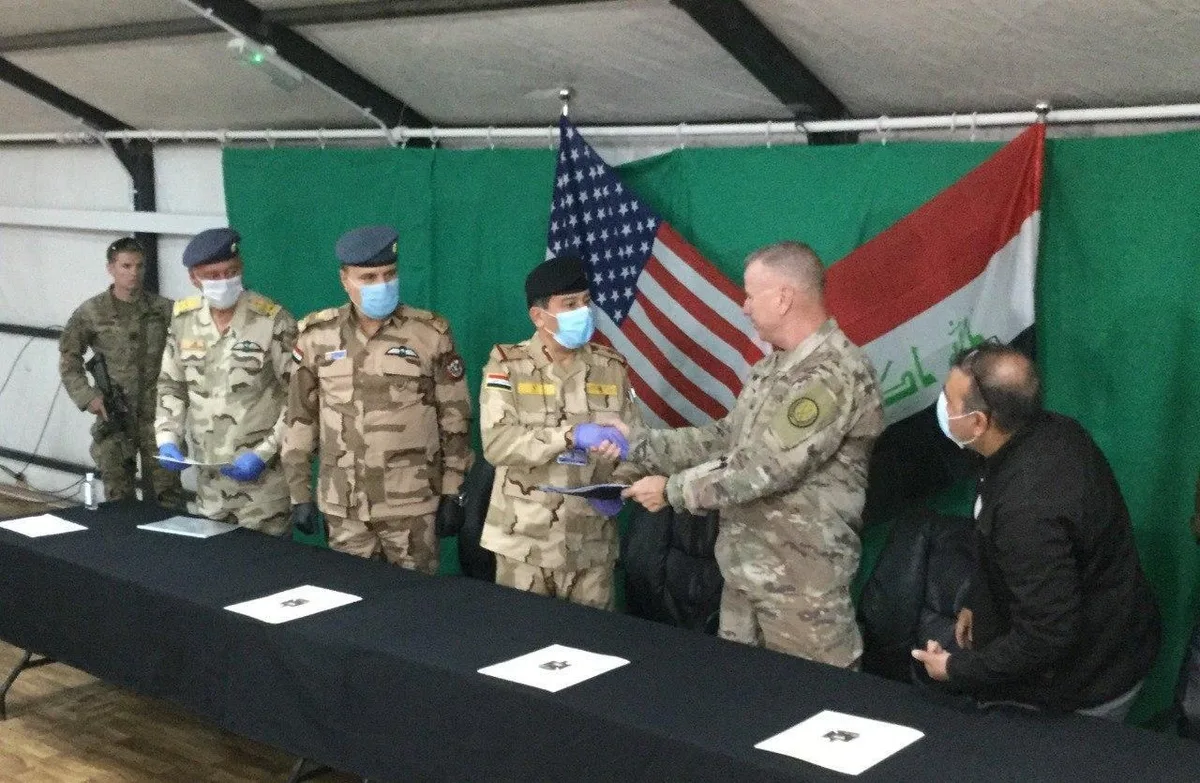
Iraqi Prime Minister Ali al-Zaidi presided over a formal handover ceremony and claimed the result as a national achievement. "We announce the end of the mission of the international coalition fighting ISIS, demonstrating that cooperation between friendly forces and friendly peoples has produced victory over one of the darkest chapters of extremism and brutality in history." He added: "The mission has concluded in victory, and the responsibility for protecting this victory falls today on all our shoulders." The withdrawal, he said, opened a "new phase, one defined by Iraq's sovereignty, the strength of its institutions, the readiness of its forces, the unity of its decision-making, and balanced partnerships with its friends." On armed factions he was explicit: "no weapon outside the umbrella of the law, and no force outside the state's institutions, in accordance with the constitution and what our wise religious authority has called for, and what our people desire."
The record does not show that disarmament has been achieved. Baghdad originally set a Sept. 30, 2026, deadline for militia disarmament; al-Zaidi extended it to June 30, 2027. His plan calls for a 90-day halt-to-attacks period in exchange for assurance that U.S. forces will not strike, followed by a weapons handover by that June date. Named Iran-aligned groups—Kataib Hezbollah, Harakat al-Nujaba, and Kataib Sayyid al-Shuhada—have refused. Abu Mujahid al-Assaf, a Kataib Hezbollah security official, is among the voices on that side of the ledger. Alina Romanowski, an Atlantic Council fellow, has noted the same hardline factions have given no sign they will surrender arms.
Some Kurdish officials and other Iraqis have expressed fear that ISIS remnants could exploit gaps and that Iran-aligned militias could gain freer rein, especially after U.S. units removed Patriot missile batteries and C-RAM counter-rocket and drone systems from Erbil and Harir Air Base during the drawdown. The wire record carries that concern; it does not resolve it. Parnell answered the strategic question the only way a limited-government power can: Iraqi forces lead inside Iraq, and the bilateral relationship becomes more normal. "The United States supports a strong sovereign Iraq that secures its borders, protects its people, and serves as the foundation for deeper commercial, diplomatic, and security cooperation between our two countries."
The anti-ISIS coalition task force headquarters is relocating to Jordan. Hundreds of U.S. troops remain in Syria. The fight against the group’s residual networks continues from those positions. That is not abandonment of the region; it is refusal to confuse a completed country mission with an endless occupation.